


You're staring at the charts, trying to make sense of the chaos.

Olumide Adeyemi
서아프리카 트레이딩 선구자 ·  Nigeria
☕ 11 분 소요
배울 내용:
- 1Technical Analysis: The Chart Is Your Bible
- 2Fundamental Analysis: The 'Why' Behind the Move
- 3Sentiment Analysis: Feeling the Market's Pulse
- 4The Showdown: Which Method Actually Wins?
- 5Where Nigerian Traders Go Wrong (I've Been There)
- 6Building Your Own Hybrid System: A Practical Start
- 7Tools & Brokers That Won't Fight You
You're staring at the charts, trying to make sense of the chaos. You've heard about technical analysis, fundamental news, and market sentiment. But which of these types of analysis in forex is the real deal for a trader in Lagos or Port Harcourt? Is it the squiggly lines, the economic reports, or the gut feeling of the crowd? I've blown up accounts relying on just one. Let's cut through the noise and figure out what works, what doesn't, and how you should be spending your screen time.
This is where most of us start. You open MT5, see all those candlesticks, and think, 'There must be a pattern here.' You're right. Technical analysis is the study of past price action to forecast future direction. It assumes all known information - news, sentiment, fear, greed - is already baked into the price. Your job is to read the tape.
It's not magic. It's pure probability. You're looking for areas where price has reacted before (support/resistance), trends that show consistent buying or selling pressure, and patterns that hint at what might happen next. I spent my first two years trying to master every indicator under the sun. Big mistake.
Price Action is King
Forget the lagging indicators for a second. The raw price movement - the highs, lows, opens, and closes - tells the clearest story. A series of higher highs and higher lows? That's an uptrend until it isn't. A sharp rejection at a previous price level? That's a strong resistance zone. I once took a short on GBP/USD purely because it failed to break above a weekly high for the third time. No RSI, no MACD. Just the chart. Made 85 pips in a day. Simple, but effective.

Example: Let's say EUR/USD has bounced off 1.0850 three times in the last month. That's a strong support zone. The next time price approaches 1.0850, the probability of another bounce is higher. You don't need an indicator to tell you that; the chart history does.
Indicators: Helpers, Not Heroes
Indicators like the RSI indicator or MACD indicator are derivatives of price. They smooth things out, help identify overbought/oversold conditions, or confirm momentum. The key word is 'confirm.' Never use an indicator as your sole entry signal. I learned this the hard way buying EUR/NGN crosses because the RSI was 'oversold,' only to watch it get more oversold for a week straight. My account didn't appreciate the lesson.
Use them to support what price is already showing you. Is price hitting a major resistance level AND the RSI is showing bearish divergence? That's a much stronger setup.
Timeframes: Your Trading Lens
Are you a scalper or a swing trader? Your choice of analysis changes completely. A scalping strategy lives on the 1-minute and 5-minute charts, hunting for 5-10 pips. A swing trading approach uses the 4-hour and daily charts to catch moves of 100 pips or more. Mixing timeframes is non-negotiable. Always zoom out to the higher timeframe to see the overall trend before taking a trade on a lower one. Trading against the daily trend is like trying to swim upstream in the Lagos lagoon during rainy season. Possible, but exhausting and stupid.

💡 윈스턴의 팁
A chart cluttered with indicators is a mind cluttered with doubt. Clear the noise. Price, volume, and one oscillator are all you need to see 90% of what's happening.
“The real secret is that you must combine the three types of analysis. They are a trinity, not separate choices.”
If technical analysis tells you what is happening, fundamental analysis tries to explain why. It's about the economic health of countries. Interest rates, inflation (CPI), employment data (like US NFP), GDP growth, and political stability. For a currency pair like EUR/USD, you're betting on the relative strength of the Eurozone versus the United States.
Here's the brutal truth for a retail trader in Nigeria: by the time you read the news headline, the market has already moved. The big banks and institutions have supercomputers and economists parsing every word from central bankers like the Fed or ECB. You're late to the party.
The Central Bank Gospel
For forex, central bank policy is the single most important fundamental factor. It's all about interest rates. Higher rates generally attract foreign investment, strengthening a currency. When the US Federal Reserve hints at raising rates, the dollar (USD) usually gets a boost. You need to follow meeting minutes and press conferences.

Warning: Trading major news releases like NFP or CPI directly is a great way to get your stop-loss hunted. The spreads widen massively, and price can spike 50 pips in a second before reversing. I lost $200 in 30 seconds trying to 'catch' a CPI print. Don't be me. Either be positioned well before the news or wait for the dust to settle.
The Nigerian Angle
Trading pairs like USD/NGN? Then local fundamentals matter intensely. CBN monetary policy decisions, oil prices (since we're an oil exporter), and even political announcements can cause sharp moves. The liquidity is thinner, so moves can be more volatile. This is where understanding local context beats pure technicals. But honestly, for most Nigerian traders starting out, stick to the major pairs (EUR/USD, GBP/USD) where the fundamentals are clearer and the markets are deeper. Save the exotic pairs for when you have real experience and a deeper pocket.
“Trading against the daily trend is like trying to swim upstream in the Lagos lagoon during rainy season.”
This is the most overlooked of the three types of analysis in forex, and it's the most important for short-term moves. Market sentiment asks: Is everyone overwhelmingly bullish or bearish? The market is a crowd, and crowds are often wrong at extremes.
Think of it like this: if every trader and their uncle in Yaba is buying gold (XAU/USD) because 'it has to go up,' who is left to buy? When everyone is on one side of the boat, it's primed to capsize. Your job is to sense that tipping point.
Contrarian Indicators
Tools like the Commitment of Traders (COT) report show positioning by large speculators. If they are extremely long a currency, it might be due for a pullback. Retail trader positioning from your broker can also be a useful contrary indicator (though take it with a grain of salt).
Social Sentiment & Fear
Check financial news headlines. Is the tone universally fearful or greedy? During a major risk-off event, everyone flocks to the US dollar and Japanese yen. During calm, 'risk-on' periods, currencies like the Australian dollar (AUD) might outperform. I missed a huge USD/JPY drop in 2022 because I was too focused on my charts and ignored the sheer panic in the broader market narrative. Price sliced through my technical levels like a hot knife through butter. Sentiment trumped structure that day.

Pro Tip: Combine sentiment with technicals. If sentiment is wildly bullish but price is struggling to break a key resistance level on the daily chart, that's a classic warning sign for a potential reversal. Look for a price pattern (like a double top) to confirm before taking a contrarian trade.
“Trading against the daily trend is like trying to swim upstream in the Lagos lagoon during rainy season.”
You want a straight answer? Fine. For the average retail trader in Nigeria with a day job and limited screen time, technical analysis is your foundation. It's objective, it's always available, and you can backtest it. Fundamentals give you the big picture context, and sentiment warns you of potential crowd mania.
But the real secret, the thing that took me years and thousands of dollars in losses to internalize, is that you must combine them. They are a trinity, not separate choices.
| Analysis Type | Best For | Biggest Pitfall |
|---|---|---|
| Technical | Defining precise entry/exit points, managing risk with stop-losses. | Becoming a robot, ignoring major news events that blow through your levels. |
| Fundamental | Understanding the long-term trend direction. | Getting 'analysis paralysis' and missing the technical entry. |
| Sentiment | Spotting potential reversals and extreme market conditions. | Being too early on a contrarian bet and watching the trend continue. |
My current workflow looks like this: I check the fundamental calendar at the start of the week. Is there a major central bank speech or high-impact data? I note the time and usually avoid trading 30 minutes before and after. Then, I look at the daily chart for technical structure. Finally, I glance at a few sentiment gauges. Only if all three aren't screaming 'NO!' do I then drill down to lower timeframes for an entry. This filter saves me from countless bad trades.
💡 윈스턴의 팁
Fundamentals tell you *what* to trade. Technicals tell you *when*. Never get the order wrong. Buying a fundamentally weak currency because the 5-minute RSI is oversold is a recipe for ruin.
“If every trader in Yaba is buying gold, who is left to buy?”
Let's get painfully specific. I see these errors every single day in trading groups.
1. Indicator Overload: Your chart looks like a Christmas tree with 10 different indicators. They all say different things, and you're paralyzed. Pick two, maybe three, that complement each other. Price action, one momentum indicator (like RSI), and one trend-following tool (like a moving average). That's it.
2. Ignoring the Spread: You're scalping on a pair with a 3-pip spread definition? That's a terrible idea. You need the price to move 3 pips just for you to break even. Choose brokers known for tight spreads on majors, like IC Markets review or Pepperstone review, and factor the spread cost into every single trade plan.
3. No Risk Management: This isn't analysis, but it kills more traders than bad analysis. You would not believe how many guys chase losses after a bad trade, doubling down until they get a margin call. Use a position size calculator religiously. Never risk more than 1-2% of your account on a single trade. I didn't do this early on. I risked 5% on a 'sure thing' EUR/USD trade. It wasn't sure. I lost a month's profits in an afternoon.
4. Chasing 'Hot Tips': Someone on WhatsApp or Telegram says 'BUY USOIL NOW!' and you jump in without looking at the chart. You are not a trader at that point; you are a gambler following a tipster. Do your own work. Always.
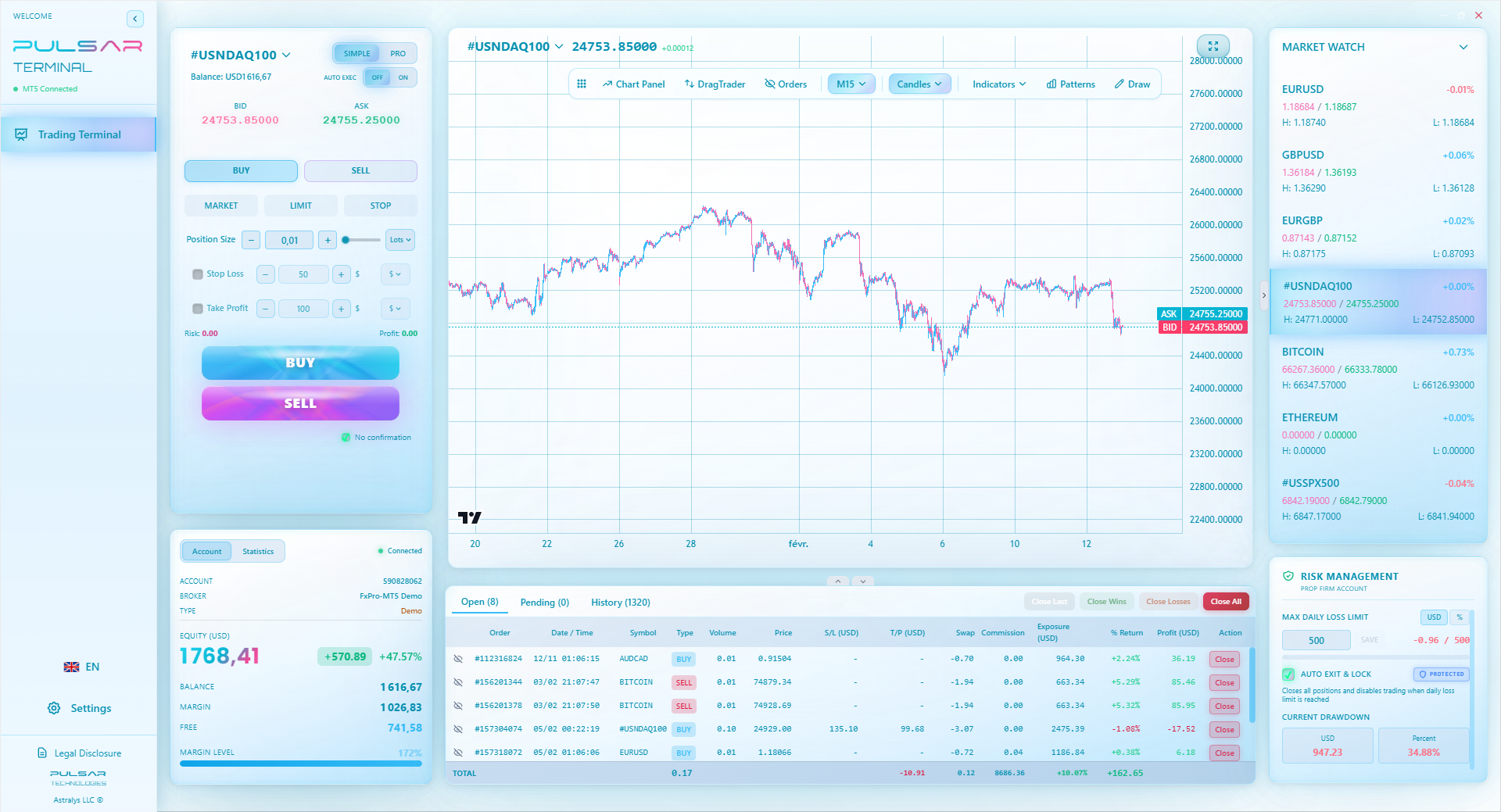
Managing complex trades with multiple take-profits and trailing stops is where most retail platforms fail, but tools like Pulsar Terminal automate this directly on your MT5, letting you focus on your analysis instead of your mouse clicks.
Pulsar Terminal
MT5 올인원 도구: 드래그앤드롭 주문, 다중 TP/SL, 트레일링 스톱, 그리드 트레이딩, 볼륨 프로파일, 프롭펌 보호. 매일 1,000명 이상의 트레이더가 사용.
“If every trader in Yaba is buying gold, who is left to buy?”
You don't need to be a master of all three today. Start with a 70/30 split and evolve.
Step 1: The Technical Core (70% of your effort)
- Learn to draw clean support and resistance lines on the daily and 4-hour charts.
- Understand basic candlestick patterns: pin bars, engulfing bars, inside bars.
- Pick one oscillator (RSI is perfect) and learn its divergences.
- Practice placing stop-losses beyond your key technical levels, not arbitrarily.
Step 2: Layer in Fundamentals (20%)
- Bookmark an economic calendar. Just be aware of high-impact events for the currencies you trade.
- Once a week, read a summary of what the Fed, ECB, and BoE are saying. Don't get lost in the jargon; just note: are they hawkish (tightening) or dovish (easing)?
- Avoid trading during major news releases until you're very confident.
Step 3: Gauge Sentiment (10%)
- Once a day, ask yourself: 'Does the market feel fearful or greedy today?' Look at safe-haven flows.
- Check if there's a unanimous consensus on a trade direction on social media. If there is, be cautious.
This hybrid approach turns you from a passive chart-watcher into an active market analyst. You'll start seeing setups where the technicals align with a fundamental bias, and sentiment isn't overly crowded. Those are your high-probability trades.
💡 윈스턴의 팁
When you find yourself agreeing with every bullish headline and tweet, that's not confirmation. That's the sentiment extreme you've been warned about. Be afraid.
“Your analysis is only as good as your ability to execute on it.”
The right platform can make applying these types of analysis in forex smoother. You need reliable data, fast execution, and tools that don't freeze.
For Technical Analysis: MT4/MT5 is the standard for a reason. The charting is excellent. But consider a companion tool that adds advanced order types and visualization. Managing multiple take-profits and trailing stops manually on MT5 is clunky.
For Fundamental Data: Your broker's economic calendar is a start. For deeper analysis, free sites like Investing.com or FXStreet provide decent calendars and news summaries.
Broker Choice in Nigeria: This is critical. You need one with reliable deposit/withdrawal methods (like bank transfer or local payment processors), good customer support that understands your region, and tight spreads. I've used several. Exness review is popular here for its local deposit options. XM review also has a strong local presence. But always, always verify their regulation and test their withdrawal process with a small amount first.
, your analysis is only as good as your ability to execute on it. If your platform is laggy or your broker requotes you constantly, even the best analysis is useless.
FAQ
Q1Which type of analysis is best for beginner forex traders in Nigeria?
Start with technical analysis. It's visual, you can practice on historical charts for free, and it gives you clear rules for entries and exits. Once you're comfortable reading charts and managing trades, then slowly incorporate fundamental context (like avoiding trades during major news) and basic sentiment checks.
Q2Can I make money using only technical analysis?
Yes, many traders do, especially short-term traders like scalpers and day traders. However, you are vulnerable to being 'stopped out' by sudden, high-impact news events that ignore all technical levels. It's safer to at least be aware of the fundamental calendar.
Q3How important is fundamental analysis for trading USD/NGN?
Extremely important. The Naira is heavily influenced by local factors: Central Bank of Nigeria (CBN) policies, oil prices, domestic inflation data, and political stability. Technicals still work for entries, but ignoring fundamentals on USD/NGN is like driving in Lagos without checking the traffic report.
Q4What's a simple way to gauge market sentiment?
Look at the performance of 'risk-on' vs. 'risk-off' assets. If global stock markets are falling sharply, and gold/USD/JPY are rising, sentiment is fearful (risk-off). If stocks are rallying and the Aussie dollar is strong, sentiment is greedy (risk-on). Also, check if financial news headlines are uniformly bullish or bearish.
Q5How many indicators should I use on my chart?
As few as possible. I recommend a maximum of three. One for trend (e.g., 50 & 200 EMA), one for momentum (e.g., RSI), and price action itself. More than that creates confusion and conflicting signals. The chart should be clean enough to see the candles clearly.
Q6Should I trade based on news headlines?
No. Trading the immediate headline is a high-speed game for algorithms. The initial spike is often a 'fakeout.' A better approach is to understand the fundamental trend (e.g., rising interest rates) and use technical analysis to find an entry in the direction of that trend after the news volatility settles.
Q7Is it necessary to combine all three types of analysis for every trade?
Not for every single trade, but they should all inform your overall bias. For example, your fundamental view might be bullish USD, and sentiment shows traders are not overly long yet. You then wait for a technical setup (like a pullback to support) on the chart to give you a low-risk entry point in line with your broader analysis.
윈스턴 교수의 수업
핵심 요약:
- ✓Master price action first; indicators are supporting actors.
- ✓Always check the economic calendar. One news event can wreck a week of technical setups.
- ✓Extreme market sentiment is a powerful contrarian signal.
- ✓Never risk more than 2% of your capital on a single idea.
이 기사가 얼마나 유용했나요?
별을 클릭하여 평가
주간 트레이딩 인사이트
무료 주간 분석 & 전략. 스팸 없음.
저자 소개
Olumide Adeyemi
서아프리카 트레이딩 선구자
나이지리아에서 가장 활발한 외환 트레이딩 교육자 중 한 명. 라고스에서 8년간 트레이딩 경험. 아프리카 트레이더를 위한 소자본 전략과 프롭 펌 챌린지 전문.
댓글
위험 고지
금융 상품 거래에는 상당한 위험이 수반되며 모든 투자자에게 적합하지 않을 수 있습니다. 과거 성과가 미래 수익을 보장하지 않습니다. 이 콘텐츠는 교육 목적으로만 제공되며 투자 조언으로 간주되어서는 안 됩니다. 거래 전에 항상 직접 조사를 수행하십시오.
이 기사도 읽어보세요

Cara Trading Forex Sukses: 7 Prinsip dari Trader Profesional
Cara trading forex sukses dengan 7 prinsip trader pro: manajemen modal, disiplin, journal trading, backtest. Data nyata, bukan janji profit palsu.
Jam Trading Forex Terbaik untuk Trader Indonesia: Panduan Lengkap dengan Tabel Waktu
Panduan jam trading forex untuk trader Indonesia. Tabel 4 sesi dunia, jam emas 20:00-00:00, sesi mana yang harus dihindari. Data akurat + tips dari trader berpengalaman.
Top 5 Sàn Forex Uy Tín Nhất 2026: Review Jujur dari Trader Indonesia
Top 5 sàn forex uy tín 2026 untuk trader Indonesia. Review jujur: spread, deposit, withdraw, dukungan lokal. Exness, XM, IC Markets & lebih.
