


I was staring at the USD/NGN chart on a Tuesday afternoon in March 2024, watching the Naira bleed value.

Olumide Adeyemi
서아프리카 트레이딩 선구자 ·  Nigeria
☕ 11 분 소요
배울 내용:
- 1Candlestick Basics: Why Nigerian Traders Need Them
- 2Single Candle Patterns: The Market's Mood Swings
- 3Multi-Candle Patterns: The High-Probability Setups
- 4Applying Candlesticks to the Nigerian Forex Context
- 5Common Mistakes Nigerian Traders Make (I've Made Them All)
- 6Integrating Candles with Other Tools
- 7Regulatory & Practical Considerations in Nigeria
I was staring at the USD/NGN chart on a Tuesday afternoon in March 2024, watching the Naira bleed value. The price was at ₦1,620, and the market was pure chaos. Then, a single candlestick formed that changed everything: a massive bullish engulfing pattern right on a key support level. It wasn't just a green candle; it was a story of panic selling exhausted and buyers stepping in with conviction. That one candle told me the short-term rout was over, and I bought. Two weeks later, we were at ₦1,450. That's the power of understanding the types of candles in forex. It's not about memorizing shapes; it's about learning the language of price action, a skill that's saved my account more times than I can count.
Forget fancy indicators for a second. If you're trading from Lagos or Port Harcourt, your first and most honest tool is the candlestick. Born in 18th-century Japan for rice trading, it's survived centuries because it works. A candle simply shows the battle between buyers and sellers in a given time - whether that's one minute, one hour, or one day.
Each candle has four critical prices: the Open, High, Low, and Close (OHLC). The 'body' is the fat part, showing the range between the open and close. The 'wicks' or 'shadows' (we call them tails here) show the extreme high and low prices reached during the period. A green (or white) body means the close was higher than the open (bullish). A red (or black) body means the close was lower than the open (bearish).
Why is this so crucial for us? Nigeria's forex market, especially with pairs like USD/NGN, can be volatile. News from the CBN can cause spikes that distort everything. A candlestick cuts through the noise. That long upper wick on a USD/NGN chart? That's the market screaming 'No higher!' as sellers aggressively rejected a rally. That's actionable intelligence you won't get from a lagging moving average. Learning the types of candles in forex is your foundation for all technical analysis, especially for strategies like swing trading where price action is king.

Example: Let's say USD/NGN opens at ₦1,500. It rallies to ₦1,550 during the session, gets smashed down, and closes at ₦1,490. You get a red candle with a long upper wick. The story? "Buyers tried to push it up 50 Naira, but sellers dominated and closed it down 10 Naira." That's bearish sentiment captured in one picture.

💡 윈스턴의 팁
A candle pattern without context is just a pretty picture. Always ask: 'Where is this happening?' Is it at a key level, or in the middle of nowhere? The location gives the pattern its power.
“Learning the types of candles in forex isn't about memorizing shapes; it's about learning the language of price action.”
These are your building blocks. Master these, and you can start gauging market sentiment on any chart.
The Doji: The Ultimate Indecision
This is where the open and close are virtually identical. The body is a tiny line. It tells you buyers and sellers fought to a standstill. After a strong Naira rally, a Doji can be the first warning sign the momentum is stalling. Don't trade it in isolation, but pay attention. It's the market taking a breath.
The Hammer and Hanging Man
These look identical - a small body at the top of the trading range with a long lower wick. The context defines them.
- Hammer: Forms after a downtrend. That long lower wick shows sellers pushed price way down, but buyers fought back to close near the open. It's a potential bullish reversal signal. I caught a beautiful Hammer on GBP/NGN in late 2024 after a steep fall, which was my cue to look for long entries.
- Hanging Man: Forms after an uptrend. It looks bullish (small body near the highs), but that long lower wick is the danger - it shows buyers finally lost control during the session. It's a distribution warning.
The Shooting Star and Inverted Hammer
Flip the previous two patterns upside down. Long upper wick, small body at the bottom.
- Shooting Star: Appears in an uptrend. A long upper wick after a rally means buyers pushed hard but got utterly rejected by the end of the session. Very bearish.
- Inverted Hammer: Appears in a downtrend. It signals a failed sell-off. Sellers couldn't hold the lows. It's a bullish hint, but needs confirmation (like a green candle next).

Warning: I've been burned trading every single-candle pattern as an immediate signal, especially with the Naira's volatility. A Hammer isn't a 'buy' button. It's an alert to watch for confirming price action in the next candle or two. Always use them with support/resistance levels.
“A Hammer isn't a 'buy' button. It's an alert to watch for confirming price action in the next candle or two.”
This is where the real money is made. These patterns tell a clearer story because they show a shift in momentum over time.
Engulfing Patterns: The Power Shift
This is a two-candle pattern and one of my favorites.
- Bullish Engulfing: A small red candle is followed by a large green candle that completely 'engulfs' the body of the first. This shows sellers were in control (red candle), then the next day, buyers stormed in with overwhelming force, not just pushing price up but erasing the prior day's losses. It's a strong reversal signal.
- Bearish Engulfing: The opposite. A small green candle followed by a large red candle that swallows it. Sellers have taken over. I remember a perfect Bearish Engulfing on EUR/USD at 1.0950 in early 2023. The first candle was a tiny green doji after a rally, the next was a massive red candle. It was the top. I shorted and rode it down 150 pips.
Morning and Evening Star: The Three-Act Play
These are three-candle reversal patterns.
- Evening Star (Bearish Reversal): 1) A large green candle in an uptrend. 2) A small-bodied candle (like a Doji) that gaps up. This is the 'star' - indecision at the top. 3) A large red candle that closes well into the body of the first green candle. It's a classic distribution pattern.
- Morning Star (Bullish Reversal): The mirror image at the bottom of a downtrend.
The Pin Bar: The Professional's Rejection Signal
Technically a single candle, but it's best understood as a pattern of rejection. A Pin Bar has a very long wick (at least 2-3 times the body size) and a small body at the opposite end. A bearish Pin Bar has a long upper wick; a bullish one has a long lower wick. It shows price was violently rejected from an area. When you see a Pin Bar at a key resistance level on the USD/NGN chart, you should be paying very close attention. It's a favorite pattern for price action purists and is central to many a scalping strategy.
“A Hammer isn't a 'buy' button. It's an alert to watch for confirming price action in the next candle or two.”
Theory is fine, but how does this play out on your screen in Abuja or Ibadan?
First, understand your sessions. Our timezone (WAT, GMT+1) means the London session (8 AM - 5 PM WAT) is our morning/afternoon, and the New York session (1 PM - 9 PM WAT) overlaps in our late afternoon. The most liquid, cleanest candlestick patterns often form during this London-New York overlap (2 PM - 6 PM WAT). That's when you get real institutional volume, not just local noise.
Second, pair selection matters. You might be tempted to only watch USD/NGN. Don't. The spreads can be wild, and the price action can be driven by local illiquidity and CBN announcements, which can create false candlestick signals. I use major pairs like EUR/USD and GBP/USD to read global risk sentiment with clean candles, and then see how the Naira correlates. A strong bearish engulfing on EUR/USD often precedes Naira strength, all else being equal.
Third, timeframe harmony. A Doji on the 1-hour chart means nothing if it's sitting in the middle of a massive green daily candle. I always use a top-down approach:
- Identify the trend on the Daily chart.
- Zoom into the 4-hour chart to find key support/resistance.
- Use the 1-hour or 15-minute chart to find my specific candlestick entry pattern. A Hammer on the 1-hour chart at a major 4-hour support level? That's a trade. A Hammer in the middle of nowhere? That's noise.

Pro Tip: When trading with high use from brokers like Exness or IC Markets, a single misread candle can blow your account. Always combine your candle signal with a position size calculator. That Hammer might be perfect, but if your position is too big, normal market wiggle will trigger your stop loss before the move even starts.
💡 윈스턴의 팁
The best candle to trade is the one that forms *after* your initial signal candle. That's your confirmation. Paying for confirmation is cheaper than paying for a mistake.
“You must divorce your personal feelings about the Naira from the objective price action on the chart. Trade the chart, not the headline.”
Let's get real. We all mess this up at the start. Here's what to avoid.
Mistake 1: Trading Every Pattern, Everywhere. Early on, I'd see a Doji on a 5-minute chart and jump in. I'd get chopped to pieces. Not every pattern is valid. Patterns have the highest success rate at obvious technical levels: previous highs/lows, round numbers (like ₦1,600 for USD/NGN), and trendlines. A bullish engulfing in the middle of a ranging market is usually a fakeout.
Mistake 2: Ignoring the Trend. 'The trend is your friend' is a cliché because it's true. A Hammer (bullish reversal) in a strong, established downtrend is called a 'trap.' It's more likely a pause before the fall continues. I learned this the hard way trying to catch falling knives in Gold (XAU/USD) during the 2022 rate hikes. Every little bullish candle got smashed. Always know the higher timeframe trend.
Mistake 3: No Confirmation. This was my biggest leak. See a Pin Bar? Wait for the next candle to close. You want to see the price start moving in your predicted direction. That next candle closing beyond the Pin Bar's body is your confirmation. Entering on the Pin Bar itself is guessing. Patience saves money.
Mistake 4: Forgetting the News. Candlesticks reflect sentiment, but a CBN MPC announcement or a sudden change in the MPR can override all technicals. A perfect Morning Star pattern can get vaporized by a hawkish CBN governor speech. Always check the economic calendar. If major news is due, stay out. The candles are lying.
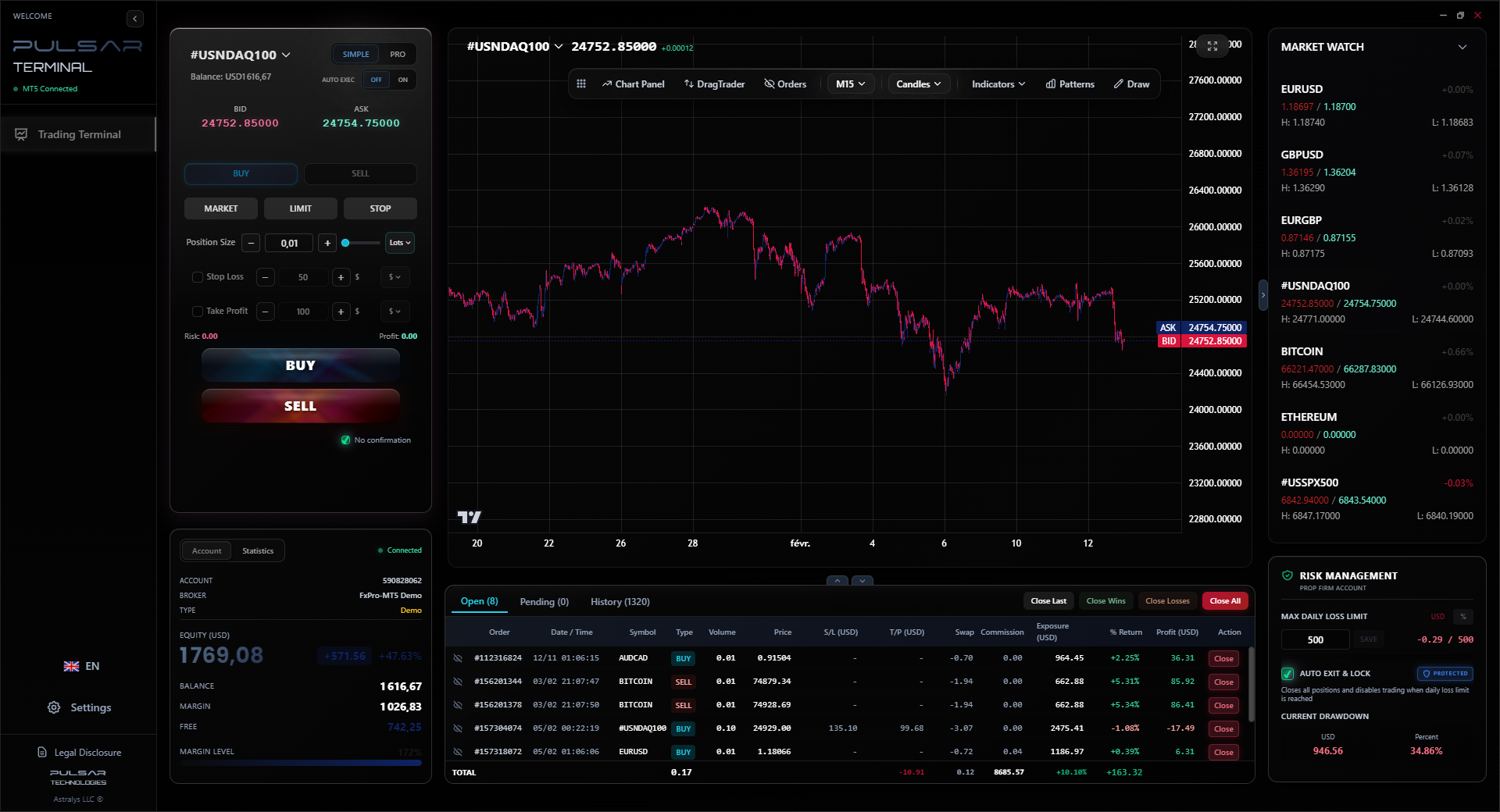
Spotting the pattern is one thing; executing the trade with precise risk management is another. Pulsar Terminal lets you set multi-level take-profits and stop-losses directly on your MT5 chart, so you can plan your candle-based trades visually and execute them without emotional interference.
Pulsar Terminal
MT5 올인원 도구: 드래그앤드롭 주문, 다중 TP/SL, 트레일링 스톱, 그리드 트레이딩, 볼륨 프로파일, 프롭펌 보호. 매일 1,000명 이상의 트레이더가 사용.
“You must divorce your personal feelings about the Naira from the objective price action on the chart. Trade the chart, not the headline.”
Candlesticks are your primary weapon, but you need an army. Here’s how I combine them.
With Support & Resistance: This is non-negotiable. A bearish engulfing pattern at a level where price has reversed three times before? That's a high-conviction short. The candle is the trigger; the level is the reason.
With Momentum Indicators: I use these for divergence, not entry. For example, if USD/NGN makes a new high but forms a Shooting Star, and the RSI indicator shows a lower high (bearish divergence), that's a powerful confluence. The candle shows rejection, the RSI shows weakening momentum. Similarly, the MACD indicator crossing can add confidence to a reversal signaled by an Engulfing pattern.
With Volume (Where Possible): True volume data is tricky in spot forex, but if your broker offers it (or you use futures data), it's gold. A bullish engulfing pattern with high volume is much more significant than one with low volume. It shows real institutional participation.
The goal isn't to clutter your chart. It's to have 2-3 reasons for a trade. Candlestick pattern + Key Level + Indicator Divergence = A plan you can execute without sweating every tick. This multi-factor approach is what separates a gambler from a trader who can consistently use the types of candles in forex to their advantage.
💡 윈스턴의 팁
If you can't instantly see the story a candle is telling (e.g., 'rejection of highs,' 'indecision,' 'buyer dominance'), don't trade it. Your clarity is your edge.
“The goal isn't to clutter your chart. It's to have 2-3 reasons for a trade.”
Trading candles is a skill, but operating in Nigeria's environment requires street smarts.
The Regulatory Scene: As of 2025/2026, the landscape is tightening. The SEC's new rules mean the wild west days are ending. You're likely using an international broker like XM or Pepperstone regulated offshore. That's fine, but know the risks: your primary recourse is with that foreign regulator. Understand their client fund protection policies. The 10% Capital Gains Tax on your profits is real. Keep clean records.
Broker Choice & Execution: Candlestick patterns, especially for scalping, rely on tight spreads and fast execution. A broker with a 3-pip spread on EUR/USD will kill a Pin Bar setup that only targets 10 pips. Look for brokers known for raw spreads and good execution. The difference between a 0.1 pip and a 1.5 pip spread is the difference between profit and loss on many short-term candle-based trades.
Psychology & The Naira Mindset: We're emotionally tied to the Naira. When it's falling, there's a panic to buy dollars; when it's rising, euphoria. This emotion can make you see candle patterns that aren't there. You must divorce your personal feelings about the Naira from the objective price action on the chart. Trade the chart, not the headline. Managing this psychology is as important as spotting the right Hammer. A tool that helps automate risk rules can be a lifesaver here, preventing emotional overrides when a trade goes against you.
FAQ
Q1What is the most reliable candlestick pattern for beginners in Nigeria?
Start with the Engulfing pattern. It's visually clear (one candle completely covering the last), and it represents a strong shift in power. A bullish engulfing after a dip in EUR/USD or GBP/USD is easier to spot and act on than more complex patterns. Just remember to only trade it at a clear support or resistance level, not in the middle of a range.
Q2How do I know if a Doji means a reversal or just a pause?
You don't, until you get confirmation. A Doji alone is a warning sign, not a signal. Wait for the next candle. If the next candle closes strongly below the Doji's midpoint after an uptrend, it's likely a reversal (evening star setup). If it closes strongly above, the trend may continue. The Doji tells you to watch your screen closely, not to place a trade.
Q3Can I use candlestick patterns to trade USD/NGN directly?
You can, but be extremely cautious. USD/NGN can have wide spreads and experience sudden gaps due to CBN policy or illiquidity. This can distort candle formations. I recommend practicing patterns on major forex pairs like EUR/USD first, where liquidity is deep and patterns are cleaner. Use that skill to gauge dollar strength, which indirectly informs your Naira outlook.
Q4What timeframe is best for candlestick analysis?
There's no 'best,' but there's a best practice. For learning, start with the 1-hour and 4-hour charts. They filter out market noise better than the 5 or 15-minute charts. Daily charts are great for spotting major reversal patterns. Never look at just one timeframe. Always check the higher timeframe trend to give context to the pattern on your trading chart.
Q5Do candlestick patterns work during high-impact news events?
No, they often fail spectacularly. A perfect pattern can form right before a CBN MPC announcement or US Non-Farm Payrolls, and the news can blow right through it. The patterns reflect market psychology, which is overridden by fundamental shocks. The rule is simple: if major news is scheduled within the next few candles, do not trade based on a pattern. The risk is too high.
Q6How many pips should I target with a candlestick pattern trade?
It depends entirely on the pattern's location and your timeframe. A Pin Bar at a daily support level might target the previous swing high, which could be 100+ pips away on a major pair. A small engulfing on a 15-minute chart might only target 15-20 pips. Your target should be based on the next logical area of resistance/support, not a fixed pip amount. Always measure your potential reward against your risk (your stop loss) before entering.
Q7Is it necessary to use candlesticks with other indicators?
Necessary? No. Highly recommended? Yes. Candlesticks give you entry and sentiment clues. Indicators like RSI or MACD can help confirm if momentum aligns with the candle's story. The most important combination is with pure price action: support/resistance levels and trendlines. A candle pattern at a key level is far stronger than a candle pattern with an RSI signal in no-man's-land.
윈스턴 교수의 수업
핵심 요약:
- ✓Trade candle patterns only at clear support/resistance levels.
- ✓Always wait for 1-candle confirmation after your initial signal.
- ✓Ignore all patterns 1 hour before major scheduled news.
- ✓Use higher timeframes (4H/Daily) to define the trend direction.
- ✓A pattern's success rate jumps with volume or indicator confluence.
이 기사가 얼마나 유용했나요?
별을 클릭하여 평가
주간 트레이딩 인사이트
무료 주간 분석 & 전략. 스팸 없음.
저자 소개
Olumide Adeyemi
서아프리카 트레이딩 선구자
나이지리아에서 가장 활발한 외환 트레이딩 교육자 중 한 명. 라고스에서 8년간 트레이딩 경험. 아프리카 트레이더를 위한 소자본 전략과 프롭 펌 챌린지 전문.
댓글
위험 고지
금융 상품 거래에는 상당한 위험이 수반되며 모든 투자자에게 적합하지 않을 수 있습니다. 과거 성과가 미래 수익을 보장하지 않습니다. 이 콘텐츠는 교육 목적으로만 제공되며 투자 조언으로 간주되어서는 안 됩니다. 거래 전에 항상 직접 조사를 수행하십시오.
이 기사도 읽어보세요

Cara Trading Forex Sukses: 7 Prinsip dari Trader Profesional
Cara trading forex sukses dengan 7 prinsip trader pro: manajemen modal, disiplin, journal trading, backtest. Data nyata, bukan janji profit palsu.
Jam Trading Forex Terbaik untuk Trader Indonesia: Panduan Lengkap dengan Tabel Waktu
Panduan jam trading forex untuk trader Indonesia. Tabel 4 sesi dunia, jam emas 20:00-00:00, sesi mana yang harus dihindari. Data akurat + tips dari trader berpengalaman.
Top 5 Sàn Forex Uy Tín Nhất 2026: Review Jujur dari Trader Indonesia
Top 5 sàn forex uy tín 2026 untuk trader Indonesia. Review jujur: spread, deposit, withdraw, dukungan lokal. Exness, XM, IC Markets & lebih.
