


I bought a 'Complete Forex Mastery' course on Udemy for R250 back in 2018.

David van der Merwe
신흥시장 트레이더 ·  South Africa
☕ 12 분 소요
배울 내용:
- 1What You're Actually Buying (And It's Not What You Think)
- 2The South African Context: Why Generic Courses Fail Us
- 3A Real Breakdown of Udemy Course Types
- 4The Critical Pieces Every Udemy Course Leaves Out
- 5How to Build a Real Trading Education (The Udemy+ Plan)
- 6Instant Red Flags: How to Spot a Useless Course
- 7The Final Verdict for South African Traders
I bought a 'Complete Forex Mastery' course on Udemy for R250 back in 2018. The instructor promised a 'foolproof system' using moving averages. I followed it religiously, risking 2% per trade like he said. Three weeks later, I'd lost 34% of my R10,000 account trading EUR/USD. The system worked perfectly in his pre-recorded videos with perfect hindsight. In live markets with slippage and spread costs? It was a disaster. That's when I learned the hard truth about most online trading education. Let's talk about what Udemy forex courses actually offer South African traders, and more importantly, what they don't.
When you click 'Buy Now' on a Udemy forex course, you're not buying trading success. You're buying information packaging. There's a crucial difference. The platform hosts over 500 courses with 'forex' in the title, priced from $12.99 to $89.99 (roughly R240 to R1,650). With their perpetual '90% off' sales, you'll rarely pay more than R300.
What does that R300 get you? Usually 5-15 hours of pre-recorded video lectures, some PDF cheat sheets, and maybe a basic Excel spreadsheet for calculations. The production quality varies wildly. Some courses look professional; others are just a guy recording his screen with a cheap microphone.
The real product isn't the strategy. It's the illusion of a shortcut. Most courses sell the dream that complex market analysis can be condensed into a simple, repeatable process. They show you cherry-picked chart examples where the indicator flashed a perfect buy signal at the exact bottom. What they don't show are the 7 failed signals that came before it, which would have stopped you out.

Warning: Any course that guarantees profits or uses phrases like 'never lose again' is a scam. Full stop. The FSCA doesn't regulate educators, so there's no watchdog for these claims. If the strategy was that good, the creator would be trading it with their own millions, not selling it for R250.
I made this mistake early on. I bought a course focused on the MACD indicator divergence strategy. The instructor made it look like printing money. In reality, by the time the divergence was clear on the USD/ZAR chart, the move was often over, and I was left entering late with a terrible risk/reward. The course didn't cost much, but following its advice cost me real capital.
Here's the biggest problem with most Udemy forex courses: they're made for a global, often US-centric, audience. They don't account for our local realities. This isn't a small detail; it's a fundamental flaw that can wreck your results.
Trading Hours and Liquidity
Many strategies taught, especially for scalping, rely on high liquidity during the London or New York sessions. If you're trading from Johannesburg on a standard broker like Exness or XM, you might be executing these strategies during our evening. Liquidity for pairs like EUR/ZAR can dry up, causing wider spreads. A course that says 'the spread on EUR/USD is always 0.8 pips' is useless when you're facing a 14-pip spread on EUR/ZAR at 8 PM SAST. I learned this painfully trying to scalp the GBP/USD using a method from a popular course. The examples were during London open. My executions in our timezone had slippage that completely invalidated the tiny profit targets.
The ZAR Pairs Reality
Most courses focus exclusively on majors like EUR/USD. As a South African trader, you're naturally drawn to USD/ZAR or EUR/ZAR. These are exotic pairs with completely different behaviors. They're more volatile, have wider spreads, and are susceptible to local political and economic news that a US-based instructor has never heard of. A generic support/resistance course won't prepare you for how the rand reacts to SARB announcements or load-shedding news.
Costs That Eat Your Edge
Let's talk numbers. You learn a strategy that aims for a 10-pip profit. On EUR/USD with a 1-pip spread, you need an 11-pip move to break even. On USD/ZAR, where the spread can be 5 pips at a broker like Pepperstone, you now need a 15-pip move just to get to zero. That 50% increase in your breakeven hurdle turns a marginally profitable strategy into a guaranteed loser. Most courses never mention this. You must use a position size calculator that factors in the specific spread of your pair and broker, not the idealized one in the video.
Regulation and Your Money
You'll learn about 'regulated brokers' in courses, but they'll reference the FCA or ASIC. You need to know about the FSCA (Financial Sector Conduct Authority). Trading with an FSCA-licensed broker like IG or AvaTrade is non-negotiable for protection. Also, remember: your profits are taxable. SARS wants its share. I've never seen a Udemy course include a module on South African tax implications for traders.

💡 윈스턴의 팁
If a trading course costs less than a decent dinner out, it's priced as entertainment, not life-changing education. Manage your expectations accordingly.
“Your real education will be paid for in screen time, emotional stress, and unfortunately, lost capital.”
Not all courses are created equal. Based on reviewing dozens, they fall into clear categories.
| Course Type | What They Promise | The Reality | Who It Might Suit |
|---|---|---|---|
| The 'Get Rich Quick' System | "My 3-Indicator Secret Makes 5% Daily!" | Pure fantasy. Often uses lagging indicators in a complex combo. Fails in sideways markets. | No one. Avoid. |
| The Basics/101 Course | "Forex Trading for Complete Beginners." | Actually useful. Explains pips, lots, bid/ask, what a spread is. Low on actionable strategy. | The absolute novice who doesn't know a candlestick from a bar chart. |
| The Indicator Deep Dive | "Master the RSI/Stochastic/Bollinger Bands." | Can be educational if honest. Shows the math and typical use. Often overstates reliability. | A trader who wants to understand one tool to add to their own system. |
| The Price Action Guru | "Trade Naked Charts! No Indicators!" | Teaches support/resistance, patterns. Valuable concepts but presented as a holy grail. Requires immense screen time and discretion. | Disciplined traders interested in swing trading. |
| The Algorithm/EA Builder | "Code Your Own Profitable Robot in MQL4." | Teaches programming, not trading. The EA you build will only be as good as the logic you feed it (which is the hard part). | Tech-savvy learners wanting automation skills. |
The best value I ever got was from a basic 101 course and a price action course. I paid about R400 total. They gave me the foundational language and chart-reading skills. Everything else - my actual edge - came from years of screen time, journaling, and losing real money.

Pro Tip: Sort courses by 'Most Recent' and read the reviews from the last 6 months. Ignore the glowing 5-star reviews from people who 'just bought it.' Look for the 3-star reviews that detail what's missing or outdated. A course on XAU/USD from 2020 is useless post-2022 volatility.
This is why traders who only use Udemy courses blow up. The curriculum is incomplete. It's like learning to fly a plane by only studying the steering wheel.
1. Risk Management as an Afterthought. They'll say 'use a stop-loss' and 'risk 1-2%.' That's it. They don't teach you how to set a stop-loss based on market structure, not an arbitrary pip amount. They don't teach position sizing for a margin call, correlation risk (e.g., going long on both USD/ZAR and EUR/USD), or how to handle a string of 5 losses in a row psychologically. My early failure was due to poor stop placement. I'd place my stop 20 pips away because the course said 'never risk more than 2%.' The market would wick 21 pips to take me out, then reverse. I was trading my P&L, not the chart.
2. The Psychology of Losing Real Money. Watching a green candle hit your take-profit in a video is easy. Sitting there as your hard-earned R2,000 trade goes R500 into the red triggers a physiological response - sweaty palms, faster heartbeat. No course can simulate that. They don't teach you how to deal with revenge trading after a loss (I blew a whole account doing this in 2019) or how to avoid overriding your system when you're scared or greedy.
3. Broker Execution and Platform Mechanics. You need to know how to place a limit order, set a trailing stop, or manage a partial closure on your specific platform (MT4, MT5, cTrader). A generic lecture won't help when you're in a live trade on IC Markets and can't figure out how to move your stop to breakeven. This is hands-on, platform-specific knowledge.
4. Backtesting and Validation. They show you the winning examples. They don't make you go back and test the strategy on 200 instances of USD/ZAR over the last year to see its real win rate and drawdown. They sell the conclusion, not the rigorous validation process. You must do this yourself. I spent 3 months backtesting a strategy from a course on EUR/USD data. The win rate was 38%, not the 70% implied. That saved me a fortune.
💡 윈스턴의 팁
The most valuable page in any course material is the trade journal template. If they don't provide one, they aren't serious about your success.
“They sell the conclusion, not the rigorous validation process. You must do this yourself.”
Udemy can be a cheap starting block, but it can't be your entire school. Here's a realistic, multi-source plan for a South African trader.
Step 1: Use Udemy for Cheap Basics. Spend R300 on a well-rated 'Forex 101' course and a 'Price Action Basics' course. Your goal is to learn the language and the absolute fundamentals. That's all you should expect from the platform.
Step 2: Move to Free, Quality Repetition. YouTube is your next teacher. Find traders who show live trading (not just highlights) and explain their thought process in real-time. Watch how they handle losses. But be critical - many are also selling a dream.
Step 3: Paper Trade with a Purpose. Open a demo account with an FSCA broker like Pepperstone. Don't just trade aimlessly. Test the specific concept from your Udemy course. Can you consistently identify the setups? Where do you get stopped out? Journal every trade: entry reason, pip risk, emotional state.
Step 4: Study the Market, Not Just Strategies. Spend 80% of your time understanding what moves your markets. Why did the rand gap down this morning? What did the SARB governor say? Follow local financial news. This contextual knowledge is more valuable than any indicator tutorial.
Step 5: Find a Mentor or Community (The Hard Part). This is the expensive but often crucial step. A real mentor will review your trades, point out your blind spots, and keep you accountable. This is what Udemy can't provide: personalized feedback. Some local trading communities exist, but vet them carefully.

Example: Your education budget. Instead of buying 10 Udemy courses for R3,000, try this: R300 for 2 basic Udemy courses. R500 for books on trading psychology (e.g., 'Trading in the Zone'). R1,000 for a month of a reputable market data/news service. The remaining R1,200 stays in your trading account as risk capital to learn from microscopic real trades.
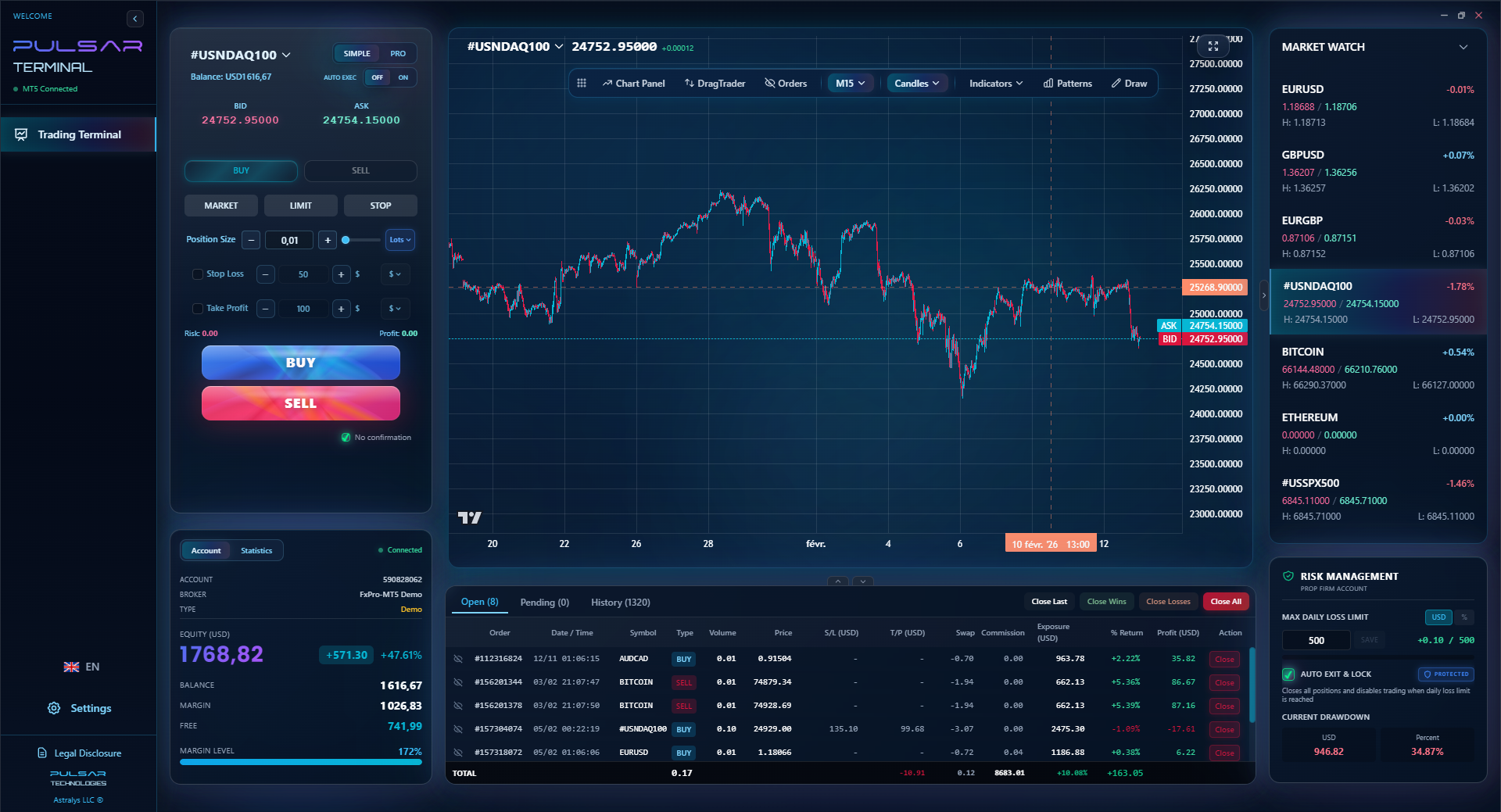
Manually moving stops to breakeven and managing multiple take-profit levels is a hassle that courses ignore, but Pulsar Terminal automates it directly on your MT5 platform.
Pulsar Terminal
MT5 올인원 도구: 드래그앤드롭 주문, 다중 TP/SL, 트레일링 스톱, 그리드 트레이딩, 볼륨 프로파일, 프롭펌 보호. 매일 1,000명 이상의 트레이더가 사용.
You can save yourself money and time by recognizing these warning signs in the sales page.
- The Income Disclaimer is Buried or Absent. Legitimate educators are upfront about the risk. If it's all promise and no disclaimer, run.
- 'Proof' is Just Screenshots of Trades. Anyone can Photoshop a trading statement or cherry-pick a few wins from a demo account. Demand verified, long-term track records (which you'll almost never get).
- The Instructor Has No Public Trading History. What's their story? Are they a former fund manager, or just a 'guru' who started teaching in 2020? If their only credential is 'creator of this course,' be skeptical.
- It's All Theory, No Live Trading. Hours of PowerPoint slides explaining economic theory are fine, but if the course doesn't include segments of the instructor trading live (with real-time commentary on their decisions), it's academic, not practical.
- They Sell the 'One Setup.' Markets change. A course that says 'only trade this one pin bar setup' is teaching dogma, not adaptable skill. I fell for this with a specific RSI indicator overbought/oversold strategy. It worked for a few months in a ranging market, then completely fell apart when the trend shifted.
- The Reviews Are All Generic. 'Great course!' 'Loved it!' These are fake or from people who haven't applied it. Look for detailed reviews that mention specific lessons or, even better, constructive criticism.
💡 윈스턴의 팁
Spend 10 minutes learning your trading platform's order types for every hour you spend on strategy. Perfect execution saves more pips than a perfect entry.
“A generic support/resistance course won't prepare you for how the rand reacts to SARB announcements.”
So, are Udemy forex courses worth it? It's a conditional yes, but with massive caveats.
They are worth R200-R400 as a super-cheap way to get a structured introduction to terminology and basic chart concepts. Think of them as buying a textbook, not hiring a personal coach. They can help you go from zero to knowing what a moving average is.
They are utterly worthless as a path to consistent profits. The moment you think a R250 course holds the secret that eludes 90% of losing traders, you've entered the fantasy zone that leads to a blown account.
Your real education will be paid for in screen time, emotional stress, and unfortunately, lost capital. The courses that truly changed my trajectory weren't on Udemy. They were the expensive, intensive mentorships and the brutal lessons from my own trade journal. The best thing a Udemy course did was give me enough knowledge to start asking the right questions and to recognize how much I didn't know.
Start small. Use Udemy as your dictionary. Then get to the real work: understanding the South African market, mastering your own psychology, and developing a strong risk management framework that protects your capital. That's the only 'course' that matters.
FAQ
Q1What is the best Udemy forex course for beginners in South Africa?
Don't look for a 'best' course. Look for the highest-rated 'Forex Trading for Complete Beginners' course that's been updated in the last year. Your goal is to learn what a pip, lot, spread, and candlestick are. Avoid any beginner course that promises a specific profitable strategy - that's an advanced topic disguised as a basic one.
Q2Can I become a profitable trader using only Udemy courses?
Almost certainly not. Udemy courses provide knowledge, not skill or experience. Profitable trading requires developing your own judgment, emotional control, and risk management discipline through live market practice. Courses are the theory; the market is the practical exam, and it's brutally hard.
Q3How do I know if a forex course instructor is legitimate?
It's very difficult. Check their LinkedIn and other social media. Do they have a verifiable history in finance or trading? Are they transparent about their losses as well as wins? Be extremely wary of anyone whose entire online presence is about selling courses, with no evidence of a prior professional trading career.
Q4Are there Udemy courses that focus on trading the South African Rand (ZAR)?
Extremely rare. Almost all courses focus on major pairs like EUR/USD. The behavior, spread costs, and drivers of USD/ZAR or EUR/ZAR are different. You will need to adapt generic concepts to our local market through your own study of economic events, the SARB, and local political news.
Q5What should I learn after a Udemy forex course?
Immediately move to a demo account and practice what you learned for at least 2-3 months. Then, focus your learning on two areas Udemy misses: 1) Trading Psychology (read books like 'The Psychology of Trading'), and 2) Detailed Risk Management (learn about correlation, drawdown limits, and advanced position sizing).
Q6Do I need to pay for expensive courses instead of Udemy?
Not necessarily. An expensive course isn't automatically better. Many are just slicker scams. The value in premium education usually comes from personalized feedback or access to a proven community. Before spending thousands, see if you can get a trial or talk to past students. The core of your learning will always be your own disciplined practice and analysis.
윈스턴 교수의 수업
핵심 요약:
- ✓Udemy courses are cheap textbooks, not profit blueprints.
- ✓South African markets (like USD/ZAR) have wider spreads that kill generic strategies.
- ✓The missing curriculum is always psychology and real risk management.
- ✓Backtest any strategy on 200+ instances before risking a cent.
- ✓Your best teacher is your own carefully kept trade journal.
이 기사가 얼마나 유용했나요?
별을 클릭하여 평가
주간 트레이딩 인사이트
무료 주간 분석 & 전략. 스팸 없음.
저자 소개
David van der Merwe
신흥시장 트레이더
요하네스버그 기반 트레이더로 신흥시장 통화 11년 경력. ZAR 통화쌍, FSCA 규제 거래, 남아공 시장 분석 전문.
댓글
위험 고지
금융 상품 거래에는 상당한 위험이 수반되며 모든 투자자에게 적합하지 않을 수 있습니다. 과거 성과가 미래 수익을 보장하지 않습니다. 이 콘텐츠는 교육 목적으로만 제공되며 투자 조언으로 간주되어서는 안 됩니다. 거래 전에 항상 직접 조사를 수행하십시오.
이 기사도 읽어보세요

Cara Trading Forex Sukses: 7 Prinsip dari Trader Profesional
Cara trading forex sukses dengan 7 prinsip trader pro: manajemen modal, disiplin, journal trading, backtest. Data nyata, bukan janji profit palsu.
Jam Trading Forex Terbaik untuk Trader Indonesia: Panduan Lengkap dengan Tabel Waktu
Panduan jam trading forex untuk trader Indonesia. Tabel 4 sesi dunia, jam emas 20:00-00:00, sesi mana yang harus dihindari. Data akurat + tips dari trader berpengalaman.
Top 5 Sàn Forex Uy Tín Nhất 2026: Review Jujur dari Trader Indonesia
Top 5 sàn forex uy tín 2026 untuk trader Indonesia. Review jujur: spread, deposit, withdraw, dukungan lokal. Exness, XM, IC Markets & lebih.
