


Here's a fact that should make you pause: over 70% of retail forex traders lose money, and excessive use is the primary culprit.

Olumide Adeyemi
서아프리카 트레이딩 선구자 ·  Nigeria
☕ 11 분 소요
배울 내용:
- 1What Is use, Really? It's Not Free Money
- 2use Ratios in Nigeria: Why 2000:1 is a Trap
- 3Margin, Equity, and How Your Account Gets Blown
- 4The Nigerian Regulatory Context: A Shifting Landscape
- 5A Practical use Strategy That Actually Works
- 6Mistakes I Made (So You Don't Have To)
- 7Choosing a Broker: Beyond the use Number
- 8The Mental Shift: From Gambler to Risk Manager
Here's a fact that should make you pause: over 70% of retail forex traders lose money, and excessive use is the primary culprit. In Nigeria, where brokers dangle ratios like 2000:1 like candy, that statistic isn't just a warning, it's a prophecy waiting to be fulfilled. I've seen it happen, and I've felt the sting myself. Understanding use in forex isn't about chasing mega-profits, it's about survival arithmetic. This guide will walk you through what use really is, how it works in our unique market, and the hard lessons I learned so you don't have to.
Let's cut through the broker marketing. use isn't a magic profit multiplier. It's a loan. Plain and simple. Your broker lends you money to control a position much larger than your deposit.
Think of it like this: you want to trade a standard lot of EUR/USD, which is 100,000 units of the base currency. Without use, you'd need $100,000 in your account. With 100:1 use, you only need $1,000 of your own money as collateral (margin). The broker fronts the other $99,000.
The catch? You're responsible for all the profits and losses on that full $100,000 position. That $1,000 isn't your risk, it's your safety deposit. If losses eat into that deposit, you get a margin call. I learned this the hard way early on. I put down $200 on a mini lot with 500:1 use, thinking my risk was just that $200. A 20-pip move against me wiped out half my margin. The panic was real. I hadn't grasped that my risk was calculated on the full position size, not my deposit.

Warning: High use doesn't increase your chance of winning. It increases the speed and magnitude of both your wins and your losses. It amplifies everything, especially fear and greed.

💡 윈스턴의 팁
Your first loss is often your smallest. Chasing it with higher use is how a $50 mistake becomes a $500 disaster. Walk away, reset, and re-enter with your original plan.
Open any broker site popular here, and you'll see use offers that would give regulators in the UK or Australia a heart attack: 500:1, 1000:1, even 2000:1. It's seductive. It feels like power. But let's break down what that actually means.
With 2000:1 use, you only need $50 to control a $100,000 position. A single pip movement in EUR/USD is worth $10. Your entire $50 margin can be wiped out by a 5-pip move against you. The market can move 5 pips in seconds because of a news headline. It's not trading, it's gambling with a hair trigger.
The Prudent Limit
International regulators cap use for retail clients at much lower levels for a reason. The EU and UK limit it to 30:1 for major pairs. Australia has similar restrictions. These aren't arbitrary; they're based on risk management principles that prevent account annihilation from normal market noise.
For a Nigerian trader, mimicking this self-discipline is crucial. Starting with use no higher than 30:1 or 50:1 forces you to commit more of your own capital, which does two things: it makes you more selective with your trades, and it gives your position room to breathe. A 30-pip stop-loss won't destroy you. I forced myself to drop from 500:1 to 50:1 after my second blown account. My trading frequency went down, but my consistency went up.

Example:
- Trade: Buy 1 standard lot EUR/USD (€100,000)
- use 2000:1: Required Margin = ~$50. A 10-pip loss = $100. Account wiped out.
- use 50:1: Required Margin = $2,000. A 10-pip loss = $100. Loss is 5% of margin.
The math doesn't lie. The higher the use, the thinner your safety net.
“High use doesn't increase your chance of winning. It increases the speed and magnitude of both your wins and your losses.”
This is where the rubber meets the road. You can't understand use without understanding its siblings: Margin, Margin Level, and Equity.
- Margin: The amount of your own money locked up as collateral to open a leveraged position. It's not a fee, it's just held aside.
- Equity: Your account balance plus/minus your floating profit/loss on open trades. This is your real-time net worth.
- Margin Level: (Equity / Used Margin) x 100%. This is your account's vital sign.
Here’s how a blow-up happens, step-by-step, using a real mistake I made trading GBP/JPY:
- I deposited 150,000 NGN (about $100 at the time).
- I opened a 0.1 lot sell position on GBP/JPY. With 500:1 use, my Used Margin was about $25.
- My Margin Level started at (100 / 25) x 100% = 400%. Looks healthy.
- The pair rallied hard against me. My floating loss grew, so my Equity dropped to $40.
- My Margin Level plummeted to (40 / 25) x 100% = 160%.
- Most brokers set a Margin Call level at 100% and a Stop Out level at 50%. At 100%, you get a warning. At 50%, they start automatically closing your losing positions to prevent your account from going negative.
- The rally didn't stop. My Equity hit $12.5. Margin Level = (12.5 / 25) x 100% = 50%.
- STOP OUT. My trade was forcibly closed at the worst possible price. I was left with about $12.5 in my account from the original $100.
The entire process took less than an hour. High use shrank the distance between a bad trade and a catastrophe. Now, I use a position size calculator for every single entry to ensure my stop-loss distance, in pips, won't push my margin level into the danger zone before the trade even starts.
For years, trading with international brokers felt like the wild west. There was no specific Nigerian watchdog for online retail forex. That's changing, fast.
The Securities and Exchange Commission (SEC) is now stepping in. The new Investments and Securities Act (ISA) 2025 gives them explicit power to regulate online FX platforms. If a platform has a physical presence here, it will need to play by SEC rules. This is a big deal for consumer protection.
However, right now, the use caps you see are set by the broker's home regulator, not Nigeria's. A broker like Exness might offer high use under its global entity, while its EU-regulated arm offers only 30:1. As a Nigerian trader, you often have access to the higher-use entities.
This puts the responsibility squarely on you. The regulator isn't protecting you from yourself by capping use. You have to be your own regulator. You also have a tax responsibility. Profits from forex trading are subject to a 10% Capital Gains Tax, payable to the FIRS. Keep a detailed trade journal; it's not just for learning, it's for your tax file.
The Central Bank of Nigeria (CBN) focuses on the institutional and official forex market. Their recent reforms, like the Nigeria FX Code, aim for transparency in the broader system. For you, the retail trader, the main takeaway is this: the environment is becoming more structured. Choosing a reputable international broker with strong external regulation (like FCA, CySEC, or ASIC) is still a very smart move for fund safety, even if you use their higher-use entity.
💡 윈스턴의 팁
If you can't calculate your exact risk in Naira before clicking 'buy' or 'sell', you have no business being in the trade. Guesstimates get annihilated by use.
“With 2000:1 use, your entire margin can be wiped out by a 5-pip move against you. That's not trading, it's gambling with a hair trigger.”
Forget the broker's maximum. Your use should be a function of your trade size and risk per trade, not the other way around. Here's my non-negotiable routine.
The 1% Rule and Position Sizing
I never risk more than 1% of my account equity on any single trade. This is the bedrock. Let's say my account is $1,000. My max risk per trade is $10.
Now, I look at a setup on XAU/USD. My analysis says I need a 15-point (150 pips) stop-loss to give the trade a fair chance. How do I calculate my position size so my potential loss is $10 or less?
- Risk in Money: $10
- Risk in Pips: 150 pips
- Pip Value for Standard Lot: For XAU/USD, 1 pip = $1 per 0.01 lot (micro lot).
- Calculation: Position Size (in lots) = Risk in Money / (Risk in Pips * Pip Value per Lot).
- $10 / (150 pips * $1 per 0.01 lot) = 0.0067 standard lots, or 0.67 micro lots.
I would enter a 0.67 micro lot position. My required margin for this trade might be $50 or $500 depending on use, but I don't care. The use used is a result of my risk-based position sizing, not the driver of it. This approach automatically uses lower effective use on trades with wider stops, which are often the higher-probability swing trading setups.
Adjusting use for Volatility
Some pairs are just wilder. GBP/JPY, GBP/AUD, and even EUR/USD during news events can move twice as fast as EUR/CHF. If I'm trading a volatile pair, I cut my position size in half before I even calculate it. This effectively halves my use on that trade. It's a simple filter that has saved me countless times.
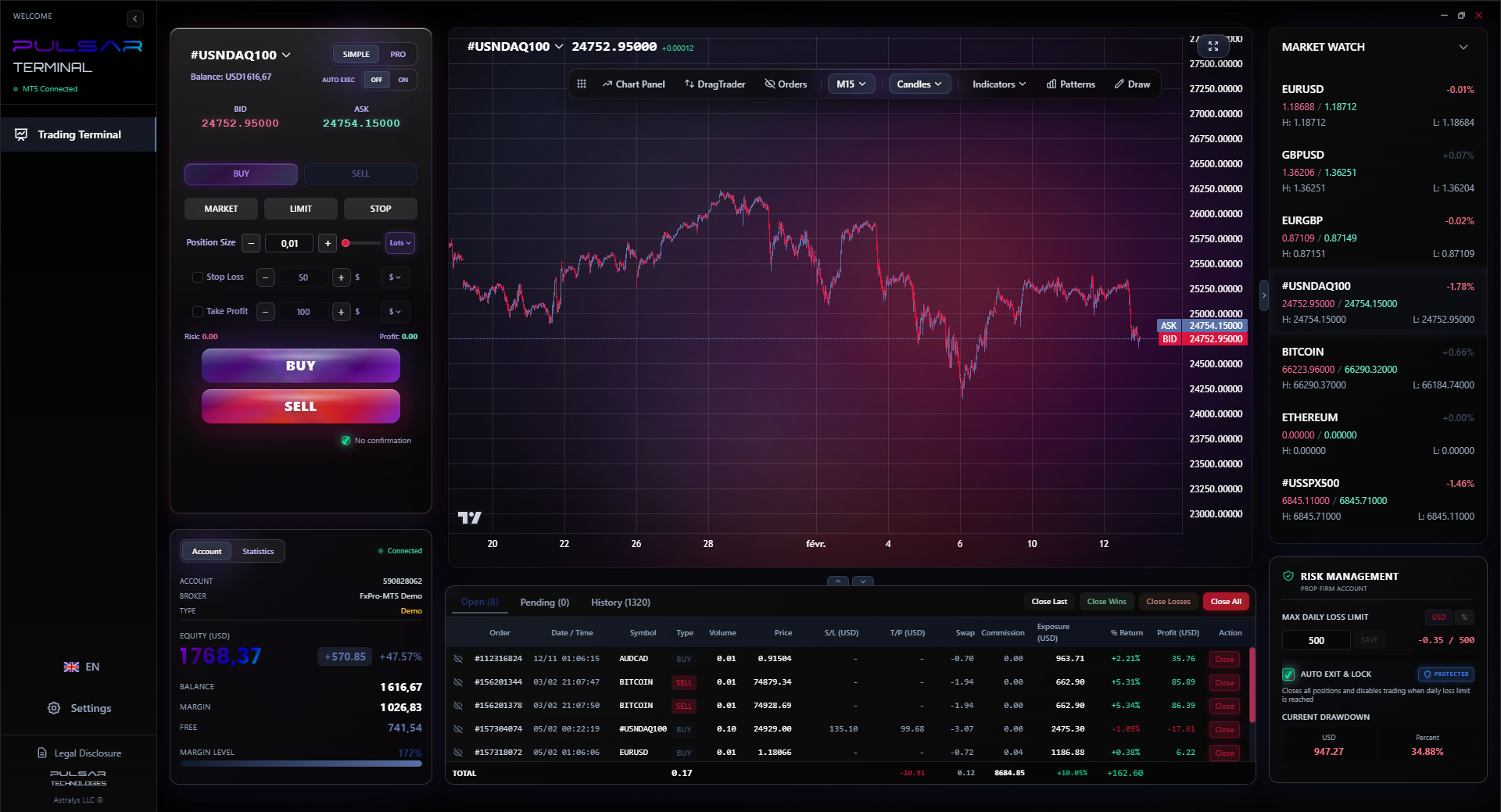
When you're managing precise risk with multiple trades, a tool like Pulsar Terminal lets you set and automate stop-loss and take-profit orders for your entire grid directly on your MT5 charts, turning your risk management plan into automatic action.
Pulsar Terminal
MT5 올인원 도구: 드래그앤드롭 주문, 다중 TP/SL, 트레일링 스톱, 그리드 트레이딩, 볼륨 프로파일, 프롭펌 보호. 매일 1,000명 이상의 트레이더가 사용.
Let me be brutally honest about my errors. This is the unglamorous side of understanding use in forex.
Mistake 1: Overleveraging on a 'Sure Thing'. It was a classic scalping strategy setup on EUR/USD. The MACD indicator and RSI were aligned, price was at support. I was so confident I used 90% of my margin on one trade with 200:1 use. A rogue tweet from a European official spiked the pair 8 pips against me in a second. Stop out. I lost a month's progress in under a minute. The trade idea wasn't wrong, but my use was suicidal.
Mistake 2: Adding to a Losing Position (Averaging Down). This is the use killer. I bought USD/NGN (yes, it was available) at 410. It dropped to 405. Instead of taking my small loss, I thought, 'It's cheaper now, I'll double my position to lower my average entry.' I used more margin. It dropped to 400. My margin level was flashing red. By the time it hit 398, the automatic liquidation wiped out both positions. I turned a 2% loss into a 40% account loss. use made a bad decision catastrophic.
Mistake 3: Ignoring the Spread on High use. When you're scalping for 5-10 pips, the spread matters. With a 3-pip spread on EUR/GBP, you're already down 30% of your target on a 10-pip scalp before the market moves. Using high use for such a strategy means the spread becomes a massive hurdle. I was paying a huge fee to the broker on every entry. My backtested winning strategy failed live because I didn't factor in the real cost of execution at high use.
“Mastering use is the shift from asking 'How much can I make?' to 'How much can I afford to lose?'”
When picking a broker in Nigeria, the highest use offer should be the last thing you look at. Here’s what comes first:
- Regulation & Reputation: Is the broker regulated by a reputable authority (FCA, ASIC, CySEC)? Even if you use their global entity, it speaks to their overall operational standards. Read our deep dives on brokers like IC Markets and Pepperstone to see how they stack up.
- Reliable Deposits/Withdrawals: Can you fund your account and get your profits out in Naira without a 3-week drama? Test their customer service with questions before depositing.
- Execution & Spreads: Slippage and wide spreads will hurt you more than moderate use. Look for brokers known for tight, stable spreads, especially on the majors.
- Then Look at use Options: Once you've found a few trustworthy brokers, then see what use tiers they offer. A good broker will offer flexible use (e.g., 1:10, 1:50, 1:100, 1:200) and let you choose per account or even per trade. You want the option to use low use, not be forced to use only high use.
| Broker Aspect | Why It Matters More Than Max use |
|---|---|
| Fund Safety | Your capital is segregated? This is non-negotiable. |
| Withdrawal Speed | Profits you can't access are useless. Nigerian traders need local payment options. |
| Spreads on EUR/USD | A 0.1 pip difference saves you money on every trade. |
| use Flexibility | Can you easily set your account to 30:1 and forget it? |
My go-to brokers now are ones where I can set a default use cap on my account. It removes the temptation.
💡 윈스턴의 팁
Treat your maximum use like a speed limit. You have a car that can go 200km/h (2000:1), but driving at 60km/h (50:1) gets you there safely and with your license intact.
, mastering use is a mental game. It's the shift from asking "How much can I make?" to "How much can I afford to lose?"
High use feeds the gambling instinct. The thrill of seeing your balance jump $100 on a small move is addictive. But sustainable trading is boring. It's about consistent, small gains protected by rigorous risk management. When I embraced lower use, my P&L charts became less exciting but steadily upward sloping.
I keep a screenshot of my first major blow-up on my trading desk. It's a reminder that the market doesn't care about my confidence. It's a humbling business. Use use as a precise tool, not a blunt weapon. Start small, risk tiny, and focus on the process. The profits will follow the discipline, not the other way around.

Pro Tip: For one week, pretend the maximum use your broker offers is 10:1. Trade with that constraint. You'll be amazed at how much more carefully you analyze entries, set stops, and manage trades. It forces quality over quantity.
FAQ
Q1What is the best use for a beginner forex trader in Nigeria?
Start with no use at all on a demo account. When you go live, use no more than 10:1 or 20:1 for your first 6 months. This forces you to learn proper position sizing and risk management without the constant threat of instant ruin. It's boring, but it's how you build foundational skills.
Q2Is 500:1 use illegal in Nigeria?
No, it's not currently illegal. Nigerian regulations on retail forex use are still evolving. The high use is offered by the international brokers' global entities. However, just because it's available doesn't mean it's wise. It's your responsibility to use it prudently.
Q3How is use calculated?
use Ratio = Total Value of Position / Required Margin. For example, a $100,000 position with a $2,000 margin requirement uses 50:1 use (100,000 / 2,000 = 50). Your trading platform calculates the required margin automatically based on your chosen lot size and the use setting on your account.
Q4Can I change my use after opening an account?
Usually, yes. Most brokers allow you to request a change in your account's use setting through your client portal or support. However, you often cannot change it if you have open positions. Some brokers also have different tiers based on your account equity.
Q5Do I pay interest on the use provided by my broker?
No, you don't pay direct interest on the leveraged funds for spot forex trades. However, you may pay or receive a swap fee (overnight financing charge) if you hold a position past the daily rollover time (usually 5 PM EST). This is based on the interest rate differential between the two currencies.
Q6What's the difference between use and margin?
use is the ratio (e.g., 100:1). Margin is the actual amount of your own money (the collateral) required to open and hold that leveraged position. use determines how much margin you need. A 100:1 use means you need 1% of the position's value as margin.
Q7How does the new SEC regulation affect my use with international brokers?
In the short term, it likely won't change the use offered by offshore brokers to Nigerian clients. The SEC's new powers under the ISA 2025 are focused on platforms operating within Nigeria. For now, it emphasizes the need for you to exercise self-discipline and choose brokers with strong external regulation for fund safety.
윈스턴 교수의 수업
핵심 요약:
- ✓Start with use no higher than 30:1, regardless of what your broker offers.
- ✓Never risk more than 1% of your account equity on a single trade.
- ✓A 5-pip move can wipe out a 2000:1 leveraged account.
- ✓use amplifies losses faster than it amplifies gains.
- ✓Your margin level is your account's most important vital sign.
이 기사가 얼마나 유용했나요?
별을 클릭하여 평가
주간 트레이딩 인사이트
무료 주간 분석 & 전략. 스팸 없음.
저자 소개
Olumide Adeyemi
서아프리카 트레이딩 선구자
나이지리아에서 가장 활발한 외환 트레이딩 교육자 중 한 명. 라고스에서 8년간 트레이딩 경험. 아프리카 트레이더를 위한 소자본 전략과 프롭 펌 챌린지 전문.
댓글
위험 고지
금융 상품 거래에는 상당한 위험이 수반되며 모든 투자자에게 적합하지 않을 수 있습니다. 과거 성과가 미래 수익을 보장하지 않습니다. 이 콘텐츠는 교육 목적으로만 제공되며 투자 조언으로 간주되어서는 안 됩니다. 거래 전에 항상 직접 조사를 수행하십시오.
이 기사도 읽어보세요

Cara Trading Forex Sukses: 7 Prinsip dari Trader Profesional
Cara trading forex sukses dengan 7 prinsip trader pro: manajemen modal, disiplin, journal trading, backtest. Data nyata, bukan janji profit palsu.
Jam Trading Forex Terbaik untuk Trader Indonesia: Panduan Lengkap dengan Tabel Waktu
Panduan jam trading forex untuk trader Indonesia. Tabel 4 sesi dunia, jam emas 20:00-00:00, sesi mana yang harus dihindari. Data akurat + tips dari trader berpengalaman.
Top 5 Sàn Forex Uy Tín Nhất 2026: Review Jujur dari Trader Indonesia
Top 5 sàn forex uy tín 2026 untuk trader Indonesia. Review jujur: spread, deposit, withdraw, dukungan lokal. Exness, XM, IC Markets & lebih.
