


You're looking at the UNISA forex trading course and wondering if dropping R6,000 is the smart move to start your trading career.

David van der Merwe
신흥시장 트레이더 ·  South Africa
☕ 10 분 소요
배울 내용:
- 1What the UNISA Course Actually Covers (And What It Doesn't)
- 2The R6,000 Fee: A Cost Breakdown and Real-World Alternatives
- 3The South African Trading Reality UNISA Won't Show You
- 4Structured Learning vs. Self-Directed Grind: A Trader's Perspective
- 5The Real Costs Beyond the Course Fee: Brokers, Spreads, and Slippage
- 6Making the Decision: A Framework for South African Beginners
- 7The Final Verdict: Education vs. Execution
You're looking at the UNISA forex trading course and wondering if dropping R6,000 is the smart move to start your trading career. I get it. You want a legitimate education, not some get-rich-quick YouTube scam. But here's the hard truth I've learned after 12 years: most formal courses teach you the theory of driving, then hand you the keys to a Formula 1 car in a hurricane. Let's break down what UNISA's 'Course in Share and Forex Trading' (code 76988) actually offers, what that fee gets you, and whether you'd be better off putting that money into a position size calculator and a year of disciplined demo trading.
UNISA's Short Learning Programme is called the 'Course in Share and Forex Trading.' It's a 6-month online course split into three modules, each costing R2,000 for that total of R6,000. You need a National Senior Certificate to register. The modules are: CFOREX1 (Introduction to Investments), CFOREX2 (Share Trading), and CFOREX3 (Forex Trading).
This is a foundational, academic course. It will teach you definitions, market structures, basic chart types, and the economic theory behind why currencies move. Think of it as getting a driver's license manual. It's essential knowledge, but passing the test doesn't mean you can handle a skid on a wet road at 120 km/h.
What it almost certainly won't teach you is the brutal psychology of live trading. It won't show you how your hand shakes clicking the sell button as your stop-loss gets hit. It won't drill into you the discipline needed to follow a scalping strategy for 100 trades without deviating. The gap between theory and practice is where 90% of funded accounts blow up.
I took a similar university-endorsed course early in my career. I aced the final exam on moving averages and Fibonacci retracements. I then proceeded to lose R15,000 in three months because I had no concept of real-world spread costs on exotic pairs or how news events spiked slippage. The course was correct, but it was incomplete for the battlefield of a live market.
R6,000 is a meaningful amount of money. Let's put it in trading terms. If your goal is to build a R50,000 trading account, that course fee represents a 12% drawdown before you've even placed a trade. Is it the best use of that capital?
What You're Paying For
You're paying for structured, accredited education from a respected institution. You get a certificate. For some people, that formal recognition has value, especially if you're looking to move into a related field in finance. The material is vetted and should be free of the outright scams plaguing the online 'mentor' space.
What You Could Do With R6,000 Instead
Let's be brutally practical. For R6,000, you could:
- Open a demo account with an FSCA-regulated broker like IC Markets or Pepperstone (cost: R0).
- Subscribe to a professional trading journal app for a year (cost: ~R1,200).
- Buy 2-3 classic trading psychology books (cost: ~R600).
- Use the remaining R4,200 to fund a micro account. Start with a risk of R42 per trade (1% of that capital) and learn with real money and real emotion.
That alternative path is messy, emotional, and has no certificate at the end. But it teaches you the only lesson that matters: how you react under pressure. I know traders who've spent R20,000 on various courses but still panic-buy when the RSI indicator is overbought because they never built their own conviction.

Warning: A certificate from UNISA or any institution is NOT a license to print money. No regulator or broker will care about it when your real account is facing a margin call. Your P&L is your only true credential.

💡 윈스턴의 팁
If you wouldn't risk the course fee on a single trade, question if it's the best investment in your trading future. Sometimes the best education is a small, painful loss you analyze for weeks.
“The UNISA fee is a one-time thing. Trading costs are forever. Ignoring them is the fastest way to turn a theoretically profitable strategy into a loser.”
The course will explain what a pip is. It won't explain why the EUR/USD spread at 10 PM SAST on a Sunday is triple the normal width because liquidity is thin, and how that murders your short-term strategy's edge. This is the local context that matters.
You're trading from South Africa. Your internet might lag. Your broker's server in London adds latency. The ZAR pairs you might be tempted to trade (like USD/ZAR) have massive spreads compared to majors. Pepperstone, for instance, lists minimum spreads on USD/ZAR around 5 pips. On a R10,000 account, that's a huge upfront cost.
Here’s a concrete example from my own mistakes. Early on, I was trading GBP/JPY from Johannesburg. My course taught me to place stops based on support levels. What it didn't teach me was that during the Asian session, the spread would widen from 2 pips to 6 pips. My tight 15-pip stop was effectively a 9-pip stop after accounting for the spread gulf. I got stopped out on pure noise multiple times before I learned to check session liquidity. That lesson cost me real rands, not theory marks.
The FSCA regulates our market for a reason. They force brokers to segregate client funds. Always, always verify your broker's FSCA license. A course might mention regulation in a paragraph; for you, it should be the first line of your due diligence. Using an unregulated offshore broker to save on spreads is like skipping a parachute check to save time.
So, is the UNISA forex trading course fees justified? It depends entirely on what kind of learner you are.
Choose the UNISA course if:
- You need the structure of deadlines and assignments to learn.
- You value an academic foundation and a formal certificate.
- You're patient and view this as a first step in a years-long journey.
- You want to understand the 'why' behind market mechanics.
Choose self-directed learning if:
- You are highly disciplined and can create your own curriculum.
- You learn best by doing, even if that means making small, costly mistakes early.
- Your primary goal is developing profitable execution, not theoretical knowledge.
- You want to allocate that R6,000 directly to market education (i.e., trading capital).
I've seen both paths succeed and fail. The common denominator in success was never the source of the knowledge. It was the thousands of hours of screen time, the relentless journaling, and the emotional control developed after blowing up an account. A course can give you a map, but you still have to walk through the jungle.

Pro Tip: Whatever path you choose, start a trade journal on day one. Note your entry, exit, position size, and - critically - your emotional state. 'Felt FOMO after 3 losing trades, entered EUR/USD early.' This record is more valuable than any course module. Review it weekly.
💡 윈스턴의 팁
The market charges tuition fees every day. They're called losses. A formal course might reduce the size of your first few 'tuition payments,' but it won't exempt you from paying them.
“Your greatest risk isn't missing a piece of theory. It's misunderstanding the psychological gamble you're taking.”
Let's talk about the costs that hit you after any course ends. The UNISA fee is a one-time thing. Trading costs are forever. Ignoring them is the fastest way to turn a theoretically profitable strategy into a loser.
Here’s a snapshot of the real South African broker landscape you'll step into:
| Broker | Typical Min. Deposit | EUR/USD Spread (Standard Acc) | Key SA Consideration |
|---|---|---|---|
| XM | $5 (~R92) | From 0.8 pips | Low barrier to entry, popular for beginners. |
| Exness | $1 (~R18) | Variable, can be tight | Very low minimums, but understand their model. |
| IC Markets | $200 (~R3,700) | Raw: 0.0 pips + $3.5 commission | True ECN, excellent for scalping. |
| Khwezi Trade | R500 (ZAR account) | From 0.4 pips | Local FSCA broker, support in SA time. |
Notice the massive difference in minimum deposits? That R6,000 course fee is the entire starting capital for some brokers and a small fraction for others. Your broker choice dictates your strategy. You can't practice swing trading on a R500 account if your strategy needs R5,000 to handle normal volatility.
My biggest post-education shock was commission. I'd learned on a spread-only demo. My first live account was a raw spread account. I made 10 trades on a MACD indicator crossover strategy, won 7 of them, and was still down money. The $7 round-turn commission per trade had completely erased my tiny gains. I had to go back and rebuild my entire edge, factoring in that hard cost. No course had prepared me for that arithmetic.
Stop asking 'Is this course worth it?' Start asking 'What is the most effective way to go from zero to a consistently disciplined trader?'
Here’s my suggested framework:
- Commit R0 First: Before spending a cent, download MT5 and open a demo account. Trade for one month. Be honest: did you follow your own rules? If you can't stick to a demo plan, a R6,000 course won't fix that.
- Audit Your Knowledge Gaps: After that month, what confused you? Was it central bank policy? Then maybe UNISA's Module 1 (Introduction to Investments) has value. Was it chart patterns? There are cheaper, focused resources. Be specific.
- Calculate the Total Entry Cost: Course (R6,000) + Minimum Live Capital (e.g., R5,000) + Monthly Data/Tool Subscriptions (R500). Are you looking at R11,500+? Is that investment aligned with your financial reality?
- Consider the Hybrid Path: What if you self-study the practical execution for free, then take a single, cheaper module on financial theory later to fill the gap? You don't have to buy the whole package.
I once mentored a trader who took the UNISA course. He knew the theory of carry trades inside out. But he was terrified of placing a live order. We spent three sessions just getting him to click 'buy' on a 0.01 lot with real money. The course gave him knowledge, but it created a barrier where he felt he wasn't 'ready' yet. Sometimes, jumping in the shallow end teaches you to swim faster.
💡 윈스턴의 팁
Your biggest cost as a trader won't be spreads or commissions - it will be the opportunities missed due to indecision. Education should cure paralysis, not cause it.
“The market doesn't care about your credentials. It only responds to your decisions.”
The UNISA 'Course in Share and Forex Trading' for R6,000 is a legitimate, structured introduction to the financial markets. It is not a scam. It will provide a solid academic base. For the right person - someone who values formal education and needs that structure - it's a reasonable option.
However, for the aspiring retail trader whose primary goal is to develop a live, profitable skill, it's an expensive first step. The core competencies of trading - risk management, emotional discipline, and adaptive execution - are forged in the fire of real or simulated trading, not in academic modules.
Your greatest risk isn't missing a piece of theory. It's misunderstanding the psychological gamble you're taking. You can learn what a gold CFD is from a book. You can only learn how you'll react when it moves R30,000 against you by being in the trade.
If you have R6,000 earmarked for your trading future, my blunt advice is to allocate it like this: R0 for a demo account (6 months minimum), R1,000 for books and a journal, and R5,000 as protected live capital to practice with real stakes. That path, while uglier and without a certificate, mirrors the actual journey of a trader. It forces you to confront the only teacher that matters: the market itself.
, the market doesn't care about your credentials. It only responds to your decisions. Make sure your education, however you get it, is about improving those decisions under pressure, not just memorizing the textbook.
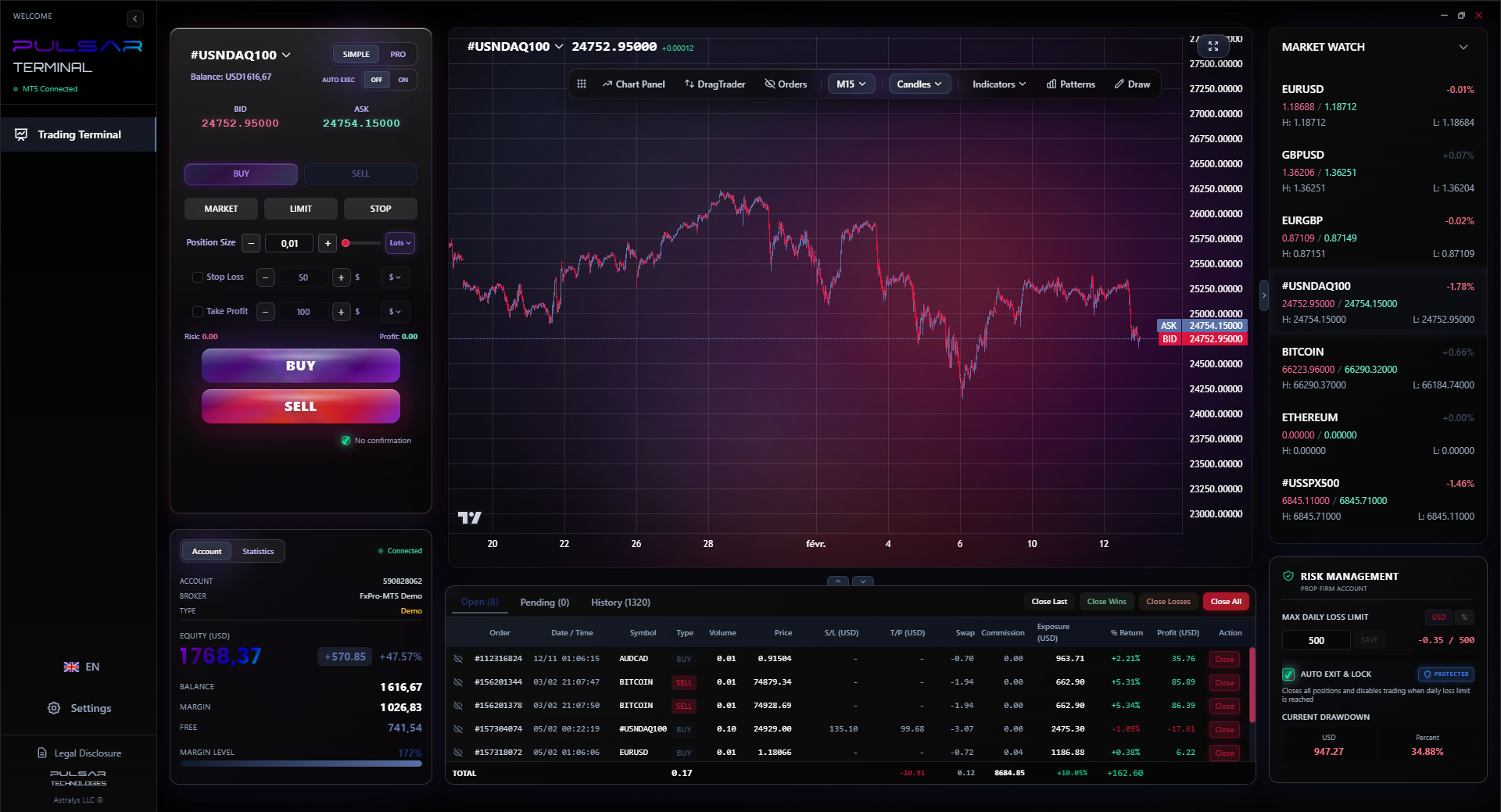
Developing the precise, disciplined execution needed to be profitable—whether after a course or through self-study—is where a tool like Pulsar Terminal for MT5 makes the difference, automating your risk rules so your psychology can't interfere.
Pulsar Terminal
MT5 올인원 도구: 드래그앤드롭 주문, 다중 TP/SL, 트레일링 스톱, 그리드 트레이딩, 볼륨 프로파일, 프롭펌 보호. 매일 1,000명 이상의 트레이더가 사용.
FAQ
Q1What is the exact fee for the UNISA forex trading course in 2025?
The total fee for UNISA's 'Course in Share and Forex Trading' (code 76988) is R6,000. This is for the full course, which consists of three modules priced at R2,000 each. This is the fee listed on their official programmes page, though it's always wise to confirm directly with UNISA before registering as fees can change.
Q2Does the UNISA course teach you how to make money trading?
No, not directly. It teaches you the principles, practices, and theory of share and forex trading. Think of it as learning the rules of chess and basic strategies. It won't teach you the high-pressure psychology needed to execute trades in real-time, manage a live portfolio, or handle the emotional stress of losses - which are the actual skills that determine profitability.
Q3Can I get a job with a UNISA forex trading certificate?
It might help as a supplementary qualification for entry-level roles in financial services or as a sign of interest to an employer. However, it is not a professional trading license or a guaranteed path to a job as a trader. For prop firms or banks, they care far more about your proven track record (a profit/loss statement) or strong academic degrees in finance/mathematics.
Q4Is it better to use the course fee money to start trading instead?
For many people, yes. If your end goal is to trade your own capital, practical experience is irreplaceable. Using R5,000 as starter capital (with very strict risk management) and R1,000 for key books and a trading journal subscription will teach you the real-world lessons of spreads, slippage, and your own psychology that a theoretical course cannot.
Q5What are the admission requirements for the UNISA course?
You need a National Senior Certificate (Matric) or an equivalent qualification at NQF level 4. The course is a Short Learning Programme, so it doesn't have the same requirements as a full degree but does require this basic educational foundation.
Q6How long is the UNISA forex trading course?
The course is designed to be completed in 6 months. It's offered online, and all study materials are downloaded - they don't send physical books. Registration typically opens in January and June each year.
Q7Will the course help me pass a prop firm challenge?
Very unlikely. Prop firm challenges test strict, real-time risk management and consistency under rules (like maximum daily loss). The UNISA course provides background knowledge, not the specific, automated discipline needed to pass a challenge. You'd need dedicated practice on a demo account replicating the challenge's rules, likely aided by precise trading tools.
윈스턴 교수의 수업
핵심 요약:
- ✓A R6,000 course fee is a 12% drawdown on a R50,000 account goal.
- ✓Broker spreads on ZAR pairs can be 5+ pips, a huge hidden cost.
- ✓Demo trading for 1 month reveals more discipline than any theory exam.
- ✓Real skill is built in 1000+ hours of screen time, not 6 months of modules.
이 기사가 얼마나 유용했나요?
별을 클릭하여 평가
주간 트레이딩 인사이트
무료 주간 분석 & 전략. 스팸 없음.
저자 소개
David van der Merwe
신흥시장 트레이더
요하네스버그 기반 트레이더로 신흥시장 통화 11년 경력. ZAR 통화쌍, FSCA 규제 거래, 남아공 시장 분석 전문.
댓글
위험 고지
금융 상품 거래에는 상당한 위험이 수반되며 모든 투자자에게 적합하지 않을 수 있습니다. 과거 성과가 미래 수익을 보장하지 않습니다. 이 콘텐츠는 교육 목적으로만 제공되며 투자 조언으로 간주되어서는 안 됩니다. 거래 전에 항상 직접 조사를 수행하십시오.
이 기사도 읽어보세요

Cara Trading Forex Sukses: 7 Prinsip dari Trader Profesional
Cara trading forex sukses dengan 7 prinsip trader pro: manajemen modal, disiplin, journal trading, backtest. Data nyata, bukan janji profit palsu.
Jam Trading Forex Terbaik untuk Trader Indonesia: Panduan Lengkap dengan Tabel Waktu
Panduan jam trading forex untuk trader Indonesia. Tabel 4 sesi dunia, jam emas 20:00-00:00, sesi mana yang harus dihindari. Data akurat + tips dari trader berpengalaman.
Top 5 Sàn Forex Uy Tín Nhất 2026: Review Jujur dari Trader Indonesia
Top 5 sàn forex uy tín 2026 untuk trader Indonesia. Review jujur: spread, deposit, withdraw, dukungan lokal. Exness, XM, IC Markets & lebih.
