


Most Nigerian traders think a forex broker is just an app where you click buy and sell.

Olumide Adeyemi
서아프리카 트레이딩 선구자 ·  Nigeria
☕ 11 분 소요
배울 내용:
- 1So, What Exactly Is a Forex Broker?
- 2How Does Your Broker Make Money? (Spoiler: It's Not Just Spread)
- 3The New Rules: Nigeria's Regulatory Shake-Up (ISA 2025)
- 4Choosing Your Broker: The 5-Point Nigerian Checklist
- 5Market Maker vs. ECN/STP: The Execution Game
- 6use & Margin: Your Best Tool and Quickest Ruin
- 7Getting Money In & Out: The Nigerian Reality
- 8Red Flags: How to Spot a Bad Broker
Most Nigerian traders think a forex broker is just an app where you click buy and sell. They're wrong, and that misunderstanding costs people real money. A broker is your gateway, your risk manager, and sometimes your biggest obstacle. I'll show you exactly what a forex broker is, how they make money from you, and how to choose one that won't leave you stranded when you need to withdraw your profits. This isn't theory; it's based on 12 years of trading here, from the wild west days to the new SEC rules.
Let's cut through the jargon. A forex broker is a company that gives you, the retail trader, a ticket to the global currency market. You can't just call up JP Morgan and ask to trade $1000. The big banks trade in multi-million dollar blocks in what's called the interbank market. A broker pools together orders from thousands of small traders like us, creating a large enough order to access those wholesale prices. They then pass on a slightly worse price to you - that's their spread - and provide the software (like MT4 or MT5) to place trades.
Think of it like a bus park. You want to get from Lagos to Abuja (trade EUR/USD). The broker owns the bus (the trading platform). They sell you a ticket (open a position) at a marked-up price (the spread). They handle the logistics of the journey (order execution) and drop you off at your destination (close the trade). Your profit or loss is the difference between your ticket price and the value when you arrive.

Warning: Never forget this: Your broker is not your friend. They are a for-profit intermediary. Their business model depends on you trading. Understanding this conflict of interest is your first lesson in self-preservation.
If you think your broker only makes money when you lose, you're only half right. They make money when you trade, period. Here’s how, with Nigerian specifics.
The Spread: The Obvious Cost
This is the difference between the buy (ask) and sell (bid) price. For EUR/USD, a typical spread might be 1.0-1.5 pips on a standard account. On a raw spread account like those offered by Exness, it can be as low as 0.1 pips, but they charge a separate commission. Let's do the math: If you trade one standard lot (100,000 units) on EUR/USD with a 1.5 pip spread, that's a $15 cost to open the trade, right off the bat. You're in the red by $15 before the market even moves.
Commission: The "Raw" Deal
ECN/RAW account models charge ultra-low spreads but add a commission per lot. This can be clearer but not always cheaper for small accounts. For example, a $3.50 per lot commission each way means a $7 round-trip cost on top of a tiny 0.1 pip spread.
Overnight Financing (Swap Rates)
This is huge for Nigerian traders who hold positions for more than a day. If you're buying a currency with a lower interest rate than the one you're selling, you pay a daily fee. If you're on the other side, you earn a tiny amount. These rates are set by the broker and can vary wildly. I once held a GBP/JPY sell position for two weeks, and the swap charges ate up 25% of my eventual profit. Always check the swap calculator before holding a trade over Wednesday night (when triple charges apply).
Inactivity Fees & Other Charges
Some brokers will charge you if your account sits dormant for 3-6 months. Others have hefty fees for certain withdrawal methods, especially if you're trying to move Naira back to your local bank. Always read the fee schedule.

Example: Let's say you deposit 100,000 NGN (approx. $65). You trade 0.1 lots on EUR/USD with a 1.5 pip spread. Your opening cost is $1.50. If you hold for 3 days and pay a -$0.50 swap, your total broker cost is $2.00. To break even, the market must move 2 pips in your favor just to cover broker fees. This is why a good position size calculator is non-negotiable.

💡 윈스턴의 팁
A broker is a utility, not a strategy. Don't get emotionally attached to a platform. Be ready to move if service degrades.
“Your broker is not your friend. They are a for-profit intermediary.”
This is the most critical update for every Nigerian trader right now. For years, we operated in a grey area. The SEC said forex trading was unregulated, so we flocked to international brokers. That game has officially changed.
The Investments and Securities Act (ISA) 2025 was signed into law in March 2025. In simple terms: It is now illegal for any company to offer online forex trading services in Nigeria without being formally registered with the SEC Nigeria. This is a approach shift (yes, I'll use that word here because it's true).
What does this mean for you?
- Local Broker Scrutiny: Any "local" broker must now be SEC-licensed. Ask for their license number. If they can't provide it, run.
- International Brokers Are Still in Play (For Now): You can still use brokers like IC Markets or XM that are regulated offshore (e.g., ASIC, FSCA). However, the law's long-term enforcement on foreign entities is unclear.
- Tax Clarity: The law reinforces what we knew: your trading profits are subject to a 10% Capital Gains Tax. Whether your broker is in Cyprus or Lagos, you're supposed to declare that income to FIRS.
The CBN is also active, issuing a new Foreign Exchange Code and rules for BDCs to curb speculation. The environment is becoming more structured, which is good for long-term legitimacy but may mean fewer "wild west" opportunities.
My advice? Stick with well-established international brokers who have a proven track record of serving Nigerian clients and processing Naira withdrawals smoothly. The regulatory safety net from abroad (like the FSCA in South Africa) is currently stronger than the nascent SEC framework here.
Don't just pick the broker with the flashiest ads on Instagram. Here’s what actually matters when you're trading from Lagos, Port Harcourt, or Abuja.
| Feature | What to Look For | Why It Matters in Nigeria |
|---|---|---|
| Regulation | Primary license from ASIC, FSCA, CySEC, or FCA. | This is your main protection against fraud. It ensures client fund segregation and a dispute resolution process. |
| Deposits/Withdrawals | Local bank transfer (NGN), cards, and e-wallets like Paystack. Low or no fees for Naira transactions. | You need to get money in and out without losing 10% to hidden fees or terrible exchange rates. Brokers like HFM offering NGN accounts are a plus. |
| Spreads & Commissions | Competitive EUR/USD spreads (under 1.5 pips on standard accounts). Clear commission structure. | This is your direct trading cost. Every pip saved goes into your pocket. Check live spreads during Lagos market hours (1-6 PM WAT). |
| Trading Platform | Reliable MT4/MT5 support. Mobile app stability. | MT4 is the industry standard here. You need a platform that works when your light is on generator. A good scalping strategy depends on fast, reliable execution. |
| Customer Support | 24/5 support with a local phone number or WhatsApp. Quick response times. | When you have a margin call at 2 AM, you need help, not an automated email reply that comes 2 days later. |
A personal story: I started with a broker that had amazing spreads but only accepted international wire transfers. To withdraw $500, I paid $35 in wire fees, my bank charged another 5,000 NGN, and the CBN's exchange rate was a nightmare. I effectively lost 15% of my profit. I switched to a broker with local Naira deposits, and it was like a weight lifted.
“For a new trader, high use isn't a benefit; it's a trap disguised as opportunity.”
This is where the rubber meets the road. Your broker's execution model determines if you get a fair price.
Market Makers (Dealing Desk) These brokers often act as the counterparty to your trade. When you buy, they sell to you from their own inventory. This creates a potential conflict of interest, especially with old-school bucket shops. They may profit directly from your losses. They often offer fixed spreads, which can be wider but predictable. In volatile markets (like when CBN news hits), requotes or slippage can be common.
ECN/STP Brokers (No Dealing Desk) These brokers route your order directly to their liquidity providers (big banks and financial institutions). They make money from commissions and a small mark-up on the spread. You generally get variable spreads, which can be razor-thin during high liquidity but can widen dramatically during news events. This is typically the model for most reputable brokers like Pepperstone or IC Markets.
My experience? I used a market maker early on. I'd consistently get stopped out by a single pip before the market reversed perfectly. It felt rigged. When I moved to an ECN model, the difference in fill quality was night and day. The trades felt cleaner. For active strategies, especially scalping, ECN/STP is the only way to go.

Pro Tip: To test execution, open a demo account and trade during high-impact news like U.S. Non-Farm Payrolls. Watch for slippage, requotes, and platform freezes. If the demo chokes, the live account will be worse.
Brokers advertise massive use (1:500, 1:1000) as a benefit. For a new trader, it's a trap. Let's break it down with Naira.
use is a loan from your broker. It lets you control a large position with a small deposit. Margin is the collateral you put up for that loan.
Example: You have 50,000 NGN ($32) in your account. With 1:500 use, your broker lets you control a position worth 25,000,000 NGN ($16,000).
Sounds amazing, right? Here's the reality. If you trade just 0.1 lots (worth ~$10,000) on EUR/USD, a move of just 32 pips against you wipes out your entire 50,000 NGN account. At 1:500, you're playing with a live grenade.
I learned this the hard way in 2015. I deposited $200, used 1:400 use, and went all-in on a USD/CHF trade based on a "sure thing" tip. The Swiss National Bank removed the currency peg. The market moved 2,000 pips in seconds. I didn't just get a margin call; my account was blown to zero and showed a negative balance. I was lucky my broker had negative balance protection.
For Nigerian traders starting out, I beg you: ignore the maximum use. Start with 1:10 or 1:20. It forces you to think about position size and risk. A tool that lets you manage multiple take-profit and stop-loss levels precisely, like those in advanced trading terminals, becomes essential to surviving high use. You need a system to lock in profits and cut losses automatically, because at 1:500, you won't have time to think.
💡 윈스턴의 팁
Test withdrawal speed with a small amount before committing serious capital. It's the truest test of a broker's integrity.
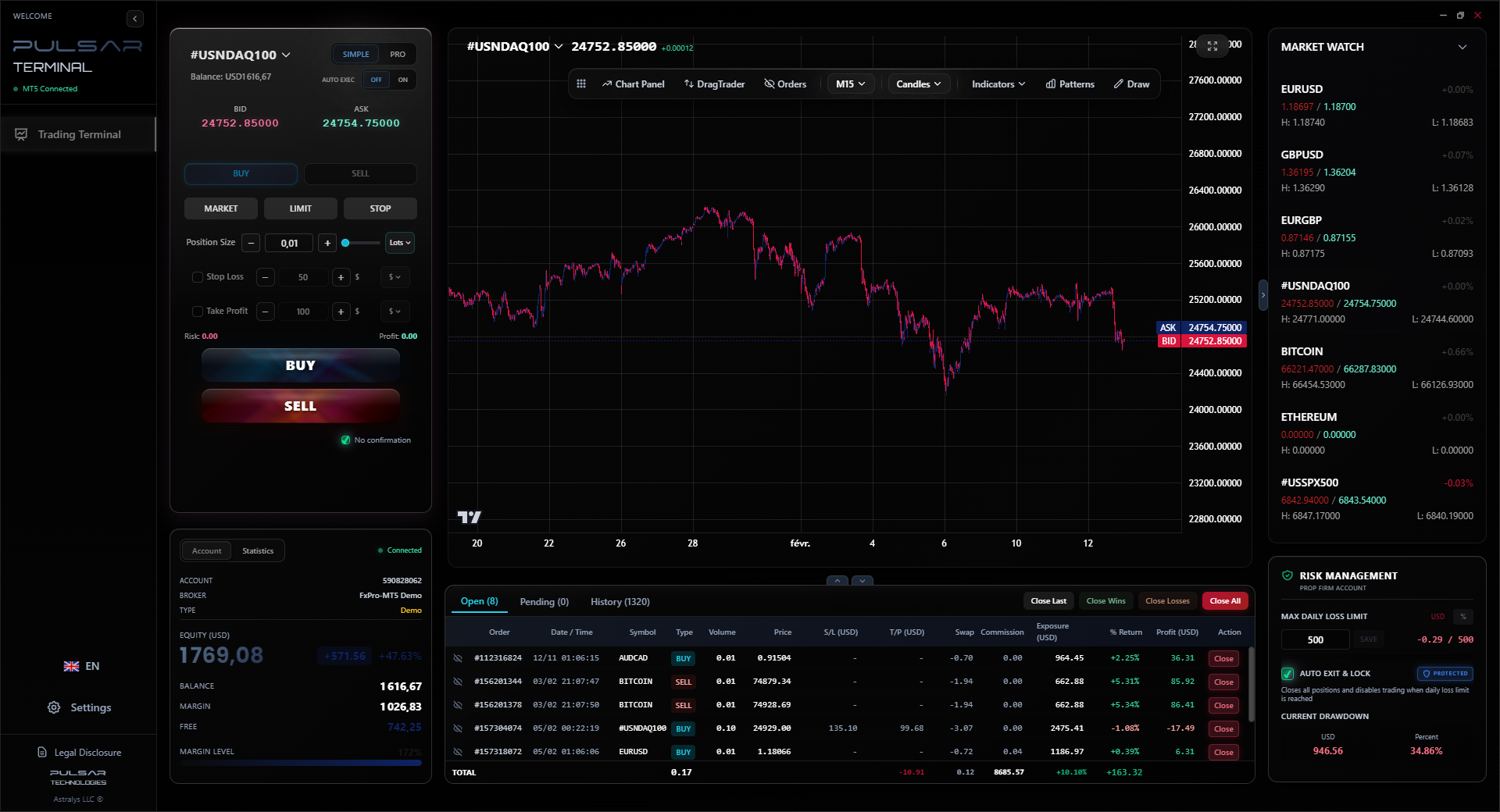
Managing the extreme risk of high leverage requires precision tools to set stop-losses, take-profits, and trailing stops automatically, which is exactly what Pulsar Terminal builds into MT5.
Pulsar Terminal
MT5 올인원 도구: 드래그앤드롭 주문, 다중 TP/SL, 트레일링 스톱, 그리드 트레이딩, 볼륨 프로파일, 프롭펌 보호. 매일 1,000명 이상의 트레이더가 사용.
“All the profits in the world mean nothing if you can't get them into your pocket.”
This is the most practical concern. All the profits in the world mean nothing if you can't get them into your pocket.
Deposits:
- Local Bank Transfer (NGN): The most common method. Brokers partner with local payment processors. Ensure the name on the account matches your trading account name exactly to avoid delays.
- Debit/Credit Cards: Visa/Mastercard deposits are usually instant. However, some Nigerian banks block international forex transactions. You may need to call your bank to pre-approve the payment.
- E-wallets: Skrill, Neteller, and local solutions like Paystack are fast. Check both the broker's fee and the e-wallet's conversion fee from Naira.
Withdrawals: This is where brokers are truly tested. A good broker processes withdrawals in 24 hours. A bad one takes weeks and invokes "compliance checks."
- Withdrawal to Naira Account: This usually involves the broker converting your USD balance to Naira at their rate (which is often worse than the official CBN rate). You'll receive Naira.
- Withdrawal to Domiciliary Account: If you have a USD account, you can request a USD wire. This avoids conversion fees but incurs international wire fees ($25-$50).
My rule: Before you deposit a large amount, test the withdrawal process with a small profit. If you make 10,000 NGN, try to withdraw 5,000 of it. If it arrives smoothly and within the promised timeframe, you have more confidence in the broker.
After over a decade, I've seen all the tricks. Here are instant deal-breakers.
- Guaranteed Profits: Any broker or "account manager" who guarantees weekly profits is running a scam. Period.
- Unregulated or Offshore "Licenses": A license from a tiny island with no financial oversight is a red flag. Look for reputable jurisdictions.
- Difficulty Withdrawing: The first sign of a scam broker is making withdrawals painfully difficult. Endless KYC requests, unexplained fees, or just ignoring your requests.
- Platform Manipulation: Constant requotes, unexplained slippage only against you, and the platform freezing during major news events.
- High-Pressure Deposits: Being pressured to deposit more to "unlock bonuses" or "meet withdrawal requirements."
- No Nigerian Payment Options: If they only accept international wire transfers and Bitcoin, they are not set up to serve the Nigerian market responsibly.
If you see one of these, walk away. There are plenty of legitimate, well-regulated brokers hungry for your business. You don't need to gamble with a shady one.
FAQ
Q1Is forex trading legal in Nigeria?
Yes, forex trading is legal for individuals. However, the new Investments and Securities Act (ISA) 2025 requires any company offering forex trading services within Nigeria to be registered with the SEC Nigeria. Nigerians can still use internationally regulated brokers.
Q2What is the minimum amount to start forex trading in Nigeria?
Technically, some brokers allow you to start with as little as $1 or 4,000 NGN. Realistically, I advise starting with at least 50,000-100,000 NGN. This allows for proper position size management and can withstand normal market volatility without being wiped out by a single trade.
Q3Do I pay tax on forex trading profits in Nigeria?
Yes. Profits from forex trading are considered capital gains and are subject to a 10% tax. You are responsible for declaring this income to the Federal Inland Revenue Service (FIRS), regardless of whether your broker is local or international.
Q4What is the best trading platform for beginners in Nigeria?
MetaTrader 4 (MT4) is the most common and beginner-friendly. It's widely supported by brokers, has a simple interface, and there's a massive community and library of educational resources (like guides on the RSI indicator) tailored to it. Most Nigerian traders start on MT4.
Q5Can I use a foreign forex broker as a Nigerian?
Yes, and most serious traders do. Look for brokers regulated by authorities like the FSCA (South Africa), ASIC (Australia), or CySEC (Cyprus) that explicitly accept Nigerian clients and offer local Naira payment methods. Check reviews like our Exness review for specifics.
Q6What is a pip in forex trading?
A pip is the smallest price move a currency pair can make, usually the fourth decimal place (0.0001). For JPY pairs, it's the second decimal (0.01). It's how you measure profit and loss. If EUR/USD moves from 1.0850 to 1.0855, it moved 5 pips. Learn more in our detailed pip definition guide.
Q7What's more important, low spreads or good regulation?
Good regulation, 100%. A broker with slightly higher spreads but strong regulation (like FSCA) protects your deposit. A broker with zero spreads but no regulation can disappear with your money tomorrow. Safety first, then optimize costs.
윈스턴 교수의 수업
핵심 요약:
- ✓A broker is your market access point, not a partner.
- ✓ISA 2025 mandates SEC registration for local forex services.
- ✓Prioritize regulation (FSCA, ASIC) over flashy use ads.
- ✓Test withdrawals before large deposits.
- ✓Use use below 1:20 when starting out.
이 기사가 얼마나 유용했나요?
별을 클릭하여 평가
주간 트레이딩 인사이트
무료 주간 분석 & 전략. 스팸 없음.
저자 소개
Olumide Adeyemi
서아프리카 트레이딩 선구자
나이지리아에서 가장 활발한 외환 트레이딩 교육자 중 한 명. 라고스에서 8년간 트레이딩 경험. 아프리카 트레이더를 위한 소자본 전략과 프롭 펌 챌린지 전문.
댓글
위험 고지
금융 상품 거래에는 상당한 위험이 수반되며 모든 투자자에게 적합하지 않을 수 있습니다. 과거 성과가 미래 수익을 보장하지 않습니다. 이 콘텐츠는 교육 목적으로만 제공되며 투자 조언으로 간주되어서는 안 됩니다. 거래 전에 항상 직접 조사를 수행하십시오.
이 기사도 읽어보세요

Cara Trading Forex Sukses: 7 Prinsip dari Trader Profesional
Cara trading forex sukses dengan 7 prinsip trader pro: manajemen modal, disiplin, journal trading, backtest. Data nyata, bukan janji profit palsu.
Jam Trading Forex Terbaik untuk Trader Indonesia: Panduan Lengkap dengan Tabel Waktu
Panduan jam trading forex untuk trader Indonesia. Tabel 4 sesi dunia, jam emas 20:00-00:00, sesi mana yang harus dihindari. Data akurat + tips dari trader berpengalaman.
Top 5 Sàn Forex Uy Tín Nhất 2026: Review Jujur dari Trader Indonesia
Top 5 sàn forex uy tín 2026 untuk trader Indonesia. Review jujur: spread, deposit, withdraw, dukungan lokal. Exness, XM, IC Markets & lebih.
