


Here's a hard truth most new traders in Lagos or Abuja don't want to hear: you can be right about the market direction and still lose money.

Olumide Adeyemi
서아프리카 트레이딩 선구자 ·  Nigeria
☕ 9 분 소요
배울 내용:
- 1The Break-Even Point: It's Not Your Entry Price
- 2Calculating Your Real Costs in Naira
- 3The Break-Even Strategy: Moving Your Stop to Safety
- 4Mistakes I See Nigerian Traders Make (I Made Them Too)
- 5Beyond Manual: Automating Your Break-Even Moves
- 6The FIRS and Your Break-Even Trades
- 7Your Action Plan: From Concept to Practice
Here's a hard truth most new traders in Lagos or Abuja don't want to hear: you can be right about the market direction and still lose money. It happens all the time. The culprit? Transaction costs. Understanding what break even in forex really means - and how to use it as a strategy - is the difference between a hobbyist and a professional. It's not just a math problem; it's your first line of defence for your capital.
Let's clear this up right away. Your break-even price is NOT the price you entered the trade. I made this mistake for months when I started, wondering why my trades showed a tiny loss even when the price ticked back to my entry. That loss was the spread and commission eating away at my position before it even had a chance to breathe.
In simple terms, the break-even point is the exact price where your trade's profit equals all the costs you paid to open and hold it. At that price, your net P&L is zero. You walk away with exactly what you started with, minus the broker's cut. For a buy trade, the break-even is always a bit above your entry. For a sell, it's always a bit below.

Example: You buy GBP/NGN at 1,850.00 with a Exness Standard account. The spread is 50 pips (that's 5.0 kobo on this pair). Your break-even price isn't 1,850.00. It's 1,850.50. The market needs to move 50 pips in your favour just for you to be back at zero. This is why understanding your broker's fee structure is non-negotiable. You can check our detailed Exness review for a breakdown of their typical spreads.

💡 윈스턴의 팁
Your first profit target on any trade should always be your break-even price. Hit that, and the psychology of the trade changes completely.
This is where theory meets your wallet. You need to know your numbers cold. The main costs for a Nigerian trader are the spread, any commission, and swap fees if you hold overnight.
The Spread: Your Silent Partner
This is the difference between the buy (ask) and sell (bid) price. It's how many market makers and brokers make their money. On major pairs like EUR/USD with a good international broker, this can be as low as 0.1 pips on a Raw/ECN account. On exotic pairs involving the Naira or on a standard account, it can be 50 pips or more. That's a huge hurdle to overcome before you even think about profit.
Commissions and Swaps
Some accounts, like the Raw/ECN models from brokers like IC Markets or Pepperstone, charge a small commission per lot but offer razor-thin spreads. You must add this to your calculation. Swap fees (or rollover) are interest charges for holding a position past 5 PM EST. They can be positive or negative depending on the currency pair's interest rate differential.
Here’s a quick comparison of how costs stack up on a 1-lot (100,000 units) trade:
| Cost Type | Standard Account (e.g., EUR/USD) | ECN/Raw Account (e.g., EUR/USD) |
|---|---|---|
| Spread | 1.2 pips = $12 | 0.1 pips = $1 |
| Commission | $0 | $7 round turn |
| Total Cost | $12 | $8 |
See that? The "tighter spread" account isn't always cheaper unless you're trading huge sizes. You need to run your own numbers based on your typical position size calculator.

Warning: Never trust a broker's "typical spread" table at face value. Check the live spreads on the platform during your most active trading hours (often London/NYC overlap). I've seen spreads on USD/NGN pairs widen from 100 pips to over 500 pips during local market news. That kind of slippage can blow past your stop-loss and turn a break-even trade into a nasty loss.
“The break-even point is your first target on every trade, not your entry price.”
Now for the powerful part. Knowing what break even in forex is allows you to use it as an active strategy, not just a concept. This is one of the first professional habits I adopted, and it saved my account more times than I can count.
The strategy is simple: once your trade has moved a predetermined amount in your favour, you manually move your initial stop-loss order to your calculated break-even price. This locks out the possibility of a loss on that trade. The market has given you a gift (favorable movement), and you're using it to remove your initial risk.
Here's a real trade I took last month on XAU/USD (Gold):
- Entry: $2,325.00 (Buy)
- Initial Stop-Loss: $2,310.00 (150 pips risk = $1,500 on 1 lot)
- Target: $2,360.00
- My rule: Move stop to break-even after a 100-pip move in my favour.
- Price rises to $2,335.00. I moved my stop from $2,310.00 to my break-even price of $2,325.80 (entry + spread).
- The price then reversed all the way down to $2,315.00. Instead of taking a $1,000 loss, my trade closed at break-even for a $0 net result. It felt like a win. I kept my capital to fight another day. You can learn more about trading this asset in our XAU/USD guide.
This technique is the bedrock of many swing trading approaches. It turns risky propositions into "risk-free" trades, allowing you to let winners run without sweating a reversal.
We have a unique environment here with currency controls and sometimes unstable internet. These factors twist common break-even mistakes into account killers.
1. Ignoring Swap Fees on Long-Term Holds: We love to hold positions, hoping for a big move. If you're trading a pair like GBP/NGN and holding for weeks, the daily swap fee can be significant. I once held a USD/JPY sell position for three weeks. I was up 40 pips, moved to break-even, and congratulated myself. When the trade closed, I was down $25. The negative swap fees had accumulated and weren't factored into my simple "entry + spread" calculation. My break-even math was wrong.
2. Moving the Stop Too Early: This is a classic error of over-eagerness. You see a 10-pip profit and slam your stop to break-even. The market then does its normal retracement, kicks you out, and rockets to your original target. Patience is key. Your trigger to move to break-even should be based on market structure (like a key support turning to resistance), not just an arbitrary pip count, though a pip minimum is a good safety net. Using the RSI indicator to gauge overbought/oversold conditions can help you time this better.
3. Not Accounting for the Spread on the Exit: Remember, if your break-even is 1.0850 and the current bid price hits 1.0850, you still might not close at zero. You need the ASK price (if you're long) to hit 1.0850. This subtle difference, especially in fast markets, can mean you still take a small loss. This is critical for scalping strategy where profits are measured in a few pips.
💡 윈스턴의 팁
If you find yourself constantly getting stopped out at break-even, your entry timing is likely the problem, not your risk management. Work on your entries.
“Moving your stop to break-even turns a risky bet into a free lottery ticket with unlimited upside.”
Manually moving stops is fine, but it's emotional and you can miss the moment. The real pros automate this process. Many advanced trading platforms and tools allow you to set a "breakeven" order automatically once a trade is in profit by X pips.
This is a game-saver. It removes hesitation and ensures discipline. For example, you can set a rule: "When trade profit reaches 20 pips, move stop-loss to entry + 1 pip." The software does the rest. This is especially useful for Nigerian traders who might face power or internet disruptions. You set your rules when you're calm, and they execute even if you're offline.
This kind of automation is also vital for managing the intense pressure of prop firm challenges, where a single losing day can disqualify you. Setting automatic break-even orders protects your daily loss limit without you having to stare at the screen.

Pro Tip: If your broker's platform doesn't have this feature natively, look into trading companion tools that plug into MT4/MT5. You can program these rules once and they'll apply to all your trades. It's the closest thing to having a robotic assistant managing your risk.
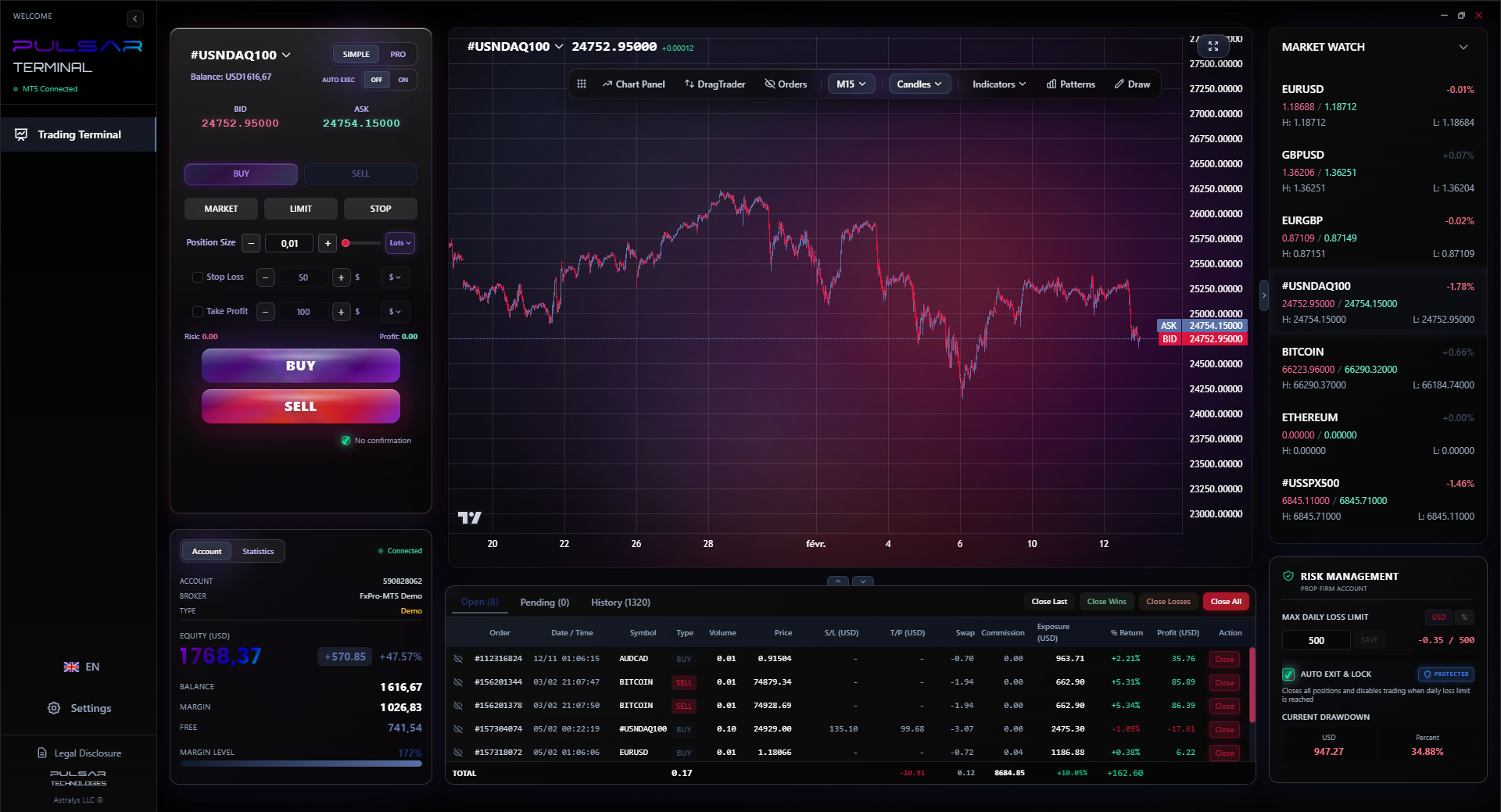
Manually moving stops to break-even is prone to error and emotion; Pulsar Terminal lets you set automatic breakeven rules that execute flawlessly on your MT5, even during a Lagos power cut.
Pulsar Terminal
MT5 올인원 도구: 드래그앤드롭 주문, 다중 TP/SL, 트레일링 스톱, 그리드 트레이딩, 볼륨 프로파일, 프롭펌 보호. 매일 1,000명 이상의 트레이더가 사용.
Here's a practical Nigerian consideration. Let's say you close 10 trades in a month at a break-even. Your net profit is zero naira. Do you have anything to report to the Federal Inland Revenue Service (FIRS)?
The straightforward answer is no, you don't owe any 10% capital gains tax on a net zero profit. However, you should still keep careful records. Your broker statement will show each trade - some with small profits, some with small losses that net to zero. Having this documentation is crucial if you're ever asked to explain your trading activity.
Think of it this way: consistent break-even trading is a survival skill, not a tax strategy. Your goal is to let your few big winners pay the tax bill. I keep a simple spreadsheet: date, instrument, entry, exit, P&L in USD, and P&L converted to Naira at the CBN's official rate for that day. It makes annual calculations much less painful.
“In Nigeria, with power and internet issues, automating your break-even moves isn't a luxury, it's a necessity.”
Knowledge is useless without action. Here’s how to implement this today:
- Audit Your Last 20 Trades: Open your journal. For each losing trade, calculate how far the price moved in your favour before reversing. Could a break-even move have saved you? I did this and found over 40% of my losses could have been avoided.
- Define Your Rule: Decide on your trigger. I recommend a minimum of 1.5 times your initial risk. If you risk 50 pips, move to break-even after a 75-pip move. This gives the trade room to breathe. You can use the MACD indicator crossover as a confirmation signal for the move.
- Practice on a Demo: Set up 10 trades. Your only goal is to successfully move your stop to break-even on each one according to your rule. Don't focus on profit; focus on executing the risk-management habit.
- Calculate Your True Break-Even: Before you enter your next live trade, do the math. Entry + spread + commission. Write that number down. That's your first target.
Mastering what break even in forex means transforms your psychology. A trade moved to break-even is no longer a source of stress. It's a free lottery ticket with unlimited upside and zero downside. That's a powerful place to trade from.
💡 윈스턴의 팁
A trade at break-even is a 'free option.' The option to win is still open, but the option to lose is closed. That's a beautiful thing.
FAQ
Q1Is the break-even point the same for buy and sell trades?
No, it's the opposite. For a buy trade, break-even is Entry Price + Transaction Costs (spread, commission). For a sell trade, it's Entry Price - Transaction Costs. The market has to move in your favour just to cover the cost of opening the door.
Q2Do I still pay swap fees if I move my stop to break-even?
If you move your stop-loss to break-even and the trade is still open, yes, you continue to accrue daily swap fees until it closes. Your 'break-even' price only accounts for costs paid up to that point. A long-held break-even trade can actually become a small loss due to swap accumulation.
Q3As a Nigerian, should I use a local or international broker for better spreads?
For trading major and minor forex pairs (not Naira pairs), international brokers like IC Markets or Pepperstone typically offer far better spreads and regulation. For USD/NGN or GBP/NGN, you may have fewer options and wider spreads regardless. Always prioritize a broker's regulation, withdrawal reliability, and local bank transfer support. Check our XM review for an example of a broker popular in Nigeria.
Q4What's a good pip amount to target before moving to break-even?
There's no magic number, but a common rule is to aim for a move equal to 1.5x to 2x your initial risk (stop-loss distance). If your stop is 30 pips away, consider moving to break-even after a 45-60 pip profit. This ensures you're not stopped out by normal market noise.
Q5Can a break-even move trigger a margin call?
No. Moving your stop-loss to your entry price only locks in a zero-loss exit. It doesn't require additional margin. In fact, it protects you from a margin call by eliminating the risk of that particular trade losing more of your capital.
Q6How do I calculate break-even for a crypto trade?
The principle is identical: Entry Price + Costs. However, costs on crypto can be more complex, including higher spreads and often a fixed percentage commission (e.g., 0.1%). Always check your broker's fee schedule for the specific crypto pair.
윈스턴 교수의 수업
핵심 요약:
- ✓Break-even = Entry Price + Spread + Commission. Never forget the plus.
- ✓Aim to move stops to BE after a move of 1.5x your initial risk.
- ✓Swap fees can turn a 'break-even' trade into a loss over time.
- ✓Automate the process. Discipline should be programmed, not willed.
이 기사가 얼마나 유용했나요?
별을 클릭하여 평가
주간 트레이딩 인사이트
무료 주간 분석 & 전략. 스팸 없음.
저자 소개
Olumide Adeyemi
서아프리카 트레이딩 선구자
나이지리아에서 가장 활발한 외환 트레이딩 교육자 중 한 명. 라고스에서 8년간 트레이딩 경험. 아프리카 트레이더를 위한 소자본 전략과 프롭 펌 챌린지 전문.
댓글
위험 고지
금융 상품 거래에는 상당한 위험이 수반되며 모든 투자자에게 적합하지 않을 수 있습니다. 과거 성과가 미래 수익을 보장하지 않습니다. 이 콘텐츠는 교육 목적으로만 제공되며 투자 조언으로 간주되어서는 안 됩니다. 거래 전에 항상 직접 조사를 수행하십시오.
이 기사도 읽어보세요

Cara Trading Forex Sukses: 7 Prinsip dari Trader Profesional
Cara trading forex sukses dengan 7 prinsip trader pro: manajemen modal, disiplin, journal trading, backtest. Data nyata, bukan janji profit palsu.
Jam Trading Forex Terbaik untuk Trader Indonesia: Panduan Lengkap dengan Tabel Waktu
Panduan jam trading forex untuk trader Indonesia. Tabel 4 sesi dunia, jam emas 20:00-00:00, sesi mana yang harus dihindari. Data akurat + tips dari trader berpengalaman.
Top 5 Sàn Forex Uy Tín Nhất 2026: Review Jujur dari Trader Indonesia
Top 5 sàn forex uy tín 2026 untuk trader Indonesia. Review jujur: spread, deposit, withdraw, dukungan lokal. Exness, XM, IC Markets & lebih.
