


I watched my screen in Lagos, sweat beading on my forehead, as my free margin hit zero.

Olumide Adeyemi
서아프리카 트레이딩 선구자 ·  Nigeria
☕ 12 분 소요
배울 내용:
- 1Free Margin 101: Your Trading Oxygen
- 2The Nigerian Math: Equity, Used Margin & Free Margin
- 3Margin Level & The Dreaded Margin Call
- 4Why This Hits Harder for Nigerian Traders
- 5Practical Strategies to Manage Your Free Margin
- 6Brokers, Platforms & Tools for the Nigerian Trader
- 7Mistakes I Made (So You Don't Have To)
I watched my screen in Lagos, sweat beading on my forehead, as my free margin hit zero. I had three open positions on EUR/USD and GBP/JPY, thinking my equity of $1,200 was enough. I didn't understand that my used margin of $1,190 left me with only $10 of free margin. A tiny 8-pip move against me triggered an automatic margin call. Bro, my broker liquidated my biggest position at a $350 loss before I could even react. That painful, avoidable lesson is why you need to master free margin - it's not just a number, it's your account's breathing room.
Let's cut through the jargon. In simple terms, your free margin is the cash in your trading account that's actually available to use. It's the money not currently locked up as collateral for your open trades.
Think of it like this: you walk into a shop with ₦50,000 in your pocket. You see a jacket you like for ₦15,000. You give the shopkeeper the ₦15,000 as a deposit to hold it for you while you look around. That ₦15,000 is your used margin - it's tied up. The ₦35,000 still in your pocket? That's your free margin. You can use it to buy something else, or you keep it safe in case the jacket's price changes before you finally buy it.
In forex, brokers require that deposit (margin) to cover potential losses. Your free margin is what's left over. The formula is dead simple, but forgetting it is expensive:
Free Margin = Equity – Used Margin

If your free margin runs out, you get a margin call. Your broker will start closing your trades to bring your account back to a safe level. It's not a request; it's an automated seizure.

💡 윈스턴의 팁
Free margin isn't a trophy to be spent. It's a shield. The bigger the shield, the longer you survive in the battle. Never resent having 'too much' of it.
“Free margin is not just a number; it's your account's breathing room.”
Let's use Naira to make this real. Assume your broker allows 1:500 use (common here).
Step 1: Know Your Equity Equity is your live account value. It's your balance plus your running profit or loss.
- You deposit ₦200,000. Your Balance = ₦200,000.
- You open a trade. It goes well and is currently up ₦25,000.
- Your Equity = Balance + Floating Profit = ₦225,000.
If that trade was losing ₦25,000, your Equity would be ₦175,000. Equity changes with every tick of the market.
Step 2: Understand Used Margin This is the collateral held for your open positions. Let's say you buy 1 standard lot of USD/NGN (this is a simplified example; most trade major pairs like EUR/USD).
- 1 standard lot = 100,000 units.
- With 1:500 use, your required margin is (100,000 / 500) = 200 units of the base currency.
- If we translate that to a dollar-based pair for clarity: a 1 standard lot ($100,000) position at 1:500 use uses $200 as margin. At an exchange rate of say ₦1,500/$, that's roughly ₦300,000 in used margin.
See how quickly it adds up? That's why you must use a position size calculator. Guessing will blow up your account.
Step 3: Calculate Free Margin Back to our example. Equity = ₦225,000. Used Margin = ₦300,000. Free Margin = ₦225,000 - ₦300,000 = -₦75,000.
You have NEGATIVE free margin. This is a critical, red-alert situation. You are already in a margin call. Trades will be closed immediately.

Example: A Safer Scenario
- Account Balance: ₦500,000
- Floating Profit on open trades: ₦50,000
- Equity = ₦550,000
- Used Margin for all open trades: ₦150,000
- Free Margin = ₦550,000 - ₦150,000 = ₦400,000 This is healthy. You have ₦400k to withstand losses or open new positions.
“A falling margin level is a louder warning signal than a single trade in the red.”
This is where most new traders in Nigeria get wrecked. Your broker doesn't just look at free margin; they watch your Margin Level percentage.
Margin Level = (Equity / Used Margin) x 100%
This is your account's vital sign. Let's break down what the numbers mean:
| Margin Level | What It Means | What Happens |
|---|---|---|
| Above 100% | You're okay. Equity > Used Margin. | Business as usual. |
| At 100% | Equity = Used Margin. Free Margin is ZERO. | You're on the cliff's edge. Can't open new trades. |
| Below 100% | Equity < Used Margin. Free Margin is NEGATIVE. | Margin Call Territory. |
| At Stop-Out Level | Hits broker's limit (often 50% or 20%). | Forced liquidation. Trades closed automatically. |
The Stop-Out
This is the knockout punch. When your margin level falls to a pre-set percentage (like 50%), the broker's system starts forcibly closing your trades, starting with the biggest loser, until your margin level recovers above the threshold. You have no say. It's over.
I learned this trading XAU/USD (gold). My margin level was at 105%. I thought I had time. A sharp, volatile spike against my position took it to 98%, then 80%, then 60% in minutes. Before I could manually intervene, the stop-out at 50% triggered. My position was closed at the worst possible price in the volatility. I went from "managing a drawdown" to "staring at a realized loss" in seconds. That's the power of ignoring margin level.

Pro Tip: Your trading platform shows margin level in real-time. Make a rule: if your margin level ever drops below 150%, you review ALL open positions immediately. Don't wait for 100%.
“A falling margin level is a louder warning signal than a single trade in the red.”
Our market has unique pressures that make managing free margin non-negotiable.
1. Extreme use Offers: To attract clients, many brokers offer insane use like 1:1000 or 1:2000. It's a double-edged sword. Yes, you can control a $10,000 position with just $10 (₦~15,000). But that also means a 10-pip move against you can wipe out that $10. Your used margin is tiny, but your risk is enormous. This creates an illusion of safety that evaporates your free margin instantly.
2. The Naira Volatility & Tax: Remember, you're taxed 10% on your gross profits. A trade that nets you ₦100,000 profit actually nets you ₦90,000. You must factor this into your risk math. If your free margin is too tight, a winning trade might not give you enough buffer for the next one after taxes. Also, funding your account can be a hassle with CBN restrictions on international card spending. You can't always just top up your account instantly when free margin gets low. You have to plan ahead.
3. Regulatory Shift & Your Broker: The new ISA 2025 Act means the SEC is now watching. While aimed at cleaning up scams, it underscores the need to use reputable, well-capitalized brokers. A shady broker might have aggressive stop-out policies or platform "glitches" during high volatility that liquidate you prematurely. I stick with brokers known for strong execution like IC Markets or Pepperstone, especially for scalping strategies where every pip matters.
4. Mental Pressure: When your free margin is low, you trade scared. You'll close winning trades too early (fearing a reversal) and let losing trades run (hoping for a miracle). This is the exact opposite of good trading psychology. Keeping ample free margin (I aim for never using more than 5-10% of equity as margin on any single trade) lets you think clearly.
💡 윈스턴의 팁
If you find yourself constantly watching your margin level instead of your trade thesis, your position size is wrong. Full stop. Scale down.
“High use offered in Nigeria isn't free money - it's a risk accelerator that can evaporate your free margin in seconds.”
Theory is fine, but what do you actually DO? Here’s my battle-tested routine.
1. The Pre-Trade Check (Non-Negotiable): Before clicking ‘Buy’ or ‘Sell’, I look at three numbers:
- Current Free Margin: Let's say it's ₦400,000.
- Potential Used Margin for this new trade: My platform shows this. Let's say it's ₦80,000.
- Worst-Case Scenario Loss: My stop-loss is 30 pips away. With my position size, that's a ₦60,000 loss.
I ask: If this new trade hits its stop-loss, will my free margin (₦400k - ₦60k = ₦340k) still be healthy? Will my overall margin level stay above 200%? If yes, I proceed. If no, I reduce my position size. Every single time.
2. Use Stop-Losses Religiously: A stop-loss isn't just a risk tool; it's a free margin preservation tool. It defines the maximum amount of equity that can turn into used margin for a losing trade. Without it, a trade can go infinitely against you, consuming every last bit of free margin until you're stopped out. Setting a stop-loss tells you exactly what your maximum used margin for that trade will be.
3. Monitor Margin Level, Not Just P&L: I keep my trading platform's ‘Terminal’ window open, showing the ‘Margin Level’ column. I care more about this number trending down than I do about a single trade being in a temporary loss. A falling margin level across several trades is a systemic risk warning.
4. The Withdrawal Rule: When I have a big win that significantly boosts my equity and free margin, I withdraw the profit. This does two things: it banks my gains (remember the 10% tax, set that aside too), and it resets my account size. Trading a bloated account because of one win leads to overconfidence and sloppy margin management. Take money off the table.
5. Understand Correlation: Opening three trades all based on a strong US dollar view (e.g., long USD/JPY, short EUR/USD, short GBP/USD) is dangerous. If you're wrong, all three will lose simultaneously, multiplying the drain on your free margin. Diversify your ideas, or be aware that correlated positions act as one giant trade for margin purposes.
“High use offered in Nigeria isn't free money - it's a risk accelerator that can evaporate your free margin in seconds.”
Your choice of broker and tools directly impacts your ability to manage margin.
Broker Selection is Critical: You need a broker that provides clear, real-time margin information and reliable execution. Look for:
- Clear Display: MT4/MT5 show free margin and margin level prominently.
- Reasonable Stop-Out Levels: 50% is common; 20% is very aggressive. Know your broker's policy.
- Local Payment Options: Brokers like HFM that offer Naira accounts and local bank transfers make managing your account balance (and thus your free margin) easier. No more worrying about your Zenith card declining a $100 top-up.
The Power of MT4/MT5: The MetaTrader platform is standard here for a reason. The ‘Terminal’ window (usually Ctrl+T) is your margin command center. It shows all the key numbers: Balance, Equity, Margin, Free Margin, Margin Level. Make it a habit to glance at it.
Beyond the Basics – Advanced Tools: As you grow, manual monitoring isn't enough. This is where companion tools for MT5 become useful. Imagine a tool that could automatically move your stop-loss to breakeven when a trade is in profit by a certain amount, or trail your stop to lock in gains. This protects your equity (and thus your free margin) automatically. Or, a tool that lets you set a hard daily loss limit - a lifesaver for prop firm challenges where a single bad day can fail you. Managing multiple take-profit levels on a single trade from one ticket also helps you secure profit in chunks, steadily freeing up margin.
Pro Tip: Never, ever rely on your broker's web platform or mobile app alone for serious margin monitoring. Use the desktop MT4/MT5 platform. The data is faster and more complete. A laggy app showing outdated free margin is a recipe for a margin call surprise.
💡 윈스턴의 팁
The market doesn't care about your used margin. It will move however it wants. Your only job is to ensure your free margin can absorb its whims.
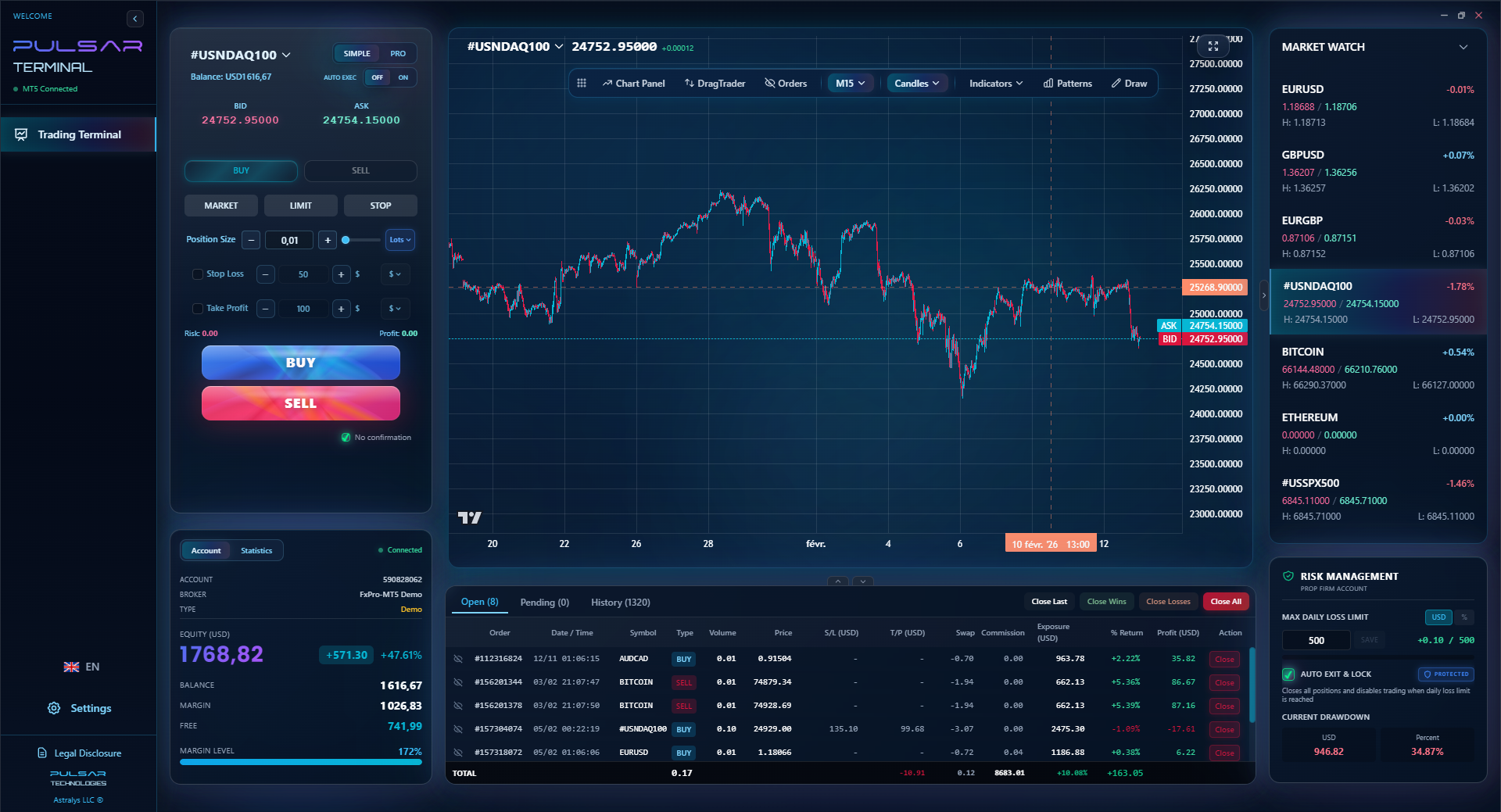
Manually trailing stops and setting breakeven points to protect your equity (and free margin) is tedious; Pulsar Terminal automates this directly on your MT5 chart, so you can manage risk without staring at the screen.
Pulsar Terminal
MT5 올인원 도구: 드래그앤드롭 주문, 다중 TP/SL, 트레일링 스톱, 그리드 트레이딩, 볼륨 프로파일, 프롭펌 보호. 매일 1,000명 이상의 트레이더가 사용.
“If your free margin is low, you trade scared. And scared money never wins.”
Let me be the cautionary tale.
Mistake 1: Adding to a Losing Trade (Averaging Down). My USD/CAD trade was 50 pips down. My analysis was ‘still sound’, so I doubled my position size to lower my average entry. My used margin doubled. My free margin halved. The trade kept going against me. Instead of a ₦40,000 loss, I took a ₦120,000 loss because the doubled position drained my free margin and triggered a wider stop-out. Averaging down is a margin killer unless you have a massive account.
Mistake 2: Ignoring Overnight/Weekend Margins. Some brokers increase margin requirements (lower use) for positions held over the weekend or during volatile news events. I once entered a trade Friday evening with a comfortable 150% margin level. Come Monday morning, the broker's higher weekend margin requirements were still in effect briefly. My margin level was now at 90% at the open, and a gap against me immediately triggered a margin call. I got liquidated before the market even properly opened. Always check your broker's policy on weekend margins.
Mistake 3: Confusing Free Margin with ‘Money I Can Withdraw’. Free margin is available to trade, not necessarily to withdraw if you have open positions. Your withdrawable balance is usually your ‘Balance’ minus the used margin for open trades. I once tried to withdraw a chunk of my free margin while I had a large, profitable position open. The withdrawal was rejected because it would have pushed my account into a margin call. Plan your withdrawals when you're flat (no open trades).
Mistake 4: Over-relying on High use. Just because you can use 1:1000 doesn't mean you should. I used to think it was free money. It's not. It's a risk accelerator. Now, even on a broker that offers it, I manually set my account use to 1:100 or 1:50 in the settings. It forces me to trade with more realistic position sizes relative to my capital, which keeps my free margin strong and my sanity intact.
FAQ
Q1What is a good free margin level for a beginner in Nigeria?
Aim to keep your free margin above 500% of your used margin when starting. If you have ₦100,000 used, try to have over ₦500,000 in free margin. This gives you a huge buffer against market swings and your own mistakes. It forces you to trade small, which is the best lesson a beginner can learn.
Q2How does the 10% capital gains tax affect my free margin?
The tax itself doesn't directly affect your live free margin calculation. However, you must mentally account for it. If you have a ₦1,000,000 profit target, you really need ₦1,111,111 in gross profits to have ₦1,000,000 after tax. If your trading plan is too tight, the tax can eat into the profits you were counting on to grow your equity and free margin. Always trade with post-tax numbers in mind.
Q3Can I increase my free margin without depositing more money?
Yes, in two ways: 1) Close some profitable trades. Realized profits increase your Balance and Equity, boosting free margin. 2) Close some losing trades. This reduces your Used Margin, which immediately increases your Free Margin. Sometimes, cutting a small loss is the best way to protect your remaining capital and free margin for better opportunities.
Q4My broker offers 1:2000 use. Should I use it all?
Absolutely not. That's like driving a Formula 1 car on the Lagos-Ibadan expressway during rush hour. The potential for a catastrophic crash is immense. High use magnifies the drain on your free margin. Use a fraction of it. Set your own sensible use limit (e.g., 1:50 or 1:100) by controlling your position size with a position size calculator.
Q5What is the difference between free margin and usable margin?
In most contexts, they are the same thing: the funds available to open new positions. However, some brokers might have a separate "usable margin" that's slightly lower than free margin, accounting for potential execution slippage or fees. Always check your specific broker's glossary. For practical purposes in Nigeria, consider them equal.
Q6Why did I get a margin call even though I had money in my account?
The 'money in your account' is your Balance or Equity. A margin call happens when your Equity falls too close to your Used Margin (i.e., your Margin Level hits 100% or your broker's call level). If that money is already being used as collateral (Used Margin), it's not available to cover further losses. Your free margin was zero or negative. The cash existed, but it was already spoken for.
Q7Are there Nigerian brokers that help manage margin better?
While there are local fintech platforms, most serious Nigerian traders use international brokers that accept NGN deposits and offer MT4/MT5. The 'help' comes from the platform tools, not the broker's nationality. Look for brokers with clear dashboards, negative balance protection, and the ability to easily set stop-losses. Brokers like XM and HFM are popular here precisely because their platforms make these key numbers visible.
윈스턴 교수의 수업
핵심 요약:
- ✓Free Margin = Equity - Used Margin. Memorize it.
- ✓Keep Margin Level above 150% at all times.
- ✓High use (1:1000) requires microscopic position sizes.
- ✓Factor in Nigeria's 10% capital gains tax on all profits.
- ✓Use stop-losses to define your maximum used margin risk.
이 기사가 얼마나 유용했나요?
별을 클릭하여 평가
주간 트레이딩 인사이트
무료 주간 분석 & 전략. 스팸 없음.
저자 소개
Olumide Adeyemi
서아프리카 트레이딩 선구자
나이지리아에서 가장 활발한 외환 트레이딩 교육자 중 한 명. 라고스에서 8년간 트레이딩 경험. 아프리카 트레이더를 위한 소자본 전략과 프롭 펌 챌린지 전문.
댓글
위험 고지
금융 상품 거래에는 상당한 위험이 수반되며 모든 투자자에게 적합하지 않을 수 있습니다. 과거 성과가 미래 수익을 보장하지 않습니다. 이 콘텐츠는 교육 목적으로만 제공되며 투자 조언으로 간주되어서는 안 됩니다. 거래 전에 항상 직접 조사를 수행하십시오.
이 기사도 읽어보세요

Cara Trading Forex Sukses: 7 Prinsip dari Trader Profesional
Cara trading forex sukses dengan 7 prinsip trader pro: manajemen modal, disiplin, journal trading, backtest. Data nyata, bukan janji profit palsu.
Jam Trading Forex Terbaik untuk Trader Indonesia: Panduan Lengkap dengan Tabel Waktu
Panduan jam trading forex untuk trader Indonesia. Tabel 4 sesi dunia, jam emas 20:00-00:00, sesi mana yang harus dihindari. Data akurat + tips dari trader berpengalaman.
Top 5 Sàn Forex Uy Tín Nhất 2026: Review Jujur dari Trader Indonesia
Top 5 sàn forex uy tín 2026 untuk trader Indonesia. Review jujur: spread, deposit, withdraw, dukungan lokal. Exness, XM, IC Markets & lebih.
