


I remember staring at my screen on a Friday afternoon, my finger hovering over the mouse.

David van der Merwe
신흥시장 트레이더 ·  South Africa
☕ 10 분 소요
배울 내용:
- 1NFP 101: What It Is & Why South African Traders Care
- 2The Critical Question: When is NFP in SAST?
- 3How NFP Actually Moves the Market (It's Not Just the Headline)
- 4Trading NFP from South Africa: A Realistic Strategy
- 5nfp-and-south-african-rand-zar-pairs
- 6Choosing a Broker & Platform for NFP Trading in SA
- 7Mistakes I've Made (So You Don't Have To)
- 8Advanced Tactics: From Watching to Actually Profiting
I remember staring at my screen on a Friday afternoon, my finger hovering over the mouse. EUR/USD was coiled tight, barely moving. The clock ticked over to 2:29 PM SAST. One minute to go. My heart was thumping like a vuvuzela at a soccer match. Then, the number hit: 467K jobs added, way above the 250K forecast. The chart exploded. In 90 seconds, price ripped through 50 pips, my stop-loss got obliterated by slippage, and I was down R1,200 before I could even blink. That was my first real NFP. It taught me that knowing when is NFP forex is just the start. You need to know how to handle the chaos, especially when you're trading from SA.
Alright, let's break this down. The Non-Farm Payrolls (NFP) report is the big one. It's released by the US Bureau of Labor Statistics on the first Friday of every month (barring holidays). It tells us how many people were added to US payrolls, excluding farm workers, government employees, and a few other categories.
Why should you, sitting in Johannesburg or Cape Town, care about American jobs? Simple: the US Dollar. The USD is the world's reserve currency. When NFP data is strong, it suggests a strong US economy. That often leads to bets that the Federal Reserve will raise interest rates to cool things down. Higher US rates attract global capital, strengthening the Dollar. A strong Dollar typically means a weaker South African Rand (ZAR). It's that direct. Pairs like USD/ZAR and EUR/ZAR can go absolutely wild.
Think of it as a monthly health check on the world's largest economy. The market's reaction sets the tone for risk sentiment for weeks. For a scalping strategy, it's pure adrenaline. For a swing trading approach, it can define your entire monthly trend. You can't afford to ignore it.
This is the core of it. Mark this in your calendar, set an alarm on your phone, do whatever you need to remember.
The report drops at 8:30 AM Eastern Standard Time (EST) in New York.
For us in South Africa, that usually means 2:30 PM South African Standard Time (SAST).
The Daylight Saving Catch
Here’s where new traders get caught out. The US observes daylight saving time (DST), but South Africa does not. When the US ‘springs forward’ in March, their clocks move an hour ahead. For that period (usually March to November), 8:30 AM EDT (Eastern Daylight Time) becomes 3:30 PM SAST.
I’ve missed this shift before. I logged in at 2:25 PM SAST in April, ready to go, only to find the market dead quiet. The report had already come out an hour earlier, and I’d missed the entire move. It was a rookie mistake that cost me a potential setup.

Warning: Always, and I mean always, double-check the release time on a reliable economic calendar the day before. Don't assume it's always 2:30 PM. The shift to 3:30 PM SAST catches everyone off guard at least once.
“The 30:1 use cap from the FSCA isn't a limitation for NFP trading; it's a lifesaver.”
You see the headline number flash on the screen: ‘NFP: 200K’. Your first instinct is to buy or sell the Dollar based on whether it beat or missed expectations. Hold on. It’s more nuanced than that.
The market reacts to a trifecta of data:
- The Headline Number: Jobs added vs. forecast (e.g., 200K actual vs. 180K forecast).
- The Unemployment Rate: Did it go up or down?
- Average Hourly Earnings: This is the inflation component. Are workers earning more? This is huge for the Fed.
These figures can tell conflicting stories. A high jobs number with weak wage growth might lead to a ‘buy the rumor, sell the fact’ scenario where the USD initially spikes then collapses. I got whipsawed on a trade like that in late 2023. NFP smashed expectations at 336K, but wage growth was soft. USD/ZAR shot up 150 pips, then gave it all back in the next hour. I was stopped out on both sides.
The initial move is often a liquidity grab - a violent spike in one direction that takes out all the clustered stop-loss orders. The real trend often establishes itself in the 15-60 minutes after the release, once the algos have finished their initial frenzy and humans start to digest the full report.

💡 윈스턴의 팁
The market's first move after NFP is often a false one, designed to trigger the most stop-loss orders. Patience in the first 10 minutes is a superpower.
Trying to predict the direction is a mug's game. I don't do it anymore. Instead, I use a volatility-based approach that respects the madness.
My Post-NFP Fade Strategy (The One That Works)
I wait for the initial explosion. After the first 2-3 minutes of pure chaos, I look for an extreme spike on the 5-minute chart. Let's say USD/ZAR rockets 200 pips higher. I'll then wait for a clear rejection candle (a long wick or a bearish engulfing pattern) to form at that high. That's my signal that the initial panic buying is exhausted.
I'll enter a short position, placing a stop-loss just above the spike's high. My profit target isn't a specific price; it's a move back towards the pre-news range or a key pre-news support level. This strategy banks on the market ‘fading’ the initial overreaction.
Managing the Obvious Risks
Your biggest enemies during NFP are slippage and spread widening. That nice 5-pip spread on USD/ZAR? It can balloon to 20 pips or more in a heartbeat. A market order can fill at a terrible price. A stop-loss can get triggered far from where you set it.
I never use tight stops right at the release. If my analysis says my stop should be 50 pips away, I'll place it at 70. That extra buffer has saved me from being taken out by meaningless noise more times than I can count. Always use a position size calculator and reduce your normal lot size by at least 50% for NFP trades. The volatility amplifies everything.

Pro Tip: Don't trade the actual release. Seriously. Consider it. Watch the first 15-30 minutes from the sidelines with a demo account. Chart the price action, note the highs and lows. Then, when the dust settles a bit, look for a cleaner technical entry. You miss the first explosive move, but you also avoid the landmines.
“I don't predict the NFP move anymore. I react to the market's overreaction.”
This is where it gets personal for us. NFP doesn't just move EUR/USD. It moves everything tied to the Dollar, and that includes our beloved (and sometimes hated) Rand.
USD/ZAR is the main event. A strong NFP typically means a stronger Dollar, which pushes USD/ZAR higher (meaning the Rand weakens). But remember, ZAR is a risk-sensitive, emerging market currency. If the NFP is so strong it sparks fears of aggressive US rate hikes that could hurt global growth, you might see a ‘risk-off’ move. In that case, everyone flees emerging markets, and USD/ZAR can go parabolic.
Cross pairs like EUR/ZAR and GBP/ZAR become incredibly volatile. You're now trading the reaction of two currencies to the US data. It's messy. I generally avoid these during the release and stick to the cleaner USD/ZAR or major Dollar pairs like EUR/USD.
A real example: In January 2024, a blockbuster NFP sent USD/ZAR from around R18.65 to R18.95 in under an hour. That’s a 300-pip move. If you had a long position of just 1 standard lot, that’s a R30,000 move in your P&L. The potential is massive, but so is the risk of a margin call if you're on the wrong side.
💡 윈스턴의 팁
If you must trade the release, use a pending order placed well away from the current price, not a market order. You'll avoid the worst of the slippage.
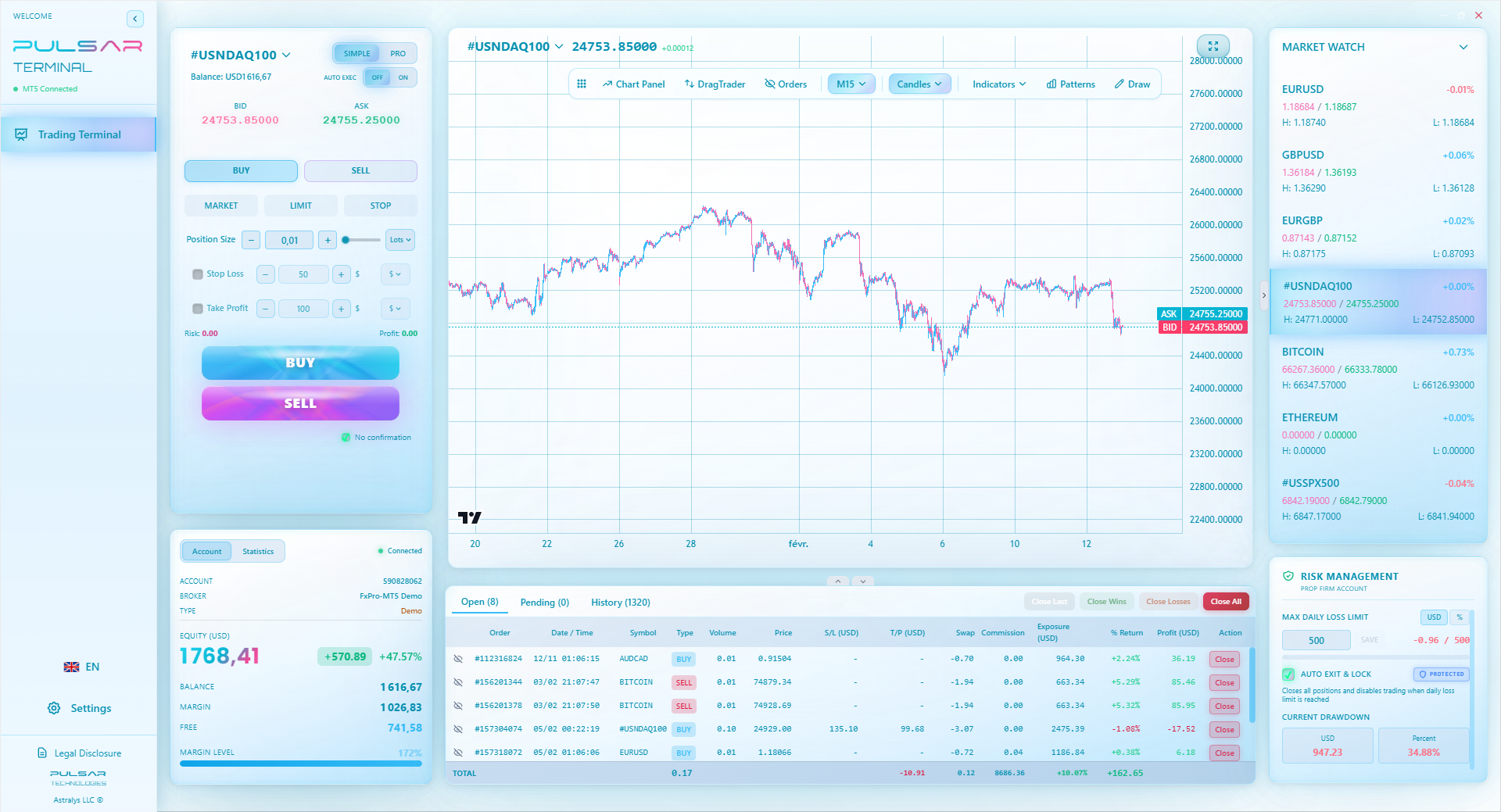
Managing multiple trades and complex orders in the NFP chaos is nearly impossible manually, which is where a tool like Pulsar Terminal's drag-and-drop order system and multi-TP/SL features on MT5 become essential.
Pulsar Terminal
MT5 올인원 도구: 드래그앤드롭 주문, 다중 TP/SL, 트레일링 스톱, 그리드 트레이딩, 볼륨 프로파일, 프롭펌 보호. 매일 1,000명 이상의 트레이더가 사용.
Not all brokers are created equal for high-volatility events. You need a broker that can handle the volume without freezing your platform or suffering from constant requotes.
Regulation is Key: Always prioritize brokers regulated by the Financial Sector Conduct Authority (FSCA). It’s your first layer of protection. They enforce rules like client fund segregation and the 30:1 use cap for retail traders. I’ve had good, reliable execution during news events with FSCA-licensed brokers. Some international brokers like IC Markets and Pepperstone also have solid reputations for fast execution and are popular with experienced South African traders.
Platform Stability: MetaTrader 4 or 5 is the standard, but they can lag during news. I’ve found that placing orders directly from a broker’s advanced web platform or using a dedicated trading terminal often provides faster execution. The ability to set advanced order types is crucial.

Example: Let's talk costs. On a normal day, a good broker might offer USD/ZAR with a 5-pip spread. During NFP, that can easily jump to 15-20 pips. If you're trading 1 lot (100,000 units), that 15-pip spread is an immediate R150 cost just to enter the trade. Factor this into your strategy.
“Your pre-NFP preparation is more important than your trade entry.”
Let me be brutally honest about my failures. It’s the best way to learn.
Mistake 1: Trading Too Big. My second NFP ever. I was confident. I tripled my usual position size on GBP/USD. The news was a miss, the Pound spiked, and I was in profit instantly. Then it reversed and hit my stop. The wider spread and slippage meant my loss was nearly double what I’d calculated. I broke my number one rule: preserve capital. I used a position size calculator religiously after that.
Mistake 2: Chasing the Move. You see price flying. FOMO kicks in. You hit the market buy button. That’s usually the exact top. I’ve been the ‘greater fool’ buying the top of the spike more than once. Now, if I miss the entry, I let it go. There’s always another trade next Friday.
Mistake 3: Ignoring the Full Report. I once took a short on USD/JPY because the headline NFP missed. I didn't notice that wage growth had come in super hot. The market focused on the inflation angle, the Dollar rallied, and my stop was hit. Always read the summary of all three components before making a decision.
💡 윈스턴의 팁
Your goal for your first five NFP events shouldn't be profit. It should be to watch, take notes, and not blow up your account. Observation is a profitable strategy.
Once you’ve survived a few NFPs, you can start getting more sophisticated.
Trading the Range Expansion: Before NFP, markets often consolidate in a very tight range. Use the ATR (Average True Range) indicator to see the normal daily range, then watch it explode post-news. The strategy is to wait for a decisive breakout and close outside of the pre-news range, then trade in the direction of the breakout on a retest. This works well for the swing trading timeframe.
Using Options for Defined Risk: This is an advanced play, but if your broker offers it, buying a straddle (a call and a put option at the same strike price) just before NFP can be a smart way to profit from a big move in either direction without having to predict it. Your maximum loss is limited to the premium you paid. It’s expensive, but it’s a clean, defined-risk strategy for volatility.
The Power of a Trading Journal: This is non-negotiable. After every NFP, I write down: the numbers, the initial reaction, the subsequent trend, my trade (if any), my emotional state, and the outcome. Over time, you’ll see patterns in your own behavior and in the market’s reaction to different data combinations. It’s the single most valuable tool in my arsenal.
FAQ
Q1What time is NFP in South Africa today?
It's almost always at 2:30 PM SAST. However, when the US is on Daylight Saving Time (roughly March to November), it shifts to 3:30 PM SAST. Never assume - always check an economic calendar for the specific date.
Q2Is it better to trade before or after NFP?
For most retail traders, it's far safer to trade after. The 5-15 minutes after the release are pure algorithmic chaos with massive spreads and slippage. I prefer to wait 20-30 minutes for a clearer direction to establish itself before entering a trade based on the new price structure.
Q3Which forex pairs are most affected by NFP?
All USD pairs are affected. The most liquid and commonly traded are EUR/USD, GBP/USD, and USD/JPY. For South African traders, USD/ZAR is the most directly impactful. Cross pairs like EUR/ZAR become extremely volatile and less predictable.
Q4Why does NFP cause such big moves?
It's the most direct monthly gauge of US economic health, and the US economy drives global financial markets. The data directly influences Federal Reserve interest rate policy. Since trillions of Dollars are traded globally, even a small surprise in the data forces massive institutional repositioning, creating huge volatility.
Q5What's a 'good' or 'bad' NFP number?
There's no fixed number. It's all about expectations. If economists forecast a gain of 180,000 jobs, a result of 250,000 would be seen as very strong (bullish for USD), while 100,000 would be weak (bearish for USD). The market's reaction also depends on the accompanying unemployment and wage growth figures.
Q6Can I trade NFP with a small account in South Africa?
You can, but you must be extremely careful. Use a micro or cent account if your broker offers it. Drastically reduce your position size - think 10% of your normal trade. The volatility can wipe out a small account in seconds if you're over-leveraged. Consider it a paid learning experience at first.
Q7Do South African brokers allow trading during NFP?
Yes, regulated brokers do. However, they may implement measures like widening spreads, increasing margin requirements, or restricting certain types of orders (like guaranteed stops) to manage their own risk during the extreme volatility. Check your broker's specific policy on news trading.
윈스턴 교수의 수업
핵심 요약:
- ✓NFP is at 2:30 PM SAST, but shifts to 3:30 PM during US daylight saving.
- ✓Trade at 50% of your normal size to survive the volatility.
- ✓Never use a tight stop-loss in the first 5 minutes.
- ✓Focus on USD/ZAR or major pairs, avoid messy crosses.
- ✓The real trend often starts 20 minutes after the release.
이 기사가 얼마나 유용했나요?
별을 클릭하여 평가
주간 트레이딩 인사이트
무료 주간 분석 & 전략. 스팸 없음.
저자 소개
David van der Merwe
신흥시장 트레이더
요하네스버그 기반 트레이더로 신흥시장 통화 11년 경력. ZAR 통화쌍, FSCA 규제 거래, 남아공 시장 분석 전문.
댓글
위험 고지
금융 상품 거래에는 상당한 위험이 수반되며 모든 투자자에게 적합하지 않을 수 있습니다. 과거 성과가 미래 수익을 보장하지 않습니다. 이 콘텐츠는 교육 목적으로만 제공되며 투자 조언으로 간주되어서는 안 됩니다. 거래 전에 항상 직접 조사를 수행하십시오.
이 기사도 읽어보세요

Cara Trading Forex Sukses: 7 Prinsip dari Trader Profesional
Cara trading forex sukses dengan 7 prinsip trader pro: manajemen modal, disiplin, journal trading, backtest. Data nyata, bukan janji profit palsu.
Jam Trading Forex Terbaik untuk Trader Indonesia: Panduan Lengkap dengan Tabel Waktu
Panduan jam trading forex untuk trader Indonesia. Tabel 4 sesi dunia, jam emas 20:00-00:00, sesi mana yang harus dihindari. Data akurat + tips dari trader berpengalaman.
Top 5 Sàn Forex Uy Tín Nhất 2026: Review Jujur dari Trader Indonesia
Top 5 sàn forex uy tín 2026 untuk trader Indonesia. Review jujur: spread, deposit, withdraw, dukungan lokal. Exness, XM, IC Markets & lebih.
