


You're probably wondering if forex trading is a legit way to make money in Nigeria, or just another online scam waiting to drain your account.

Olumide Adeyemi
Perintis Dagangan Afrika Barat ·  Nigeria
☕ 12 minit baca
Apa yang akan anda pelajari:
- 1What Is Forex Trading, Really? (Nigerian Edition)
- 2The Legal Landscape: CBN, SEC, and What's Actually Allowed
- 3Real Costs: From Minimum Deposit to Hidden Fees
- 4How to Start Trading: A No-BS 5-Step Plan
- 55 Mistakes That Wipe Out Nigerian Traders
- 6Trading Strategies: What Actually Works Long-Term
- 7Taxes and Record Keeping: Don't Get Surprised by FIRS
- 8Final Verdict: Should You Trade Forex in Nigeria?
You're probably wondering if forex trading is a legit way to make money in Nigeria, or just another online scam waiting to drain your account. I get it. The ads promise Lamborghinis, but the reality for most traders is a slow bleed of their capital. I've been trading for over a decade, and I've seen the Nigerian market evolve from a wild west to something... slightly more regulated. Let's cut through the noise. This isn't about getting rich quick. It's about understanding what forex trading actually is, how it works under Nigeria's new rules, and whether you have the stomach for it.
Forex trading is simply buying one currency while selling another. You're betting on the exchange rate between them. Think of it like this: you're trading the value of the US Dollar against the Naira, or the Euro against the Pound. The global market is massive, with over $6 trillion traded daily. That's where the liquidity and opportunity come from.
For us in Nigeria, it's more than just charts. It's directly tied to the economic realities we live with - the fluctuating Naira, inflation, and import costs. When you trade EUR/USD, you're indirectly trading a piece of the economic relationship between Europe and America. It's not magic; it's supply and demand on a global scale.

Warning: Many 'gurus' sell forex trading as a simple puzzle you can solve. It's not. It's a probabilistic game where you manage risk, not a system you 'crack'. If someone tells you they have a secret, they're likely selling you the secret, not using it.
The first thing you need to internalize is that you are not predicting the future. You are placing calculated bets based on odds. Sometimes you're right, sometimes you're wrong. Your job is to ensure your winning trades pay more than your losing ones cost. That's the entire game. Forget the Lamborghini. Focus on not blowing up your account.

💡 Petua Winston
Your first goal isn't profit. It's survival. A trader who survives 100 trades without blowing up has learned more than a guru with a 90% win-rate over 10 trades.
This is where most guides get fuzzy. Let's be clear. Yes, forex trading is legal for individuals in Nigeria. No, you can't just do anything you want. The rules have tightened significantly, especially with the new Investments and Securities Act (ISA) 2025.
The Two Key Regulators
You have two main bodies to think about:
- Central Bank of Nigeria (CBN): They control the official foreign exchange market. Their main job is to stabilize the Naira. Their big rule for you? You cannot use the official FX window (the cheaper rate) to fund your trading account. Trying to do that is considered economic sabotage. You fund your account with your own money, through the channels your broker provides.
- Securities and Exchange Commission (SEC): This is the big change. The ISA 2025, signed in March 2025, says it's now illegal for any company to run an online forex trading platform in Nigeria without registering with the SEC. This is meant to protect you from shady bucket shops.
What This Means For You
You can still use international brokers like Exness or XM. They're regulated overseas (by bodies like CySEC). The new SEC rule targets platforms operating within Nigeria. However, you must declare any profits to the Federal Inland Revenue Service (FIRS). Capital gains tax is 10%. Keep records.

Pro Tip: Always verify a broker's regulation before depositing. A broker's fancy website means nothing. Their regulatory license is everything. If you can't find it easily, walk away.
The CBN's new electronic system (EFEMS) and 10-minute reporting rule for banks don't directly stop you from trading, but they shape the overall market environment. It's a more transparent system than we had five years ago.
“Forex trading isn't a career path for most people. It's a demanding side hustle at best, a very expensive hobby at worst.”
Let's talk numbers, because this is where dreams meet reality. They say you can start with $5. Technically, true. Practically, a terrible idea.
Minimum Deposit: Many standard accounts start at $50-$100. This isn't a fee; it's your trading capital. Starting with less is like trying to learn to drive in a Formula 1 car on a $5 fuel budget - you'll stall immediately. You need enough to withstand a few losing trades without a margin call.
The Real Costs (Where You Lose Money):
- The Spread: This is the difference between the buy and sell price. It's the broker's cut. On a major pair like EUR/USD, it might be 1.0-1.5 pips on a standard account. You're down that amount the second you open a trade.
- Swap/Rollover Fees: If you hold a trade overnight, you pay or receive interest. It's usually small, but it adds up.
- Commissions: Some account types charge a commission per trade instead of a wider spread.
- Your Own Mistakes: This is the biggest cost. Poor risk management, revenge trading, over-use - these will dwarf any broker fee.
I learned this the hard way early on. I deposited $200, thrilled by 100:1 use. I put on a trade on GBP/JPY (a volatile pair) with far too much size. The market moved 30 pips against me - a completely normal fluctuation - and I was wiped out. The cost wasn't the spread; it was my arrogant position size.
Here’s a comparison of how costs play out:
| Cost Type | Typical Example | Impact on a $100 Trade (1 mini lot) |
|---|---|---|
| Spread | 1.5 pips on EUR/USD | -$1.50 immediately |
| Commission | $3.50 per lot (round turn) | -$3.50 on trade close |
| Poor Stop-Loss | Placing stop 50 pips away on a 10-pip target trade | Risking $50 to make $10 (terrible ratio) |
1. Educate Yourself (The Free Way)
Skip the expensive courses for now. Learn the basics: what a pip is, how use works, what a candlestick shows. Use free resources. But understand this: knowledge alone doesn't make you money. It just stops you from being an idiot.
2. Pick a Reputable Broker
Do your homework. Look for brokers with strong international regulation. Read our reviews on IC Markets and Pepperstone to understand what to look for. For Nigerian traders, check their deposit/withdrawal methods. Can you fund it easily via bank transfer or P2P? This is a major practical hurdle.
3. Download a Platform & Demo Trade
MetaTrader 4 or 5 (MT4/MT5) is the industry standard. Download it, open a demo account, and play with it for at least 2-3 months. Treat the virtual $50,000 like real money. Your goal in the demo isn't to get rich; it's to lose. Experience drawdowns, test your emotions, and learn the platform's mechanics until it's second nature.
4. Develop a Simple Strategy
Start with one thing. Maybe you just trade pullbacks to a moving average on the 1-hour chart. Maybe you use RSI divergence. It doesn't need to be complex. It needs to be clear. Write down the rules: When do I enter? Where is my stop-loss? Where is my take-profit? Then, follow them in your demo.
5. Go Live with Tiny Size
When you switch to real money, cut your position size by 80% from what you used in demo. The psychology is completely different. That $100 trade feels like $10,000 when it's your actual money. Start with the goal of preserving capital for the first 6 months, not making profit.

Example: On a $500 account, risking 1% per trade means you can only lose $5. On EUR/USD, where 1 pip = $1 on a mini lot, that means your stop-loss can only be 5 pips away from entry. That's tight. It forces you to be precise or trade smaller.
This process isn't sexy. It's slow. But it's the only one that has a chance of working.
💡 Petua Winston
If you can't explain your trade setup in one simple sentence, you don't have a strategy. You have a hope.
“use amplifies losses faster than gains. 100:1 is more than enough to blow an account.”
I've made most of these. My students make them. Let's save you the pain.
- Trading Like It's Sports Betting: No plan, just a 'feeling' that GBP will go up. This is gambling, not trading. The market doesn't care about your feeling.
- Overusing use: The broker offers 500:1. That doesn't mean you should use it. use amplifies losses faster than gains. 100:1 is more than enough to blow an account. I once used 200:1 on a gold (XAU/USD) trade. A $15 sudden spike against me wiped out 40% of my account in 10 seconds. use is a tool, not a weapon.
- Chasing Losses (Revenge Trading): You lose $50. You immediately jump into another trade to 'make it back,' doubling your size. This is the fastest route to a zero balance. Walk away after a loss.
- Ignoring Economic News: The Naira gets devalued by the CBN, and you're in a USD/NGN trade without a clue. Major news causes volatility. Know the calendar.
- Funding Problems: Using dodgy third-party agents to fund your account because your bank card is blocked. This can lead to your broker freezing your account. Use the broker's official, approved methods for Nigeria, even if it's slower.
The common thread? Psychology and poor risk management. The technical analysis is the easy part. Controlling your ego and fear is the real battle.
Managing multiple trades and emotions is hard, which is why tools like Pulsar Terminal automate risk management and order execution directly on your MT5 platform.
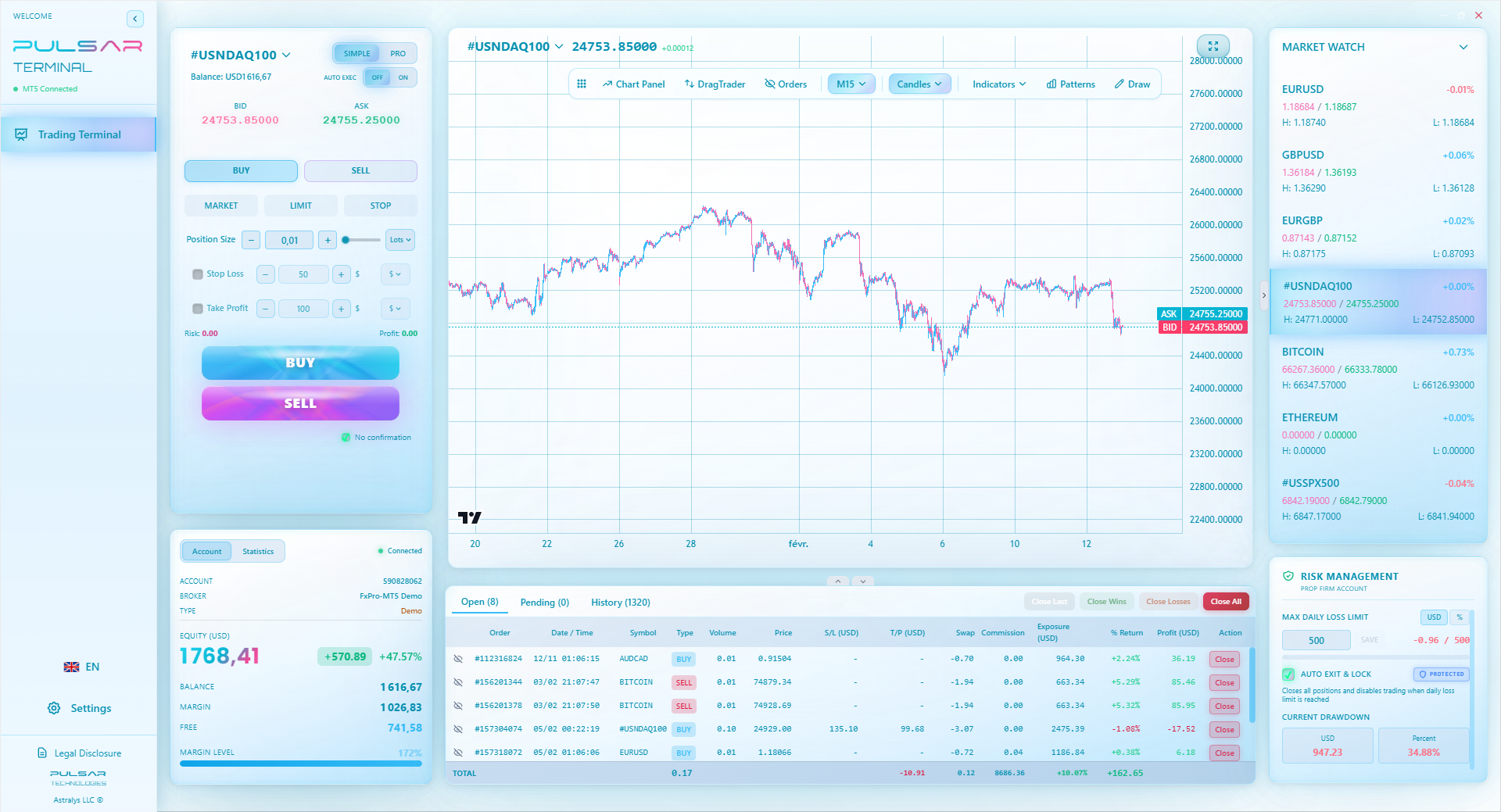
Forget the 95% win-rate nonsense. Profitable strategies are about risk/reward, not being right all the time.
Price Action & Support/Resistance: This is foundational. You learn to read the raw price movement on the chart, identifying key levels where the market has reversed before. It works because other traders see these same levels. It's not a crystal ball; it's identifying zones of higher probability.
Trend Following: The old saying is true: 'The trend is your friend.' You use indicators like moving averages to identify the direction of the market and then look for opportunities to join the move. This means you'll miss the exact bottom and top, and that's okay. You're catching the meat in the middle.
Breakout Trading: You identify a period where the price is consolidating (moving sideways in a range), and you place trades when the price breaks out of that range. The key here is distinguishing a real breakout from a false one (which happens often).
My Personal Blunder with Indicators: Early on, I loaded my chart with 10 different indicators - MACD, Stochastics, Bollinger Bands, you name it. They all gave different, conflicting signals. I was paralyzed. I lost money not because the indicators were wrong, but because I had no clear rule for which one to follow. Now, I use one, maybe two, at most. Clarity beats complexity every time.
No strategy works forever in all conditions. A scalping strategy that works in a quiet London morning will get slaughtered during US news releases. You need to understand the context. The best strategy is the one you understand completely and can execute mechanically, without emotion.
“Your first profitable year in live trading is a miracle. Your second is a coincidence. Consistency only starts in year three or four.”
If you make consistent profits, this will become relevant. Ignorance isn't a defense.
The Rule: Profits from forex trading are treated as Capital Gains in Nigeria. The current rate is 10%, payable to the Federal Inland Revenue Service (FIRS).
What You Need to Do:
- Keep careful Records: This is non-negotiable. Use a spreadsheet or journal. For every trade, log: Date, Currency Pair, Entry Price, Exit Price, Position Size, Profit/Loss in USD, and Profit/Loss in Naira (at the exchange rate on the day you closed the trade).
- Track Your Deposits & Withdrawals: Keep all statements from your broker and your bank. You need to prove your starting capital and your withdrawals.
- Calculate Your Taxable Income: It's roughly: (Total Withdrawals in Naira) - (Total Deposits in Naira) = Gross Profit. Then apply your allowable expenses (maybe a portion of internet, data) to get your taxable profit.
- File a Tax Return: You are responsible for declaring this income. Consult with a small business accountant familiar with digital income. The cost is worth the peace of mind.
I'm not a tax advisor, but I learned the hard way to keep records from day one. A few years back, I had a great quarter and couldn't accurately reconstruct my trades for my accountant. It was a stressful, time-consuming mess. Now, I update my trade journal every single day, without fail.
The bottom line: Treat your trading like a small business from the start. Proper records don't just help with taxes; they are your most valuable tool for reviewing your performance and improving.
💡 Petua Winston
The market's job is to find the price where you will be wrong. Your job is to know where that is before you enter, and get out when it gets there.
So, should you do it?
No, if:
- You need quick money to solve a financial emergency.
- You're easily influenced by emotions like greed and fear.
- You won't dedicate serious time to learning and practicing.
- You see it as an alternative to a job with a steady paycheck.
Yes, if:
- You have risk capital you can afford to lose completely. This is money that, if gone, doesn't affect your rent, bills, or family's well-being.
- You are intellectually curious about global economics and markets.
- You have the discipline to follow a plan even when it's boring or scary.
- You understand it's a skill that takes years to develop, like law or medicine.
Forex trading isn't a career path for most people. It's a demanding side hustle at best, a very expensive hobby at worst. For the tiny minority who succeed, it offers freedom and intellectual challenge. But that minority got there through relentless focus on risk management, not through genius predictions.
My final advice? Start with a demo account. Give it six months of consistent, disciplined practice. If you can't make fake money work, you have no chance with real money. If you can, and you still have the passion, then fund a small live account and begin the real journey. The market will be here tomorrow. There's no rush.
Pro Tip: Your first profitable year in live trading is a miracle. Your second is a coincidence. Consistency only starts in year three or four. Plan for the marathon, not the sprint.
FAQ
Q1Is forex trading legal in Nigeria?
Yes, it is legal for individuals to trade forex online. However, the regulatory environment is strict. The Central Bank of Nigeria (CBN) prohibits using the official foreign exchange window to fund trading accounts. Also,, the new Investments and Securities Act (ISA) 2025 makes it illegal for platforms to operate in Nigeria without SEC registration.
Q2What is the minimum amount to start forex trading in Nigeria?
While some brokers allow deposits as low as $5, starting with such a small amount is impractical for learning. A more realistic minimum is $50-$100. This gives you enough capital to practice proper risk management and withstand a few small losses without immediately facing a margin call.
Q3How do I fund my forex trading account from Nigeria?
Due to restrictions on Naira debit cards for international transactions, the most common methods are direct bank transfers to the broker's account (if they have a Nigerian correspondent bank) and peer-to-peer (P2P) payment options. Always use the official deposit methods listed by your regulated broker to avoid account freezes.
Q4Do I pay tax on forex trading profits in Nigeria?
Yes. Profits are considered capital gains and are subject to a 10% tax, payable to the Federal Inland Revenue Service (FIRS). It is your responsibility to keep accurate records of all trades, deposits, and withdrawals to calculate your taxable income and file a return.
Q5What is the best time to trade forex in Nigeria (WAT)?
The most active and liquid trading sessions overlap between 1:00 PM and 6:00 PM West Africa Time (WAT). This is when the London session is still open and the New York session begins, creating higher volatility and more trading opportunities on major pairs like EUR/USD and GBP/USD.
Q6Can I use use offered by my broker?
You can, but you must understand it's a double-edged sword. use like 100:1 means a 1% move against you can wipe out your entire account. It's a tool for precision, not for maximizing bet size. Most new traders use far too much use, which is the primary cause of rapid account blow-ups.
Q7Which broker is best for Nigerian traders?
There's no single 'best' broker. You should choose a broker with strong international regulation (e.g., ASIC, CySEC, FCA), competitive spreads, and reliable deposit/withdrawal methods for Nigeria. Research and compare brokers like Exness, XM, IC Markets, and Pepperstone to see which suits your specific needs.
Pelajaran Prof. Winston
:
- ✓Legal does not mean unregulated. Know CBN and SEC rules.
- ✓Start with at least $50, not $5, to learn properly.
- ✓Risk maximum 1% of capital on any single trade.
- ✓Keep a trade journal for taxes and performance review.
- ✓Master one simple strategy before trying anything complex.
Sejauh mana artikel ini berguna?
Klik bintang untuk menilai
Pandangan Dagangan Mingguan
Analisis & strategi mingguan percuma. Tiada spam.
Tentang Penulis
Olumide Adeyemi
Perintis Dagangan Afrika Barat
Salah seorang pendidik dagangan forex paling aktif di Nigeria. 8 tahun pengalaman dagangan dari Lagos. Pakar dalam strategi modal rendah dan cabaran prop firm untuk pedagang Afrika.
Komen
Anda mungkin juga suka

Cara Trading Forex Sukses: 7 Prinsip dari Trader Profesional
Cara trading forex sukses dengan 7 prinsip trader pro: manajemen modal, disiplin, journal trading, backtest. Data nyata, bukan janji profit palsu.
Jam Trading Forex Terbaik untuk Trader Indonesia: Panduan Lengkap dengan Tabel Waktu
Panduan jam trading forex untuk trader Indonesia. Tabel 4 sesi dunia, jam emas 20:00-00:00, sesi mana yang harus dihindari. Data akurat + tips dari trader berpengalaman.
Top 5 Sàn Forex Uy Tín Nhất 2026: Review Jujur dari Trader Indonesia
Top 5 sàn forex uy tín 2026 untuk trader Indonesia. Review jujur: spread, deposit, withdraw, dukungan lokal. Exness, XM, IC Markets & lebih.
All these calculators are built into Pulsar Terminal with real-time data from your MT5 account. One-click position sizing, automatic risk management, and instant calculations.
