


I remember watching the USD/ZAR chart in late 2024, the pair just grinding sideways around ZAR18.

David van der Merwe
Pedagang Pasaran Membangun ·  South Africa
☕ 11 minit baca
Apa yang akan anda pelajari:
I remember watching the USD/ZAR chart in late 2024, the pair just grinding sideways around ZAR18. My usual volatility plays were dead. That's when a client asked me, 'Should I just use my bank's platform for this?' He was talking about Absa. Most traders I know run straight to international brokers, but there's a case to be made for the local giant, especially if you're moving real money or need that bank-level trust. Let's break down Absa forex trading, not as a banker, but as a trader who's placed orders on their platform and felt those fees firsthand.
First thing's first: when we talk about 'Absa forex trading,' we're not talking about one single thing. It's a suite of services, and confusing them is where most people get tripped up. As a bank, Absa's main game is facilitating international payments and currency conversion for businesses and individuals. That's their bread and butter. The 'trading' part for retail clients like you and me comes in primarily through two doors: the Currency Investment Account and the World Trader Account.
The Currency Investment Account is less about active trading and more about holding foreign cash. You can park your Rands and convert them into USD, EUR, GBP, or one of 15 other currencies. It's for diversification or waiting for a better rate to send money overseas. No monthly fees, which is nice.
The World Trader Account is where you get access to international stock exchanges. You fund it in USD, EUR, or GBP and can buy shares on the NYSE, NASDAQ, etc. It's not a spot forex margin trading platform like MetaTrader. Think of it as Absa's gateway to global equities, not a platform for scalping the EUR/USD.

Warning: Don't open a World Trader Account thinking you'll get 30:1 use on currency pairs. That's not what it's for. For that kind of trading, you'd use an FSCA-regulated broker offering MT4/MT5, which is a different part of the financial environment. I made this assumption early on and wasted a week getting the account approved only to realize my mistake.
So, Absa's strength isn't in providing a hyper-competitive retail forex broker experience. It's in security, integration with your local banking, and moving larger sums of money across borders with the backing of the South African Reserve Bank.

💡 Petua Winston
A bank's exchange rate is a product with a markup, not a market price. Your first trade is always against your bank's spread.
This is where the rubber meets the road. Absa's main forex platform for businesses and more sophisticated clients is Absa Access FX. They call it Africa's most advanced platform, and for corporate hedging and large transactions, it probably is. It offers 24-hour trading, limit orders, and connects to global liquidity pools. For the average retail trader starting out, however, you likely won't touch this. You'll be using Online Banking or the Absa app for currency conversions and investments.
Let's talk about the fees that actually hurt. I once needed to convert R50,000 to USD for a trading deposit with an international broker. I did it through Absa's online forex service.
The Fee Breakdown on a Transfer
Using their published rates: a 0.55% commission (min R190), a R100 electronic fee, and most importantly, the exchange rate margin. Absa doesn't give you the pure interbank rate. They add a margin, typically between 1.2% and 4%. On my R50,000 conversion, with a margin of around 2%, that was an extra R1,000 lost in the spread before I even placed a trade. Compared to a specialist forex broker's spread of a few pips, it's a massive difference.

Example: The Hidden Cost of Conversion You want $1,000. Interbank rate: ZAR18.50/USD. Absa's offered rate (with 2% margin): ~ZAR18.87/USD. Cost via Absa: R18,870. Cost at interbank rate: R18,500. Hidden cost: R370. That's a 2% loss the moment you convert.
For receiving international payments, like profits from an overseas broker, they'll also take 0.55% (min R190, max R820). It adds up. The Currency Investment Account has no monthly fee, but remember, the profit for Absa is in that exchange rate margin when you fund it.
The World Trader Account brokerage fees vary by market. They're not the cheapest, but you're paying for the convenience and security of it being under your existing banking roof. If you're a long-term investor buying US stocks, it might be acceptable. For active trading, those fees will eat you alive.
“Trying to actively trade forex through a bank is like trying to win a Formula 1 race in a family sedan.”
This is the core decision. You wouldn't use a sledgehammer to put in a picture hook. Don't use a bank's forex service for active speculative trading.
Here’s a blunt comparison:
| Feature | Absa (Currency Services) | FSCA-Regulated Broker (e.g., Exness, IC Markets) |
|---|---|---|
| Primary Use | International payments, holding forex, investing in global shares. | Speculative margin trading on currency pairs, indices, commodities. |
| Platform | Absa Access FX, Online Banking. | MetaTrader 4/5, cTrader, proprietary platforms. |
| use | Not applicable for spot forex. | Up to 30:1 (FSCA retail limit). |
| Typical Spread | Built into exchange rate (1.2%-4% margin). | Tight spreads, often < 1 pip on majors like EUR/USD. |
| Regulator | South African Reserve Bank. | Financial Sector Conduct Authority (FSCA). |
| Best For | Moving large sums securely, long-term currency holding, integrated banking. | Active trading, technical analysis, swing trading, using advanced tools. |
I use both. I keep my main banking and large currency conversions for family abroad with Absa. The trust factor is real. But all my active trading? That's on an FSCA-regulated broker's platform. The spreads are a fraction of the cost, the execution is faster for quick trades, and I have access to proper charting and automation tools. Trying to actively trade through a bank is like trying to win a Formula 1 race in a family sedan.

Pro Tip: Use Absa to send money to your dedicated trading broker account. Once it's there, in the broker's environment, your trading costs plummet. Just factor in Absa's sending fees as a cost of doing business.
Where Absa truly shines for a trader is not in their platform, but in their market intelligence. As one of Africa's largest banks, their economists have a serious pulse on the Rand. Their public commentary is worth its weight in gold.
Take their 2024/2025 outlook. They called the 'benign trading conditions' and the ZAR18 range. That was a signal to avoid range-breakout strategies and maybe focus on shorter-term mean reversion plays. If you were swing trading USD/ZAR expecting massive volatility, you had a boring year. They've also flagged 2025 for potential volatility linked to US tariffs and local politics under the GNU. That's a heads-up to maybe keep your position size calculator handy and prepare for wider stops.
Their Africa Financial Markets Index is another gem. When they highlight FX reforms in Nigeria or Egypt, it tells you where new XAU/USD correlations or cross-currency flows might emerge. This is macro-level stuff that can inform your longer-term bias on the Rand.
I once took a short USD/ZAR position based partly on Absa's positive sentiment on local political progress, combined with a classic RSI indicator divergence on the daily chart. It worked. The bank's fundamental view gave me the confidence to hold through minor pullbacks. Their research won't give you entry and exit pins, but it can provide the crucial narrative context that technicals alone lack.
💡 Petua Winston
Use your bank for what it's good at: moving and holding money. Use a specialized broker for what it's good at: executing trades. Trying to make one do the job of the other is expensive.
“Your first goal isn't profit, it's learning the platform and avoiding a margin call.”
This is the unsexy but critical part. Getting money in and out.
Funding a Foreign Broker: This is where you'll likely use Absa. The rules have eased. You can transfer up to R150,000 for trading purposes relatively easily via SWIFT. Over R1 million needs a form, over R10 million gets more complex. Remember those fees we discussed? That's the cost. The SWIFT network itself is slow, but Absa's part of SWIFT GPI which helps track it.
Tax: The South African Revenue Service (SARS) sees your net trading profits as income. It's not capital gains from a long-term investment. You must declare it. Keep careful records of all your trades, deposits, and withdrawals. Your broker statements are key. If you use your Absa account to receive profits, those statements are part of your audit trail. I learned this the hard way after a good year in 2021 and spent a stressful February reconciling everything.
The Golden Rule: Never, ever try to use a personal foreign currency allowance for trading. That's for travel. Using it to fund a trading account is a compliance nightmare waiting to happen. Always use the formal, documented international transfer route for trading capital. It keeps you clean with the FSCA and SARS.
Client fund safety is paramount. With Absa, your money is in a major bank. With an FSCA broker, they are required to segregate client funds. This means your trading capital is held in a separate account from the broker's company money. If the broker goes under (unlikely with a good one), your funds should be protected. Always verify the broker's FSCA license number on the regulator's website.
Managing complex trades and strict risk rules, like those needed for prop firms or precise ZAR swings, is far easier with a tool that automates orders and protections directly on your MT5 charts.
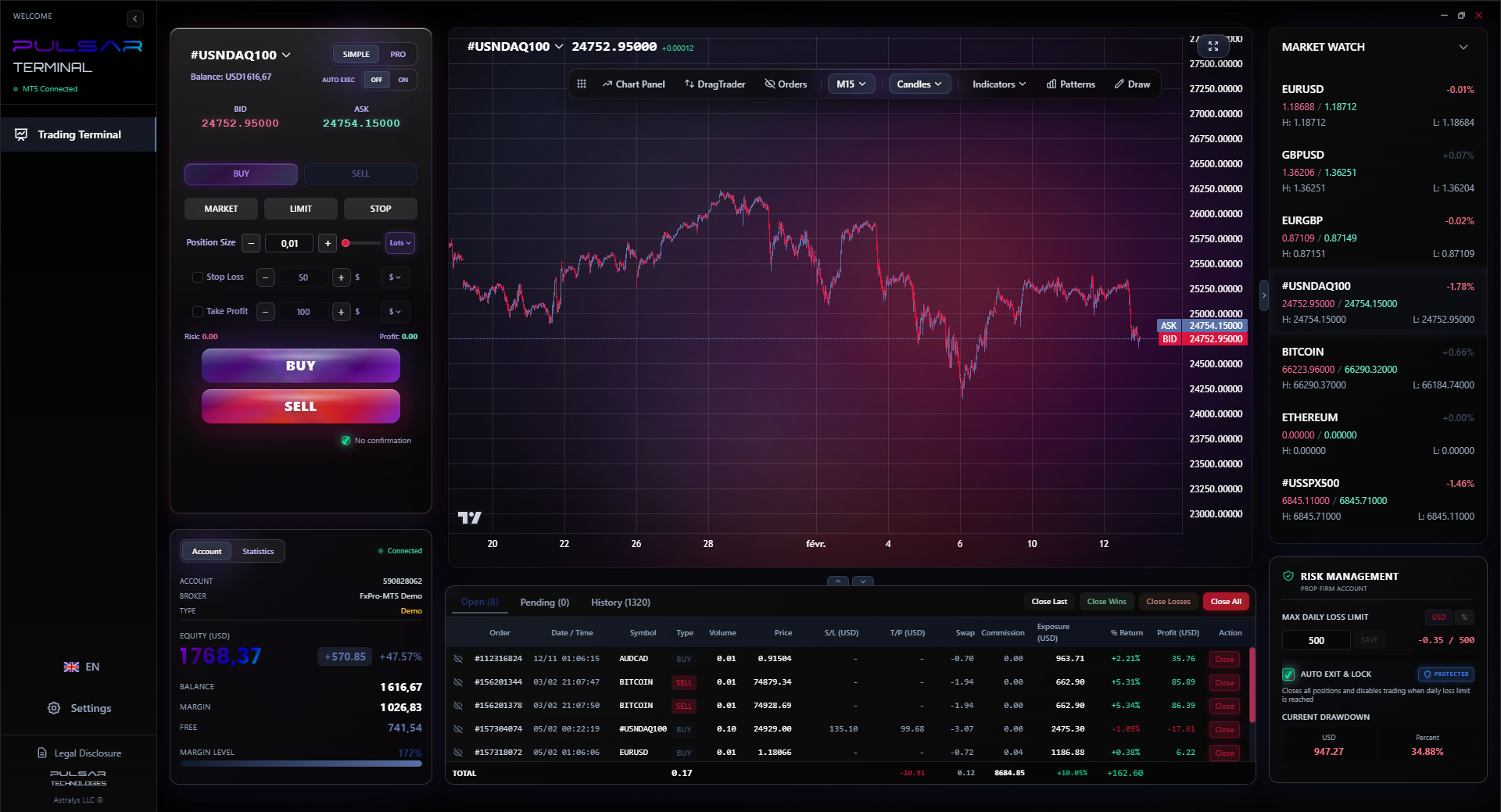
Let's say you're a South African with an Absa account, ready to get into the forex markets. Here’s the pragmatic path I'd recommend, based on doing it wrong the first time.
- Define Your Goal: Are you looking to invest in US stocks for the long term? Open a World Trader Account via Absa Online Banking. Are you looking to actively trade currencies for weekly profit? Go to step 2.
- Choose an FSCA Broker: Do your research. Look at XM, Pepperstone, or others. Compare their spreads on USD/ZAR, their platforms (MT5 is my preference), and their deposit/withdrawal methods for South Africans.
- Open Your Broker Account: Complete the verification. It's a process, but it's for your protection.
- Fund It via Absa: Log into Absa Online or use the app. Initiate an International Transfer to your new broker's client trust account. Use the exact details they provide. Be ready to pay the 0.55% + R100 + exchange margin. Consider this a one-time setup cost.
- Start Small & Learn: Once funds arrive (can take 2-5 days), start with a demo account on the broker's platform. Then trade live with tiny, tiny sizes. Your first goal isn't profit, it's learning the platform, understanding the real spread, and avoiding a margin call.
- Integrate Analysis: Follow Absa's quarterly economic reports for fundamental bias on the ZAR. Use your trading platform's charts and tools (like the MACD indicator) for your technical entries and exits.
This path gives you the best of both worlds: Absa's security and local intelligence for moving money, and a professional trading environment with competitive costs for actually executing trades.
“The bank's fundamental view gave me the confidence to hold through minor pullbacks.”
Let me save you some money and frustration.
Pitfall 1: Trading the 'Absa Rate.' You see the USD buying rate on your banking app and think, 'I'll wait for it to drop to 18.00 to convert.' That rate includes Absa's margin. You're not watching the real market. Use a free financial site or your trading platform to watch the actual USD/ZAR spot price.
Pitfall 2: Ignoring Total Cost of Conversion. That R370 'hidden cost' on a R50,000 conversion? You need to make that back in your trading just to break even on the transfer. Always calculate the full cost of getting money in and out.
Pitfall 3: Using the Wrong Product. Trying to day-trade with a World Trader Account is the classic error. It's like using a savings account for a poker game. Understand what each product is designed for.
Pitfall 4: Not Planning for Tax. You have a great run, withdraw R200k in profits to your Absa account, and spend it. SARS will come knocking. Set aside a percentage (consult a tax professional for the exact rate) of every single profitable withdrawal immediately. Open a separate savings account for your tax liability. Trust me, future-you will be grateful.
My biggest personal mistake was underestimating the psychological comfort of 'keeping it all with the bank.' I left too much capital sitting in Absa's environment for too long, missing better opportunities and paying more in fees than I needed to. Diversifying your financial tools is as important as diversifying your trades.
FAQ
Q1Can I trade forex with use on Absa's platform?
No, not in the way you can with a dedicated forex broker. Absa's main retail offerings (Currency Investment Account, World Trader Account) are for holding foreign currency or investing in international shares, not for margin trading on currency pairs. For leveraged spot forex trading, you need an FSCA-regulated broker offering platforms like MetaTrader.
Q2What are the advantages of using Absa for forex-related activities?
The main advantages are security, convenience, and integrated banking. Moving large sums feels safer with a major bank regulated by the South African Reserve Bank. It's convenient if you already bank with them. Their market research on the ZAR is also top-tier and can provide valuable fundamental context for your trading decisions.
Q3How much does it cost to convert Rands to USD with Absa?
The total cost has three parts: a commission (0.55%, min R190), an electronic fee (R100 for sending), and an exchange rate margin (typically 1.2% to 4% added to the interbank rate). On a R50,000 conversion, the total cost can easily exceed R1,000, most of which is hidden in the less favorable exchange rate.
Q4Is it legal for South Africans to use international forex brokers?
Yes, it is completely legal. The key is to use an international broker that is also regulated by South Africa's Financial Sector Conduct Authority (FSCA). This ensures they comply with local rules, including the 30:1 use limit for retail clients and client fund segregation. Always verify the broker's FSCA license.
Q5What is the difference between Absa's Currency Investment Account and a forex trading account?
A Currency Investment Account is for holding a foreign currency balance, like a foreign currency savings account. You profit if that currency strengthens against the Rand. A forex trading account with a broker is for speculating on price movements of currency pairs (like EUR/USD) using use, allowing you to profit from both rising and falling prices without necessarily owning the underlying currency.
Q6How do I fund an international trading account from my Absa account?
You use Absa's International Transfer service (SWIFT) via Online Banking or the app. You'll need the beneficiary details (your name) and the broker's client trust account banking details. Be prepared for the fees and the 2-5 business day processing time. Never use a travel allowance for this purpose.
Pelajaran Prof. Winston
:
- ✓Absa's forex strength is in security & payments, not active trading.
- ✓The real cost is a 1.2-4% margin on the exchange rate.
- ✓Use Absa to fund a dedicated FSCA-regulated broker.
- ✓Their market research is a valuable fundamental filter.
Sejauh mana artikel ini berguna?
Klik bintang untuk menilai
Pandangan Dagangan Mingguan
Analisis & strategi mingguan percuma. Tiada spam.
Tentang Penulis
David van der Merwe
Pedagang Pasaran Membangun
Pedagang berpangkalan di Johannesburg dengan 11 tahun dalam mata wang pasaran membangun. Pakar dalam pasangan ZAR, dagangan terkawal FSCA, dan analisis pasaran Afrika Selatan.
Komen
Anda mungkin juga suka

Cara Trading Forex Sukses: 7 Prinsip dari Trader Profesional
Cara trading forex sukses dengan 7 prinsip trader pro: manajemen modal, disiplin, journal trading, backtest. Data nyata, bukan janji profit palsu.
Jam Trading Forex Terbaik untuk Trader Indonesia: Panduan Lengkap dengan Tabel Waktu
Panduan jam trading forex untuk trader Indonesia. Tabel 4 sesi dunia, jam emas 20:00-00:00, sesi mana yang harus dihindari. Data akurat + tips dari trader berpengalaman.
Top 5 Sàn Forex Uy Tín Nhất 2026: Review Jujur dari Trader Indonesia
Top 5 sàn forex uy tín 2026 untuk trader Indonesia. Review jujur: spread, deposit, withdraw, dukungan lokal. Exness, XM, IC Markets & lebih.
All these calculators are built into Pulsar Terminal with real-time data from your MT5 account. One-click position sizing, automatic risk management, and instant calculations.
