


Here's a fact that might surprise you: a broker can be regulated by the FSCA in South Africa, but your money and legal agreement might not actually be with that local entity.

David van der Merwe
Pedagang Pasaran Membangun ·  South Africa
☕ 10 minit baca
Apa yang akan anda pelajari:
- 1Regulation & Safety: The FSCA License and the Fine Print
- 2Accounts & Fees: What It Really Costs in Rands
- 3Platforms & Tools: From MT5 to Social Trading
- 4Deposits & Withdrawals: Getting Your Rands In and Out
- 5What Can You Trade? use and Instruments
- 6Straight Talk: Pros and Cons for South Africans
- 7Final Verdict & Who It's Best For
Here's a fact that might surprise you: a broker can be regulated by the FSCA in South Africa, but your money and legal agreement might not actually be with that local entity. That's the first thing you need to understand about AvaTrade. They're a massive global name, and they operate here with an FSCA license. But is that enough? I've traded with them, and I've seen friends use them. This guide isn't a sales pitch. It's a straight-talking look at what AvaTrade offers South African traders, the real costs in Rands, the platform choices, and the critical regulatory fine print you must know before you deposit a single cent.
Let's cut to the chase. AvaTrade is regulated by the Financial Sector Conduct Authority (FSCA) under license number 45984, operating as Ava Capital Markets Pty Ltd. This is good. It means they've jumped through the local hoops and are authorized to offer CFDs to South Africans.
But here's the critical part, and I wish someone had spelled this out for me years ago. Many South African clients are actually onboarded through AvaTrade's entity based in the British Virgin Islands (BVI). Why does this matter? If you have a serious dispute - I'm talking about a platform glitch costing you money or a withdrawal issue - your legal recourse may be through the BVI financial authority, not the FSCA. The FSCA license gives them the right to market here, but it doesn't automatically mean your funds are protected under South African law.
That said, the FSCA rules they must follow include keeping client funds in segregated accounts (so your money isn't used for the company's Friday night braai), and crucially, they must enforce the retail use cap of 30:1. This is a hard rule for all FSCA-regulated brokers. So, while AvaTrade globally might advertise 400:1, for you and me as retail traders here, it's capped at 30:1. It's a safety net, honestly. I blew up an account using 100:1 use early in my career; 30:1 forces better discipline. You can read more about the dangers of over-use in our guide on margin call.

Warning: Don't just check for an FSCA license. When you sign up, check the legal entity name on your client agreement. If it's not 'Ava Capital Markets Pty Ltd,' you are not directly under FSCA protection for disputes.

💡 Petua Winston
A local regulator's license is a good sign, but always check which legal entity holds your money. The name on your contract is your real counterparty.
AvaTrade's pricing is built on spreads, not commissions, for their standard retail accounts. Let's translate their international pricing into the South African reality.
Minimum Deposit: You'll typically need R1,800 to R1,950 to open a live account. That's the equivalent of $100. It's a reasonable starting point, lower than some local brokers who ask for R5,000 upfront.
Spreads: This is where you pay. On the standard account, the EUR/USD spread averages around 0.9 pips. It's not the tightest in the world, but it's competitive for a no-commission model. If you trade bigger volumes and qualify for a Professional account (meeting FSCA criteria on experience and portfolio size), you can get spreads down to about 0.6 pips on EUR/USD.
The Hidden Cost: Inactivity Fees. This is a big one. If you don't trade for 3 months, a fee of $50 (roughly R900) is deducted per quarter. After a full year of inactivity, a $100 annual admin fee hits. I learned this the hard way. I opened an account, funded it, then got busy with life for four months. Came back to find a chunk missing. It's in the terms, but it stings. Only deposit money you plan to trade with actively.
Withdrawals: AvaTrade doesn't charge a fee, but your bank might for the international transfer. If you fund in ZAR and keep a ZAR account, you avoid conversion fees, which is a plus.

Example: Let's say you trade 1 standard lot (100,000 units) of EUR/USD with a 0.9 pip spread. The cost is $9 per round turn (0.00009 * 100,000). On a R20,000 account, that's a meaningful chunk per trade. Always factor spread cost into your position size calculator.
💡 Petua Winston
Inactivity fees are the silent killers of dormant accounts. If you're taking a break from trading, withdraw your capital. Don't let it sit and erode.
“The FSCA license gives them the right to market here, but it doesn't automatically mean your funds are protected under South African law.”
AvaTrade's biggest strength might be its platform variety. They cater to everyone, which is great, but can be overwhelming.
MetaTrader 4 & 5 (MT4/MT5): This is where I spent most of my time. They offer the full MT4 and MT5 suites. The execution was solid, and having access to the massive library of custom indicators and Expert Advisors (EAs) is a huge advantage for systematic traders. If you're into scalping strategy, the MT5 platform on AvaTrade performed well for me with minimal slippage.
AvaTradeGO: Their proprietary mobile app is slick. It's won awards for a reason. It's perfect for checking your positions on the go, managing risk, and it includes 'AvaSocial,' their built-in copy trading feature. It's more intuitive than MT4 on a phone, for sure.
AvaOptions & DupliTrade: These are for specialists. AvaOptions is for trading vanilla options, a different beast altogether. DupliTrade is a third-party copy trading system, but it requires a $2,000 minimum, which is steep for a beginner.
The key is to pick one platform and master it. Don't bounce around. I made the mistake of trying to use WebTrader, MT5, and the app all at once when I started. It fragmented my focus. For most serious retail traders, MT4 or MT5 is the way to go.

Pro Tip: Download the demo on all the platforms you're considering. Spend a week trading fake money on each. See which interface makes sense to you. Your platform is your cockpit; you need to feel in control.
💡 Petua Winston
Platform choice is personal. Master one tool completely before even looking at another. Depth beats breadth every time in trading.
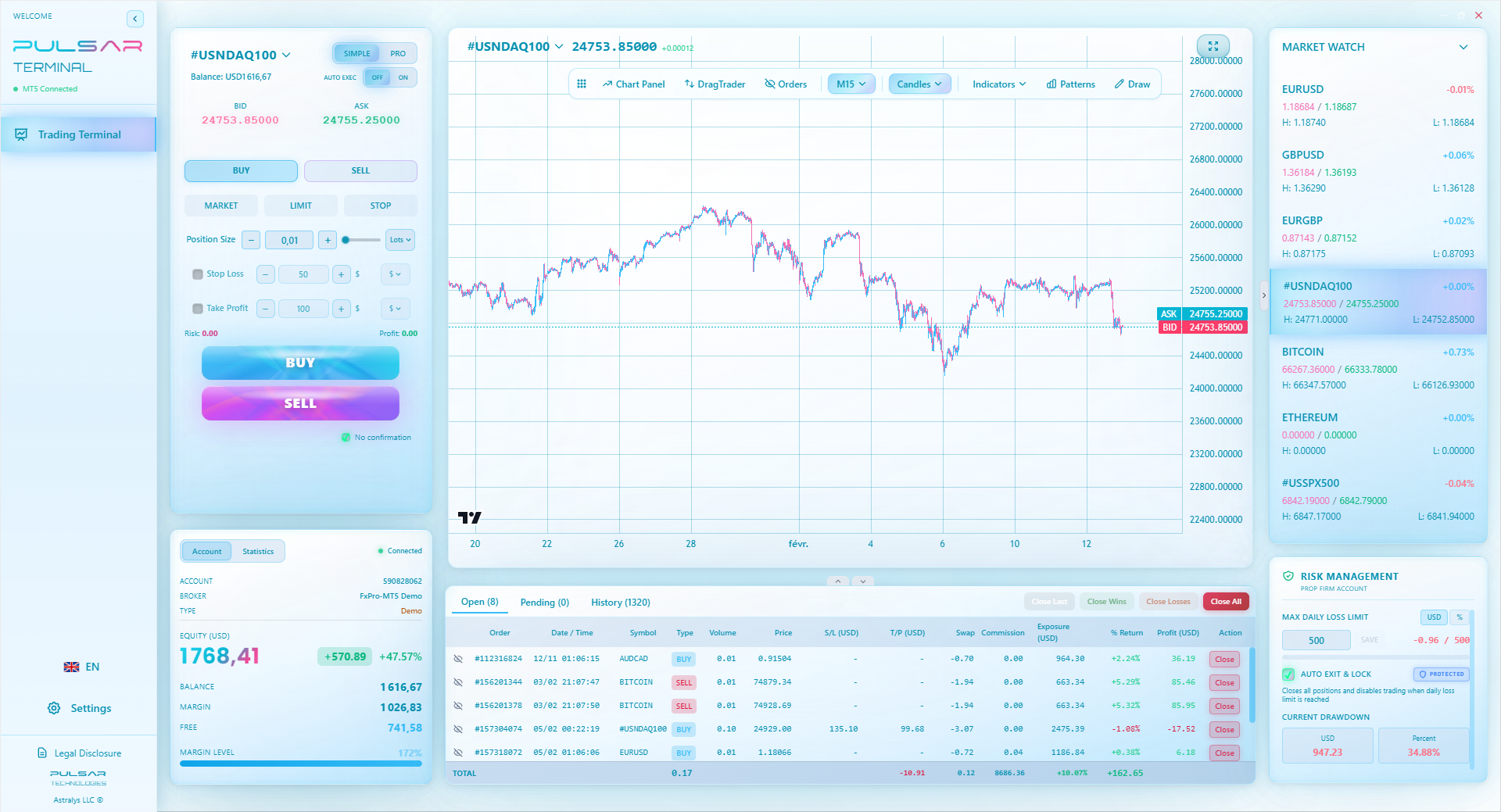
If you choose to trade on AvaTrade's MT5 platform, a tool like Pulsar Terminal can supercharge it with advanced order types and risk management features like one-click trailing stops and multi-target partial closures.
This is where a broker's local presence really helps. AvaTrade supports ZAR as a base currency, which is a major plus.
Funding Your Account:
- EFT (Bank Transfer): This is the most common method. It works with FNB, Standard Bank, Absa, Nedbank, and Capitec. Usually no fee from AvaTrade, and funds clear in 1-2 business days. It's reliable.
- Credit/Debit Cards: Visa/Mastercard deposits are instant. Useful if you see a setup and need to fund quickly, but be mindful of your own bank's international transaction fees.
- E-wallets: Skrill and Neteller are supported. Deposits are fast (within 24 hours), but these services have their own fee structures.
Withdrawals: The process is the reverse. They aim to process requests within a business day. Money usually lands back in my FNB account within 3-5 business days total. I've never had a withdrawal refused or delayed suspiciously, which is a good sign. Remember, withdrawals must generally go back to the source of the deposit for anti-fraud reasons.
The SARB Factor: While AvaTrade handles the broker side, you are still responsible for complying with South African Reserve Bank (SARB) rules on foreign capital allowances. Your bank may ask questions about large, frequent international transfers. Keep your records straight.
“I learned about inactivity fees the hard way. Came back to my account after four months to find a chunk missing.”
use: The 30:1 Cap
As a South African retail trader, you are locked into a maximum of 30:1 use by FSCA rule. AvaTrade will enforce this. On a major pair like EUR/USD, that means for every R1,000 in your margin, you control a position worth R30,000. It's sufficient for most swing trading strategies but limits the crazy risk (and potential reward) of higher use. It's a protective measure, and frankly, a wise one.
Instruments Available
AvaTrade offers a deep menu beyond just forex:
- Forex: All the majors, minors, and plenty of exotics including ZAR pairs like USD/ZAR and EUR/ZAR. The spread definition on exotics is wider, so trade them with that in mind.
- CFDs: Indices (J200 for the JSE Top 40, US SPX500, UK100), commodities (Gold, Oil), individual shares (US, EU, AU stocks), and cryptocurrencies.
- Recently Added: They've rolled out futures trading on MT5, which is a more direct market than CFDs for some instruments.
My experience? The equity CFD offering is strong. I've traded Tesla and Apple CFDs through them alongside my forex positions. The spreads on indices, especially the US SPX500, were tight during active hours. If you want to trade gold, check out our specific XAU/USD guide for strategies that work with CFD brokers like AvaTrade.
After using them and talking to other local traders, here's my balanced take.
Pros:
- FSCA Regulation: Having that local license adds a layer of legitimacy and ensures use caps are followed.
- ZAR Accounts: Eliminates currency conversion risk and fees on your deposit/withdrawals.
- Platform Choice: Unmatched variety. Whether you're an MT5 purist or a mobile-only trader, they have you covered.
- Reliable Execution: In my time with them, I didn't experience requotes or platform crashes during major news events. Slippage was minimal.
- Local Support: They have a South African support team and phone number. Getting help in your timezone is a big deal.
Cons:
- Potential Regulatory Grey Area: The BVI onboarding for many clients is a significant caveat to the FSCA safety net.
- Inactivity Fees: They are aggressive and can eat into a dormant account.
- Spreads: Not the absolute lowest. For pure, high-volume scalping, there are cheaper brokers like IC Markets or Pepperstone.
- Withdrawal Speed: While reliable, 3-5 days isn't instant. Some brokers using local payment processors are faster.
Pro Tip: If you are a high-frequency scalper chasing the tightest possible spread definition, compare AvaTrade's raw spreads on their professional account (if you qualify) with a true ECN broker. For most other styles, their spreads are fine.
“For a trader who wants a reputable, full-service broker that accepts Rands, they are definitely worth putting on your shortlist.”
So, is AvaTrade a good forex broker for South Africans? Yes, for the right trader.
AvaTrade is a great fit if:
- You value a well-known brand with an FSCA presence.
- You want to trade in Rands and use EFTs easily.
- You're a multi-asset trader who wants forex, indices, and stocks in one place.
- You like having platform options, especially the official MT4/MT5 platforms.
- You're not a hyper-scalper where every 0.1 pip counts.
Look elsewhere if:
- The BVI entity structure makes you deeply uncomfortable.
- You frequently leave accounts inactive for months.
- Your entire strategy is built on ultra-low, raw spreads and direct market access.
- You want the absolute fastest local withdrawal times.
South African Alternatives to Consider:
- For Lower Costs: Exness also holds an FSCA license and often has tighter spreads, but their product range is different.
- For MT4/MT5 Focus: XM is another global broker popular here with strong MT4 integration and lots of educational resources.
- For Advanced Traders: IC Markets offers true ECN pricing, though their local FSCA presence is structured differently.
My bottom line? AvaTrade is a solid, all-round broker for South Africans. They're not perfect - the inactivity fee is a pain, and the regulatory setup requires you to read the fine print. But for a trader who wants a reputable, full-service broker that accepts Rands and offers the tools to grow, they are definitely worth putting on your shortlist. Start with a demo, get a feel for their platforms, and only fund a live account with money you're ready to trade actively.
FAQ
Q1Is AvaTrade legally allowed to operate in South Africa?
Yes. AvaTrade is regulated by the Financial Sector Conduct Authority (FSCA) under license number 45984. This means they are authorized to offer CFD trading services to South African residents.
Q2What is the minimum deposit for South African traders?
The minimum deposit is typically between R1,800 and R1,950, which is the ZAR equivalent of $100 USD. This is for their standard retail trading account.
Q3What use can I get as a South African retail trader?
The FSCA mandates a maximum use of 30:1 for all retail traders. AvaTrade must enforce this cap, regardless of the higher use they may advertise in other regions. Professional clients who meet specific criteria can apply for higher use.
Q4Does AvaTrade charge an inactivity fee?
Yes, and it's significant. After 3 consecutive months of no trading activity, a quarterly fee of $50 (approx. R900) is charged. After 12 months of inactivity, an additional annual administration fee of $100 is also applied.
Q5Can I use the MetaTrader platforms with AvaTrade?
Absolutely. AvaTrade offers full access to both MetaTrader 4 (MT4) and MetaTrader 5 (MT5). These are the industry-standard platforms for serious technical analysis and automated trading.
Q6How long do withdrawals to a South African bank account take?
Once processed by AvaTrade (which usually takes 1 business day), it typically takes an additional 2-4 business days for the funds to reflect in your South African bank account via EFT. Total time is usually 3-5 business days.
Q7Are there any good alternatives to AvaTrade in South Africa?
Yes. Other FSCA-regulated brokers popular with South Africans include Exness, XM, and IC Markets. It's wise to compare their spreads, platforms, and fee structures. For example, if lowest cost is your priority, IC Markets is often a strong contender.
Pelajaran Prof. Winston
:
- ✓FSCA regulation mandates a 30:1 use cap for your safety.
- ✓Minimum deposit starts around R1,800 ($100 equivalent).
- ✓Inactivity fees can cost you $50 per quarter after 3 months.
- ✓Always verify the legal entity you are contracting with.
Sejauh mana artikel ini berguna?
Klik bintang untuk menilai
Pandangan Dagangan Mingguan
Analisis & strategi mingguan percuma. Tiada spam.
Tentang Penulis
David van der Merwe
Pedagang Pasaran Membangun
Pedagang berpangkalan di Johannesburg dengan 11 tahun dalam mata wang pasaran membangun. Pakar dalam pasangan ZAR, dagangan terkawal FSCA, dan analisis pasaran Afrika Selatan.
Komen
Anda mungkin juga suka

Cara Trading Forex Sukses: 7 Prinsip dari Trader Profesional
Cara trading forex sukses dengan 7 prinsip trader pro: manajemen modal, disiplin, journal trading, backtest. Data nyata, bukan janji profit palsu.
Jam Trading Forex Terbaik untuk Trader Indonesia: Panduan Lengkap dengan Tabel Waktu
Panduan jam trading forex untuk trader Indonesia. Tabel 4 sesi dunia, jam emas 20:00-00:00, sesi mana yang harus dihindari. Data akurat + tips dari trader berpengalaman.
Top 5 Sàn Forex Uy Tín Nhất 2026: Review Jujur dari Trader Indonesia
Top 5 sàn forex uy tín 2026 untuk trader Indonesia. Review jujur: spread, deposit, withdraw, dukungan lokal. Exness, XM, IC Markets & lebih.
All these calculators are built into Pulsar Terminal with real-time data from your MT5 account. One-click position sizing, automatic risk management, and instant calculations.
