


Here's a sobering stat: over 90% of trading strategies that look brilliant on paper fail in live markets.

David van der Merwe
Pedagang Pasaran Membangun ·  South Africa
☕ 10 minit baca
Apa yang akan anda pelajari:
- 1What Backtesting Actually Is (And What It Isn't)
- 2Why Backtesting in South Africa is Different
- 3Getting the Right Historical Data (The Foundation)
- 4Manual vs. Automated Backtesting: A Realistic Look
- 5The Numbers That Actually Matter (Forget Just Profit)
- 6Pitfalls That Will Destroy Your Backtest (And Your Account)
- 7The Final Step: Forward Testing (Paper Trading)
Here's a sobering stat: over 90% of trading strategies that look brilliant on paper fail in live markets. I've blown up accounts proving it. In South Africa, where the Rand's wild swings can make or break you in a session, proper backtesting isn't a nice-to-have, it's survival. This isn't about fancy theories; it's about using real ZAR spreads, FSCA's 30:1 use limits, and our unique market hours to pressure-test your edge before you risk a single cent.
Let's clear this up right away. Backtesting forex is simply running your trading rules against historical price data to see what would have happened. You're asking: "If I'd traded this way for the last five years, would I be rich or broke?"
It's not a crystal ball. A strategy that crushed it in 2022 might get slaughtered in 2024's different volatility. I learned this the hard way with a neat little scalping strategy I built for EUR/USD. It showed a 75% win rate from 2018-2020. I funded an account with R10,000, confident. The first month of live trading? A R2,300 loss. The spread had widened by an average of 0.3 pips in the current market, and my tiny profit targets were suddenly impossible to hit consistently.

Warning: The biggest lie in backtesting is assuming perfect execution. You won't get the exact entry price. Slippage and requotes are real, especially during our local news events when ZAR pairs go nuts.
The real value isn't in finding a 'perfect' system. It's in killing bad ones quickly and cheaply. You save your real capital for the ideas that survive the historical gauntlet.

💡 Petua Winston
A backtest without a defined maximum drawdown is a fantasy. Know your pain threshold in Rands before you see it on a screen.
“In South Africa, where the Rand's wild swings can make or break you in a session, proper backtesting isn't a nice-to-have, it's survival.”
You can't just copy a generic YouTube strategy and expect it to work here. Our market has fingerprints all over it.
The ZAR Factor
Our beloved (and sometimes hated) Rand is a commodity currency. USD/ZAR doesn't just move on Fed news; it dances to the tune of platinum, gold, and iron ore prices. A strategy backtested only on EUR/USD will be blind to this. You must test on the pairs you'll actually trade. If you're looking at ZAR crosses, our guide on XAU/USD (gold) is a must-read to understand one of its key drivers.
Regulation & Costs That Bite
Remember, the FSCA caps use at 30:1 for retail traders. Your backtest must respect this. A strategy that needs 100:1 to work is illegal for you to run live. More crucially, you have to bake in real costs.
Let's get specific with a broker like Tickmill (FSCA regulated). On their Raw account, EUR/USD has a raw spread of 0.11 pips, plus a $3 per lot commission. If your backtest uses 'free' data with no commission, you're lying to yourself. That commission turns a theoretically profitable scalping trade into a loser fast. Always add at least 0.5-1 pip to your historical data to simulate the spread and commission you'll actually pay.
Local Session Impact
While the major markets are asleep, liquidity in ZAR pairs can dry up. A backtest that assumes you can enter and exit a R1 million ZAR trade instantly at 10 PM SAST is fantasy. You need to understand volume profiles and time your strategy accordingly.
“The biggest lie in backtesting is assuming perfect execution. You won't get the exact entry price.”
Garbage in, garbage out. This is where most guys mess up.
Free Data Sources: Your MT4/MT5 platform has built-in historical data. It's okay for a rough start, but it's often incomplete, especially for lower timeframes like 1-minute or 5-minute charts, which are crucial for precise backtesting. I once spent two weeks building a system on MT4's default 1H data, only to find the results completely different when I bought tick data.
Paid Data is Worth It: For serious work, consider a service like Dukascopy or HistData. You want tick data or at least 1-minute OHLC (Open, High, Low, Close). Why? Because your stop-loss and take-profit are hit at specific prices within a candle, not just at the close. If you're testing a strategy with a 5-pip stop, you need to know if the price spiked through it intra-candle.

Pro Tip: When you download data, make sure it includes the bid/ask spread for the period. The spread isn't constant. It widens massively during the Asian session (when we're awake) and during news. If your data shows a fixed 0.8 pip spread for EUR/USD all day, every day, it's wrong.
For South Africans, prioritize data for USD/ZAR, EUR/ZAR, and GBP/ZAR if you trade them. Their spreads are wider and more variable than majors like EUR/USD. Not factoring this in is a surefire way to overestimate your profits. A tool that can help you model these variable costs in your testing is useful.
“The biggest lie in backtesting is assuming perfect execution. You won't get the exact entry price.”
Manual Backtesting (The Grind): This is you, sitting with a chart, scrolling back in time, and manually noting where your strategy would have triggered. I did this for years. It's painful but incredibly educational. You develop a feel for the market's rhythm. The huge downside? It's slow and prone to bias. You might 'see' a signal that isn't really there, or skip over a losing trade subconsciously.
Automated Backtesting (The Speed): This is where you code your strategy (or use a strategy builder) and let software test years of data in minutes. Platforms like MetaTrader's Strategy Tester, TradingView's Pine Script, or dedicated software like Soft4FX are popular.
Here's my experience: I automated a simple moving average crossover system. The backtest over 10 years showed an annual return of 12%. Great! Then I added a realistic 1.5 pip total cost (spread + commission) per trade. The profit vanished. Then I added a rule that skipped trades during major SA news announcements (like SARB rate decisions). The number of trades dropped by 30%, but the win rate improved. Automated testing let me run these 'what-if' scenarios in an afternoon.

Example: Let's say your strategy triggers 200 trades a year on EUR/USD.
- Ignoring costs: Maybe +R20,000 profit.
- With real costs (1 pip = ~R1.50 per mini lot): Subtract R1.50 * 200 trades = R300. Now profit is R19,700.
- With occasional slippage of 2 pips on 10% of trades: Subtract another R60. Now R19,640. See how the 'edge' gets eaten? Always use a position size calculator with your backtested results to see the real ZAR impact.
The best approach? Start manual to learn the nuances, then move to automated to test rigorously and without emotion.
💡 Petua Winston
If you can't explain your strategy's edge in one simple sentence, your backtest is probably overfitted with complexity.
“Looking only at total profit is like judging a car only by its top speed. You need to check the brakes and fuel efficiency too.”
Looking only at total profit is like judging a car only by its top speed. You need to check the brakes and fuel efficiency too.
1. Maximum Drawdown (MDD): This is the biggest peak-to-trough loss your strategy would have suffered. If your backtest shows a R100,000 portfolio dropping to R70,000 at one point (a 30% drawdown), you must ask yourself: Could I stomach a R30,000 loss and keep trading the system? If not, the strategy is useless to you, no matter its final profit. My worst was a 42% drawdown on a carry trade strategy. I abandoned it, even though it was "profitable" on paper.
2. Profit Factor: (Gross Profit / Gross Loss). Anything above 1.2 is decent. Above 1.5 is good. I get skeptical of anything above 3.0 in a long-term test - it often means the data or logic is flawed, or the strategy is over-optimized for the past.
3. Win Rate & Risk/Reward Ratio: These two are married. A strategy with a 40% win rate can be brilliant if its average winner is 3x its average loser (a 1:3 risk/reward). Conversely, a 70% win rate where you risk R200 to make R50 is a slow road to ruin via margin call.
4. Sharpe/Sortino Ratio: These measure risk-adjusted return. Higher is better. It tells you if you're being compensated for the volatility you're enduring. A smooth equity curve is the dream.
5. Number of Trades: A strategy that only signals 4 times a year hasn't been tested enough. You need a statistically significant sample - at least 50-100 trades in your test period.
Table: Interpreting Your Backtest Results
| Metric | Good Sign | Red Flag |
|---|---|---|
| Profit Factor | 1.5 - 2.5 | > 3.5 (Overfitted) |
| Max Drawdown | < 20% of capital | > 35% of capital |
| Win Rate | Balanced with Risk/Reward | 80%+ (Probably a scam) |
| Trade Count | 100+ in test period | < 30 |
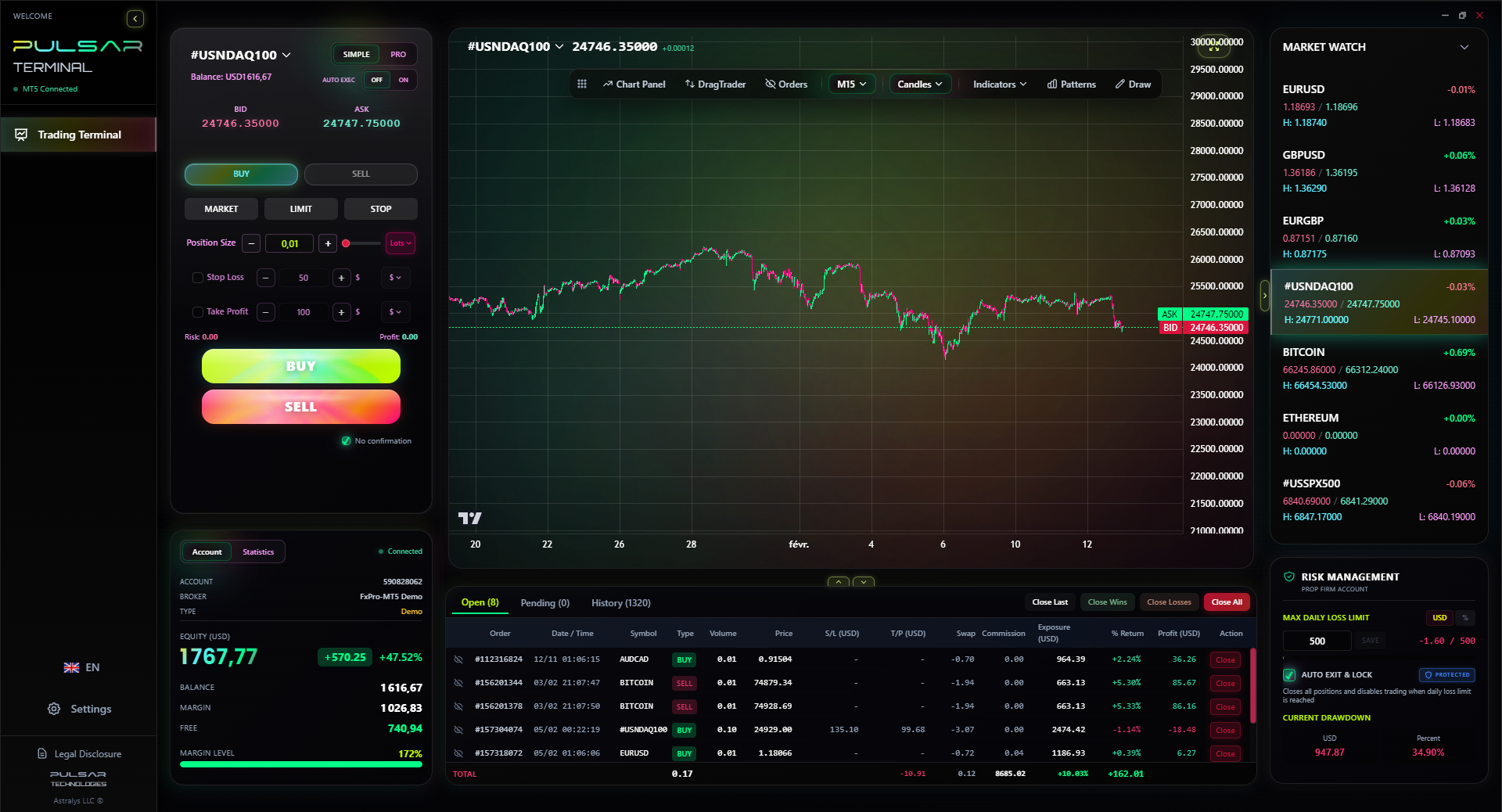
Once your strategy is backtested, executing it precisely with multiple take-profit levels and automated trailing stops is where Pulsar Terminal turns your plan into disciplined, repeatable action on MT5.
“Looking only at total profit is like judging a car only by its top speed. You need to check the brakes and fuel efficiency too.”
I've fallen into every one of these traps. Learn from my losses.
Overfitting (Curve-Fitting): This is the killer. You tweak your strategy's parameters until it fits the historical data perfectly. Example: "Buy when the 13-period RSI crosses above 47.5, but only on Tuesdays after 10:15 AM SAST." It will look amazing on the past data but will fail miserably on new, unseen data. The cure? Keep your strategy simple. Use a tool like the MACD indicator with its default settings first, don't immediately start hunting for 'magic' numbers.
Ignoring Slippage & Spread: As discussed, this is non-negotiable. If your strategy aims for 5-pip profits, and the average spread+commission is 2 pips, you've already lost 40% of your potential. Your edge has to be larger than your costs.
Survivorship Bias: This is more relevant for stock trading, but the concept applies. You're testing on data from brokers that survived. You're not seeing the crazy price spikes that might have happened on a dodgy, now-defunct broker that would have blown your stop loss.
Strategy Works on One Pair Only: You backtest a mean-reversion strategy on USD/ZAR and it works. Don't assume it will work on EUR/JPY. Different pairs have different personalities (trending vs. ranging). Test across multiple instruments.
Not Accounting for Psychology: The backtest shows 10 losses in a row. Could you take those hits live and place the 11th trade exactly as the rules say? Most can't. This is where swing trading strategies often have an edge for beginners - fewer trades mean less emotional fatigue.
💡 Petua Winston
The market's job is to find the flaw in your logic. A rigorous backtest is you trying to find it first, in private.
“Backtesting is your final exam on past papers. Forward testing is the mock exam with new questions.”
Backtesting is your final exam on past papers. Forward testing is the mock exam with new questions.
What is it? You take your backtested strategy and run it in real-time on a demo account (or with tiny live size) for at least 1-3 months. You're not testing the strategy's logic anymore - you're testing your ability to execute it in the live market environment, with all its emotions, distractions, and real-time data feeds.
This is where you encounter the real spread. This is where you see if your broker's execution causes slippage on your entries. This is where you practice your discipline.
I have a rule: No strategy goes live with meaningful capital until it has completed a 100-trade forward test (or 3 months, whichever is longer) and the results are within 15% of the backtested expectations. If the backtest showed a 55% win rate and a 1.8 Profit Factor, the forward test needs to be in the 47-63% win rate ballpark.
Pro Tip: Use a broker with a reliable demo platform that mirrors their live conditions. IC Markets and Pepperstone are known for this among prop traders. Trade the demo as if it's real money. Log every trade, the reason, and your emotional state.
If the forward test fails, go back to the drawing board. You've just saved a fortune. If it passes, you can then scale in with real confidence, using proper position size calculator principles. The journey from a backtested idea to a live, profitable system is long and humbling, but it's the only path that works.
FAQ
Q1Is backtesting forex legal in South Africa?
Absolutely. Backtesting is just analyzing historical data, which is perfectly legal. The FSCA regulates the brokers you trade with live, not the analytical work you do on your own computer. Just make sure the live trading you do afterwards is with an FSCA-regulated broker if you want local protection.
Q2What's the best free software for backtesting?
For most South African traders starting out, the Strategy Tester in MetaTrader 4 or 5 is the most accessible. It's built into the platform you're probably already using. TradingView's Pine Script is also powerful and free for basic use. For more advanced, multi-broker analysis, you might need to look at paid options later.
Q3How far back should I backtest my forex strategy?
Aim for at least 5-10 years of data. This should cover different market cycles: high volatility (like the 2020 pandemic), low volatility, and trending vs. ranging periods. Testing only on 1 year of a strong bull market for the USD will give you a dangerously biased result.
Q4My backtest is profitable but my live trading isn't. Why?
This is the most common problem. Nine times out of ten, it's because your backtest didn't use realistic trading costs (spreads, commissions) or account for slippage. The other major reason is psychological: you're not following the strategy rules due to fear or greed. Re-check your cost assumptions and start forward testing on a demo to bridge the gap.
Q5Can I backtest strategies for USD/ZAR specifically?
Yes, but you need good quality historical data for the pair, which can be harder to find than for majors like EUR/USD. You must be especially careful to model the wider and more variable spreads that ZAR pairs have. Ignoring this will massively overstate your potential profits.
Q6Do I need to know how to code to backtest properly?
Not necessarily, but it helps a lot. MT4/5 have visual strategy builders where you drag and drop conditions. However, to test complex ideas or manage trades with multiple take-profit levels, coding (MQL for MetaTrader) becomes almost essential. It's a valuable skill to learn.
Pelajaran Prof. Winston
:
- ✓Always add real ZAR spreads & commissions to your test data.
- ✓Require a minimum of 100 trades in your backtest sample.
- ✓A Max Drawdown over 35% is a strategy killer for most.
- ✓Forward test for 3 months before going live.
- ✓Profit Factor between 1.5 and 2.5 is the sweet spot.
Sejauh mana artikel ini berguna?
Klik bintang untuk menilai
Pandangan Dagangan Mingguan
Analisis & strategi mingguan percuma. Tiada spam.
Tentang Penulis
David van der Merwe
Pedagang Pasaran Membangun
Pedagang berpangkalan di Johannesburg dengan 11 tahun dalam mata wang pasaran membangun. Pakar dalam pasangan ZAR, dagangan terkawal FSCA, dan analisis pasaran Afrika Selatan.
Komen
Anda mungkin juga suka

Cara Trading Forex Sukses: 7 Prinsip dari Trader Profesional
Cara trading forex sukses dengan 7 prinsip trader pro: manajemen modal, disiplin, journal trading, backtest. Data nyata, bukan janji profit palsu.
Jam Trading Forex Terbaik untuk Trader Indonesia: Panduan Lengkap dengan Tabel Waktu
Panduan jam trading forex untuk trader Indonesia. Tabel 4 sesi dunia, jam emas 20:00-00:00, sesi mana yang harus dihindari. Data akurat + tips dari trader berpengalaman.
Top 5 Sàn Forex Uy Tín Nhất 2026: Review Jujur dari Trader Indonesia
Top 5 sàn forex uy tín 2026 untuk trader Indonesia. Review jujur: spread, deposit, withdraw, dukungan lokal. Exness, XM, IC Markets & lebih.
All these calculators are built into Pulsar Terminal with real-time data from your MT5 account. One-click position sizing, automatic risk management, and instant calculations.
