


Everyone tells you to read a beginner forex book.

David van der Merwe
Pedagang Pasaran Membangun ·  South Africa
☕ 10 minit baca
Apa yang akan anda pelajari:
- 1Why Most Forex Books Fail You (Especially Here)
- 2The One Book That Actually Helps
- 3South African Rules You Can't Ignore
- 4Real Costs for SA Beginners (The Hidden Fees)
- 5Brokers, Platforms, and Your First Deposit
- 6Building Your First Simple Strategy (Forget Complexity)
- 7Common SA Traps and How to Avoid Them
Everyone tells you to read a beginner forex book. They're wrong. Most are generic, outdated, and ignore the specific realities of trading from South Africa. You don't need a library. You need a clear map of the local minefield: FSCA use limits, ZAR account quirks, and which brokers won't get your EFT blocked. I'll cut through the noise and give you the one resource that actually works, paired with the hard local facts no international book will tell you.
Let's be honest. The typical beginner forex book is written for a global audience, usually by someone who's never had to think about SARB exchange controls or finding an FSCA-regulated broker. They'll drone on about 100:1 use as if it's standard, when here you're capped at 30:1. They'll talk about funding with PayPal like it's easy, ignoring that many South Africans face hurdles with international payment processors.
The biggest failure? They teach theory, not survival. They won't tell you that in 2024, the FSCA fined a guy over R1 million and debarred him for 10 years for selling trading signals without a license. That's the real-world regulation you're stepping into. A good local guide isn't just about candlestick patterns, it's about not getting your account frozen or falling for an unregulated scam that's been banned elsewhere but still targets South Africans.
I learned this the hard way. Early on, I followed advice from a popular US book and tried to use a high-use international broker. My first sizable withdrawal was a nightmare of delays and questions from my local bank about the offshore transfer. It almost wasn't worth the profit. The lesson? Your first piece of education must be local context. Everything else builds on that.
Forget the 20-book reading list. If I could only give a South African beginner one resource, it would be "Trading in the Zone" by Mark Douglas. It's not a strategy book. It won't teach you a single indicator. And that's exactly why it's the most important beginner forex book you'll ever read.
Douglas tackles the one thing that will destroy you faster than a bad trade: your own psychology. He breaks down the myths - like the belief that you need to know what will happen next - and builds a framework for thinking in probabilities. For a South African trader starting with a smaller capital base (because let's face it, converting Rands to Dollars eats into your size), managing your mental capital is even more critical. A few bad trades driven by emotion can wipe out a modest account.

Example: Say you deposit R10,000. After fees and a poor exchange rate, you might get $530 into your trading account. A single emotional, over-leveraged trade could take out 20% of that in minutes. "Trading in the Zone" teaches you how to avoid that self-sabotage.
Why this over a technical guide? Because you can learn a simple scalping strategy or a swing trading method in an afternoon online. Internalizing the discipline to execute it consistently takes real work, and this book is the manual. Pair this book with a demo account practice, and you're ahead of 90% of beginners who just hunt for a magical indicator.

💡 Petua Winston
Your first R10,000 in profits isn't money. It's tuition fees you've paid to the market. Don't withdraw it to buy gadgets. Re-invest it as trading capital to compound your learning.
“Your first piece of education must be local context. Everything else builds on that.”
This is your non-negotiable homework. Screw this up, and your trading journey ends before it starts.
The FSCA is Your Best Friend
The Financial Sector Conduct Authority (FSCA) regulates the space. Always verify your broker's FSP number on their official register. If a broker isn't FSCA regulated, you're basically sending your money into the void with zero local recourse. I stick with regulated entities like IC Markets or Pepperstone for this reason.
The FSCA also caps use at 30:1 for major currency pairs for retail clients. Any "broker" offering you 500:1 or 1000:1 is likely an unregulated offshore entity. That high use isn't a gift, it's a trap designed to blow your account faster.
SARB and Your Money
The South African Reserve Bank controls how money moves. You have a R1 million single discretionary allowance per year to move offshore without tax clearance. Need to send more? You'll need tax clearance for the additional R10 million foreign investment allowance. This is crucial for funding and withdrawing. Always use brokers that accept ZAR deposits directly to avoid your bank flagging international forex transactions, which they sometimes do.
Tax Man Cometh
Yes, SARS wants a piece. Profits from forex trading are taxable as income. Keep a careful log of all your trades. The cost of a good accountant is less than the cost of a SARS audit.
They'll show you the shiny 0.0 pip spread but forget to mention the other five ways they take your money. Here’s the real breakdown for a South African starting out.
The Obvious Cost: Spreads & Commissions This is your direct trading cost. On a major pair like EUR/USD:
| Broker Type | Typical EUR/USD Spread | Commission (per standard lot) | Best For... |
|---|---|---|---|
| Raw/ECN Account | 0.0 - 0.2 pips | $3 - $7 | Active traders, scalpers. High volume. |
| Standard Account | 0.8 - 1.5 pips | $0 | Beginners with smaller accounts, lower frequency. |
As a beginner with a smaller account, the standard account often makes more sense. Yes, the spread is wider, but you're not getting killed on commission with every tiny trade. A 1-pip spread on a micro lot (1,000 units) costs you about R0.80. That's manageable.
The Silent Killers:
- Currency Conversion: Depositing Rands to a USD account? The broker or your bank takes a 2-3% cut on the exchange rate. Solution: Use a broker offering ZAR-denominated accounts.
- Overnight Financing (Swap): Hold a trade past 10pm SA time? You pay or receive interest. It can add up, especially on a swing trading position held for weeks. Always check the swap rate before holding long-term.
- Inactivity Fees: Some brokers charge if you don't trade for 3-6 months.
- Withdrawal Fees: Surprisingly common. Always check the policy.

Warning: That "R0 deposit" offer from some brokers? It's a marketing trick. You need real capital to trade realistically and absorb losses. Start with an amount you can afford to lose completely - R2,000 to R5,000 is a common sensible start for learning.
💡 Petua Winston
If you can't explain your trade setup in one sentence (e.g., 'Price pulled back to the 100 SMA in an uptrend'), it's too complicated. Complexity is the enemy of execution.
“A good local guide isn't just about candlestick patterns, it's about not getting your account frozen.”
Choosing your broker and platform is like choosing your first car. You need something reliable, affordable, and easy to handle, not a Formula 1 car you can't drive.
Broker Checklist for South Africans:
- FSCA Regulation: Non-negotiable. Verify the FSP number.
- ZAR Accounts: Saves you from hidden forex conversion fees.
- Local Deposits/Withdrawals: EFT support is a must. Instant EFT is even better.
- Reasonable Minimum Deposit: R500 - R2,000 is a good range. Avoid brokers demanding R10,000 upfront.
- Demo Account: A full-featured, unlimited demo is essential for practice.
Platforms: MT4 vs. MT5 vs. The Rest For 95% of beginners, MetaTrader 4 (MT4) is the answer. It's simpler than MT5, has more custom indicators and tutorials available, and every broker supports it. MT5 has some advantages, but the complexity isn't worth it when you're starting. Proprietary platforms from brokers like IG or Plus500 can be sleek, but you're locked into that broker. MT4 skills are transferable.
My First Deposit Mistake: I once deposited $500 (about R9,000 at the time) with a broker that had high withdrawal fees and slow EFT processing. When I wanted to withdraw R3,000 of profits, it took 7 business days and cost me R200 in fees. I learned to prioritize withdrawal terms as much as deposit bonuses. Now, I look for brokers with free, fast EFTs back to my South African bank account.
Once you're set up, your first tool should be a position size calculator. Never guess your trade size. Ever.
You've read the psychology book, you know the rules, you've got a demo account. Now what? Don't fall into the indicator rabbit hole. Your first strategy should be stupidly simple.
Here's a basic framework you can start testing today on USD/ZAR or EUR/USD:
- Find the Trend: Use the 100-period Simple Moving Average (SMA) on a 1-hour chart. Is the price above it? Bias is up. Below it? Bias is down. That's it. No guessing.
- Wait for a Pullback: Price doesn't go straight up or down. It retraces. Wait for it to pull back towards that 100 SMA.
- Look for an Entry Signal: Use one oscillator for confirmation. The RSI indicator dipping below 30 in an uptrend (then crossing back above) can signal the pullback is ending. Or use the MACD indicator histogram to start turning back in the trend's direction.
- Manage Your Risk: Place your stop-loss on the other side of the recent swing low/high. Your take-profit should be at least 1.5 times the distance of your stop-loss. Use your position size calculator so this trade risks no more than 1% of your demo account.
Real Trade Example (On Demo): USD/ZAR is above the 100 SMA on H1. It pulls back from R18.90 to R18.70, near the SMA. RSI hits 28 and curls up. I enter a buy at R18.72. Stop-loss at R18.60 (12 cents risk). Take-profit at R18.90 (18 cents reward). That's a 1:1.5 risk-reward ratio. I size my position so a 12-cent move against me loses 1% of my account.
This isn't a get-rich-quick scheme. It's a process to learn. Backtest this for 50 trades on demo. Journal every single one. This practice is worth more than any advanced course.
💡 Petua Winston
The spread isn't just a cost; it's a filter. If your strategy doesn't account for a 1-pip spread on USD/ZAR, it's a fantasy. Always backtest with real broker spreads, not ideal ones.
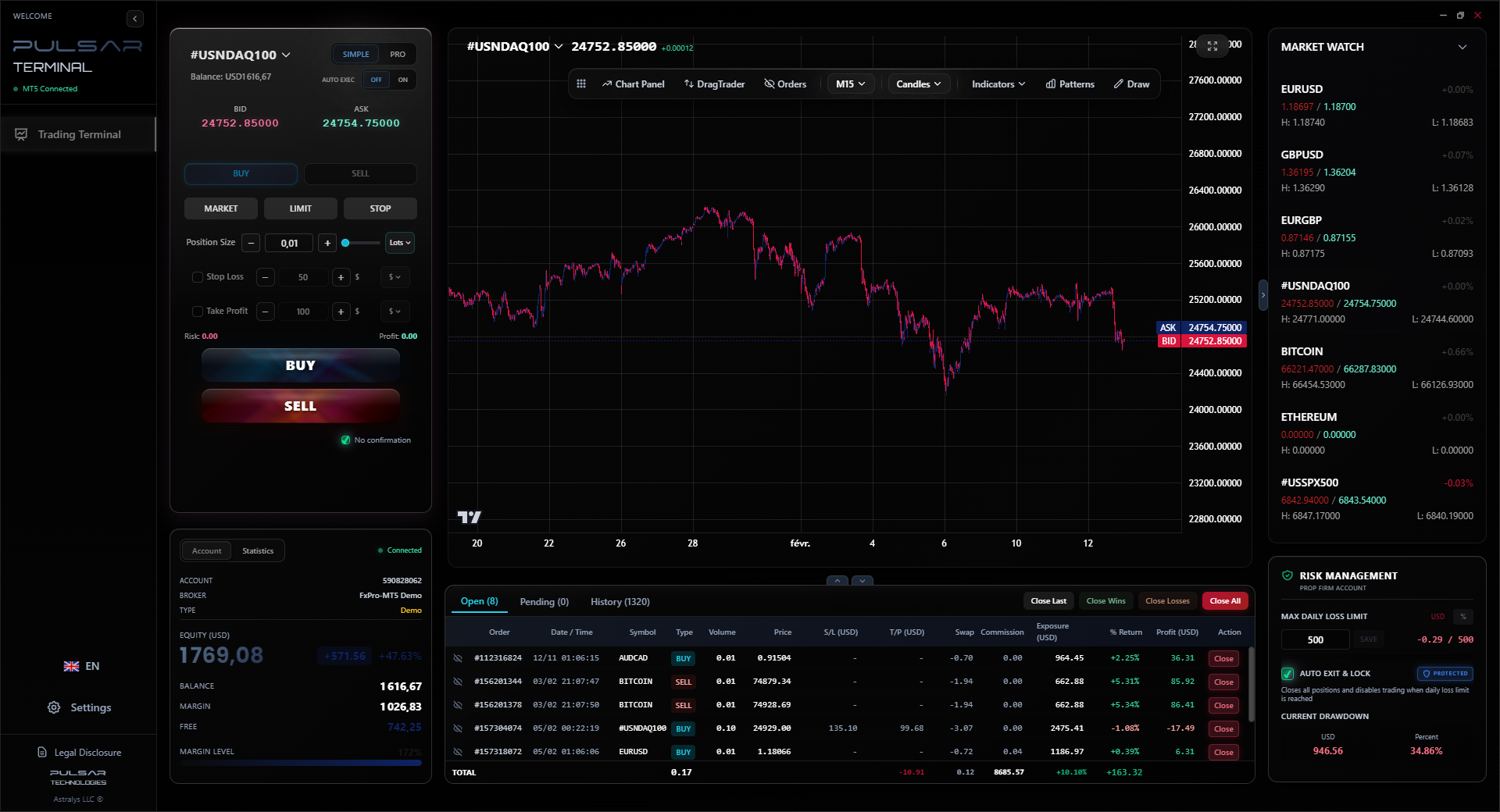
Once you move from demo to live, managing multiple trades and risk becomes critical; Pulsar Terminal's drag-and-drop orders and multi-TP/SL tools on MT5 turn complex risk management into a simple, visual process.
“Your greatest edge as a beginner is not being stupid.”
The local market has its own special breed of pitfalls.
The "Signal Seller" Scam: This is huge here. Someone on Instagram with a rented Ferrari promises guaranteed signals for R500/month. Remember the guy the FSCA debarred? That's him. If it was guaranteed, they'd be trading, not selling. Avoid entirely.
Prop Firm Hype: Proprietary trading firms where you pass a challenge to trade their capital are popular. They're not inherently a scam, but they're a terrible beginner goal. They require advanced risk management and consistency under pressure. Focus on being consistently profitable with your own small capital first for at least six months. The rules are brutal - a single bad day can fail you.
Over-Leveraging the Rand: USD/ZAR is volatile. Pair that with high use, and you can hit a margin call in a heartbeat. With 30:1 use, a 3.3% move against you wipes your margin. USD/ZAR can do that in a bad afternoon. Use half the use you're allowed, especially on ZAR pairs.
Ignoring Swap Rates: If you're swing trading and holding trades for days, the swap on USD/ZAR can be significant. You might make 50 pips on the trade but pay 20 pips in swap fees. Always factor it in.

Pro Tip: Your greatest edge as a beginner is not being stupid. Avoid these traps, focus on preserving capital, and you'll outlast the majority who blow up their accounts chasing the next big thing within three months.
FAQ
Q1Is forex trading legal in South Africa?
Yes, it's completely legal, but you must use a broker licensed by the Financial Sector Conduct Authority (FSCA). Trading with unregulated offshore brokers is risky and offers you no protection under South African law.
Q2What is the minimum amount I need to start forex trading in South Africa?
You can technically start with as little as R500 with some brokers. However, I'd strongly advise starting with a minimum of R2,000 - R5,000 on a demo account first to learn. When you go live, that amount allows for proper position sizing and risk management without being wiped out by a couple of bad trades.
Q3Why is use capped at 30:1 in South Africa?
The FSCA imposed this cap to protect retail traders from themselves. High use magnifies losses just as fast as profits. Most beginners misuse use, leading to rapid account blow-ups. The 30:1 cap forces more sensible trading and is a good thing for new traders.
Q4Do I pay tax on my forex trading profits?
Absolutely. The South African Revenue Service (SARS) views trading profits as income. You are required to declare them and pay income tax. Keep detailed records of all your trades, deposits, and withdrawals for your tax return.
Q5Is MetaTrader 4 or MetaTrader 5 better for beginners?
MetaTrader 4 (MT4), 100%. It's simpler, has a massive library of free educational resources and indicators tailored to it, and is universally supported. MT5 has extra features you won't use as a beginner, and its interface can be confusing. Start with MT4.
Q6Can I use international brokers like Exness or XM?
Q7What's the biggest mistake South African forex beginners make?
Two tied for first: 1) Using too much use on volatile pairs like USD/ZAR, and 2) funding a USD account with Rands and losing 3% immediately to bank conversion fees. Open a ZAR account, and use use sparingly.
Pelajaran Prof. Winston
:
- ✓Psychology beats strategy. Read 'Trading in the Zone' first.
- ✓FSCA regulation is non-negotiable. Always verify the FSP number.
- ✓Use a ZAR account to avoid 3% bank conversion tax.
- ✓Start simple: 100 SMA for trend, one oscillator, strict 1% risk.
- ✓use is a tool, not a reward. Start with 10:1, not 30:1.
Sejauh mana artikel ini berguna?
Klik bintang untuk menilai
Pandangan Dagangan Mingguan
Analisis & strategi mingguan percuma. Tiada spam.
Tentang Penulis
David van der Merwe
Pedagang Pasaran Membangun
Pedagang berpangkalan di Johannesburg dengan 11 tahun dalam mata wang pasaran membangun. Pakar dalam pasangan ZAR, dagangan terkawal FSCA, dan analisis pasaran Afrika Selatan.
Komen
Anda mungkin juga suka

Cara Trading Forex Sukses: 7 Prinsip dari Trader Profesional
Cara trading forex sukses dengan 7 prinsip trader pro: manajemen modal, disiplin, journal trading, backtest. Data nyata, bukan janji profit palsu.
Jam Trading Forex Terbaik untuk Trader Indonesia: Panduan Lengkap dengan Tabel Waktu
Panduan jam trading forex untuk trader Indonesia. Tabel 4 sesi dunia, jam emas 20:00-00:00, sesi mana yang harus dihindari. Data akurat + tips dari trader berpengalaman.
Top 5 Sàn Forex Uy Tín Nhất 2026: Review Jujur dari Trader Indonesia
Top 5 sàn forex uy tín 2026 untuk trader Indonesia. Review jujur: spread, deposit, withdraw, dukungan lokal. Exness, XM, IC Markets & lebih.
All these calculators are built into Pulsar Terminal with real-time data from your MT5 account. One-click position sizing, automatic risk management, and instant calculations.
