


I remember staring at my screen in 2018, watching a GBP/JPY trade blow through my stop loss.

Olumide Adeyemi
Perintis Dagangan Afrika Barat ·  Nigeria
☕ 10 minit baca
Apa yang akan anda pelajari:
- 1Why Backtesting is Non-Negotiable (Especially in Nigeria)
- 2The OG: MT5 Strategy Tester (Built-In & Free)
- 3TradingView's Replay Mode: The Visual Learner's Dream
- 4Specialized Backtesting Platforms: FX Blue & Soft4FX
- 5What to Look For: The Nigerian Trader's Checklist
- 6The Graveyard of Strategies: Common Mistakes to Avoid
- 7My Personal Backtesting Routine (Steal This)
I remember staring at my screen in 2018, watching a GBP/JPY trade blow through my stop loss. I was down ₦120,000 in minutes on a strategy I was 'sure' would work. That was the day I stopped gambling with live capital and got serious about backtesting. The right software isn't a luxury here, it's survival gear. It's the difference between funding your account and funding your broker's new car. Let's cut through the noise and find the tools that actually work for our market conditions, internet speeds, and budgets.
You wouldn't drive from Lagos to Abuja without checking your fuel and tires. Yet traders pour real Naira into strategies they've never tested. It's madness. In Nigeria, where market moves can be exaggerated by liquidity gaps and our own economic news, a strategy that works on EUR/USD might get slaughtered on USD/NGN pairs. Backtesting shows you the real expectancy: how much you can expect to make per trade over the long run. It reveals if your brilliant idea is just curve-fitted to past data - a fancy way of seeing ghosts in the noise.
I learned this the hard way with a scalping strategy I built for gold. On a demo, it won 7 trades in a row. I put $500 live on it. The eighth trade was a news spike that wiped out 80% of that account because my stop was too tight for typical XAU/USD volatility. A proper backtest over 5 years of data would have shown that exact scenario happening a dozen times.

Warning: A strategy tested on only 3 months of data is worse than useless. It gives you false confidence. You need to see how it handles bull markets, bear markets, and sideways chop across multiple years.
Your goal isn't to find a perfect system. It's to find a strong one that survives slippage, spread widening (common with Nigerian brokers during volatility), and your own emotional interference. This is where a good position size calculator becomes your best friend, but only after you have solid backtested numbers to plug into it.

💡 Petua Winston
A strategy that hasn't survived a 30% drawdown in a backtest won't survive a 10% drawdown in your hands. Test for pain, not just profit.
“The right backtesting software isn't a luxury, it's survival gear for your trading account.”
Let's start with what you probably already have. If you trade with a broker like Exness or IC Markets, you have access to MetaTrader 5. The built-in Strategy Tester is your foundation. It's not flashy, but it's brutally honest.
What It Does Well
It tests Expert Advisors (EAs) and custom indicators with precision. You can model every tick (using real tick data if you download it), which is crucial for accurate scalping results. The reporting gives you the raw stats: profit factor, expected payoff, max drawdown in both cash and percentage terms. I use it as my first filter. If an EA can't show a profit factor above 1.3 over a 5-year multi-currency backtest here, I scrap it immediately.
The Limitations
It's clunky. Coding strategies in MQL5 has a learning curve. The visual interface is from the Windows 98 era. And while it's great for testing automated systems, manually testing a discretionary price action strategy is a pain. You can't easily replay the market day-by-day to see how your rules would have played out in real-time.

Pro Tip: Always test using the 'Every Tick' model AND the '90% of ticks' model. If the results differ wildly, your strategy is too sensitive to slippage and spread - a death sentence for trading with Nigerian internet latency.
For the price (free), it's unbeatable for basic validation. But it's just the start. To truly build confidence, you need to see your strategy in action, not just look at the final equity curve. That's where the next tier of software comes in.
“A strategy tested on only 3 months of data is worse than useless - it gives you false confidence.”
This is where the game changed for me. TradingView's Premium subscription (about $15/month) includes Bar Replay mode. It lets you roll back the chart to any date and play the market forward, candle by candle or bar by bar, hiding the future data.
Why is this a killer feature for us? It bridges the gap between pure mechanical backtesting and live trading. You can practice your entry and exit rules in real-time on historical data. Found a nice pin bar on EUR/USD from 2022? Hit replay, go to the day before it formed, and watch it develop. Would you have actually taken the trade?
I used this to refine my swing trading rules. My backtest said my win rate was 55%. But in replay mode, I discovered I was missing the best setups because they didn't look 'perfect' in the moment. My actual executable win rate was closer to 48%. That insight saved me from margin call territory by forcing me to adjust my position size calculator inputs.
The Catch: It's manual. You can't run a 10-year automated test. It's for qualitative validation and psychology training. Use it to confirm the numbers your MT5 Strategy Tester spits out. The combination is powerful: MT5 for the hard stats, TradingView Replay for the feel.
“A strategy tested on only 3 months of data is worse than useless - it gives you false confidence.”
When you need to get surgical, you step up to dedicated tools. These are for traders who are serious about system development.
FX Blue Trade Simulator: This is a gem. It's a free MT4/MT5 plugin that simulates trades in real-time on historical data. You can manually click entries and exits, or it can semi-automate your rules. The beauty? It accounts for spread, commission, and swap in real-time. I used it to test a grid trading strategy and found the swap costs would have eaten 30% of my profits on a USD/NGN rollover. That's a deal-breaker you won't find in a simple MT5 test.
Soft4FX Simulator: This is the professional's choice, but it comes at a cost (around $200 one-time). It imports MT4/MT5 history and lets you replay the market with an incredible level of detail. You can see the order book depth (if you have the data), test execution delays, and model different broker spread behaviors. It's overkill for a beginner, but if you're managing serious capital or designing EAs for sale, it's worth every penny.

Example: Testing a simple MACD indicator crossover on GBP/USD from 2020-2023.
- MT5 Tester: Profit = $2,150, Max Drawdown = 12%
- FX Blue (with 1-second execution delay & variable spread): Profit = $1,840, Max Drawdown = 15% That 14% difference in profit is your reality check.
These tools answer the critical question: "Will this work in the real world with my broker, on my connection?" For most Nigerian retail traders starting out, FX Blue's free tools are a massive upgrade.
💡 Petua Winston
The 'optimization' button is the most dangerous in any software. Use it to find a stable range of parameters, not a single magic number.
“Over-optimization is just fitting your strategy to past noise. The future won't repeat it.”
Don't just download the shiniest app. Your best forex backtesting software must check these boxes for our local reality.
- Offline Functionality: Can it run without a constant internet connection? We all know about 'NEPA taking light' or data network dips. Your testing shouldn't stop.
- Data Handling: It must allow you to import quality historical data. The free data that comes with MT5 is often incomplete. You need clean tick data for accurate results, especially for major pairs like the ones in our EUR/USD guide.
- Realistic Cost Modeling: Can it factor in the actual spreads from your broker? If you're with XM or Pepperstone, their average spreads on a pair should be input into the model. A strategy that's profitable at a 0.8 pip spread might bleed money at 1.5 pips.
- Speed: Testing 10 years of data on multiple timeframes shouldn't take 3 days. Time is money.
- Clear Reporting: It must output the key metrics in a way you understand: Profit Factor, Sharpe Ratio, Max Consecutive Losses, and Largest Drawdown. If you can't find the drawdown figure in 10 seconds, the software is failing you.
Here’s a quick comparison for clarity:
| Software | Best For | Cost | Key Limitation for NG Traders |
|---|---|---|---|
| MT5 Tester | Testing EAs & automated systems | Free | Poor manual testing, ugly interface |
| TradingView Replay | Visual, discretionary strategy practice | ~$15/mo | Not automated, manual process |
| FX Blue Simulator | Realistic trade simulation with broker costs | Free | MT4/MT5 only, requires some setup |
| Soft4FX | Professional, ultra-realistic institutional testing | ~$200 one-time | Steep learning curve, expensive |
Start with the free tools. Master them. Only pay for an upgrade when you can articulate exactly what the free tool is missing for your specific needs.
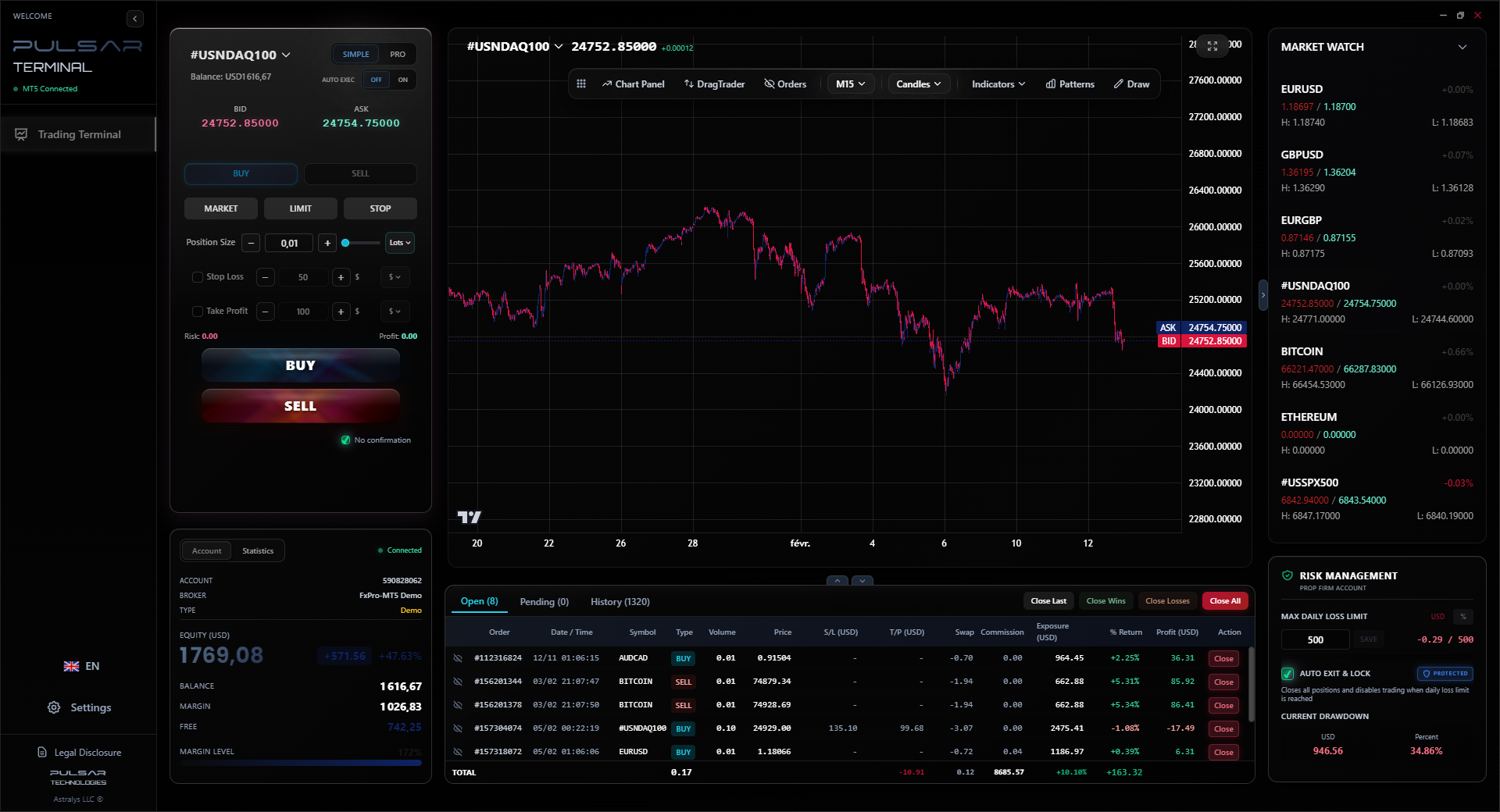
Once your strategy is backtested, executing it precisely is key. Pulsar Terminal automates complex order management like multi-TP/SL and trailing stops directly on your MT5, so your live trades match your plan.
“Over-optimization is just fitting your strategy to past noise. The future won't repeat it.”
I've buried more strategies than I care to admit. Here's how to avoid the common pitfalls that turn a great backtest into a live trading disaster.
Over-optimization (Curve-Fitting): This is the big one. You tweak your RSI indicator setting to 27.5 instead of 30 because it gives you 5% more profit. You've just fitted your strategy to past noise. The future won't repeat it. A strong strategy works with RSI at 28, 30, or 32.
Ignoring Slippage and Spread: Your backtest assumes you get filled at the exact price you click. In Lagos during a news event? Forget it. Always add a realistic slippage figure (1-2 pips for majors, more for exotics) and use the worst spread your broker quotes, not the average.
Too Short a Time Period: Testing only on 2023's trending market? What about the ranging mess of 2021? Your test must include different market environments (trending, ranging, volatile).
Survivorship Bias: You test on a major pair that's always liquid. Try that same strategy on a less common cross pair. The liquidity dries up, spreads widen, and your stops get hunted. This is critical if you ever look at XAU/USD or other CFDs.
The antidote to all of this is out-of-sample testing. Backtest on data from 2015-2020. Then, validate it on completely unseen data from 2021-2022. If it holds up, you might have something. If it fails, you just saved your account.
💡 Petua Winston
Your first 100 hours of backtesting should be spent trying to break your strategy, not prove it's brilliant. Be your own worst critic.
“The goal isn't to find a perfect system. It's to find a strong one that survives your own emotional interference.”
Here's exactly what I do, step-by-step, before a single Naira goes live.
- Idea Generation: I see a pattern or indicator setup (e.g., MACD divergence at a key level). I write the entry, stop loss, and take-profit rules in plain English. No ambiguity.
- Quick & Dirty MT5 Test: I code a simple EA for the rules or use a visual backtester. I run it on 8 years of data across 3-4 major pairs. I'm looking for a profit factor > 1.5 and a max drawdown under 25%. If it fails here, it's dead. 90% of ideas die at this stage.
- TradingView Replay: For the 10% that pass, I take it to TradingView. I manually replay 100-200 setups across different years. This builds muscle memory and confirms I can actually spot the setup in real-time conditions.
- FX Blue Reality Check: I run a 1-year simulated trade history in FX Blue, using the exact spreads from my IC Markets account. This final step often kills another 5% of strategies due to execution friction.
- Forward Test (Demo): Only then does it go to a 1-month demo test with tiny size. This is the final exam.
This process takes time. A solid strategy might take 40-60 hours to properly vet. That's the work. The trading is just the button click at the end. Remember, the goal of finding the best forex backtesting software isn't to find a magic profit machine. It's to build an unshakeable confidence in your edge, so when the drawdown hits (and it will), you don't abandon ship.
FAQ
Q1Is free backtesting software good enough?
Absolutely. For 95% of Nigerian retail traders, the combination of MT5's free Strategy Tester and FX Blue's free simulator is more than enough. Paying for software before you've maxed out the free tools is like buying a Formula 1 car to learn to drive in Lagos traffic - pointless and expensive.
Q2How much historical data do I really need?
Minimum 5 years. Preferably 7-10. You need to see how your strategy behaves through a major crisis (like the 2020 pandemic crash), periods of high inflation, and boring ranging markets. One year of data is a snapshot, not a movie.
Q3My backtest is profitable but I lose live. Why?
Psychology first. But technically, it's usually one of three things: 1) You didn't account for realistic slippage and spread, 2) You over-optimized the strategy to past data (curve-fitting), or 3) You're not executing the rules exactly as tested. A live trade feels different than a backtest line on a chart.
Q4Can I backtest manual strategies or only EAs?
You can and must test manual strategies. Use TradingView's Replay mode for visual practice. For rule-based manual strategies, you can often code the basic logic into an EA for an initial MT5 backtest to get the statistical edge, then practice execution manually in Replay mode.
Q5What's the single most important backtest metric?
Maximum Drawdown. It tells you the worst peak-to-trough loss your account would have suffered. If that number makes you sweat (e.g., 40%), your position size is too big, or the strategy is too risky. Profit Factor is a close second - anything below 1.2 is barely worth the risk.
Q6How do I get quality historical data for backtesting?
For free data, Dukascopy and TrueFX offer decent tick data for majors. For more reliable, clean data, paid services like Tickstory (around $50) are popular. It's worth the one-time fee if you're serious. Garbage data in = garbage results out.
Pelajaran Prof. Winston
:
- ✓Test for at least 5-7 years of data across different market environments.
- ✓Always model realistic slippage (1-2 pips) and your broker's worst spreads.
- ✓Maximum Drawdown is your most critical metric. Know it before you trade live.
- ✓Use free tools (MT5 Tester, FX Blue) before spending a single Naira on software.
Sejauh mana artikel ini berguna?
Klik bintang untuk menilai
Pandangan Dagangan Mingguan
Analisis & strategi mingguan percuma. Tiada spam.
Tentang Penulis
Olumide Adeyemi
Perintis Dagangan Afrika Barat
Salah seorang pendidik dagangan forex paling aktif di Nigeria. 8 tahun pengalaman dagangan dari Lagos. Pakar dalam strategi modal rendah dan cabaran prop firm untuk pedagang Afrika.
Komen
Anda mungkin juga suka

Cara Trading Forex Sukses: 7 Prinsip dari Trader Profesional
Cara trading forex sukses dengan 7 prinsip trader pro: manajemen modal, disiplin, journal trading, backtest. Data nyata, bukan janji profit palsu.
Jam Trading Forex Terbaik untuk Trader Indonesia: Panduan Lengkap dengan Tabel Waktu
Panduan jam trading forex untuk trader Indonesia. Tabel 4 sesi dunia, jam emas 20:00-00:00, sesi mana yang harus dihindari. Data akurat + tips dari trader berpengalaman.
Top 5 Sàn Forex Uy Tín Nhất 2026: Review Jujur dari Trader Indonesia
Top 5 sàn forex uy tín 2026 untuk trader Indonesia. Review jujur: spread, deposit, withdraw, dukungan lokal. Exness, XM, IC Markets & lebih.
All these calculators are built into Pulsar Terminal with real-time data from your MT5 account. One-click position sizing, automatic risk management, and instant calculations.
