


You're looking at Bidvest Forex and wondering if it's a good way to trade the markets, right? Let's get this straight from the start: it's not.

David van der Merwe
Pedagang Pasaran Membangun ·  South Africa
☕ 11 minit baca
Apa yang akan anda pelajari:
- 1What Bidvest Forex Actually Is (And Isn't)
- 2The SARB Cage: Regulations You Can't Ignore
- 3The Real Costs: Where They Make Their Money
- 4Bidvest vs. Real Forex Brokers: A World Apart
- 5How a Trader Might Actually Use Bidvest
- 6Better Alternatives for South African Traders
- 7Recent Shake-Ups and The Future
- 8Final Verdict for a Trader
You're looking at Bidvest Forex and wondering if it's a good way to trade the markets, right? Let's get this straight from the start: it's not. If you're a retail trader wanting to speculate on EUR/USD or gold, you've clicked on the wrong thing. Bidvest Forex is an Authorised Dealer for international payments and travel money. But that doesn't mean it's useless for us. Understanding how the traditional system works - the one regulated by the South African Reserve Bank (SARB) - is crucial. It's the cage we all operate in, and knowing its limits shows you where the real opportunities are. I'll break down exactly what Bidvest does, what it costs, and why you'd use a proper FSCA-regulated broker instead.
First, a crucial distinction. Bidvest Bank Limited is an Authorised Dealer with the SARB. That's a fancy term for a bank licensed to handle foreign exchange transactions under South Africa's strict Exchange Control Regulations. They are not, I repeat NOT, a forex broker for speculative trading.
Their core business is facilitating legitimate international payments for businesses and individuals. Think importing goods, paying for studies overseas, or sending money to family. They also do travel money: you can order foreign cash or get their Mastercard World Currency Card loaded with up to 17 currencies. It's a service for moving money across borders for a real purpose, not for trying to profit from rate fluctuations.
I learned this the hard way early on. About a decade back, I needed to fund an overseas brokerage account. I used my local bank (similar to Bidvest) for the transfer. The spread was criminal - a hidden 2.8% on the rate - and it took three business days. I lost potential market position and a chunk of capital before I even started. That was my tuition fee for understanding the difference between a payment service and a trading platform. For actual trading, you need a broker like IC Markets or Pepperstone, which give you direct market access.

Warning: Using a bank or Authorised Dealer like Bidvest for speculative trading is like using a cargo ship for a Formula 1 race. It's the wrong tool, it's slow, and the fees will sink you.
Whether you use Bidvest or a international broker, you operate under SARB's Financial Surveillance Department. Ignoring these rules isn't being a rebel; it's being reckless. Here’s what every South African trader must know.
The Personal Allowances
This is your lifeline. As a resident, you get two annual allowances:
- Single Discretionary Allowance: R1 million. You can move this offshore for any reason. No tax clearance needed.
- Foreign Investment Allowance: R10 million. This one requires a Tax Clearance Certificate from SARS. It's for investment purposes.
These are per calendar year. If you're serious about building capital, you're using these. I structure my annual transfers around them. I once tried to be clever and use a friend's allowance for a larger transfer. The bank's compliance department flagged it instantly, froze the transaction, and it took a month of paperwork to unravel. Not worth the headache.
The Iron Rules
- All transactions apply. There's no "small amount" exemption. Buying $50 for an app subscription falls under exchange control.
- 30-Day Re-Conversion Rule: Come back from a trip with leftover US dollars? You legally have 30 days to sell them back to an Authorised Dealer. I've never seen this enforced on small amounts, but it's on the books.
- Illegal Channels = Big Trouble. Buying Rands or Forex on the black market or through unlicensed schemes is a direct ticket to prosecution and asset forfeiture.
The system is designed to prevent capital flight. Your job as a trader is to work within it legally. This framework is why services like Bidvest Forex exist: they are the gatekeepers.

💡 Petua Winston
Your SARB allowances are annual. Use them or lose them. I schedule my major transfers in January to maximize time in the market.
“Bidvest Forex is the airport currency kiosk. A real forex broker is the stock exchange.”
Bidvest Forex and banks don't charge a commission the way you think. Their profit is in the spread - the difference between the real interbank rate and the rate they give you. It's a hidden fee.
While Bidvest talks about "competitive rates" and "fixed margins," the industry standard for traditional banks is a 2% to 3% margin built into the rate. On a R100,000 transfer, that's R2,000 to R3,000 gone before your money even leaves the country. Then add the SWIFT fee, which can be another R500 to R1,000.
Let's compare with some 2025 bank fees (this is public info):
| Service Provider | Typical Fee / Margin | Notes |
|---|---|---|
| Traditional Bank (e.g., Bidvest, Nedbank) | 2% - 3% margin + SWIFT fee | Hidden in the rate. Nedbank's explicit travel commission is ~2.15%. |
| Capitec Bank | R250 - R500 flat fee | For specific international payment types. Clearer, but still adds up. |
| Fintech (e.g., Future Forex) | Claims up to 50% lower | Newer players attacking the hidden margin model. |
| Forex Broker (e.g., XM) | As low as 0.0 pips + commission | For trading, not payments. Spreads on EUR/USD can be under 1 pip. |

Example: You need to send €10,000 overseas. Interbank rate is 20.00 ZAR/EUR.
- Bidvest/Bank Rate: They might offer you 20.40 ZAR/EUR (a 2% margin). Cost: R204,000.
- Real Cost: R200,000.
- Your Hidden Fee: R4,000. That's a lot of pips to make back.
For their World Currency Card, watch for the "Currency Conversion Fee" if you spend in a currency you didn't load. It's another layer of cost. The bottom line: for large payments, that 2-3% is a massive drag. For trading, it's a non-starter. You'd be wiped out by fees before your MACD indicator even gave a signal.
This is the core confusion. Let's lay it out side-by-side.
Bidvest Forex (Authorised Dealer):
- Purpose: International payments, travel money, currency exchange.
- Regulator: South African Reserve Bank (SARB) as an Authorised Dealer.
- Pricing: Wide spread (2-3%), fixed fees.
- Platform: Online ordering, bank branches. Not a trading platform.
- Action: You buy currency to send or spend. It's a one-time transaction.
- Minimum: Whatever the payment amount is.
FSCA-Regulated Forex Broker (e.g., Exness, FP Markets):
- Purpose: Speculative trading on currency pairs, indices, commodities.
- Regulator: Financial Sector Conduct Authority (FSCA) in SA.
- Pricing: Tight spreads (often below 1 pip), sometimes a small commission.
- Platform: MetaTrader 4/5, cTrader – with charts, indicators, use.
- Action: You open/close trades to profit from price movement. No physical currency changes hands.
- Minimum Deposit: Can be as low as $100 (≈R1800).
Think of it like this: Bidvest is the airport currency kiosk. A forex broker is the stock exchange. One lets you convert money for a trip; the other lets you bet on the direction of the entire travel industry.
If your goal is to trade, you need the broker. Full stop. The use, the real-time charts, the ability to go short - none of that exists with Bidvest. I use brokers for trading, and I use a cheap fintech service (when I can't use my broker's card) for moving profits back home. Different tools for different jobs.
💡 Petua Winston
Always ask for the 'all-in' rate. The number before the slash on the screen is a lie. The real cost is the total ZAR leaving your account divided by the foreign currency received.
“A 3% bank fee means your trade needs a 3% profit just to break even. That's not an edge, it's an anchor.”
So, does a trader ever touch Bidvest Forex? Possibly, in two specific scenarios.
Scenario 1: Funding a Foreign Brokerage Account. Let's say you've done your research and opened an account with an international broker that doesn't offer ZAR accounts. You need to get your Rands into USD or EUR to fund it. You could use Bidvest's international payment service. Here's the process:
- Ensure your transfer is within your annual SARB allowance.
- Provide supporting documents to Bidvest (invoice from broker, maybe a statement).
- Pay their spread and fee.
- Wait 1-3 days.
It's legitimate but expensive. A smarter move is to find an FSCA-regulated broker that offers a ZAR account, so you deposit and withdraw in Rands, avoiding the conversion fee on every transaction.
Scenario 2: The Travel Card for Research Trips. This is a niche one. If you're a fundamentals trader who travels to conferences or to get a feel for an economy (e.g., checking Turkish inflation firsthand), the World Currency Card can be handy. You can lock in a rate before you go. But for most retail traders, a global debit card from your broker or a Wise/Revolut card will be cheaper.

Pro Tip: Before using any bank for an international transfer, get the quote in writing: the exact exchange rate and all fees. Then compare it to the mid-market rate on Google or XE. The difference is your true cost. You'll often find fintechs are 1-1.5% better.
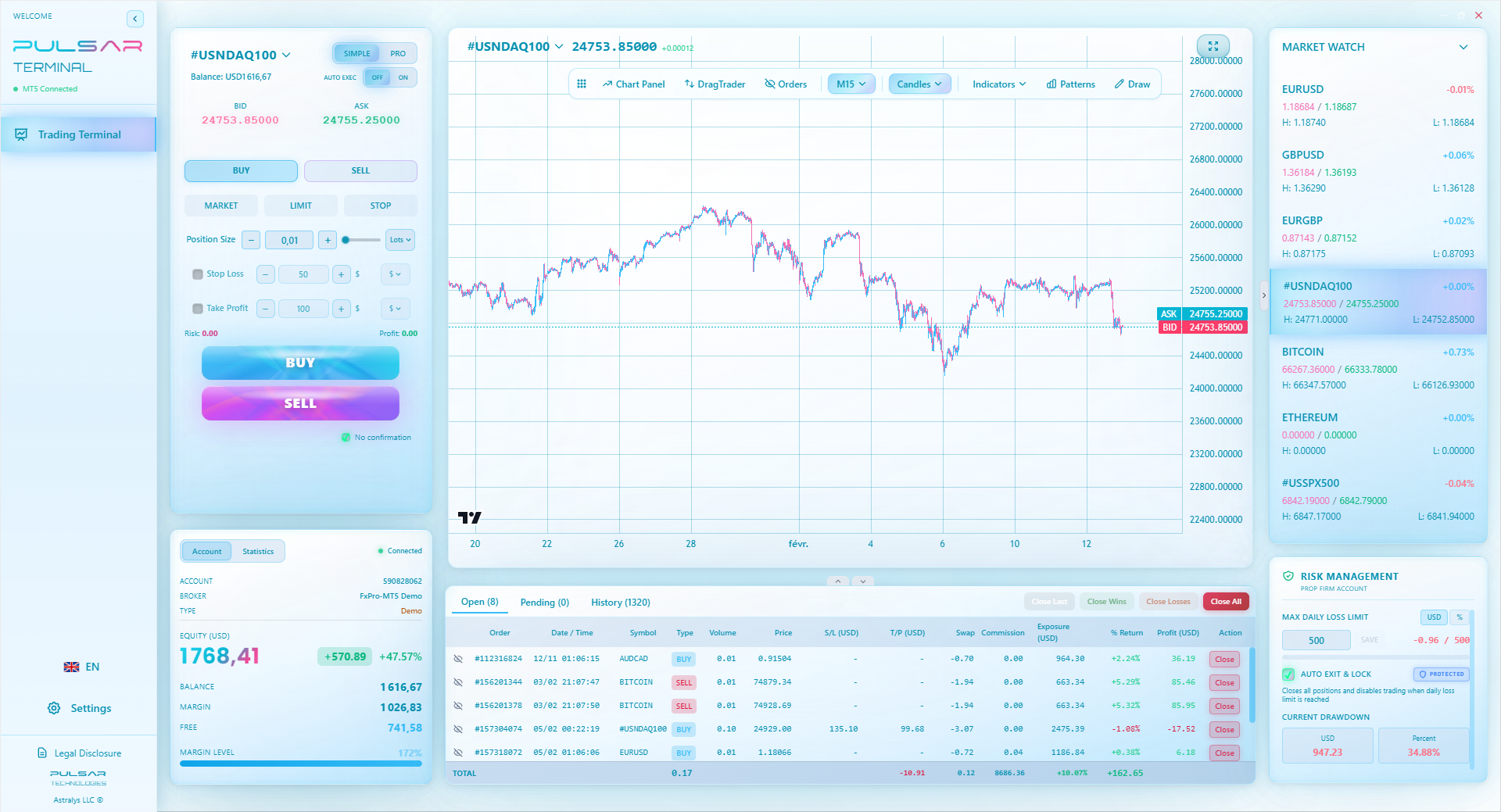
Managing complex trades and risk across different brokers and accounts is where a tool like Pulsar Terminal, with its unified dashboard and advanced order types, becomes indispensable for the serious SA trader.
Your world shouldn't be limited to Bidvest. Here's the environment you should know.
For International Payments & Transfers:
- Fintechs: Wise (formerly TransferWise), Future Forex, CurrencyFair. They use peer-to-peer matching or better rates, often cutting the cost by more than half. I use Wise to bring profits back from overseas brokers; the transparency is brilliant.
- Specialist FX Companies: Smaller authorised dealers sometimes offer better corporate rates for large, regular business payments.
For Speculative Forex Trading:
- FSCA-Regulated Brokers: This is your arena. Look for brokers with a solid local presence and regulation. IC Markets (global, but popular here), Exness, and XM are common choices. They offer ZAR accounts, local bank deposit options, and tight spreads on XAU/USD and major pairs.
- Trading Platforms: MT4/MT5 is king here. It's where all the custom indicators and community knowledge resides. Your broker just provides access to it.
- Payment Methods: Many brokers now accept instant EFTs from major SA banks. Some are integrating with digital wallets. This makes funding and withdrawing faster and cheaper than a traditional telegraphic transfer through a bank.
The key is specialization. Don't ask a payment company to be your broker, and don't ask your broker to be your travel agent. Use the best tool for each specific job.
💡 Petua Winston
A 3% bank fee means your trade needs a 3% profit just to break even on the transfer. That's not an edge, it's an anchor.
“Don't fight the SARB system. Work within it intelligently.”
The landscape isn't static. Here's what's changed and where it's going.
The Big One: Access Bank's Acquisition. In 2024, Access Bank South Africa bought Bidvest Bank for R2.8 billion. What does this mean for you? Probably not much in the short term. The brand and services continue. Long-term, it might mean more integration into a pan-African banking network, which could improve rates for cross-border payments within Africa.
Fintechs on the Attack. As noted in mid-2025, companies like Future Forex are publicly calling out the "over R15 billion annually" in hidden bank fees. This public pressure and better technology are forcing transparency. Competition is finally arriving.
SARB's Slow Evolution. The 2020 promise of a new capital flow framework to reduce red tape is... still pending. The old exchange controls remain. However, the continuous publication of guidelines (like the January 2026 individual guide) shows they're trying to clarify a complex system. For traders, the allowances are generous enough if you plan properly.
Broker Competition Heats Up. More global brokers are getting FSCA regulation and catering to the SA market. This competition drives down spreads and improves platform features. Your position size calculator and risk management tools are now far more sophisticated than they were five years ago.
The trend is clear: transparency is increasing, and costs for pure currency exchange are falling. But the fundamental wall between payment services and leveraged trading platforms remains. Know which side of that wall you're on.
Here's my blunt assessment after 12 years of navigating this system.
Bidvest Forex is not a trading product. It will not help you execute a scalping strategy or manage a trailing stop. If you walked in there asking for a trading account, they'd look at you like you're lost.
However, understanding Bidvest's world is critical. It's the regulated, SARB-approved pipeline that makes everything else possible. It defines the rules (the allowances, the documentation) that you must follow to move money legally. It's the benchmark for high-cost, traditional forex services.
Your action plan:
- For Trading: Open an account with a reputable, FSCA-regulated broker. Fund it via their cheapest local payment method. Never use a bank's international transfer for regular trading deposits.
- For Moving Large Sums: If you need to move profits back or fund an overseas account, compare Bidvest's quote (get it in writing) against a fintech like Wise. The fintech will almost always win.
- For Travel Money: Their World Currency Card is fine, but again, compare with fintech travel cards. For small amounts, the convenience might outweigh a small cost difference.
Don't fight the SARB system. Work within it intelligently. Use Bidvest as a reference point for cost, but not as a tool for your trading business. Your edge as a trader comes from your market analysis and discipline, not from finding a cheap way to convert Rands. Don't let the complexity of South Africa's exchange controls be the thing that triggers a margin call. Plan your money moves with the same precision you plan your trades.
FAQ
Q1Can I trade forex with Bidvest Forex?
No, absolutely not. Bidvest Forex is an Authorised Dealer for international payments and travel money, not a leveraged speculative trading platform. You cannot open positions, use margin, or trade currency pairs through them.
Q2What are the typical hidden fees when using a bank like Bidvest for forex?
The main fee is the spread margin, typically 2% to 3% built into the exchange rate they offer you. On a R100,000 transaction, that's a R2,000-R3,000 hidden cost. You may also pay a SWIFT telegraphic transfer fee of R500-R1000.
Q3How do I legally get money overseas to fund a trading account?
Use your annual SARB allowances (R1m discretionary, R10m investment with tax clearance). The cheapest method is to use an FSCA-regulated broker with a ZAR account. If you must fund a foreign broker, compare transfer costs from your bank against fintechs like Wise, and always stay within your allowance limits.
Q4Is Bidvest Bank's World Currency Card good for traders?
Only in a very specific case: if you travel internationally for trading research or conferences and want to lock in a rate beforehand. For daily use, a multi-currency card from a fintech or a global debit card from your broker is usually cheaper and more flexible.
Q5What's the difference between SARB regulation (Bidvest) and FSCA regulation (brokers)?
SARB regulation via Authorised Dealer status is about controlling cross-border money flows and enforcing exchange controls. FSCA regulation is about overseeing financial services providers (like brokers) to ensure fair conduct, client fund protection, and market integrity for trading activities.
Q6Did the Access Bank acquisition change Bidvest Forex services?
Not significantly for retail customers in the short term. The brand and services continue. Long-term, it may lead to better integration for cross-African payments via Access Bank's network, but core forex exchange and payment services remain the same.
Q7As a trader, when should I actually contact Bidvest Forex?
Only if you need a large, documented international payment for a legitimate purpose (e.g., moving profits back home, paying for overseas services) and you want a quote to compare against fintech alternatives. They are not your first port of call for anything trading-related.
Pelajaran Prof. Winston
:
- ✓Bidvest is for payments, not trading.
- ✓SARB allowances are R1m & R10m annually.
- ✓Hidden bank fees can cost 2-3% per transfer.
- ✓Use FSCA brokers for speculative trading.
- ✓Always compare costs with fintechs.
Sejauh mana artikel ini berguna?
Klik bintang untuk menilai
Pandangan Dagangan Mingguan
Analisis & strategi mingguan percuma. Tiada spam.
Tentang Penulis
David van der Merwe
Pedagang Pasaran Membangun
Pedagang berpangkalan di Johannesburg dengan 11 tahun dalam mata wang pasaran membangun. Pakar dalam pasangan ZAR, dagangan terkawal FSCA, dan analisis pasaran Afrika Selatan.
Komen
Anda mungkin juga suka

Cara Trading Forex Sukses: 7 Prinsip dari Trader Profesional
Cara trading forex sukses dengan 7 prinsip trader pro: manajemen modal, disiplin, journal trading, backtest. Data nyata, bukan janji profit palsu.
Jam Trading Forex Terbaik untuk Trader Indonesia: Panduan Lengkap dengan Tabel Waktu
Panduan jam trading forex untuk trader Indonesia. Tabel 4 sesi dunia, jam emas 20:00-00:00, sesi mana yang harus dihindari. Data akurat + tips dari trader berpengalaman.
Top 5 Sàn Forex Uy Tín Nhất 2026: Review Jujur dari Trader Indonesia
Top 5 sàn forex uy tín 2026 untuk trader Indonesia. Review jujur: spread, deposit, withdraw, dukungan lokal. Exness, XM, IC Markets & lebih.
All these calculators are built into Pulsar Terminal with real-time data from your MT5 account. One-click position sizing, automatic risk management, and instant calculations.
