


Here's a fact that cost me money early on: over 60% of retail traders lose because of poor entry timing and emotional decisions.

David van der Merwe
Pedagang Pasaran Membangun ·  South Africa
☕ 11 minit baca
Apa yang akan anda pelajari:
- 1What Exactly Is a Buy Limit Order?
- 2Buy Limit vs. Other Orders: Don't Mix Them Up
- 3When Should a South African Trader Use a Buy Limit?
- 4Common Mistakes & Risks I've Made (So You Don't Have To)
- 5How to Set Up a Buy Limit with FSCA Brokers
- 6Advanced Strategies & Pro Tips for the Local Market
- 7Final Thoughts: Patience is a Strategy
Here's a fact that cost me money early on: over 60% of retail traders lose because of poor entry timing and emotional decisions. I was part of that statistic until I stopped chasing price and started letting it come to me. That's where understanding the buy limit meaning in forex changed everything. It's not just a button you click; it's a disciplined strategy for entering the ZAR pairs and majors traded by South Africans. This guide will show you exactly how to use it, where I messed up, and how to integrate it with our local brokers and regulations.
Let's cut through the jargon. A buy limit order is a pending order you place to buy a currency pair at a specific price below the current market price. You're telling your broker's platform, "Hey, if the price drops down to this level I like, please open a buy trade for me automatically."
It's the opposite of buying at the market price right now. You're anticipating a dip, a pullback to support, or a retracement before the price moves up again. The key thing to remember: it only gets triggered if the market price falls to your specified price or goes through it. If the price never drops that far, your order just sits there, waiting. It's a patient trader's tool.
I used to watch the USD/ZAR chart, see it rising, and FOMO-buy at the top, only for it to immediately retrace 50 pips. A buy limit order forces you to define your value area beforehand. It takes the emotion out of the entry. You decide your price based on your analysis, not on the panic or excitement of the moment.

Warning: Execution isn't 100% guaranteed. In extremely fast-moving markets (like during a major SARB announcement), the price might skip your level. Your broker will execute at the next available price, which could be worse than you planned. This is called slippage.

💡 Petua Winston
A buy limit without a stop loss is just a hope. The market doesn't reward hope. Always attach your stop the moment you place the order.
When you're setting up an order on MT4 or MT5 with your FSCA-regulated broker, the options can be confusing. Getting them wrong is a classic rookie error.
Buy Limit vs. Buy Stop: This is the big one. A Buy Limit is set below the current price to catch a dip. A Buy Stop is set above the current price to catch a breakout. I once meant to set a buy limit on EUR/USD at 1.0850 (below price) but accidentally set a buy stop. The price spiked, triggered my order at a terrible high, and I was instantly in a losing trade. Double-check your order type every single time.
Buy Limit vs. Market Order: A market order is "buy right now at whatever price is available." It's immediate. A buy limit is conditional and patient. Use market orders when you need immediate entry for a scalping strategy, and buy limits when you're planning a swing trading entry at a key level.
Buy Limit vs. Sell Limit: A Sell Limit is a pending order to sell above the current price, expecting a drop from a resistance level. They're mirror images.
Here’s a quick table to keep it straight in your head:
| Order Type | Where You Set It | Your Market Expectation |
|---|---|---|
| Buy Limit | Below current price | Price will dip, then rise |
| Buy Stop | Above current price | Price will break out higher |
| Sell Limit | Above current price | Price will rise, then fall |
| Sell Stop | Below current price | Price will break down lower |
“A buy limit order forces you to define your value area before the market gets there. It trades patience for price.”
At Key Support Levels on ZAR Pairs
This is my bread and butter. The USD/ZAR and EUR/ZAR can be volatile. When they approach a clear historical support level on the daily or 4-hour chart, I don't buy there. I place a buy limit order 5-10 pips below that support. Why? Because price often overshoots support briefly before bouncing. In early 2024, USD/ZAR tested support at 18.20. I placed a buy limit at 18.15. It dipped to 18.14, triggered my order, and rallied to 18.80. My entry was R0.05 better than if I'd placed a market order at the support line.
During Fibonacci Retracements
After a strong upward move, price often retraces. Using the Fibonacci tool, the 50% or 61.8% retracement levels are classic buy limit zones. Combine this with a support trendline or a key round number for confluence.
Before Major South African News
This is advanced and risky. Say the SARB is expected to hike rates, which should strengthen the Rand. You might anticipate an initial "sell the news" reaction in USD/ZAR (a spike up) before the fundamental strength kicks in. You could place a buy limit on EUR/ZAR at a lower level to catch the subsequent Rand strengthening move. You must understand the market narrative and use a tight stop loss.

For Trading Gold (XAU/USD) in ZAR Terms
While you trade XAU/USD in dollars, its value in Rand matters for your overall portfolio. When gold pulls back to a moving average like the 50-day EMA, a buy limit can be a great way to add to a position. Check out our specific guide on trading XAU/USD for more on this.
💡 Petua Winston
The best buy limit levels often have two or three technical reasons to be there. One reason is a guess. Three is a plan.
Mistake 1: Placing it in a Strong Downtrend. The biggest lesson I learned the hard way. A buy limit is for buying dips in an uptrend or a range. In 2023, GBP/ZAR was in a clear, strong downtrend. I saw it was "oversold" on the RSI indicator and placed a buy limit at a previous low. It triggered, bounced 30 pips, then continued crashing. I was trying to catch a falling knife. The trend always overrides an oscillator reading.
Mistake 2: Setting it Too Far from Price. Greed. You want a really good price, so you set your buy limit 200 pips below the market. The price might never get there, and you miss the entire move. Be realistic with your technical levels.
Mistake 3: Forgetting About the Spread. If you set a buy limit at 1.0700 on EUR/USD and the ask price hits 1.0700, your order should trigger, right? Not exactly. Remember, you buy at the ask price. If the spread is 2 pips, the bid price might be 1.0698 when the ask is 1.0700. Your broker's server might see the bid touch your level, but the ask hasn't. This can cause a slight delay or require the price to move a fraction further. Always be aware of your broker's typical spread, especially on exotic pairs like ZAR crosses.
Risk: Overnight Gaps. You have a buy limit set on EUR/USD for Monday. Over the weekend, a major event causes the market to open Sunday night (SA time) 50 pips below your buy limit. Your order won't trigger because the price opened already past your level. It gapped down. Pending orders don't protect against gaps.
Risk: Partial Fills on Large Orders. If you're placing a large order (say, 10 lots), your broker might only fill part of it at your exact limit price if there isn't enough liquidity. The rest gets filled at worse prices. This is more relevant for institutional sizes but good to know.
“I was trying to catch a falling knife with a buy limit in a downtrend. The trend always overrides a clever order placement.”
The process is similar across most platforms used by top South African brokers like IC Markets, Pepperstone, and XM. I'll use MetaTrader 5 (MT5) as the example, as it's the most common.
- Right-click on the chart of the pair you want to trade (e.g., USD/ZAR).
- Select "Trading" and then "New Order."
- A window pops up. Change the "Type" dropdown from "Market Execution" to "Pending Order."
- Another dropdown will appear. Select "Buy Limit."
- "Price": This is your entry price. Click the small arrow to automatically insert the current bid price, then manually adjust it lower to your desired level.
- "Stop Loss" and "Take Profit": ENTER THESE NOW. Do not leave them at zero. This is non-negotiable risk management. Your stop loss should be placed below your entry (below the support level you're targeting).
- "Volume": Choose your lot size. Use a position size calculator to determine this based on your account risk (e.g., never risk more than 1-2% of your capital on a single trade).
- "Expiration": You can set a date for the order to cancel if not triggered. Useful if your analysis is only valid for a few days (e.g., before a news event).
- Click "Place."
You'll now see a horizontal line on your chart at your entry price, usually in blue. Your trade is not active yet. It's waiting. You can drag and drop this line to adjust the price if you change your analysis.

Example: USD/ZAR is trading at 18.50. You identify strong support at 18.30. You decide to place a buy limit at 18.28 (2 pips below support to account for a slight overshoot). You have a R100,000 account and are willing to risk 1% (R1,000). You place your stop loss at 18.18 (10 pips or 100 points risk). Each pip on USD/ZAR is roughly R5.40 per standard lot for a ZAR-based account. To risk R1,000, you can trade a position size of about 0.18 lots. You set your take profit at 18.60 for a 3:1 reward-to-risk ratio.
💡 Petua Winston
If you find yourself constantly moving your buy limit order to chase a better price, you didn't have a plan. Cancel the order and go back to your charts.
The Buy Limit Grid: This is for ranging markets. Instead of one buy limit, you place several at descending price levels within a consolidation zone. For example, on EUR/USD trading between 1.0800 and 1.0900, you place buy limits at 1.0850, 1.0825, and 1.0800, each with a smaller position size. The idea is to average your entry price. Warning: This can quickly lead to over-use if the range breaks down. You must have a strict overall stop loss.
Combining with Sell Limits for a Range: In a clear range, you can set a buy limit at the bottom support and a sell limit at the top resistance. This systematizes range trading. Cancel the opposite order if one gets triggered.
Using it for Prop Firm Challenges: Many prop firms popular in SA have strict daily loss limits. A buy limit helps you enter precisely, avoiding emotional, poor entries that can blow your daily drawdown. It enforces discipline, which is 80% of passing those challenges.
Mind the Liquidity Times: The USD/ZAR market is most liquid during South African business hours and when London overlaps. Placing a buy limit in the dead of night SA time (during Asian session) might result in wider spreads and more slippage if triggered.
Always Check for Dividends/Swaps: If you're trading a ZAR pair and hold the position overnight, you'll pay or receive a swap (overnight financing fee). Factor this into your swing trading plan, especially if you plan to hold for several days. The swap can eat into profits or add to costs.
Managing multiple pending orders like buy limits and their attached stop losses across pairs is far easier with a tool like Pulsar Terminal, which lets you drag, drop, and modify everything directly on your MT5 chart.
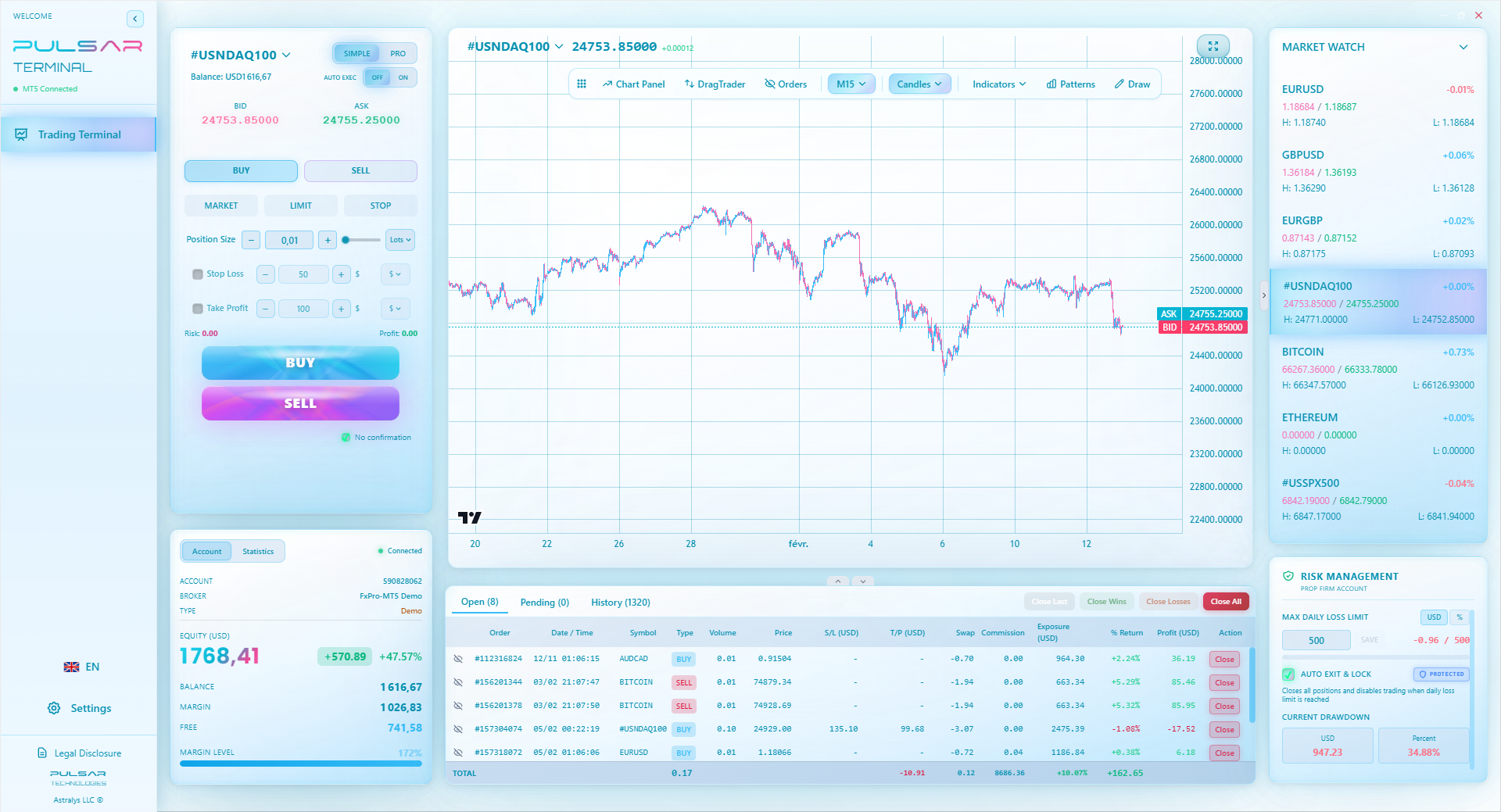
“That mental space a pending order creates? That's where the real trading edge is found.”
Understanding the buy limit meaning in forex was a turning point for me. It shifted my mindset from a reactive gambler to a proactive planner. It forced me to do the analysis before the trade, to define my risk, and to wait for the market to give me my price.
For us trading from South Africa, with the added complexity of ZAR volatility and specific FSCA rules, this kind of disciplined tool is useful. It helps navigate the higher use offered here (like 1:500 from some brokers) without getting shredded by emotional entries.
Start small. Take your favorite pair, maybe EUR/USD for its liquidity, and practice setting buy limits on pullbacks in a clear uptrend. Get used to the process on your broker's platform. Notice how it feels to not be glued to the screen, waiting to click. The trade is set. Your job is done until it triggers or you cancel it.
That mental space it creates? That's where the real trading edge is found. It lets you analyze the next opportunity instead of sweating the current one. Remember, the market will always give you another chance. A buy limit order is how you calmly prepare to take it.
FAQ
Q1Can a buy limit order be used to buy above the current price?
No, absolutely not. That's a common point of confusion. A buy limit order is specifically for buying below the current market price. If you want to buy when the price rises above a certain level (to catch a breakout), you need to use a Buy Stop order. Mixing these up is a very expensive mistake.
Q2What happens if the price gaps past my buy limit order?
If the market opens or moves so fast that it jumps from above your buy limit price to significantly below it without trading at your price, your order will not be executed. This is called a gap. Your pending order is only triggered if the actual ask price trades at or through your specified level. Gap risk is a real limitation of all pending orders.
Q3Is there a fee for placing a buy limit order with South African brokers?
Generally, no. FSCA-regulated brokers like XM or Tickmill do not charge a fee simply for placing a pending order. You only incur costs if the order is executed (the spread and/or commission). However, always check your specific broker's fee schedule for any unusual charges.
Q4How long does a buy limit order stay active?
By default, it stays active until you cancel it or it gets triggered. However, most platforms (MT4/MT5) allow you to set an expiry date and time when placing the order. This is useful if your trade idea is based on a short-term event or pattern that becomes invalid after a certain point.
Q5Can I modify or cancel a buy limit order after placing it?
Yes, you can. In your MT5 terminal, go to the "Trade" tab, find your pending order, right-click on it, and select "Modify or Delete Order." You can then change the entry price, stop loss, take profit, or lot size, or you can delete it entirely. This flexibility is key to managing your plan as the market evolves.
Q6Should I use buy limit orders for scalping the USD/ZAR?
It's possible but tricky. Scalping requires very fast entries. A buy limit can work if you identify a precise micro-support level on a 1 or 5-minute chart. However, the spread on USD/ZAR can be wider than majors, and during low liquidity, slippage on your limit order is more likely. Many scalpers prefer immediate market orders for speed. It depends on your strategy's precision.
Q7Does the FSCA have any rules about pending orders like buy limits?
The FSCA doesn't regulate specific order types. Their role is to ensure brokers are financially sound and treat customers fairly. However, they require brokers to have strong systems to execute client orders properly. If your broker consistently fails to execute valid buy limit orders (e.g., due to platform manipulation), that would be an FSCA compliance issue. Always use a well-regulated broker.
Pelajaran Prof. Winston
:
- ✓Buy Limits are for entries below price in uptrends/ranges.
- ✓Always attach Stop Loss & Take Profit immediately.
- ✓Beware of spreads & slippage on ZAR pairs.
- ✓Never use a Buy Limit in a strong downtrend.
Sejauh mana artikel ini berguna?
Klik bintang untuk menilai
Pandangan Dagangan Mingguan
Analisis & strategi mingguan percuma. Tiada spam.
Tentang Penulis
David van der Merwe
Pedagang Pasaran Membangun
Pedagang berpangkalan di Johannesburg dengan 11 tahun dalam mata wang pasaran membangun. Pakar dalam pasangan ZAR, dagangan terkawal FSCA, dan analisis pasaran Afrika Selatan.
Komen
Anda mungkin juga suka

Cara Trading Forex Sukses: 7 Prinsip dari Trader Profesional
Cara trading forex sukses dengan 7 prinsip trader pro: manajemen modal, disiplin, journal trading, backtest. Data nyata, bukan janji profit palsu.
Jam Trading Forex Terbaik untuk Trader Indonesia: Panduan Lengkap dengan Tabel Waktu
Panduan jam trading forex untuk trader Indonesia. Tabel 4 sesi dunia, jam emas 20:00-00:00, sesi mana yang harus dihindari. Data akurat + tips dari trader berpengalaman.
Top 5 Sàn Forex Uy Tín Nhất 2026: Review Jujur dari Trader Indonesia
Top 5 sàn forex uy tín 2026 untuk trader Indonesia. Review jujur: spread, deposit, withdraw, dukungan lokal. Exness, XM, IC Markets & lebih.
All these calculators are built into Pulsar Terminal with real-time data from your MT5 account. One-click position sizing, automatic risk management, and instant calculations.
