


Most Nigerian traders get cent accounts completely wrong.

Olumide Adeyemi
Perintis Dagangan Afrika Barat ·  Nigeria
☕ 10 minit baca
Apa yang akan anda pelajari:
- 1What Exactly Is a Cent Account? It's Not Just 'Small Money'
- 2Why This Matters for Nigerian Traders (The Real Reasons)
- 3The Brutally Honest Pros and Cons (No Sugarcoating)
- 4How to Actually Use a Cent Account: A Step-by-Step Plan
- 5Pitfalls Every Nigerian Trader Falls Into (And How to Avoid Them)
- 6Brokers and Platforms: What to Look For in Nigeria
- 7Moving Up: When and How to Transition to a Standard Account
- 8Beyond the Basics: Advanced Uses for the Disciplined Trader
Most Nigerian traders get cent accounts completely wrong. They either think it's just for kids or they treat it like Monopoly money, learning nothing. The truth is, a cent account is the single most powerful tool you have to go from a gambler to a professional trader, but only if you use it with the right mindset. I'll show you exactly how to do that, based on the brutal lessons I learned when I nearly blew my first real account.
Let's clear this up first. A cent account isn't just a regular account where you deposit a small amount of Naira. It's a different beast entirely. In a standard account, 1 lot is 100,000 units of the base currency. In a cent account, 1 lot is 1,000 units. More importantly, the profit and loss are displayed in cents, not dollars or naira.
Think of it this way: If you trade 0.01 lot on a standard account, your pip value might be $0.10. On a cent account, trading 1.00 lot (which is the equivalent size) gives you a pip value of $0.10... but it's displayed as 10 cents. The risk feels different psychologically. It allows you to trade proper position sizes with real market conditions, but the financial stakes are 1/100th of a standard account. This is the key feature most people miss. It's a simulation that uses real money, not a demo.

Pro Tip: Don't confuse a cent account with a micro account. Some brokers offer micro lots (0.01) on standard accounts. A true cent account has its own symbol, often ending in 'c' (like EURUSDc), and the P&L is in cents on your MT4/MT5 screen. Brokers like Exness and XM are popular in Nigeria for offering these.
Our market is unique. The economic pressure is real, and the temptation to try and turn 50k Naira into 500k Naira in a week is huge. That's a recipe for disaster. A cent account fights that impulse head-on.
First, it respects our capital constraints. You can start with the equivalent of $10 (about 15k Naira) and actually trade a sensible strategy, not just take one wild bet. Second, it kills the demo account disconnect. On a demo, you click buttons without feeling anything. With a cent account, you see real money - even if it's small - going up and down. That emotional connection is critical for learning discipline.
I made my worst mistake early on. I practiced a scalping strategy on a demo, made 'profit' for two weeks straight, then jumped into a standard account. I lost 30% of my deposit in one afternoon because the fear of losing real money made me freeze and break all my rules. Had I used a cent account bridge, I would have felt that pressure at a 1/100th of the cost.
The Psychology Bridge
This is the unsung hero of the cent account. It builds the muscle memory for risk management. When you set a 20-cent stop-loss and it gets hit, you feel a tiny sting. That sting teaches you more about the importance of stops than any textbook. It prepares you for the day your stop-loss on a standard account is $20.

💡 Petua Winston
A cent account is a microscope, not a toy. It's for studying your own psychology under minimal financial stress. If you can't follow a plan for 100 cents, you'll never follow it for 100 dollars.
“If you treat a cent account like a game, you will develop gaming habits.”
Let's be real. Cent accounts aren't magic.
The Good Stuff:
- Real Market Execution: You experience slippage, requotes, and spreads just like the big boys. A broker's spread definition on EURUSDc is the same as on EURUSD. This is useful.
- Test Strategies with Real Stakes: Backtesting is one thing. Forward-testing a strategy with real, albeit small, money is another. You'll see if you have the guts to follow it.
- Perfect for Micro Goals: Want to consistently make $1 a day? That's 100 cents. It's a clear, achievable target to build consistency.
The Ugly Truth:
- The 'Just Cents' Mentality Trap: This is the biggest killer. People overtrade because "it's just 50 cents." They don't use a position size calculator. They take 10 trades at once. This builds terrible habits.
- Withdrawal Hassles: Some brokers make withdrawing small cent-account profits annoying, with high fees relative to the balance. Always check the terms.
- False Confidence: Turning $10 into $20 feels easy. Turning $1,000 into $2,000 is a completely different game due to psychological pressure. Don't let a cent account win fool you.

Warning: If you treat a cent account like a game, you will develop gaming habits. You must trade it with the same seriousness as a $10,000 account. Your future self will thank you.
Here's my prescribed method, born from getting it wrong the first time.
Step 1: The Mindset Shift. Deposit the naira equivalent of $20-$50. Now, mentally multiply that number by 100. That's your 'virtual' capital. If you deposit $50, act as if you are managing $5,000. Every decision must reflect that.
Step 2: Position Sizing for Real. This is non-negotiable. If your strategy risks 1% of your 'virtual' $5,000 capital per trade, that's $50. On the cent account, your max risk per trade is therefore 50 cents. Use your calculator. For a trade on EUR/USD with a 15-pip stop, your position size must be calculated to lose no more than 50 cents if those 15 pips hit.
Step 3: The Performance Gate. Set a strict rule. You are not allowed to open a standard account until you can do all of the following on your cent account for 3 consecutive months:
- Achieve a consistent profit (doesn't have to be huge).
- Never breach your daily max loss (e.g., never lose more than 200 cents in a day).
- Follow your trading plan on every single trade, no exceptions.
I once broke my own gate. I had two good months, got excited, funded a standard account, and blew 40% of it in a week because I hadn't ingrained the discipline. I went back to the cent account for another four months. It was humbling, but it saved my trading career.
“The cent account phase is your laboratory. Without notes, you're just a monkey pushing buttons.”
I've seen these destroy people's progress time and again.
Pitfall 1: The Overtrading Spiral. Because lots are 'cheap,' traders take 5, 10, 15 positions. The screen is a mess. The broker loves you (you're paying spread on all of them), but you're learning nothing about market focus. Solution: Limit yourself to ONE open trade at a time in the learning phase.
Pitfall 2: Ignoring the News. "It's just a cent account, who cares about NFP?" Wrong. You need to experience how a major news event like U.S. payrolls can vaporize your careful stop-loss due to spread widening and slippage. Trade through these events intentionally to learn respect for the economic calendar.
Pitfall 3: No Record Keeping. You must journal. Every trade. Entry, exit, why you took it, how you felt. The cent account phase is your laboratory. Without notes, you're just a monkey pushing buttons. I still have my cent account journal from 2015. Looking back, I can see the exact moment I started respecting support and resistance, because my win rate jumped.
Pitfall 4: Chasing Prop Firm Payouts. This is a big one now. Traders use cent accounts to practice for prop firm challenges. That's smart. But they practice the wrong thing - they practice hitting profit targets. What you should practice is surviving. Practice not hitting the daily margin call equivalent. That's the real skill needed to pass.
💡 Petua Winston
The most valuable data from your cent account phase isn't your profit number. It's the record of every time you deviated from your plan. Those deviations are your enemy, and you must learn to recognize them before they cost you real money.
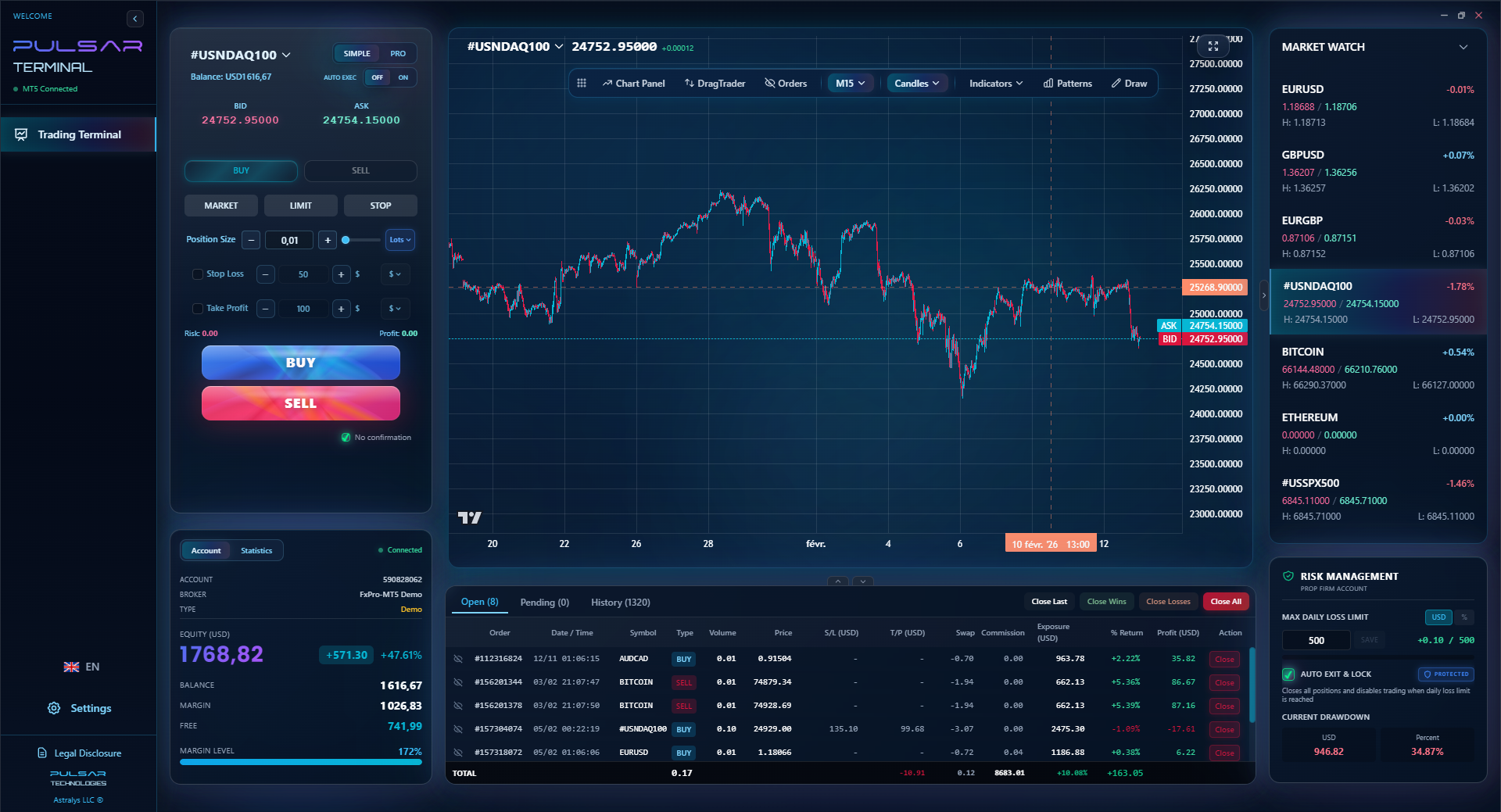
Manually tracking your cent account trades and daily loss limits is tedious; Pulsar Terminal automates this journaling and can enforce your max daily loss rule directly on your MT5 platform.
Not all brokers offering cent accounts are equal for Nigerian traders. Your checklist should include:
- Naira Deposits/Withdrawals: Local bank transfers or reliable payment gateways like Flutterwave or Paystack. You don't want to lose 20% of your cent profit to crazy forex conversion fees.
- True Cent Account Offering: Ensure it's a dedicated cent account type, not just micro lots.
- Regulation: While offshore, some oversight is better than none. It adds a layer of security for your funds.
- Platform Stability: MT4/MT5 is standard. Make sure it runs smoothly on your phone and laptop.
| Broker | Cent Account Note | Good For Nigerian Traders Because... |
|---|---|---|
| Exness | Offers a dedicated 'Cent' account type. | Excellent local deposit options, very popular in the market. |
| XM | Offers 'Micro' and 'Ultra Low' accounts with cent-based trading. | Strong educational resources, good for beginners. |
| IC Markets | Raw Spread account allows very small trade sizes. | the best execution speeds, good for serious practice. |
| Pepperstone | Razor account allows micro lots. | Top-tier regulation and reliable platforms. |
My personal journey started with a broker that had terrible withdrawal times for Nigeria. I switched to one with seamless local transfers, and it removed a massive headache. Always test the deposit and withdrawal process with a small amount first.
“The confidence wasn't hope, it was earned data.”
This is the graduation day. Don't rush it.
The 'When' Signs:
- You've hit your 3-month performance gate consistently.
- Your trading journal shows clear, repeatable patterns of success (and you understand why you succeeded).
- A losing trade doesn't make you want to 'revenge trade.' You just log it and move on.
The 'How' Process:
- Start Small, For Real: Fund your first standard account with money you can afford to lose completely. This is not your life savings. This is your 'standard account tuition fee.'
- Divide by 100 Mentally: Your cent account risk was 50 cents per trade? On your standard account, with $1,000, your 1% risk is $10. That feels massive compared to 50 cents. Start by risking 0.5% ($5) for your first 10 trades to re-acclimate.
- Trade Your Plan, Not Your P&L: The numbers will look bigger. You'll be tempted to close winners early and let losers run. This is the final test. You must execute the same plan you perfected on the cent account.
I remember my first standard account trade. It was on XAU/USD. My planned risk was $15. My hands were literally sweaty. The trade went against me and hit my stop. I lost the $15. The feeling was intense, but because I had felt the 'sting' of a 15-cent loss a hundred times before, I didn't panic. I just took the next setup. That's the power of a proper cent account foundation.
Once you've mastered the fundamentals, your cent account becomes a powerful R&D lab.
Testing New Instruments: Want to try trading GBP/JPY or US30? Don't experiment on your main account. Use a small allocation in your cent account to learn the pair's personality, its average spread, and how it reacts to news.
Strategy Stress-Testing: Found a new MACD indicator and RSI indicator confluence idea? Test it live for 20-30 trades in the cent account before you put a single dollar of real capital behind it. You'll quickly see if it has an edge or if it was just curve-fitted to past data.
Perfecting Swing Trading Psychology: Swing trades last days or weeks. On a demo, you just set and forget. On a cent account, you have to sit through the drawdowns and resist the urge to close early for days on end. This is priceless practice for the patience required in swing trading.
My most profitable swing trading strategy was developed entirely in a cent account over six months. I took 47 trades, refining my entry and stop placement each time. By the time I deployed it with real size, I knew every nuance, every likely drawdown scenario. The confidence wasn't hope, it was earned data.
FAQ
Q1Is a cent account the same as a demo account?
No, and this is a critical difference. A demo account uses virtual money with often ideal execution. A cent account uses your real money (albeit a small amount) and you experience real market conditions - slippage, spread widening, emotional attachment. It's a training simulator vs. a video game.
Q2How much naira do I need to start a cent account in Nigeria?
You can start with as little as 5,000-10,000 Naira (roughly $3-$7 equivalent). Many brokers have minimum deposits around $10. The key isn't the amount, it's treating that small sum as if it were 100 times larger for the purposes of risk management.
Q3Can I get rich from a cent account?
Realistically, no. The purpose is education and skill-building, not wealth creation. If you turn $10 into $100, that's a 900% return and fantastic, but it's still only $90 profit. The goal is to prove you can achieve consistent returns, so you can confidently apply the same principles to larger capital later.
Q4Which broker is best for cent accounts in Nigeria?
It depends on your needs. Exness is hugely popular for its easy Naira deposits and dedicated cent account. XM is great for beginners due to its education. For traders focused on execution speed above all, IC Markets is a top choice. Always verify their current deposit/withdrawal channels for Nigeria.
Q5How do I calculate my position size on a cent account?
Use the same position size calculator you would for a standard account, but remember your account balance and risk are in cents. If your 'virtual' capital is $5,000 (so $50 real), and you risk 1% ($50 virtual, $0.50 real), and your stop-loss is 20 pips, the calculator will tell you the lot size needed to lose 50 cents if stopped out. This discipline is everything.
Q6Should I use use on a cent account?
You can, but you shouldn't max it out. Use use to access sensible position sizes, not to take enormous risks because 'it's just cents.' If 1:100 use lets you trade a 0.1-lot position that aligns with your risk calculation, use it. If you're using 1:1000 to trade 10 lots on a $10 account, you're gambling, not learning.
Pelajaran Prof. Winston
:
- ✓Treat every 1 cent as if it were $1. Mental scaling is key.
- ✓Pass a strict 3-month performance gate before even thinking about a standard account.
- ✓Your journal is more important than your profit/loss statement.
- ✓Use the account to test strategies, not to chase tiny profits.
Sejauh mana artikel ini berguna?
Klik bintang untuk menilai
Pandangan Dagangan Mingguan
Analisis & strategi mingguan percuma. Tiada spam.
Tentang Penulis
Olumide Adeyemi
Perintis Dagangan Afrika Barat
Salah seorang pendidik dagangan forex paling aktif di Nigeria. 8 tahun pengalaman dagangan dari Lagos. Pakar dalam strategi modal rendah dan cabaran prop firm untuk pedagang Afrika.
Komen
Anda mungkin juga suka

Cara Trading Forex Sukses: 7 Prinsip dari Trader Profesional
Cara trading forex sukses dengan 7 prinsip trader pro: manajemen modal, disiplin, journal trading, backtest. Data nyata, bukan janji profit palsu.
Jam Trading Forex Terbaik untuk Trader Indonesia: Panduan Lengkap dengan Tabel Waktu
Panduan jam trading forex untuk trader Indonesia. Tabel 4 sesi dunia, jam emas 20:00-00:00, sesi mana yang harus dihindari. Data akurat + tips dari trader berpengalaman.
Top 5 Sàn Forex Uy Tín Nhất 2026: Review Jujur dari Trader Indonesia
Top 5 sàn forex uy tín 2026 untuk trader Indonesia. Review jujur: spread, deposit, withdraw, dukungan lokal. Exness, XM, IC Markets & lebih.
All these calculators are built into Pulsar Terminal with real-time data from your MT5 account. One-click position sizing, automatic risk management, and instant calculations.
