


Let me be straight with you: most custom indicators are a complete waste of time.

David van der Merwe
Pedagang Pasaran Membangun ·  South Africa
☕ 12 minit baca
Apa yang akan anda pelajari:
Let me be straight with you: most custom indicators are a complete waste of time. I've spent hundreds of hours coding them, only to realise they were just fancy lagging confirmations of what price was already screaming at me. But here's the twist - when you build the right one for the right reason, it can change everything. For us trading from SA, with our unique market hours and the ZAR's wild swings, a well-crafted custom tool isn't just nice to have; it can be the edge that keeps you profitable when others are getting stopped out. I'll show you the difference between useful customization and pointless complexity.
You can download a thousand indicators for free. So why go through the hassle of learning MQL4 or MQL5? It's not about being a programmer. It's about solving a specific problem that off-the-shelf tools can't.
For years, I traded the USD/ZAR using the standard RSI indicator. It worked okay, but I kept getting whipsawed during the London/South Africa session overlap (8am-11am SAST). The volatility would spike, the RSI would shoot into overbought, and I'd exit only to watch the trend continue for another 200 pips. I was missing context.
My problem wasn't the RSI's calculation. My problem was that a one-size-fits-all RSI didn't account for the specific, higher volatility of my trading session. So, I built a custom "Session Adjusted RSI." It simply adjusted the RSI's overbought/oversold thresholds based on the average true range of the last 5 candles during the SA/London overlap. Instead of fixed levels at 70 and 30, they became dynamic (e.g., 75 and 25 during high volatility).
The result? I stopped getting scared out of strong trends. One trade in October 2024 on USD/ZAR saw me hold from 18.2500 to 18.6500, banking 400 pips where my old system would have had me exit at 18.3500. That's the power of a custom fix for a local problem.

Example: My old RSI exit: RSI hits 72, I exit USD/ZAR at 18.3500. My custom RSI logic: Average session volatility is high, so overbought threshold adjusts to 78. RSI at 72 is ignored. Trend continues to 18.7500.
This is the core reason. You're not building a magic crystal ball. You're tailoring a tool to fit your specific trading style, the pairs you trade (especially important for exotics like USD/ZAR), and the times you're active. If you're a night owl doing scalping on EUR/USD during US hours, your needs are different from a guy trading ZAR pairs at market open. Generic indicators are for generic traders.
“Generic indicators are for generic traders.”
The thought of coding terrifies most traders. I get it. I failed computer science in varsity. But MQL for indicators is simpler than you think. You're mostly just telling the platform how to calculate and draw something.
The Two Paths
You have two main options. First, learn the basics of MQL4/5 yourself. MetaQuotes has a decent help file, and there are tons of tutorials. Start by modifying existing code. Find a simple moving average indicator and change its calculation period from a fixed number to one based on another indicator's value. Baby steps.
Second, and this is what I often recommend first, use a visual indicator builder. Some platforms and third-party tools let you drag, drop, and link logic blocks to create an indicator without writing a full line of code. It's a fantastic way to learn the logic before the syntax.
Your First "Project"
Don't try to build a complex neural network. Start with this: create a simple indicator that draws a horizontal line on your chart at the daily high and low of the South African market open (9:00 SAST). This is a pure price action tool that's incredibly relevant for our market. You can't buy this. You code it once, and it's yours forever. It teaches you about time functions, price arrays, and drawing objects.
I remember my first "successful" custom indicator. It was just a moving average, but it plotted in a different colour when the Johannesburg Stock Exchange was open. Took me a weekend, but seeing it work was a bigger rush than a winning trade. It proved I could solve my own problems.

Pro Tip: Before you code a single line, write down in plain English exactly what you want the indicator to DO. "I want a line that turns red when the price is above the 200-period SMA AND the volume is 20% higher than average." This pseudo-code is your blueprint. It turns an overwhelming coding task into a simple checklist.

💡 Petua Winston
A professor once told me, 'An indicator that can be gamed by looking at a simple chart is no indicator at all.' If your custom creation doesn't reveal something new, it's just decoration.
“You're not building a magic crystal ball. You're tailoring a tool to fit your specific trading style.”
This is where custom indicators earn their keep. The global forex community builds tools for EUR/USD and GBP/USD. We need tools that work for our reality.
1. ZAR Volatility Adjustments: As I mentioned, standard volatility indicators (like ATR) give you a number. A custom indicator can translate that into action. Code an ATR band that expands around a moving average. During low liquidity (like late Friday SA time), the bands tighten, telling you a breakout might be weaker. During SA morning liquidity, the bands widen, helping you set more realistic stop-losses. I set my position size calculator to reference this custom ATR value, not a fixed stop. It saved me from a nasty margin call during a surprise SARB announcement that spiked USD/ZAR by 3% in minutes.
2. Session-Based Overlays: Build an indicator that shades the background of your chart for key sessions: JSE Open (9:00-17:00 SAST), London Overlap (9:00-11:00 SAST), and New York Open (15:30 SAST). Then, have it calculate and display the average pip range for USD/ZAR for each shaded session separately. You'll quickly see that 70% of the day's movement often happens in that 2-hour London overlap. It forces you to respect session context.
3. Local News Integration: This is more advanced, but possible. You can create an indicator that scrapes (or you manually input) key SA event times - CPI, SARB repo rate decisions, budget speeches - and plots a vertical line on your chart 15 minutes before and after the event. It's a visual reminder to reduce use or stay out. Pair this with a swing trading approach around these events, and you have a system built for SA fundamentals.
Using a broker like Exness or IC Markets with strong MT4/MT5 support is crucial here. You need a stable platform that won't glitch when your custom code is running.
“You're not building a magic crystal ball. You're tailoring a tool to fit your specific trading style.”
I've blown up a small account chasing this dragon. Let me save you the pain.
The Lagging Confirmation Trap: This is the killer. You build a complex indicator that uses a moving average of the RSI, which is itself based on price. By the time it gives a signal, price has already moved. You're just paying for confirmation with lag. I once built a "SuperTrend Confirmer" that used three different trend filters. It looked beautiful on past data. In real-time, every signal came late. I lost R4,200 in a week before I scrapped it.
Over-Optimization (Curve Fitting): You tweak your indicator's parameters until it perfectly fits the last 6 months of USD/ZAR data. It predicts every past turn perfectly! Then you run it live, and it fails miserably. Why? You didn't build a strong tool; you built a key that only fits one specific lock - the past. The future has different locks. Your indicator must be simple and logical, not perfectly fitted.
Ignoring the Spread: This is a classic SA mistake, especially with exotics. You code a scalping indicator for USD/ZAD that gives signals for 5-pip moves. But the spread on USD/ZAR can be 15-25 pips during off-hours. Your indicator is mathematically correct but economically useless. Always factor in the typical spread from your broker (check reviews for Pepperstone or XM for real spread data) into your indicator's logic. If your signal target isn't at least 2.5x the average spread, bin it.

Warning: If you find yourself constantly adding more conditions to your indicator to make it "work," you're in the pitfall zone. A good rule: if you can't explain the logic of your indicator to another trader in 30 seconds without using the word "algorithm," it's too complicated.
💡 Petua Winston
In the markets, complexity is often the enemy of execution. The most elegant custom tools I've seen solved one simple problem perfectly. They didn't try to do ten things poorly.
“If you can't explain the logic of your indicator in 30 seconds, it's too complicated.”
Let's make this concrete. Here are two custom indicators I actually use, and you can build too.
1. The "Liquidity Finder" for USD/ZAR:
- Goal: Identify times of day when USD/ZAR is most likely to have reliable, directional moves (not just noise).
- Logic: The indicator calculates the difference between the high and low (the range) for each 30-minute candle. It then maintains a running average of this range for each specific 30-minute time slot over the past 20 days (e.g., the 9:00-9:30 SAST slot).
- Plot: On the live chart, it colours the current 30-minute candle's background. Green if the current range is already > 120% of that slot's historical average range (meaning active, directional movement). Grey if it's below 80% (meaning quiet, possibly choppy).
- Use: I don't take new scalping positions during grey periods. I look to manage or exit existing ones. I focus on entering during green periods. It's not a buy/sell signal. It's a "market quality" signal.
2. The "Simple Divergence Highlighter" for XAU/USD (Gold):
- Goal: Automatically spot regular and hidden divergence between price and the MACD indicator histogram.
- Logic: The code scans for price swing highs/lows and corresponding MACD histogram peaks/troughs. If price makes a higher high but the MACD histogram makes a lower high, it draws a red dashed line connecting the two price highs and texts "Bearish Div" on the chart.
- Plot: Visual lines and labels directly on the chart.
- Use: This automates a tedious manual process. Gold often shows beautiful divergence setups. This tool helps me spot them faster, especially when I'm also monitoring the ZAR pairs. I caught a major short on gold in March 2025 using this, entering at $2,185 and exiting at $2,135.
You don't need to sell these. The value is in your own use. They make your analysis faster and more consistent.
“If you can't explain the logic of your indicator in 30 seconds, it's too complicated.”
A custom indicator is not a trading system. It's a single tool in your toolbox. You wouldn't use a hammer to screw in a lightbulb.
Your trading system needs three things: a trigger (entry), a risk valve (stop loss), and a profit mechanism (take profit). A custom indicator is best used for one of these roles, not all three.
For example:
- As a Filter: My Liquidity Finder is a filter. It says "trade" or "don't trade." It doesn't tell me direction.
- As a Confirmation: My Divergence Highlighter is a confirmation. I might see a support level on EUR/USD. If my custom indicator also shows bullish divergence there, it adds conviction to the long entry.
- As a Risk Manager: You could build an indicator that monitors your account equity in real-time and suggests a maximum position size, or even warns you when you're approaching a daily loss limit for a prop firm challenge.
Here's my rule: My primary entry signal always comes from price action - support/resistance, chart patterns. My custom indicators are the lieutenants that give me the "all clear" or warn me of hidden dangers. They work for me, not the other way around.
Also, test relentlessly. Run your indicator on a demo account for at least two months. Note every signal it gives and the outcome. Not just the wins, but the losses and the times it gave no signal when a big move happened. That last part - the silence - is just as important as the signals.
💡 Petua Winston
Backtest your indicator's logic, not just its code. Ask: 'Does this make economic sense if the spread is 20 pips?' A mathematically perfect signal can be financially bankrupt.
“A custom indicator is not a trading system. It's a single tool in your toolbox.”
Once you're comfortable with custom indicators, the next logical step is Expert Advisors (EAs) – automated trading robots. But let's be realistic. A fully automated, profitable EA is the holy grail and incredibly hard to build.
A more achievable and, in my opinion, smarter goal for a retail trader is semi-automation. Use your custom knowledge to build tools that handle the tedious parts.
What you can automate:
- Trade Management: This is the goldmine. You can code a script that, once you manually enter a trade, automatically moves your stop loss to breakeven once the price moves a certain number of pips in your favour. Or, it can trail a stop. This removes emotion from the hardest part: letting winners run.
- Alert Systems: Instead of staring at charts, code an indicator that sends you an SMS or Telegram message when USD/ZAR breaks above its 50-day high, or when a specific divergence pattern forms. You get the signal, you make the discretionary decision.
- Daily/Weekly Analytics: An EA that runs at market close, calculates your win rate, average win/loss, and your performance during different SA session times, and emails you a report. This is useful feedback.
I moved to semi-automation after a brutal lesson. I had a winning trade on GBP/JPY, up 85 pips. I got greedy, didn't move my stop, went to make coffee, and came back to find it had reversed and hit my original stop for a 40-pip loss. A 125-pip swing against me. I was furious at myself. The next week, I coded a simple "Breakeven Manager" script. Now, for any trade that goes +50 pips, it automatically moves my stop to entry +5 pips. I never have a winning trade turn into a loser again. That peace of mind is worth more than any single indicator signal.
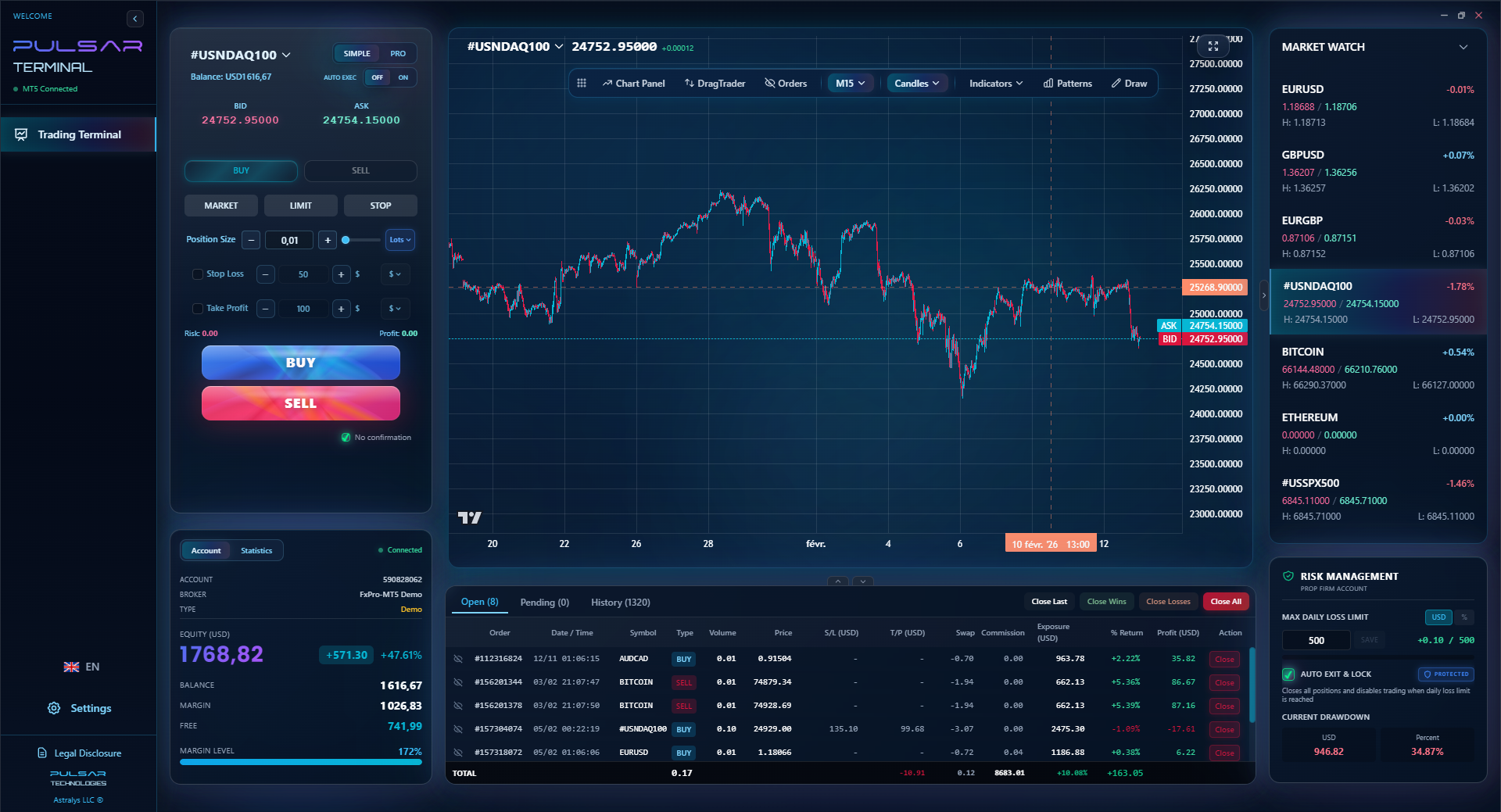
Managing trades with custom scripts is powerful, but a dedicated tool like Pulsar Terminal builds this functionality directly into MT5 with one-click breakeven, trailing stops, and multi-TP orders, letting you focus on your strategy.
FAQ
Q1Do I need to be a programmer to create custom forex indicators?
Not at all. While knowing MQL helps, you can start by modifying free code from forums or using visual builders that require no coding. The most important skill is understanding trading logic, not complex programming. Start small - change a number in an existing indicator and see what happens.
Q2Are custom indicators legal with South African brokers like those regulated by the FSCA?
Yes, absolutely. Using custom indicators and even automated Expert Advisors (EAs) is completely legal with FSCA-regulated brokers. The key is that the broker must allow the use of the platform (like MT4/MT5) that supports them. Always check your broker's terms, but all major FSCA brokers like IG, AvaTrade, and Tickmill allow them. The regulations focus on broker conduct and client fund safety, not on the tools you use to analyse the market.
Q3What's the biggest mistake new traders make with custom indicators?
They build or buy an indicator that gives buy/sell signals and then follow it blindly without understanding its logic or its flaws. They treat it as a "black box" profit machine. The second biggest mistake is over-optimizing it to fit past data perfectly, which guarantees it will fail on future, unseen market conditions.
Q4How much time does it take to build a useful custom indicator?
Your first simple one (like plotting a daily level) might take a weekend of learning and tinkering. A more complex, strong indicator for daily use can take 20-40 hours of work spread over a few weeks. Don't rush it. The time invested in building a tool that fits you is often repaid many times over in improved trading decisions.
Q5Can I sell a custom indicator I create?
Technically, yes. There's a market for them. But ethically, you should only sell it if it's genuinely strong, well-tested, and you're transparent about its limitations. Personally, I believe the best indicators are the ones you build for your own specific needs - they have the most value to you, and you understand their every quirk.
Q6Should I use custom indicators for scalping the ZAR pairs?
Be very careful. Scalping requires ultra-fast execution and very tight spreads. A complex custom indicator that repaints (changes past signals) or has any lag will destroy a scalping account. If you scalp, any custom tool should be extremely lightweight - perhaps just visual markers for recent high/low liquidity zones - and you must account for the wider spreads on exotics like USD/ZAR. It's often better to scalp major pairs with tight spreads and use custom tools for analysis on ZAR pairs.
Pelajaran Prof. Winston
:
- ✓Solve one local problem: adjust for ZAR volatility or SA session times.
- ✓Start by modifying free code; visual builders are your friend.
- ✓Always factor in the spread, especially on exotic pairs (15-25 pips).
- ✓Use indicators as filters or confirmations, never as sole entry signals.
- ✓Semi-automate trade management first (breakeven stops) before full automation.
Sejauh mana artikel ini berguna?
Klik bintang untuk menilai
Pandangan Dagangan Mingguan
Analisis & strategi mingguan percuma. Tiada spam.
Tentang Penulis
David van der Merwe
Pedagang Pasaran Membangun
Pedagang berpangkalan di Johannesburg dengan 11 tahun dalam mata wang pasaran membangun. Pakar dalam pasangan ZAR, dagangan terkawal FSCA, dan analisis pasaran Afrika Selatan.
Komen
Anda mungkin juga suka

Cara Trading Forex Sukses: 7 Prinsip dari Trader Profesional
Cara trading forex sukses dengan 7 prinsip trader pro: manajemen modal, disiplin, journal trading, backtest. Data nyata, bukan janji profit palsu.
Jam Trading Forex Terbaik untuk Trader Indonesia: Panduan Lengkap dengan Tabel Waktu
Panduan jam trading forex untuk trader Indonesia. Tabel 4 sesi dunia, jam emas 20:00-00:00, sesi mana yang harus dihindari. Data akurat + tips dari trader berpengalaman.
Top 5 Sàn Forex Uy Tín Nhất 2026: Review Jujur dari Trader Indonesia
Top 5 sàn forex uy tín 2026 untuk trader Indonesia. Review jujur: spread, deposit, withdraw, dukungan lokal. Exness, XM, IC Markets & lebih.
All these calculators are built into Pulsar Terminal with real-time data from your MT5 account. One-click position sizing, automatic risk management, and instant calculations.
