


Here's a number that should make you sit up straight: between 2024 and 2025, roughly 80 to 100 proprietary trading firms globally just vanished.

James Mitchell
Penganalisis Dagangan Kanan
☕ 11 minit baca
Apa yang akan anda pelajari:
- 1The Real Reason Cyprus Prop Firms Imploded
- 2The U.S. Regulatory Maze (And Why Prop Firms Hate It)
- 3How to Spot a Prop Firm About to Go Under
- 4Protecting Yourself as a U.S. Trader Now
- 5The Post-Bankruptcy Landscape: Who's Left Standing?
- 6So, Should You Use a Cyprus-Based Prop Firm Today?
- 7The Future of Prop Trading for U.S. Traders
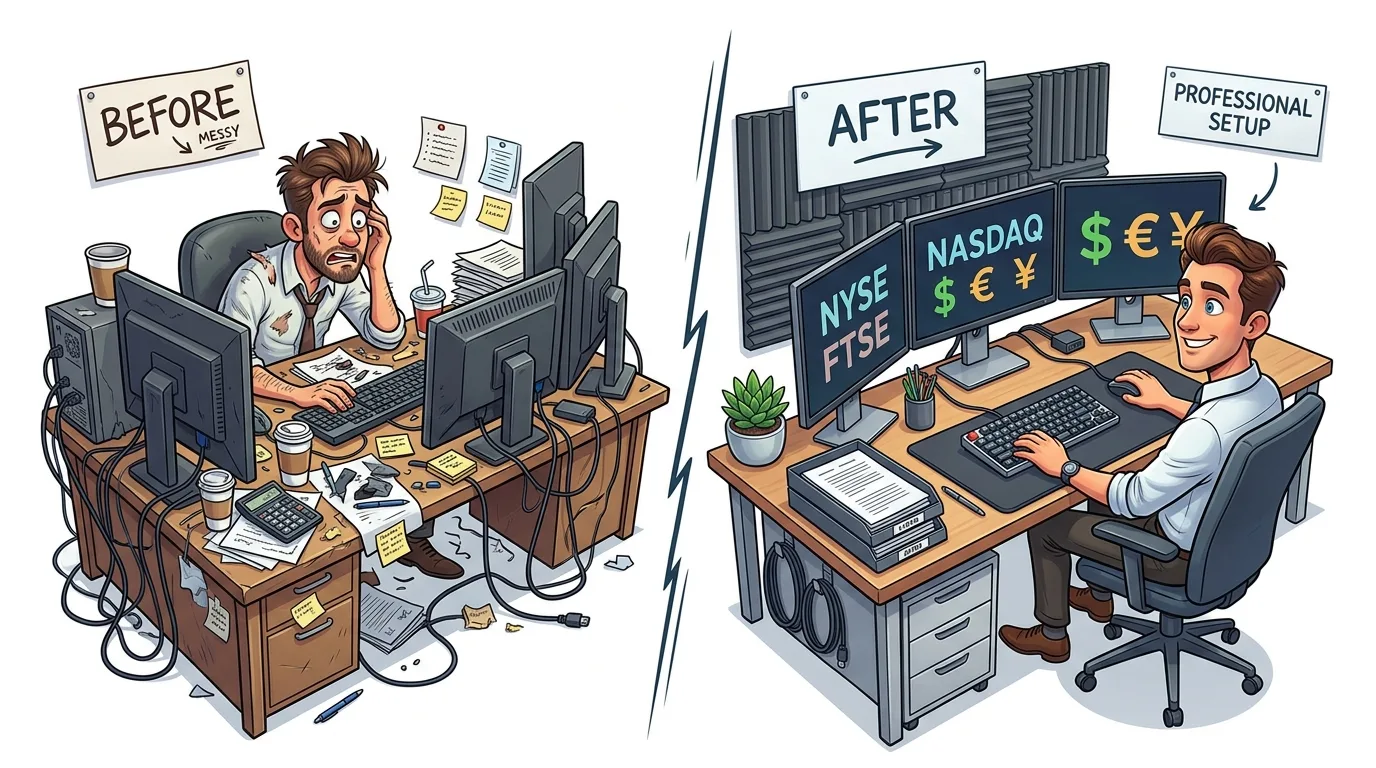
Here's a number that should make you sit up straight: between 2024 and 2025, roughly 80 to 100 proprietary trading firms globally just vanished. That's about 13-14% of the entire industry. A huge chunk of those were Cyprus-based operations that U.S. traders like you and I were using. It wasn't a market crash that did them in; it was a software company pulling the plug. If you're trading with a prop firm or thinking about it, you need to understand what happened, why it matters for your money, and how to spot the next domino before it falls.
Let's clear something up first. When we talk about Cyprus based prop firm bankruptcies, we're rarely talking about a classic 'ran out of money' failure. These weren't Lehman Brothers moments. The collapse was more like a landlord changing the locks because the tenants were breaking the rules.
The catalyst was MetaQuotes, the company behind MetaTrader 4 and MetaTrader 5. In early 2024, they started a massive crackdown. They revoked platform licenses from prop firms that were serving U.S. clients without a proper broker relationship or operating in what they saw as a regulatory grey area. Imagine waking up and your trading platform just doesn't work. That's what happened.

Warning: A firm being 'based in Cyprus' doesn't automatically mean it's regulated by CySEC for prop trading. Most aren't. They're often just using Cyprus as an operational hub, while their actual trading and client management exists in a much less defined space.
Cyprus is a popular base because of its EU membership and established financial services infrastructure. But for prop firms, the key attraction was often the perceived flexibility. The 2024-2025 wave of Cyprus based prop firm bankruptcies exposed the flaw in that model: when your entire business runs on a platform you don't own, you're on borrowed time. Major names like SurgeTrader shut down literally overnight on May 24, 2024. It was a brutal lesson in counterparty risk that had nothing to do with market analysis.
I learned this the hard way. I had a $50,000 funded account with a now-defunct Cyprus firm. I was up about $2,800, just working a steady swing trading strategy on EUR/USD. One Tuesday, the login failed. No email, no warning. Just radio silence. That money wasn't protected by any investor compensation scheme. It was just gone.

This mess is deeply tied to the American regulatory environment. U.S. rules are a thicket, and foreign firms navigate them at their own peril.
Here’s the core issue: In the U.S., the SEC oversees securities, and the CFTC handles futures and forex. If you're a firm handling client money to trade, you need to register as a broker-dealer or a Futures Commission Merchant (FCM). That comes with huge costs, net capital requirements, and intense scrutiny.
The "Evaluation Service" Loophole
Most prop firms avoid this by saying they're not brokers. They're "evaluation services." You pay a fee to take a challenge on a demo account. If you pass, they "hire" you and give you simulated capital. Your profits are then paid as a "performance bonus." It's a clever workaround that, until recently, kept the SEC and CFTC mostly at arm's length.
But the regulators are circling. The CFTC's 2023 case against MyForexFunds (accusing them of a $310 million fraud) was a shot across the bow. Then, in early 2024, the SEC tried to expand the definition of "dealer" to potentially snare more prop firms. That rule got struck down in court by late 2024, but the intent was clear: the grey area is getting smaller.
This regulatory pressure is a primary reason you see so many firms now restricting U.S. clients. It's also why surviving firms are pushing U.S. traders towards futures prop firms or platforms like DXtrade instead of MT4/MT5. The compliance headache just isn't worth it for many of them.

Pro Tip: If a prop firm openly and easily accepts U.S. clients on MT4/MT5 today, be very skeptical. The reputable ones have either moved to other platforms or have extremely strong legal structures. Do your homework on their broker relationships.

💡 Petua Winston
A firm's longevity through the 2024 shakeout is a stronger indicator of reliability than any shiny marketing claim. Prioritize survivors.

“The 2024 prop firm collapse wasn't about bad trading; it was about a software company changing the rules.”
After watching this unfold, I've identified patterns. The firms that disappeared shared common traits long before their websites went dark. Here’s what to watch for.
1. Opaque or Constantly Changing Rules: This is the biggest red flag. If they start applying rules retroactively, changing profit split terms after you're funded, or introducing bizarre new drawdown calculations, they're likely in financial distress. Fidelcrest was blacklisted in 2024/2025 for exactly this – withholding payouts by changing the goalposts.
2. Payout Delays and Excuses: A firm that consistently pays within 3-5 business days is healthy. One that starts giving excuses about "bank processing," "audits," or "technical issues" is waving a giant red flag. True Forex Funds faced massive backlash in 2025 when "technical issues" led to canceled accounts and frozen funds.
3. Overly Aggressive Marketing: Be wary of firms pushing "90% off!" sales every other week or promising guaranteed success. It smells of desperation for cash flow. Their revenue model might have shifted from trader profits to selling endless evaluation fees.
4. Platform Instability and Crashes: Frequent slippage, platform disconnections during news events, or inconsistent execution can indicate they're cutting corners on infrastructure or are with a low-tier broker to save money. This often precedes a collapse.
5. No Clear Broker Partnership: A legitimate firm should be able to tell you which regulated broker (or brokers) holds and executes the trades. If they're vague or say it's "their own liquidity," run. This was a core issue in the MetaQuotes crackdown.
I ignored the payout delay warning once. A firm I was with went from 3-day payouts to 14 days, then 21. They blamed "high volume." I got my final $1,200 payout, but two weeks later, they were on a blacklist for non-payment. Trust the process, not the excuse.

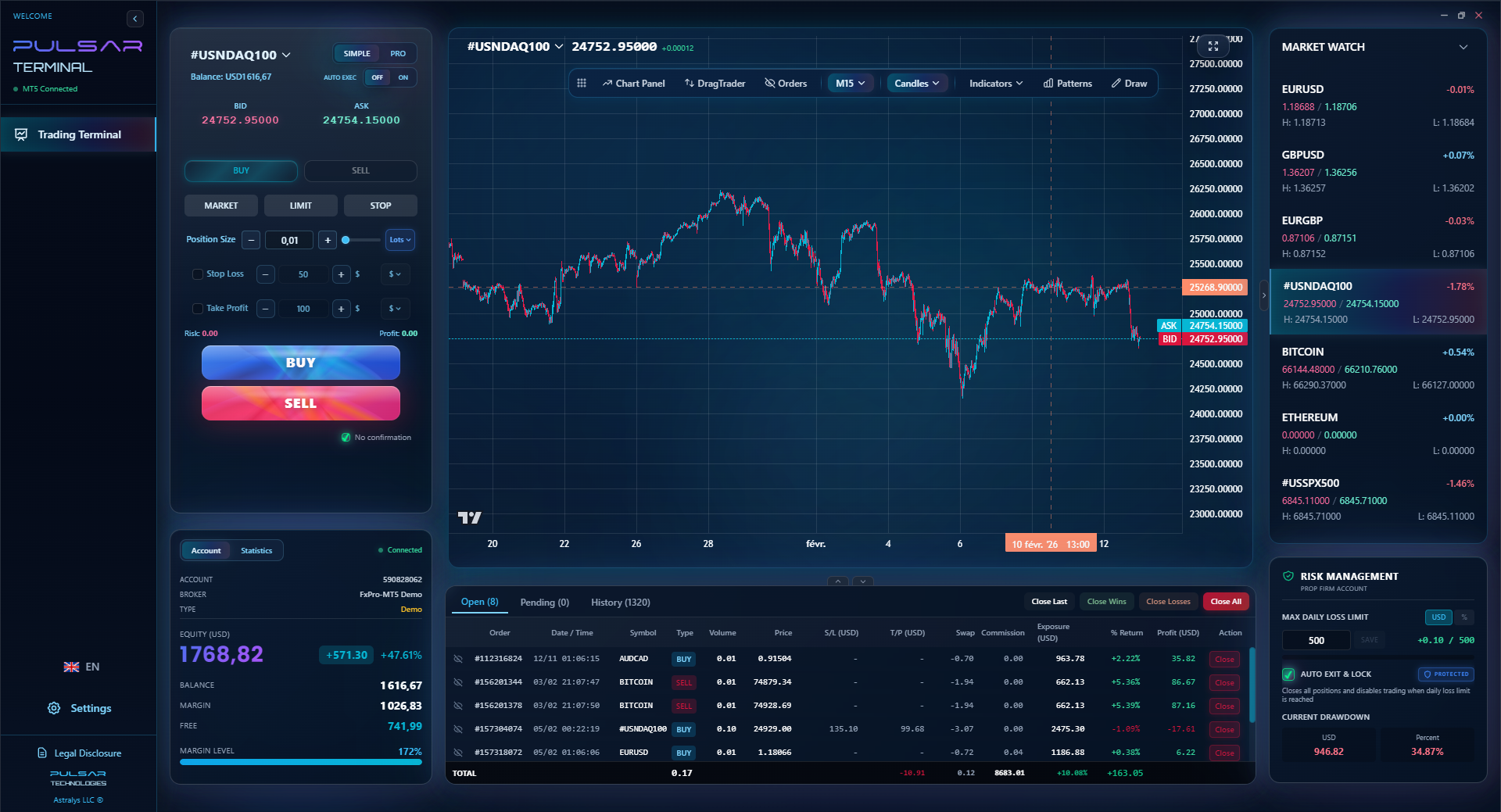
When trading a prop firm challenge, strict rule adherence is everything; Pulsar Terminal automates daily loss and drawdown protection directly on your MT5 chart, so you never breach limits by accident.
The game has changed. You can't just buy the cheapest challenge and hope for the best. You need a strategy for firm selection that prioritizes survival.
First, accept the stats: Only about 5-10% pass evaluations on the first try. Only 7% of all traders who buy a challenge ever get a payout. The average trader sinks over $4,000 into challenge fees. Knowing this, you must manage your risk before you even place a trade. Use a position size calculator religiously, even in the evaluation.
Platform Choice is Critical: Prefer firms using DXtrade, cTrader, or NinjaTrader for U.S. clients. These platforms aren't subject to the same MetaQuotes restrictions. If a firm only offers MT4/MT5 to you, dig deep into their regulatory compliance story.
Consider the Futures Route: Futures prop firms (using Tradovate, NinjaTrader, etc.) often operate more cleanly within U.S. regulations because futures are traded on regulated exchanges like the CME. The path from challenge to payout can be more straightforward.
Diversify Your "Firm Risk": Don't put all your effort (and fee money) into one firm. If you're serious about this, consider splitting your capital across two different firms with different operational bases. If one goes down, you're not back to square one.
Document Everything: Screenshot your challenge rules, your funded account agreement, and all payout requests. If a firm tries to change terms retroactively, you have evidence.

Example: Let's say you risk 1% per trade. On a $100,000 eval account, that's $1,000. If your stop loss is 50 pips on EUR/USD, your position size is ($1,000 / 50 pips) / $10 per pip = 2 mini lots. Sticking to this prevents a single bad trade from blowing your chance and your fee. Learn more about managing this with our guide on pips.
💡 Petua Winston
Your first line of defense isn't a stop-loss; it's the due diligence you do before paying a single challenge fee. Research is a non-negotiable trade setup.

“Only 7% of traders who buy a prop firm challenge ever see a payout. Your strategy must account for that 93% failure rate.”
The wave of Cyprus based prop firm bankruptcies acted like a forest fire. It destroyed the weak and overgrown parts of the industry, leaving a clearer, if more sparse, landscape.
The firms that survived generally share these traits:
- Transparent and Stable Rules: Their rules are clear, public, and don't change without significant notice.
- Verified Payouts: They have a track record of payouts verified by a community (not just testimonials on their own site).
- Strong Broker Partnerships: They openly partner with well-known, regulated brokers for trade execution.
- Platform Diversification: They've adapted by offering alternative platforms to U.S. and international clients.
This doesn't mean every surviving firm is perfect, but the bar is much higher. The era of the "fly-by-night" prop shop, especially those targeting U.S. traders from Cyprus, is largely over. The remaining players are businesses trying to build a sustainable model, not just collect challenge fees.
For you, this is better. It's easier to research a handful of stable firms than to wade through hundreds of questionable ones. Look for firms reviewed on trusted independent sites, not just affiliate marketing pages. Check our deep dives on brokers like IC Markets or Exness to understand the caliber of broker a top prop firm should be using.
The consolidation also means less predatory marketing. You're less likely to be bombarded with "get rich quick" ads from firms that won't exist in six months. The focus, for both firms and traders, is shifting towards long-term performance and risk management.

It's the million-dollar question. My answer isn't a simple yes or no. It's a "maybe, but only under specific conditions.
Yes, if:
- The firm is transparent about its broker partner (a legit, CySEC or other top-tier regulated broker).
- It has a multi-year history of verified payouts, especially through the 2024-2025 chaos.
- Its rules are crystal clear and you see no complaints about retroactive changes.
- It offers a platform other than MT4/MT5 to you as a U.S. resident.
No, if:
- It's a new firm with less than 2 years of solid history.
- The rules seem too good to be true (e.g., no daily drawdown, insane use).
- You can't find independent, recent payout proof (search forums, not just YouTube).
- It's on any community blacklist or has numerous unresolved complaints.
The jurisdiction matters less now than the firm's specific practices. A well-run firm with a solid structure in Cyprus is far safer than a shady operation registered in a completely opaque offshore haven. Your due diligence is your best defense. Don't just look at the profit split; look at the firm's foundation. Understanding tools like the RSI indicator or MACD won't help you if the firm vanishes with your profits.
💡 Petua Winston
In this environment, treat your prop firm like a business partner, not a software vendor. If you wouldn't go into business with them, don't trade with them.
“A payout delay is the canary in the coal mine for a prop firm. Trust the process, not the excuse.”
Where do we go from here? The trend is clear: more regulation, not less. The prop firm model will keep evolving to fit within legal frameworks.
I think we'll see a continued bifurcation:
-
Futures-Focused Prop Firms: These will become the dominant path for U.S. traders. The regulatory path is clearer, the platforms (NinjaTrader, Tradovate) are U.S.-based, and the instruments trade on regulated exchanges. It removes a layer of counterparty risk.
-
Globally Licensed Firms: The larger, surviving multi-asset firms will likely pursue formal licensing in key jurisdictions, perhaps even limited broker registrations, to legitimize their operations and access broader markets. This will increase their costs, which might mean slightly higher challenge fees or tighter rules for traders.
-
The "Community" Model: We might see a rise in trader collectives or co-op style models where traders pool capital under a formal legal structure, cutting out the prop firm middleman entirely. This is complex but addresses the core trust issue.
For you, the key is adaptability. The strategy that got you funded in 2023 might not be the vehicle you use in 2026. Stay informed on regulatory news. Join trader communities not for signals, but for intelligence on which firms are paying smoothly and which are showing cracks. Your edge isn't just in your trading system; it's in your ability to navigate the business side of this industry. Mastering a scalping strategy is pointless if you're scalping on a platform that's about to be shut down.
The days of easy, uncomplicated access to huge use via offshore prop firms are fading. The future belongs to traders who treat prop firm selection with the same seriousness as trade selection.
FAQ
Q1What caused the Cyprus prop firm bankruptcies in 2024-2025?
The primary cause wasn't market losses but a crackdown by MetaQuotes, the company behind MetaTrader. They revoked platform licenses from prop firms serving U.S. clients without proper broker relationships, causing 80-100 firms to shut down almost overnight.
Q2Are Cyprus prop firms regulated by CySEC?
Usually not for their prop trading activities. CySEC regulates investment firms and brokers handling client funds. Most prop firms operate as evaluation services, which falls outside traditional CySEC oversight, creating a regulatory grey area.
Q3Can U.S. traders still use Cyprus-based prop firms?
Yes, but it's more difficult. Many firms have stopped onboarding U.S. clients, especially onto MT4/MT5. U.S. traders often need to use firms that offer alternative platforms like DXtrade or shift towards futures-focused prop firms that fit better within U.S. regulations.
Q4What's the biggest red flag for a failing prop firm?
Retroactive rule changes and consistent payout delays. If a firm starts changing drawdown rules or profit splits after you're funded, or if payouts stretch from days to weeks with constant excuses, it's a major sign of financial or operational trouble.
Q5What percentage of traders actually get paid by prop firms?
The data is stark. Only about 7% of all traders who purchase a challenge ever receive a payout. About 70% of failures are due to risk management breaches, like violating drawdown or daily loss limits.
Q6Is my money safe with a prop firm?
Not in the traditional "bank deposit" sense. You don't have an insured account. Your safety depends entirely on the firm's solvency and integrity. Your challenge fee is almost always non-refundable, and your simulated profits are only as good as the firm's promise to pay.
Q7Should I avoid all Cyprus-based prop firms now?
Not necessarily. Avoid firms based on their specific practices, not just their location. A transparent, well-established Cyprus firm with a strong broker partner and verified payout history is safer than a new, opaque firm registered anywhere else.
Pelajaran Prof. Winston
:
- ✓Platform risk is now as critical as market risk.
- ✓70% of failures are from poor risk management, not bad analysis.
- ✓The average trader invests $4,270 in challenges with no return.
- ✓Seek firms with clear, stable broker partnerships.
Sejauh mana artikel ini berguna?
Klik bintang untuk menilai
Pandangan Dagangan Mingguan
Analisis & strategi mingguan percuma. Tiada spam.
Tentang Penulis
James Mitchell
Penganalisis Dagangan Kanan
Berpangkalan di New York dengan lebih 9 tahun pengalaman perdagangan. Fokus pada pasangan USD utama, cabaran prop firm, dan landskap peraturan AS.
Komen
Anda mungkin juga suka

Cara Trading Forex Sukses: 7 Prinsip dari Trader Profesional
Cara trading forex sukses dengan 7 prinsip trader pro: manajemen modal, disiplin, journal trading, backtest. Data nyata, bukan janji profit palsu.
Jam Trading Forex Terbaik untuk Trader Indonesia: Panduan Lengkap dengan Tabel Waktu
Panduan jam trading forex untuk trader Indonesia. Tabel 4 sesi dunia, jam emas 20:00-00:00, sesi mana yang harus dihindari. Data akurat + tips dari trader berpengalaman.
Top 5 Sàn Forex Uy Tín Nhất 2026: Review Jujur dari Trader Indonesia
Top 5 sàn forex uy tín 2026 untuk trader Indonesia. Review jujur: spread, deposit, withdraw, dukungan lokal. Exness, XM, IC Markets & lebih.
All these calculators are built into Pulsar Terminal with real-time data from your MT5 account. One-click position sizing, automatic risk management, and instant calculations.
