


I stared at my MT5 platform, watching a sell order on USD/ZAR fill at 18.7520.

David van der Merwe
Pedagang Pasaran Membangun ·  South Africa
☕ 11 minit baca
Apa yang akan anda pelajari:
- 1The Two Faces of Deviation: Don't Mix Them Up
- 2Measuring Market Chaos: Standard Deviation in Action
- 3Controlling Slippage: Your MT4/5 Settings Explained
- 4The South African Context: ZAR Pairs & News
- 5Practical Trade Examples: Where Both Deviations Meet
- 6Broker Differences & The FSCA Rules
- 7Putting It All Together: Your Pre-Trade Checklist
I stared at my MT5 platform, watching a sell order on USD/ZAR fill at 18.7520. I’d clicked at 18.7500. That 20-pip difference wasn’t a spread. It was slippage, and my ‘deviation’ setting was too loose. That trade, back in early 2023, cost me an extra R800 on a standard lot before it even started. It was a harsh, paid-for lesson on one critical deviation meaning in forex. But it’s only half the story. The other half - statistical deviation - is what helps you spot those volatile moves in the first place. Let’s break down both, because confusing them is a sure way to bleed capital.
If you hear 'deviation' in a trading context here in SA, you need to ask: which one? Getting this wrong is like confusing a speedometer with a brake pedal. Both are in the same car, but they do completely different jobs.
Statistical Deviation (The Market's Pulse): This is all about volatility. It measures how far the price of a currency pair, like USD/ZAR or EUR/USD, is swinging away from its average. Think of it as the market's mood swings. A high reading means big, fast moves. A low reading suggests the market is napping, consolidating in a tight range. We use indicators, primarily the Standard Deviation, to put a number on this chaos.
Slippage Tolerance (Your Order's Safety Net): This is a setting in your trading platform, most in MetaTrader 4 and 5. When you click 'buy' or 'sell', you're asking for a specific price. But in a fast market, that price might be gone by the time your order reaches the broker's server. The 'deviation' setting here is your limit. You're telling the platform: 'If you can't get my price, you can try within X pips of it. If it's worse than that, don't even bother.' It's your defence against terrible fills.
I learned the hard way that not setting this properly is like giving a stranger a blank cheque. During a SARB interest rate announcement, my tight stop-loss on a GBP/ZAR trade got blown through because my deviation was set to the default 'maximum'. The order filled 45 pips past my stop, turning a R1,200 loss into a R2,900 nightmare. That loss stung, but it taught me to never ignore the order execution side of the deviation meaning in forex.
This is where we get practical. The Standard Deviation indicator is your best friend for quantifying the deviation meaning in forex as volatility. It doesn't predict direction, but it tells you the intensity of the move.
How It Works on Your Charts
You'll find it in your platform's indicator list. The default period is often 20, which means it's calculating how much the price has deviated from its 20-period moving average. A rising Standard Deviation line means volatility is increasing - the candles are getting bigger, the ranges are widening. A falling line means volatility is contracting.

Example: Let's say USD/ZAR has a 20-day average price of 18.5000. The Standard Deviation might calculate a value of 0.0150 (150 pips). This tells you that, statistically, most of the price action is happening between 18.4850 and 18.5150. A break above 18.5150 isn't just a high price; it's a high price plus elevated volatility.
My Go-To Uses for Volatility Deviation
- Setting Stop-Losses: In a low deviation environment, I can place tighter stops. The market isn't jumping around much. When deviation spikes, I widen my stops immediately. Trying to keep a 20-pip stop in a 150-pip volatile market is asking to be stopped out by noise.
- Spotting Breakouts: A period of very low deviation (a tight, coiled price range) often precedes a big move. When the price finally breaks out of that range, and the Standard Deviation line starts rising sharply, it confirms the breakout has energy. I used this watching EUR/USD coil between 1.0850 and 1.0880 for days last year. The deviation line was flat. The break above 1.0880 with a rising deviation line was my signal. That trade ran for 110 pips.
- Avoiding False Starts: Sometimes price makes a little jump. If the Standard Deviation doesn't budge, it's often just a random flicker, not a true volatile shift. I've saved myself from many bad entries by waiting for volatility to confirm the move.
It pairs beautifully with other tools. I often have it next to my RSI indicator or MACD indicator to gauge not just the momentum's direction, but its strength.

💡 Petua Winston
Volatility isn't your enemy; it's your informant. A rising standard deviation line doesn't say 'get out,' it says 'the rules have changed - widen your stops, reduce your size, or find a new game.'
“Confusing statistical deviation with slippage deviation is like confusing a speedometer with a brake pedal.”
This is the administrative, unsexy side of the deviation meaning in forex. But ignoring it is financial suicide, especially for a scalping strategy where every pip counts. Let's open the 'Order' window in MetaTrader.
You'll see a field called 'Deviation'. It's measured in points (for 5-digit brokers, 1 point = 0.1 pip). The default is often something huge, like 100 points (10 pips).

Warning: A large deviation setting on a market order is dangerous. It gives your broker too much leeway to fill you at a worse price during news or fast markets.
How to Set It: For most trades on major pairs during normal hours, I set a deviation of 5-10 points (0.5 to 1 pip). This says: 'Try to get my price, but if it's slipped by more than a pip, reject the order.' For highly liquid pairs like EUR/USD, you can often use 2-3 points. For something less liquid, or if you're trading around SA market open, you might need 15-20 points.
The Trade-Off: Set it too tight, and your orders will get rejected ('Requote' messages) constantly. Set it too loose, and you'll get filled at terrible prices. You need to find the sweet spot for your broker and the pair you're trading. I did a test with my Exness review account on USD/ZAR. With a 5-point deviation during London open, 30% of my orders were requoted. At 10 points, it dropped to under 5%. That's the balance.
This setting is crucial for pending orders too, but it works differently. For a Buy Limit, a positive deviation might get you a better fill (lower price). The logic flips. It's worth spending an hour in a demo account just clicking orders and seeing how the fills change with different deviation settings.
Trading from SA adds unique layers to the deviation meaning in forex. Our local pairs, especially USD/ZAR, behave differently to the majors you read about in most guides.
Liquidity & Spreads: USD/ZAR is liquid, but not like EUR/USD. The spread is wider, often 50-100 pips compared to 1 pip on the Euro. This inherent spread is a constant deviation from the 'mid' price. Your standard deviation indicator will reflect this wider natural range. A 100-pip move on USD/ZAR is a regular Tuesday; on EUR/USD, it's a notable event.
News-Driven Volatility Spikes: Our market is hypersensitive to local data. CPI prints, SARB rate decisions, budget speeches, and political headlines can cause instantaneous, massive volatility spikes. The statistical deviation will go vertical. This is when the slippage tolerance deviation becomes most critical.
I have a specific rule: 30 minutes before a major SA news event, I widen my slippage deviation setting to 30-50 points. Why? Because I know the spread will balloon, and prices will jump. If I don't, my stop-loss or take-profit orders might not execute at all, leaving me exposed. Conversely, I avoid placing new market orders in that window unless I'm deliberately trying to catch the news move (and even then, I use extreme caution).

Pro Tip: For ZAR pairs, always check your broker's specific policy on 'margin call' [/en/glossary/margin-call] levels during volatile events. Some may widen margins, which can trigger a call faster if you're over-leveraged. A sharp move plus a margin call is a brutal combination.
💡 Petua Winston
Your slippage deviation setting is a contract with yourself. A loose setting is a contract that says, 'I'm okay with a bad price.' Only sign that contract when you have a very good reason.
“A bad fill on entry can ruin your trade psychology before the market even decides if you're right or wrong.”
Theory is fine, but let's look at real money. Here are two trades where understanding both meanings was the difference between profit and loss.
Trade 1: The Good (Volatility Deviation for Entry)
- Pair: XAU/USD (Gold)
- Context: It had been ranging between $1810 and $1830 for a week. The Standard Deviation (20-period) on the 4-hour chart was sinking, showing compression.
- Plan: Wait for a break of the range WITH a confirming rise in the Standard Deviation line.
- Execution: Price broke above $1832. The Standard Deviation line, which had been flat, turned upwards. This was the signal. I entered a buy at $1833.50.
- Slippage Management: Deviation set to 5 points (0.5 pips). Got a clean fill.
- Result: Took profit at $1850. A 165-pip gain. The rising volatility deviation confirmed the breakout wasn't a fake. You can read more about trading gold in our XAU/USD guide.
Trade 2: The Bad (Ignoring Slippage Deviation)
- Pair: GBP/JPY
- Context: Trying to scalping strategy during the Asian-London overlap. Fast, thin market.
- Mistake: I was focused on the chart. My order deviation was still set to 50 points from a previous news trade. I didn't check.
- Execution: Saw a signal, clicked sell at 162.45. The order filled instantly at 162.41. A 4-pip slippage against me before the trade even moved.
- Result: The trade went my way... by 3 pips. Because of the 4-pip slippage on entry, I was in the red by 1 pip and got nervous, closing for a tiny loss. The trade then ran another 15 pips in my original direction. The bad fill ruined my psychology and the trade. A proper position size calculator would have shown me the real risk, including that potential slippage.
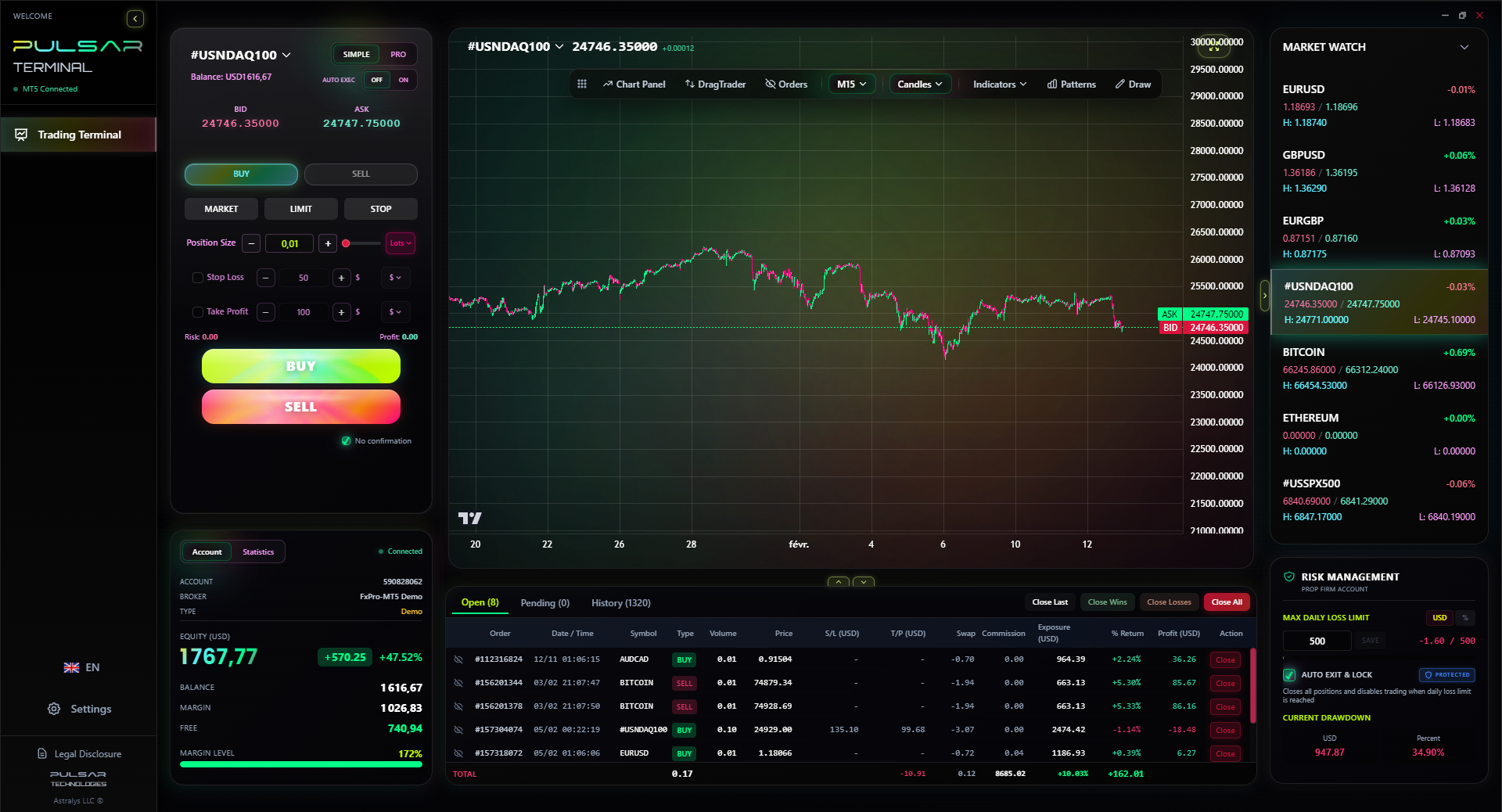
Managing multiple orders and their slippage risks during volatile swings is complex, but tools like Pulsar Terminal automate advanced order types and trailing stops directly on your MT5 chart, helping you execute your deviation-based plans precisely.
Not all brokers handle deviation the same way. This is where regulation matters. Trading with an FSCA-licensed broker like those in our IC Markets review or Pepperstone review gives you a layer of protection.
FSCA & Order Execution: The FSCA mandates 'best execution' principles. This means brokers must take all sufficient steps to get you the best possible price when executing your order. Your 'deviation' setting interacts with this. A reputable broker will strive to fill you within your set deviation. A less scrupulous one might always fill you at the worst edge of your deviation range. It's subtle but costly over time.
Variable Spreads & Deviation: Many SA brokers offer variable spreads. During calm times, the USD/ZAR spread might be 50 pips. During news, it can gap to 300. Your market order deviation setting must account for this. If your deviation is 10 points (1 pip) and the spread is 300 pips wide, your order will be rejected or filled at an astronomically bad price. This is a key reason I prefer ECN/STP brokers with transparent execution models.
use Limit: Remember, the FSCA's 30:1 use cap for retail traders isn't just a random rule. It's a volatility control. High use magnifies the impact of both types of deviation. A 50-pip slippage on a 500:1 leveraged account can be catastrophic. At 30:1, it's still painful, but more survivable. Always trade with a use level that allows for normal market deviation.
💡 Petua Winston
Before a major SA news event, I don't just widen my slippage deviation. I cut my position size in half. If I'm wrong on the direction, the slippage hurts less. If I'm right, I still profit. It's about surviving the volatility spike to play another day.
“The FSCA's 30:1 use cap is, in part, a volatility control mechanism for retail traders.”
Here’s my routine. Do this before every single trade, and you’ll internalize the deviation meaning in forex.
- Check the Volatility (Statistical): Glance at the Standard Deviation indicator on your timeframe. Is it high, low, rising, falling? This decides my initial stop-loss distance and whether I should even be trading right now.
- Set the Safety Net (Slippage): Open the order window. What pair am I trading? What’s the typical spread? Is there news due? Based on that, set my deviation points. For a calm EUR/USD scalp: 3 points. For a USD/ZAR swing trading position: 15 points.
- Calculate Real Risk: Use your position size calculator. Add your intended stop-loss distance PLUS a potential slippage buffer (your deviation setting in pips) to the total risk. If that pushes your risk beyond 1-2% of your account, reduce the position size.
- Monitor & Adjust: If I’m in a trade and volatility starts spiking (deviation rising), I might manually move my stop to breakeven or adjust a trailing stop. I don’t just set and forget.
This process takes 30 seconds. But those 30 seconds have saved me thousands. It turns deviation from an abstract concept into a concrete risk management tool.
FAQ
Q1What is a good deviation setting for slippage in MetaTrader?
There's no single number. For highly liquid pairs (EUR/USD, GBP/USD) during active sessions, start with 2-5 points (0.2-0.5 pips). For less liquid pairs or exotic crosses, try 10-20 points (1-2 pips). For ZAR pairs like USD/ZAR, 10-15 points is a good starting point. Test in your broker's environment and adjust based on how often you get requotes versus bad fills.
Q2How is standard deviation different from Average True Range (ATR)?
Both measure volatility, but differently. Standard Deviation measures how dispersed prices are around a moving average (mean). ATR measures the average size of the candles (range) over a period, factoring in gaps. Standard Deviation is better for identifying statistically unusual moves. ATR is often preferred for setting stop-losses and take-profits in terms of current market range. I use both: Standard Deviation for context, ATR for placing my orders.
Q3Can deviation settings prevent all slippage?
No. It can only control it. If you set a very tight deviation (e.g., 1 point), your order will simply be rejected (requote) if the price moves. This prevents bad slippage but might prevent you from getting into a trade altogether. The goal is to manage slippage to an acceptable level, not eliminate it, especially in fast markets.
Q4Does the FSCA regulate how brokers handle slippage?
Indirectly, yes. The FSCA's 'best execution' rules require brokers to take all sufficient steps to obtain the best possible result for clients when executing orders. A broker that consistently fills orders at the worst extreme of a client's deviation setting, or during normal conditions, could be in breach of these rules. It's one reason to choose a well-regulated broker.
Q5Why is USD/ZAR standard deviation always higher than EUR/USD?
Two main reasons: Liquidity and underlying volatility. EUR/USD is the most traded pair globally, with massive liquidity that dampens wild swings. USD/ZAR has lower liquidity and is sensitive to commodity prices, local politics, and SA-specific risk sentiment. Its wider natural spread and bigger daily ranges mean its statistical deviation is inherently higher. A 100-pip move is normal for ZAR, but a major event for the Euro.
Q6Should I change my deviation setting for stop-loss and take-profit orders?
For stop-loss and take-profit orders (which are executed as market orders once triggered), your global deviation setting in MT4/5 usually applies. This is critical! A tight stop-loss in a volatile market with a tight deviation setting might not execute, leaving you exposed to much larger losses. Always ensure your deviation setting is appropriate for the expected volatility when your exit orders might hit.
Pelajaran Prof. Winston
:
- ✓Standard Deviation measures market volatility; set stops accordingly.
- ✓Slippage Deviation controls order fills; never use the default.
- ✓For ZAR pairs, expect & plan for higher volatility deviation.
- ✓Widen slippage settings (30-50 pts) before major news events.
- ✓Always factor potential slippage into your position size calculation.
Sejauh mana artikel ini berguna?
Klik bintang untuk menilai
Pandangan Dagangan Mingguan
Analisis & strategi mingguan percuma. Tiada spam.
Tentang Penulis
David van der Merwe
Pedagang Pasaran Membangun
Pedagang berpangkalan di Johannesburg dengan 11 tahun dalam mata wang pasaran membangun. Pakar dalam pasangan ZAR, dagangan terkawal FSCA, dan analisis pasaran Afrika Selatan.
Komen
Anda mungkin juga suka

Cara Trading Forex Sukses: 7 Prinsip dari Trader Profesional
Cara trading forex sukses dengan 7 prinsip trader pro: manajemen modal, disiplin, journal trading, backtest. Data nyata, bukan janji profit palsu.
Jam Trading Forex Terbaik untuk Trader Indonesia: Panduan Lengkap dengan Tabel Waktu
Panduan jam trading forex untuk trader Indonesia. Tabel 4 sesi dunia, jam emas 20:00-00:00, sesi mana yang harus dihindari. Data akurat + tips dari trader berpengalaman.
Top 5 Sàn Forex Uy Tín Nhất 2026: Review Jujur dari Trader Indonesia
Top 5 sàn forex uy tín 2026 untuk trader Indonesia. Review jujur: spread, deposit, withdraw, dukungan lokal. Exness, XM, IC Markets & lebih.
All these calculators are built into Pulsar Terminal with real-time data from your MT5 account. One-click position sizing, automatic risk management, and instant calculations.
