


Here's the biggest lie I hear from new traders: 'It's just capital gains, SARS won't notice.' Let me be blunt.

David van der Merwe
Pedagang Pasaran Membangun ·  South Africa
☕ 10 minit baca
Apa yang akan anda pelajari:
Here's the biggest lie I hear from new traders: 'It's just capital gains, SARS won't notice.' Let me be blunt. That's a fast track to a nasty audit and a life-altering tax bill. I've seen it happen. The South African Revenue Service (SARS) is not your average tax authority, and they've gotten very good at tracking forex profits. This isn't about tax evasion tips. It's a risk manager's guide to understanding your legal obligations, so you don't blow up your account and your finances. We're going to set the record straight on what you actually owe.
This is where most people get it wrong, and it's the difference between paying 18-45% or a flat effective rate of around 22.4%. SARS doesn't care what you call yourself. They look at your behavior.
If you're placing trades frequently, using technical analysis, holding positions for short periods (days or weeks), and it's a primary source of income, you're almost certainly an active trader. Your profits are treated as revenue income. That means every rand of profit gets added to your salary, rental income, and everything else, and you're taxed at your marginal rate. Ouch.
If you buy and hold a currency pair for years (which is rare in forex), or you make a couple of speculative trades a year, you might be classified as an investor. Your profits would then be subject to Capital Gains Tax (CGT). Only 40% of the gain is included in your taxable income. So, if you make R100,000, only R40,000 is added to your other income and taxed. The effective top rate is about 18% (40% of 45%).

Warning: Don't assume you're an investor because it's cheaper. SARS uses precedent. If your trading journal shows daily charts, use of indicators like the RSI indicator, and a scalping strategy, they'll call you a trader. I learned this the hard way early on. I had a great year of swing trading EUR/AUD, netting about R280,000. I tried to file it as CGT. My accountant, a former SARS auditor, laughed and showed me the case law. My trading frequency and method made me a trader, full stop. That misclassification would have cost me over R50,000 in extra tax and penalties.
How SARS Decides
They look at a checklist: frequency of trades, holding period, use of use, your intention (though this is weak), and whether you're applying trading skills. Running a MACD indicator crossover strategy? That's a skill. You're a trader.
“SARS doesn't care what you call yourself. They look at your trading behavior.”
Let's talk numbers. This is where the rubber meets the road.
Income Tax Rates (2024/2025 Tax Year) If you're classified as a trader, here's the progressive scale your profits get stacked onto:
| Taxable Income (R) | Rate of Tax (R) |
|---|---|
| 1 – 237,100 | 18% of taxable income |
| 237,101 – 370,500 | 42,678 + 26% of amount above 237,100 |
| 370,501 – 512,800 | 77,362 + 31% of amount above 370,500 |
| 512,801 – 673,000 | 121,475 + 36% of amount above 512,800 |
| 673,001 – 857,900 | 179,147 + 39% of amount above 673,000 |
| 857,901 – 1,817,000 | 251,258 + 41% of amount above 857,900 |
| 1,817,001 and above | 644,489 + 45% of amount above 1,817,000 |
Capital Gains Tax (For Investors) For individuals: 40% of the gain is included. So, effective maximum rate = 40% x 45% = 18%. For companies: 80% of the gain is included, taxed at 27% = 21.6% effective rate.
The Provisional Tax Bomb This is the silent account killer. If you earn income outside of a normal salary (like from trading), you must register as a provisional taxpayer. You pay tax in advance, twice a year.
- First Payment: End of August. You estimate your total year's profit and pay half the estimated tax.
- Second Payment: End of February. You top up based on a revised estimate.
- Third Payment (Voluntary): End of September if you underestimated.

Example: You make R500,000 profit from January to July. You estimate the full year will be R1,000,000. Your marginal rate on R1m is 41%. You owe roughly R410,000 for the year. Your first provisional payment in August must be R205,000 (half). If that money is still in your trading account, you're forced to close positions to pay SARS. This causes more forced selling than any margin call I've ever seen.
What You Can Deduct (Legitimately) You can offset expenses directly related to generating your trading income:
- Trading platform/data fees (MT5 subscriptions, premium charting tools).
- A portion of internet, electricity, and home office costs.
- Education (courses, books, seminars) directly related to improving trading.
- Accounting and tax advisory fees.
- Losses from previous years can be carried forward.
I keep a separate business bank account for all trading deposits and expenses. Every month, I transfer a fixed 'salary' to my personal account and leave the rest for tax and reinvestment. It's the only way to stay sane.

💡 Petua Winston
Your tax rate is your single largest trading cost. Manage it with the same precision you manage your stop-loss.
“The provisional tax system causes more forced selling than any margin call.”
If you get a SARS audit letter (and with forex income, the chances are rising), your trading journal isn't just a performance tool. It's your evidence. Without it, you're defenseless.
You need to keep, at a minimum:
- A Full Trade Ledger: Entry price, exit price, date/time, instrument (e.g., EUR/USD), size in lots, profit/loss in the base currency (USD, EUR, etc.). Most brokers like Exness or IC Markets provide this, but you need your own backup.
- Bank Statements: All deposits to and withdrawals from your broker. This proves the money trail.
- Broker Statements: Monthly and annual statements. These must match your ledger.
- Currency Conversion Records: You must declare profits in ZAR. Keep a record of the SARB exchange rate on the day you close each trade, or use the average rate for the month. Don't guess.
- Expense Receipts: For all those deductions we talked about.
I use a simple spreadsheet that auto-calculates ZAR profit using daily closing rates. It takes 10 minutes a week. That spreadsheet saved me R15,000 in a 2022 audit when SARS questioned my loss declarations. I could show them every single losing trade on XAU/USD from that quarter.

Pro Tip: Use a dedicated tool or spreadsheet from day one. Don't think you'll reconstruct it later. You won't. A good position size calculator should also log your trades. If your tool doesn't do that, find one that does.
Accurate trade logging is the foundation of tax compliance, and Pulsar Terminal automates this by recording every order and its P&L directly within your MT5 platform.
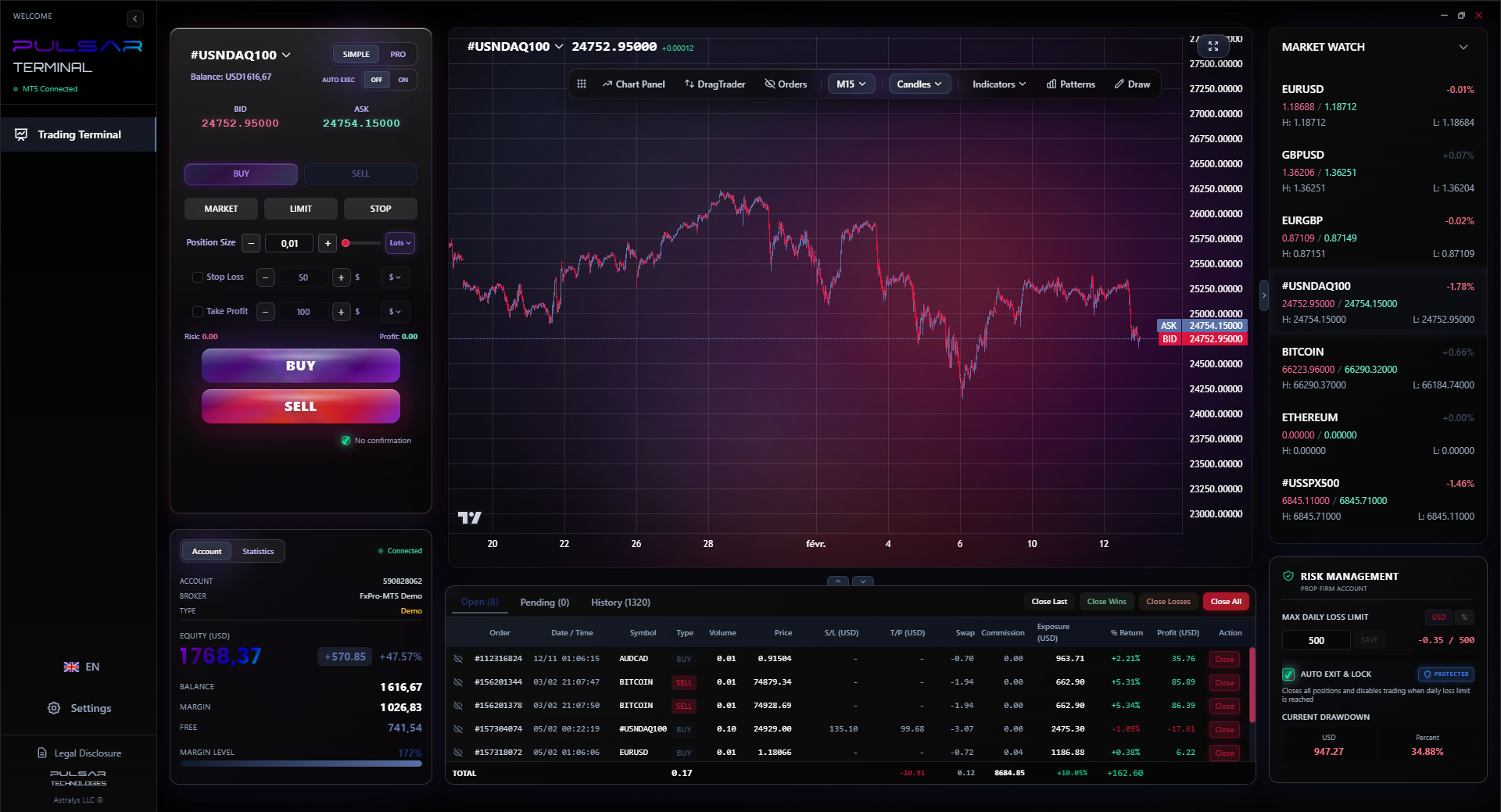
“Your trading journal isn't just a performance tool. It's your legal defense.”
Trading with an unregulated broker is like driving without a license. In South Africa, the Financial Sector Conduct Authority (FSCA) is the regulator. A broker holding an FSCA license (like many of the big names: Pepperstone, XM, etc.) must adhere to strict financial reporting. Crucially, SARS can and does request data from FSCA-regulated entities.
Local vs. International Brokers: Many international brokers accept South Africans. You can fund in USD or EUR. However, you still have to convert profits to ZAR for SARS. Some local brokers, like Khwezi Trade, offer ZAR-denominated accounts, which simplifies the currency conversion headache but may come with wider spreads.
Payment Methods: Stick to traceable methods: EFT, credit card, or registered e-wallets like Skrill/Neteller. Avoid cash deposits at all costs. You need a clear audit trail from your bank account to the broker and back.
use and Risk: High use (like 1:500 or 1:1000) can magnify profits, which is great until you have to pay tax on those paper gains that later vanish. I once had a R75,000 profit on a highly leveraged GBP/JPY trade get wiped out by a weekend gap before I could withdraw. I still had a provisional tax liability on that 'profit' for that period. It was a brutal lesson in cash flow management.
💡 Petua Winston
A separate 'Tax Liability' savings account is not optional. Fund it with every profitable withdrawal. Future-you will be grateful.
“Your trading journal isn't just a performance tool. It's your legal defense.”
Forget about hiding money. SARS's new data matching systems are too good. Focus on legitimate, strategic planning.
- Trade Through a Company: This is a big one. Companies pay a flat tax rate of 27% (as of 2024/25). If you're a top-earning trader in the 45% bracket, that's an 18% saving. However, setup costs, annual financial statements, and additional regulations (like VAT registration if turnover exceeds R1m) make it only worthwhile for consistently profitable, high-volume traders. I didn't switch to a company structure until my average annual trading profit exceeded R800,000 for three years running.
- Retirement Annuity (RA): You can deduct RA contributions from your taxable income (up to 27.5% of your income or R350,000 pa). If you have a R500,000 trading profit, contributing R100,000 to an RA reduces your taxable income to R400,000. That could drop your tax bracket.
- Tax-Free Savings Account (TFSA): You can't trade forex directly in a TFSA. But you can use your tax-free trading profits to max out your TFSA contributions (R36,000 per year). The growth inside the TFSA is forever tax-free. It's a great way to build a passive investment pot with your trading winnings.
- Income Smoothing: This is a professional tactic. If you have a massive winning year, consider realizing some losses before year-end to offset the gain (tax-loss harvesting). Conversely, if you're having a bad year, it might be a good time to realize some gains, as you'll be in a lower tax bracket.
The key is to plan your tax liability with the same rigor you plan your trades. Your annual tax bill should never be a surprise.
“Plan your tax liability with the same rigor you plan your trades.”
The market might take 50% of your account. SARS can take 100% of your life savings if you mess this up. Here are the fatal errors:
Mistake 1: Ignoring Provisional Tax. You make R2 million in March. You blow R1.5 million by October. You still owe provisional tax in February based on that March estimate. If you don't have the cash, you're in debt to SARS. They charge interest at the official rate plus a penalty. It compounds fast.
Mistake 2: Mixing Personal and Trading Money. You fund your broker from your personal account, withdraw profits to pay for a car, and can't trace what was profit vs. capital. SARS will assume every withdrawal is taxable profit. Game over.
Mistake 3: Thinking Offshore Means Invisible. SARS has automatic exchange of information agreements with over 100 countries (CRS). Your broker in Cyprus or Mauritius is sending your account details to SARS every year. They know.
Mistake 4: Not Using an Accountant Who Understands Trading. Your family accountant who does your mom's small business taxes likely doesn't understand use, margin, forex pips, or the difference between revenue and capital treatment for trading. Find a specialist. The fee is a tax-deductible expense and worth every cent.
My final piece of advice: Before you place your next trade, open a spreadsheet. Label it '2025 Tax Estimate'. Make your first entry: a transfer of 35% of your current account balance to a separate, high-interest savings account labeled 'SARS PROVISIONAL TAX'. Do it now. That single habit will do more for your long-term survival than any trading strategy.
FAQ
Q1Do I pay tax on forex trading if I make a loss?
You don't pay income tax on a loss, but you must still declare your trading activity if you are a provisional taxpayer. The loss can be carried forward to offset future trading profits, reducing your tax in a profitable year. This is why keeping records is critical even when losing.
Q2What happens if I use an international broker not regulated by the FSCA?
Your legal obligation to pay tax in South Africa remains 100%. Your broker's location doesn't change your tax residency. In fact, it can be riskier, as you have fewer protections if the broker fails. SARS can still obtain your information through international agreements, and you are responsible for self-declaring all income.
Q3How do I convert my forex profits from USD to ZAR for SARS?
You must use the official South African Reserve Bank (SARB) exchange rate for the day you received the income (usually the trade close date). You can use the daily 'Representative Rate' published on the SARB website. Alternatively, SARS may allow an average rate for a period of time, but you must be consistent with your method.
Q4Can I deduct the cost of a trading course or mentorship?
Yes, if you are classified as a trader (earning revenue income). Expenses incurred in gaining or improving the skills needed to produce your income are generally deductible. This includes courses, seminars, books, and subscription to financial news services. Keep the receipts.
Q5When am I forced to register for VAT as a forex trader?
You are required to register for VAT if your taxable turnover (your total trading revenue, not profit) exceeds R1 million in any 12-month period. For most retail traders, this is a very high bar. However, if you're trading huge volumes, it's a consideration. VAT on financial services is complex, so seek expert advice if you near this threshold.
Q6What is the single most important document for my forex taxes?
Your annual profit and loss statement from your broker, reconciled with your own trade ledger and bank statements. This trio of documents forms the core of your tax return and is your first line of defense in an audit.
Pelajaran Prof. Winston
:
- ✓Classify correctly: Trader (revenue) vs. Investor (CGT).
- ✓Register as a provisional taxpayer immediately.
- ✓Keep forensic records: trades, statements, conversions.
- ✓Set aside 35% of profits for tax in a separate account.
- ✓Use a specialist tax accountant, not a generalist.
Sejauh mana artikel ini berguna?
Klik bintang untuk menilai
Pandangan Dagangan Mingguan
Analisis & strategi mingguan percuma. Tiada spam.
Tentang Penulis
David van der Merwe
Pedagang Pasaran Membangun
Pedagang berpangkalan di Johannesburg dengan 11 tahun dalam mata wang pasaran membangun. Pakar dalam pasangan ZAR, dagangan terkawal FSCA, dan analisis pasaran Afrika Selatan.
Komen
Anda mungkin juga suka

Cara Trading Forex Sukses: 7 Prinsip dari Trader Profesional
Cara trading forex sukses dengan 7 prinsip trader pro: manajemen modal, disiplin, journal trading, backtest. Data nyata, bukan janji profit palsu.
Jam Trading Forex Terbaik untuk Trader Indonesia: Panduan Lengkap dengan Tabel Waktu
Panduan jam trading forex untuk trader Indonesia. Tabel 4 sesi dunia, jam emas 20:00-00:00, sesi mana yang harus dihindari. Data akurat + tips dari trader berpengalaman.
Top 5 Sàn Forex Uy Tín Nhất 2026: Review Jujur dari Trader Indonesia
Top 5 sàn forex uy tín 2026 untuk trader Indonesia. Review jujur: spread, deposit, withdraw, dukungan lokal. Exness, XM, IC Markets & lebih.
All these calculators are built into Pulsar Terminal with real-time data from your MT5 account. One-click position sizing, automatic risk management, and instant calculations.
