


You're probably sitting there, looking at your trading account, wondering if SARS is going to come for a slice of your hard-earned pips.

David van der Merwe
Pedagang Pasaran Membangun ·  South Africa
☕ 9 minit baca
Apa yang akan anda pelajari:
- 1How SARS Sees Your Forex Trades: Income vs. Capital
- 2The Real Numbers: Tax Rates & What You Can Claim
- 3Provisional Tax: The Twice-Yearly Pain
- 4Record Keeping: Your Lifeline in an Audit
- 5Brokers, Banking, and Exchange Control Headaches
- 6Common Tax Mistakes (And How to Avoid Them)
- 7Your Action Plan: Getting Tax-Smart Now
You're probably sitting there, looking at your trading account, wondering if SARS is going to come for a slice of your hard-earned pips. The short, uncomfortable answer is yes, you absolutely have to pay tax when trading forex in South Africa if you're making a profit. But it's not as simple as a flat rate on your gains. How SARS views your trading - as a hobby, a business, or an investment - changes everything. I've seen too many traders get this wrong and face a nasty surprise come tax season. Let's get this sorted, so you're not one of them.
This is the single most important concept you need to grasp. SARS doesn't just see 'profit.' They look at how you made it. Get this classification wrong, and you could be paying way more tax than necessary, or setting yourself up for penalties.
If you're trading frequently, chasing short-term moves, and it looks like a business, SARS will call it one. Your profits become ordinary revenue. That means every rand gets added to your salary, rental income, and everything else. You then pay tax at your marginal rate, which can go as high as 45%. I made this mistake in my third year. I was scalping the EUR/USD like a madman, treating it as a side hustle. My accountant rightly classified it as income, and let me tell you, that tax bill stung.
Now, if you're more of a set-and-forget trader, holding positions for months based on long-term economic views, you might argue for capital gains treatment. Here, only 40% of the net gain is added to your taxable income. It's usually better, but it's not a given. SARS will scrutinize your trading journal, frequency, and intent. You can't just label your losing swing trades as 'investments' after the fact.

Warning: Assuming your forex profits are automatically capital gains is the fastest route to a SARS audit. The default position for an active trader is income. You need strong evidence to argue otherwise.
Let's talk specifics. No vague advice, just the numbers as they stand.
What You Pay:
- Income Tax (if trading is a business): Your profits are taxed at your personal marginal rate. Here's the 2024/2025 scale:
| Taxable Income (ZAR) | Rate |
|---|---|
| Up to R237,100 | 18% |
| R237,101 – R370,500 | 26% |
| R370,501 – R512,800 | 31% |
| R512,801 – R673,000 | 36% |
| R673,001 – R857,900 | 39% |
| R857,901 – R1,817,000 | 41% |
| Over R1,817,000 | 45% |
- Capital Gains Tax (if applicable): (Selling Price - Cost - Expenses) x 40% = Taxable Capital Gain. That gain is then added to your other income and taxed at the rates above.
- Corporate Tax: If you trade through a registered company (a smart move if you're serious), profits are taxed at a flat 27%.
What You Can Deduct (The Good Part): You can offset legitimate business expenses against your trading income. This is non-negotiable. Keep receipts for:
- Trading platform fees & data subscriptions.
- Hardware (a portion of your computer, monitors).
- Education (courses, books).
- Home office expenses (if you have a dedicated space).
- Internet and electricity costs related to trading.
- Bank charges for moving money to/from your broker.

Example: Let's say you made R200,000 in net profit this year. You spent R15,000 on a new trading PC, R5,000 on a course, and R1,000 monthly on high-speed internet (R12,000). Your taxable income isn't R200k. It's R200,000 - R15,000 - R5,000 - R12,000 = R168,000. That's a R32,000 difference in your taxable income right there.

💡 Petua Winston
Your first profitable year, hire an accountant. The cost is a business expense. The peace of mind is priceless.
“Assuming your forex profits are automatically capital gains is the fastest route to a SARS audit.”
Here's where new traders get caught out. If your forex income isn't subject to PAYE (and it never is), you are a provisional taxpayer. This means SARS expects you to pay your estimated tax in advance, twice a year.
First Period (End of August): You pay at least 50% of your estimated total tax liability for the year. Second Period (End of February): You top it up to 100% of your estimated liability. Final Settlement (After tax year-end): You file your actual return, pay any shortfall, or get a refund.
Miss these payments, and SARS hits you with penalties and interest. It compounds daily. I learned this the hard way in my second year. I had a great first half, paid nothing, thinking I'd settle it all later. The penalty notice was a brutal wake-up call. Use the SARS position size calculator… just kidding, but do use their online calculators or get an accountant to help you estimate.
If SARS ever asks questions (and they are asking more about forex lately), your records are your only defense. "My broker statement" is not enough. You need a system.
You MUST keep, in ZAR:
- A detailed trade journal. Every entry, exit, stop loss, take profit, and reason for the trade.
- Monthly broker statements. Most platforms like Exness or IC Markets provide these.
- A summary of all deposits and withdrawals, with proof (bank statements).
- A P&L statement for the full tax year.
- Records of all expenses with receipts.
Currency Conversion: This is critical. You must convert every foreign currency trade into ZAR for tax purposes. Don't use the spot rate on the day. SARS provides official average exchange rates quarterly. Use those. Getting this wrong messes up your entire tax calculation.
Think of your trading journal as part of your business. The notes you make on why you took a trade, or why you moved a stop loss, aren't just for improving your MACD indicator strategy. They're evidence of your trading intent for SARS.
💡 Petua Winston
Set up a separate, high-interest savings account and label it 'SARS'. Every time you make a withdrawal of profits, transfer 30% of it directly into that account. Out of sight, out of mind, and ready when the taxman calls.
“When you have a big winning trade, the first thing you should think about isn't what to buy. It's 'what's my tax liability on this?'”
Choosing a Broker
You can use local FSCA-regulated brokers or international ones. Local brokers like those under the FSCA make ZAR deposits/withdrawals easy. International brokers often offer tighter spreads. I've used both. A broker like Pepperstone might give you a 0.0 pip spread on EUR/USD, but you'll need to manage the foreign exchange and reporting yourself.
The New Exchange Control Squeeze
Pay attention. This changed in late 2025 and it's a big deal. The South African Reserve Bank (SARB) has tightened the rules for moving money offshore.
If you're using an international broker, your South African bank now has a heavier duty. Before sending your money overseas to fund your account, they must check your tax status with SARS. You'll likely need a Tax Compliance Status PIN for an International Transfer (TCS-AIT). No PIN, no transfer. This is to ensure you're tax-compliant before money leaves the country.
It also works in reverse. When you withdraw profits, the receiving bank might ask for similar compliance proof. This isn't to scare you off international brokers, but you must factor in this extra admin step. It adds days, sometimes weeks, to the process.
The Rand Conversion Trap
Remember, all your profits must be declared in ZAR. If you withdraw USD profits to your local account, the bank converts it. That conversion rate becomes your official 'sale' price for that asset (the USD). You need to track this against your average acquisition cost to calculate any further forex gain or loss on the currency conversion itself. Yes, it's meta.
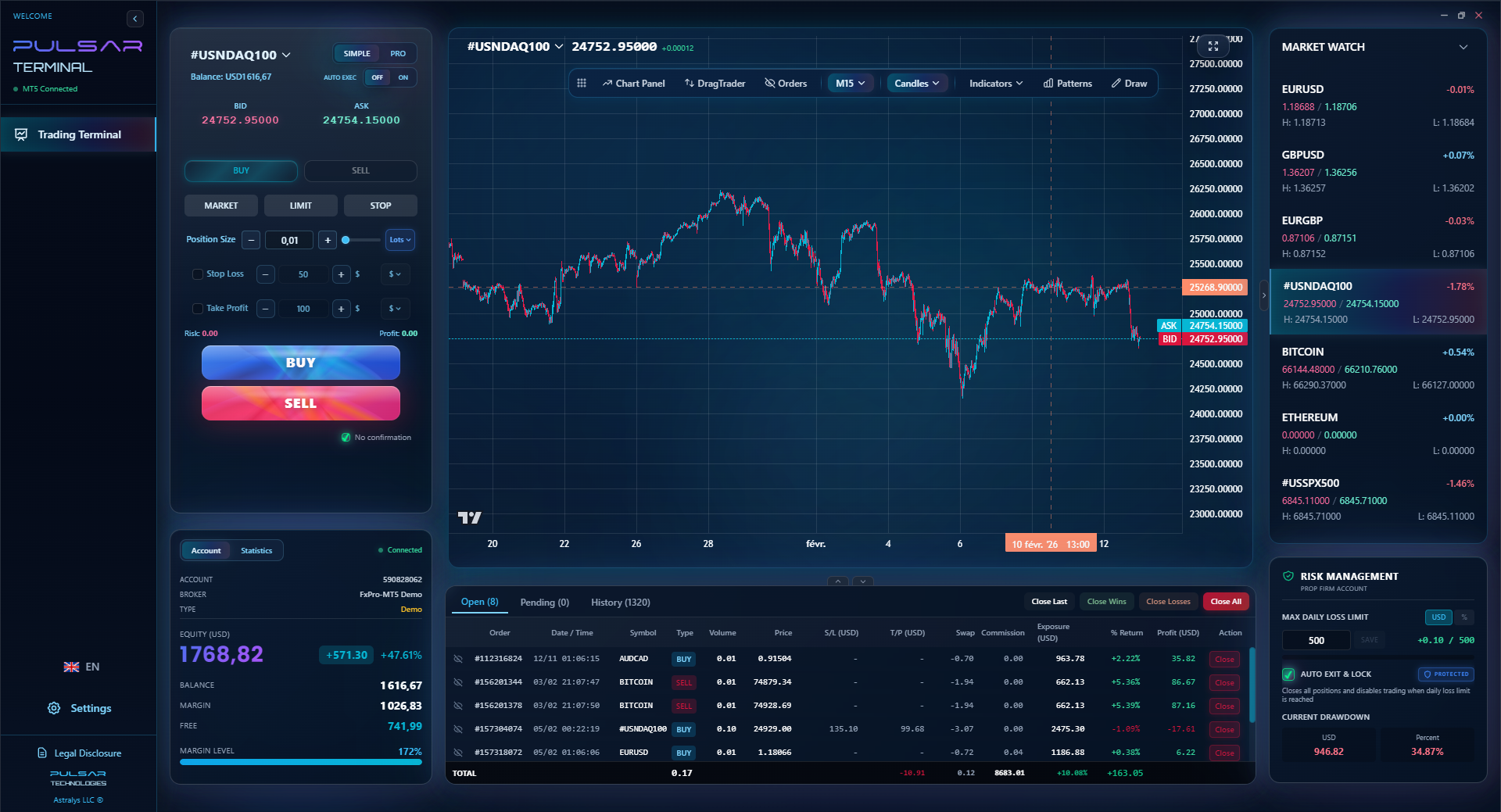
Managing complex trades and journaling for tax purposes is easier with tools that automate order management and provide clear trade analytics, directly within your MT5 platform.
I've made some of these. I've seen students make all of them.
- Ignoring Provisional Tax: The number one error. You will pay penalties. Set calendar reminders for August and February.
- Not Keeping ZAR Records: You can't do your taxes in USD or EUR. Convert as you go, monthly, using SARS rates.
- Mixing Personal and Trading Funds: Open a separate bank account for trading. It makes tracking deposits, withdrawals, and expenses infinitely easier.
- Forgetting About Expenses: That trading course, that faster internet upgrade, that second monitor - they're not just costs, they're tax deductions. Save every receipt.
- Assuming Losses Mean No Filing: Even if you had a losing year, if you're a provisional taxpayer, you likely still need to submit a return. Those losses can be carried forward to offset future profits.
- Not Understanding use's Tax Impact: use magnifies gains and losses, but for tax purposes, you're taxed on the net realized profit or loss. A high-use account that triggers frequent margin calls can create a tax nightmare of realized losses. Manage your risk.
💡 Petua Winston
Your trading journal is your first line of defense in an audit. 'Felt a reversal' is weak. 'Price rejected the 200-day MA with a bearish engulfing bar on high volume' is evidence of a business process.
“Yes, you have to pay tax when trading forex in South Africa. It's the price of being a professional.”
Don't wait for tax season. Start today.
- Register as a Provisional Taxpayer with SARS (if you aren't already). Do it online.
- Open a Separate Bank Account. Label it 'Trading Business'.
- Choose Your Record-Keeping System. This could be a simple spreadsheet, dedicated software, or a section in your trading journal. Log every trade, deposit, withdrawal, and expense. Convert to ZAR monthly.
- Find a Tax Professional. I'm a trader, not a tax accountant. Find one who understands trading or is willing to learn. Their fee will save you multiples in avoided errors and penalties.
- Forecast Your Tax. Every quarter, look at your P&L. Estimate what you might owe and start setting aside the cash in a separate savings account. A good rule is to set aside 25-35% of your net profits immediately. This prevents a cash flow crisis when SARS's payment is due.

Pro Tip: When you have a big winning trade, the first thing you should think about isn't what to buy. It's 'what's my tax liability on this?' Get into that habit. It turns tax from a scary annual event into a managed part of your business.
The bottom line? Yes, you have to pay tax when trading forex in South Africa. But with the right setup and discipline, it becomes a manageable cost of doing business, not a terrifying ordeal. It's the price of being a professional.
FAQ
Q1Is forex trading legal in South Africa?
Yes, absolutely. It's regulated by the Financial Sector Conduct Authority (FSCA). The legality isn't the issue; it's the tax compliance that trips people up.
Q2What is the tax-free threshold for forex trading?
There's no specific 'forex tax-free threshold.' If your trading is classified as income, it's added to your other income (like your salary). You only start paying tax once your total taxable income exceeds the annual tax threshold (R95,750 for the 2024/2025 year for individuals under 65).
Q3Can I use my Tax-Free Savings Account (TFSA) for forex trading?
Generally, no. TFSAs are for approved investments like ETFs, unit trusts, and certain shares listed on South African exchanges. You cannot actively trade forex or CFDs within a TFSA. Don't try to mix the two.
Q4Do I pay tax if I use an offshore broker?
Yes. South African residents are taxed on their worldwide income. It doesn't matter if your broker is in Cyprus, Australia, or the Seychelles. All profits must be declared to SARS in South African Rand.
Q5How do I convert my forex profits to ZAR for tax?
You must use the official average exchange rates published by SARS every quarter. These are based on South African Reserve Bank data. Do not use the spot rate on the day you closed a trade. The rates are available on the SARS website.
Q6What happens if I don't declare my forex trading income?
You are committing tax evasion. SARS has sophisticated data-matching systems and is increasingly looking at alternative income streams. Penalties can include back-taxes plus interest, substantial administrative penalties (up to 200% of the tax owed), and in severe cases, criminal prosecution.
Q7Can trading losses reduce my other tax?
If your trading is classified as a business (income), the net loss can be offset against your other income (like your salary), reducing your overall tax bill. If it's classified as capital, a capital loss can only be offset against other capital gains.
Pelajaran Prof. Winston
:
- ✓SARS treats active trading as business income, taxed at up to 45%.
- ✓You are a provisional taxpayer: pay estimated tax every August and February.
- ✓Convert all trades to ZAR using SARS' quarterly average rates.
- ✓Keep a detailed journal and all receipts - they're your audit armor.
- ✓Set aside at least 25-30% of net profits immediately for tax.
Sejauh mana artikel ini berguna?
Klik bintang untuk menilai
Pandangan Dagangan Mingguan
Analisis & strategi mingguan percuma. Tiada spam.
Tentang Penulis
David van der Merwe
Pedagang Pasaran Membangun
Pedagang berpangkalan di Johannesburg dengan 11 tahun dalam mata wang pasaran membangun. Pakar dalam pasangan ZAR, dagangan terkawal FSCA, dan analisis pasaran Afrika Selatan.
Komen
Anda mungkin juga suka

Cara Trading Forex Sukses: 7 Prinsip dari Trader Profesional
Cara trading forex sukses dengan 7 prinsip trader pro: manajemen modal, disiplin, journal trading, backtest. Data nyata, bukan janji profit palsu.
Jam Trading Forex Terbaik untuk Trader Indonesia: Panduan Lengkap dengan Tabel Waktu
Panduan jam trading forex untuk trader Indonesia. Tabel 4 sesi dunia, jam emas 20:00-00:00, sesi mana yang harus dihindari. Data akurat + tips dari trader berpengalaman.
Top 5 Sàn Forex Uy Tín Nhất 2026: Review Jujur dari Trader Indonesia
Top 5 sàn forex uy tín 2026 untuk trader Indonesia. Review jujur: spread, deposit, withdraw, dukungan lokal. Exness, XM, IC Markets & lebih.
All these calculators are built into Pulsar Terminal with real-time data from your MT5 account. One-click position sizing, automatic risk management, and instant calculations.
