


I was checking the FSCA's warning list last July when I saw it: 'Durban Forex Group.' No license, no contact details, just another name on the growing pile of outfits promising easy money.

David van der Merwe
Pedagang Pasaran Membangun ·  South Africa
☕ 10 minit baca
Apa yang akan anda pelajari:
I was checking the FSCA's warning list last July when I saw it: 'Durban Forex Group.' No license, no contact details, just another name on the growing pile of outfits promising easy money. Meanwhile, my own USD/ZAR swing trade was quietly working, up 220 pips on a simple trend-following setup. That contrast - between the shadowy groups and the actual, grind-it-out work of trading - is what every South African needs to understand. Let's talk about what the Durban Forex Group situation really means for you, and how to build a real trading career on this side of the world.
The Financial Sector Conduct Authority (FSCA) doesn't issue warnings for fun. When they named Durban Forex Group in July 2024, it was a specific red flag: this entity was suspected of offering financial services without authorization. That's regulator-speak for 'operating outside the law.' The FSCA tried to contact them and came up empty. That's never a good sign.
Here's the practical translation for you: if you give your money to an unlicensed entity, you have virtually zero protection. If they disappear with your capital, your recourse is basically nil. The FSCA can't help you recover funds from a ghost company. This warning ties into a broader pattern. Another entity, 'Durban Tradefx,' has been flagged by review sites like WikiFX for having no verifiable license and a suspicious regulatory history. Their website went dark, which is the classic exit scam move.

Warning: An unregulated firm might show you fake profits on a platform they control. They'll let you 'withdraw' a small amount to build trust, then pressure you to deposit more. When you try to pull out your real money, suddenly there are 'fees' or 'technical issues.' By then, it's too late.
The lesson isn't to be scared of trading. It's to be careful about who you trade with. Always, and I mean always, verify a provider's FSCA license number on the regulator's official website before you deposit a single cent.

💡 Petua Winston
The regulator's warning list is your first line of defense. Check it before you check a broker's promises.
So, who can you trust? Thankfully, South Africa has a solid list of properly regulated brokers. The FSCA is a respected regulator, and brokers under its watch must follow strict rules: they have to keep your money in segregated accounts (separate from their own business funds), treat you fairly, and maintain certain financial standards.
You've got two main paths: local FSCA regulation or going with a major international broker that also holds top-tier licenses (like ASIC in Australia or the FCA in the UK). For most beginners, starting with an FSCA-regulated broker is simpler for ZAR deposits and withdrawals.
Here’s a quick comparison of some well-known options that accept South African clients:
| Broker | Key Regulation | Min Deposit (USD approx) | Notable Feature for SA Traders |
|---|---|---|---|
| IG | FSCA, FCA (UK) | $250 | Excellent educational content, great for beginners. |
| Plus500 | FSCA | $100 | Super intuitive proprietary platform. |
| FP Markets | FSCA, ASIC | $100 AUD | Raw spreads on MetaTrader, very cost-effective. |
| XM | Multiple (CySEC, ASIC) | $5 | Low minimum deposit, lots of account types. |
| IC Markets | ASIC | $200 | the best raw spreads & execution speed. |
| Exness | CySEC, FSCA | $5 | Very low minimums, popular for scalping strategies. |
| Tickmill | FSCA, FCA | $100 | Reliable execution, good all-rounder. |
My personal go-to for active trading is IC Markets. The spreads are consistently tight - I often see 0.0 pips on EUR/USD - and the order execution is lightning fast. That matters when you're trying to get in and out of trades precisely. For a beginner, I'd point you towards XM or Exness purely because you can start with so little capital, risk virtually nothing, and just learn the platform mechanics.
The Deposit & Withdrawal Reality
Using an FSCA-regulated broker usually means you can do a local EFT in ZAR without international transfer fees. If you use an international broker, you'll likely deposit in USD or EUR. Watch those bank fees! Standard Bank charges around R35 for a ZAR refund from a Shyft Wallet, and Capitec's fee for an outgoing foreign payment is about R250. Factor that into your start-up capital. It's why starting with R1,500-R5,000 is a more realistic 'serious beginner' amount than the R70 minimum some brokers advertise.
“The lesson isn't to be scared of trading. It's to be careful about who you trade *with*.”
Let's cut through the 'get rich quick' nonsense. I'll give you real numbers from my own books and what I've seen from traders I mentor.
The Costs:
- Spreads: Your main cost. On a major pair like EUR/USD, expect 0.0 - 1.5 pips on a good raw spread account. If you're on a standard commission-free account, it might be 1.5 - 2.0 pips.
- Commission: On a raw account, you might pay $3 - $7 per lot (per side).
- Swap/Overnight Fees: These matter for swing trading. Holding a USD/ZAR buy position overnight might earn you a small credit or cost a debit, depending on the interest rate differential. Don't ignore this on longer-term trades.
- The Hidden Cost: Your own mistakes. This is the biggest one. I once blew a R4,000 account in two weeks by over-trading gold (XAU/USD) without a stop loss. That was a very expensive lesson on margin call mechanics.
Realistic Monthly Earnings (Consistent, not guaranteed):
- Beginner (First 1-2 years): R1,000 - R10,000. If you're hitting R10k, you're doing exceptionally well. Most are at the lower end or losing.
- Intermediate (Profitable system): R10,000 - R50,000. This is where the grind pays off. You're covering a decent salary.
- Experienced (Scaled capital): R50,000 - R300,000+. This requires significant, well-managed capital and proven discipline.

Example: Let's say you start with R20,000. A conservative, good month might be a 5% return. That's R1,000 profit. Aim for that consistency before you even think about bigger numbers. Use a position size calculator religiously to ensure a 5% month doesn't turn into a -15% month on one bad trade.
This is where you, as a South African, might have an edge. You live the news that moves USD/ZAR, EUR/ZAR, and GBP/ZAR. You feel the load-shedding, you hear the political debates, you see the commodity price headlines.
USD/ZAR is a beast. It's volatile, liquid, and heavily influenced by:
- Global Dollar Strength: The DXY index is your best friend for context.
- SA-Specific Risk: Political stability, Eskom news, fiscal policy.
- Commodity Prices: Gold and platinum rallies directly boost the ZAR (as we saw in 2025).
- Capital Flows: When foreign investors pile into SA bonds (like the R72 billion net purchase in 2025), the ZAR strengthens.
A trade I took in early 2026: USD/ZAR had been in a strong downtrend (ZAR strengthening). It pulled back to a key resistance area around 18.50. The RSI indicator showed bearish divergence on the daily chart - price made a higher high, but momentum didn't. I sold at 18.485, with a stop at 18.750. The target was the previous swing low. I closed half at 17.900 and let the rest run. That's a classic trend-continuation setup.
The key with ZAR pairs is respecting the spread definition. They're wider than EUR/USD. A 50-pip stop on EUR/USD is tight; on USD/ZAR, it's nothing. You need wider stops and a longer-term perspective. It's perfect for swing trading, not so much for frantic scalping.
💡 Petua Winston
Your biggest edge trading ZAR pairs isn't a secret indicator. It's your lived understanding of the local news driving the volatility.
“Your goal for the first six months shouldn't be profit. It should be education and survival.”
The Durban Forex Group warning is a symptom. The disease is the promise of effortless profits. Here’s how to spot the bad actors:
- Guaranteed Returns: Anyone promising specific, high weekly returns (like the '1,000% return' scam run by Crypto Mzansi Group that landed someone a 10-year prison sentence in 2025) is lying. Trading is probabilistic, not certain.
- Pressure to Deposit More: 'Your account is doing great! Deposit another R50,000 to unlock the platinum strategy!' This is a massive red flag.
- Complex Withdrawal Process: Legitimate brokers might have a processing time, but the rules are clear. Scammers invent endless 'fees,' 'taxes,' or 'verification delays' to keep your money.
- Social Media Hype: Be wary of Instagram or Facebook pages filled with pictures of cars and cash, claiming to be 'mentors' from a Durban forex group or similar. Real traders are usually too busy analyzing charts to curate that lifestyle feed.

Pro Tip: The best 'signal group' is your own analysis. Learn to read price action. Backtest a simple strategy. That knowledge can't be stolen from you. Relying on a WhatsApp group from an unregulated 'guru' is a surefire way to lose money.
The safest path is to ignore the noise, open an account with a verified broker like Pepperstone or IC Markets, and start small. Your goal for the first six months shouldn't be profit. It should be education and survival.
Forget joining any 'Durban forex group' you see advertised. Your success depends on your own plan. Here's a skeleton to build on:
- Market & Instrument: Start with ONE. Maybe it's USD/ZAR. Maybe it's EUR/USD. Master that before adding another.
- Strategy: Will you trend-follow? Trade ranges? Use a specific indicator crossover like the MACD indicator? Define your entry rules with crystal clarity. Example: 'Buy only if price is above the 200-day EMA, pulls back to the 50-day EMA, and the RSI indicator is above 30 and turning up.'
- Risk Management (The Most Important Part):
- Never risk more than 1-2% of your account on a single trade.
- Always know your stop-loss and take-profit levels BEFORE you enter.
- Use your position size calculator for every single trade.
- Psychology: You will have losing streaks. Your plan must include how you'll handle them (e.g., 'After 3 consecutive losses, I will stop trading for the day and review my charts').
- Journal: Write down every trade. Entry, exit, reason, emotional state. This is your single best tool for improvement.
I made my biggest leap forward when I stopped looking for the 'secret' and just focused on executing my simple plan, trade after trade. The consistency, not the brilliance of any single idea, is what builds an account.
💡 Petua Winston
A trading plan you follow 80% of the time is better than a perfect plan you follow 20% of the time. Consistency beats genius.
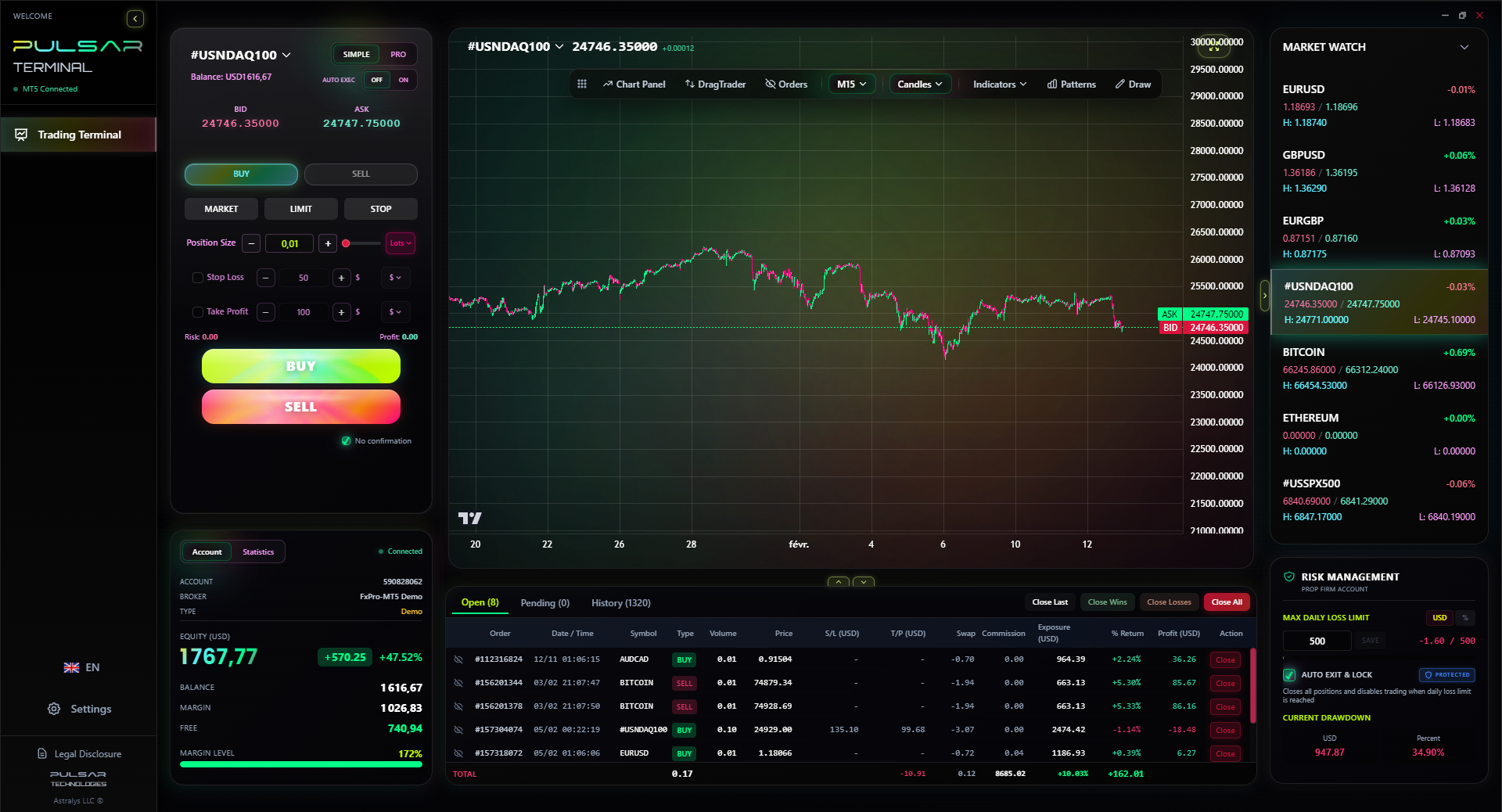
Executing a detailed trading plan with multiple take-profit levels is much easier with a tool like Pulsar Terminal, which lets you set complex order structures directly on your MT5 chart.
“The path is clear, and it bypasses all the shady groups entirely.”
Let's make this actionable. Here's your to-do list for the next week:
- Education: Spend 1 hour daily on free resources from reputable brokers or established educators. Learn what a pip definition is, how use works, what a stop-loss is.
- Verification: Go to the FSCA website. Look up the 'Authorised Financial Services Providers' list. Get comfortable with the tool.
- Broker Selection: Pick one broker from the regulated list above. Open a demo account. Play with it for at least two weeks. Place fake trades. Get used to the platform.
- Develop a Hypothesis: On your demo account, try a simple idea. 'I will buy when price crosses above the 20-period moving average.' See how it works. Lose fake money. Learn.
- Fund an Account: When you're comfortable, start with a small live amount - that R1,500 to R5,000 range. The goal is to make the real-money psychological feel normal, not to get rich.
The path is clear, and it bypasses all the shady groups entirely. It's less glamorous than the social media posts promise, but it's the only one that leads to real, sustainable trading. Your job isn't to find a guru from Durban; it's to become your own.
FAQ
Q1Is Durban Forex Group a scam?
The FSCA has warned the public that Durban Forex Group is not authorized to provide financial services. This means they operate outside the regulatory system designed to protect you. Dealing with them carries a very high risk of losing your money, with little to no legal recourse.
Q2What is the minimum amount to start forex trading in South Africa?
Technically, you can start with as little as R70-R150 ($5-$10) using a micro account from brokers like XM or Exness. However, for meaningful trading that allows for proper risk management, a more realistic starting capital is between R1,500 and R5,000. This lets you withstand normal market fluctuations without being wiped out by a single trade.
Q3Which brokers are legally allowed to operate in South Africa?
Brokers regulated by the Financial Sector Conduct Authority (FSCA) are legally authorized. This includes brokers like IG, Plus500, FP Markets, Tickmill, and AvaTrade's local entity. Many major international brokers (like IC Markets, XM) also accept South African clients while being regulated by other top-tier authorities like ASIC.
Q4How much can a beginner forex trader earn in South Africa?
A realistic expectation for a beginner (first 1-2 years) is between R1,000 and R10,000 per month, with many traders not being profitable at all initially. Consistent earnings of R10k+ per month typically come after developing a proven, disciplined trading system and managing risk effectively.
Q5Is forex trading taxable in South Africa?
Yes. Profits from forex trading are considered taxable income by SARS. You need to declare your net profits (profits minus losses and allowable expenses) in your annual tax return. It's crucial to keep detailed records of all your trades for this purpose.
Q6What is the best trading platform for beginners in SA?
MetaTrader 4 (MT4) remains the most popular and beginner-friendly platform due to its simplicity, wide availability, and vast library of free indicators. Most FSCA-regulated brokers offer it. It's a great place to start learning before exploring MT5 or cTrader.
Q7Why is the South African Rand (ZAR) so volatile?
USD/ZAR is volatile because it's sensitive to both global risk sentiment (US dollar strength) and local South African factors like political news, electricity supply (load-shedding), commodity price swings (gold/platinum), and changes in foreign investment flows into South African bonds and stocks.
Pelajaran Prof. Winston
:
- ✓Always verify FSCA authorization before depositing
- ✓Start with R1,500-R5,000 for realistic risk management
- ✓Risk a maximum of 1-2% of your capital per trade
- ✓USD/ZAR requires wider stops due to higher volatility
- ✓Profitable trading is a skill, not a lucky signal
Sejauh mana artikel ini berguna?
Klik bintang untuk menilai
Pandangan Dagangan Mingguan
Analisis & strategi mingguan percuma. Tiada spam.
Tentang Penulis
David van der Merwe
Pedagang Pasaran Membangun
Pedagang berpangkalan di Johannesburg dengan 11 tahun dalam mata wang pasaran membangun. Pakar dalam pasangan ZAR, dagangan terkawal FSCA, dan analisis pasaran Afrika Selatan.
Komen
Anda mungkin juga suka

Cara Trading Forex Sukses: 7 Prinsip dari Trader Profesional
Cara trading forex sukses dengan 7 prinsip trader pro: manajemen modal, disiplin, journal trading, backtest. Data nyata, bukan janji profit palsu.
Jam Trading Forex Terbaik untuk Trader Indonesia: Panduan Lengkap dengan Tabel Waktu
Panduan jam trading forex untuk trader Indonesia. Tabel 4 sesi dunia, jam emas 20:00-00:00, sesi mana yang harus dihindari. Data akurat + tips dari trader berpengalaman.
Top 5 Sàn Forex Uy Tín Nhất 2026: Review Jujur dari Trader Indonesia
Top 5 sàn forex uy tín 2026 untuk trader Indonesia. Review jujur: spread, deposit, withdraw, dukungan lokal. Exness, XM, IC Markets & lebih.
All these calculators are built into Pulsar Terminal with real-time data from your MT5 account. One-click position sizing, automatic risk management, and instant calculations.
