


Let me guess.

David van der Merwe
Pedagang Pasaran Membangun ·  South Africa
☕ 11 minit baca
Apa yang akan anda pelajari:
- 1Why Most Chart Pattern PDFs Are Useless (Especially Here)
- 2The 3 Patterns That Actually Work for ZAR Pairs
- 3Integrating Patterns with South African Market Reality
- 4Tools That Are Better Than a Static PDF
- 5Risk Management for Pattern Trading (The SA Edition)
- 6Building Your Own Pattern Library (Forget the PDF)
- 7Next Steps: Beyond Basic Patterns
Let me guess. You've downloaded at least three different 'Ultimate Forex Chart Patterns PDF' guides, each promising the secret to consistent profits. And you're still confused, maybe even a bit poorer. The truth is, most of those free PDFs are generic garbage that ignore the realities of trading the ZAR pairs we deal with here. They don't mention FSCA regulations, local broker spreads, or how a head and shoulders pattern on USD/ZAR behaves differently than on EUR/USD. I've been trading from Johannesburg for over a decade, and I've made every mistake in the book - including relying on those shiny PDFs. Let's cut through the noise and talk about what chart patterns actually mean for a South African trader in 2026.
Here's the brutal truth: 90% of the forex chart patterns PDFs floating around are recycled content from 2010. They show you perfect textbook examples on EUR/USD, but they're completely divorced from the market context you're actually trading in. They never tell you that a double top pattern on USD/ZAR (currently around 18.50) requires a different risk approach than on a major pair because of the rand's infamous volatility.
These guides also completely ignore the single most important factor: liquidity and session timing. A triangle pattern breaking during the London session might be valid, but the same pattern on EUR/ZAR breaking during thin Johannesburg afternoon liquidity? That's often a fakeout waiting to slap you. I learned this the hard way in 2019. I saw a beautiful ascending triangle on GBP/ZAR on my MT4 platform, entered perfectly on the breakout, and watched it reverse completely an hour later when London traders went home. The PDF didn't mention that.

Warning: Be extremely wary of any 'forex chart patterns pdf' that doesn't discuss volume or liquidity context. A pattern without confirmation is just a pretty drawing. For ZAR pairs, always check if the move coincides with major market sessions (London or New York) for higher reliability.
The other massive omission is cost. These PDFs show you where to enter, but they never calculate the spread into your target. On a pair like USD/ZAR, a competitive spread might be 50 pips during active hours. If your pattern suggests a 150-pip profit target, the spread just ate a third of your potential gain before you even started. You need to use a proper position size calculator that factors in these local costs, not some generic formula.

💡 Petua Winston
A pattern is just a picture until volume tells you the story. On ZAR pairs, a breakout on rising volume is your green light. A breakout on thin volume is a trap.
“90% of forex chart patterns PDFs are recycled content completely divorced from the reality of trading volatile ZAR pairs.”
Forget the encyclopedias. After years of screen time, I've found only a handful of patterns provide consistent, tradable setups on our local currency pairs. These work because they reflect real market psychology and are visible on the timeframes South African retail traders actually use.
Flag and Pennant Continuation Patterns
This is my bread and butter for pairs like USD/ZAR and EUR/ZAR. The rand is a momentum-driven currency, often pushed by commodity flows and global risk sentiment. After a sharp, news-driven move (like a SARB interest rate decision or a big gold price swing), the price often consolidates in a small, sloping rectangle - the flag. The key is volume: the initial spike should be on high volume, the consolidation on low volume. I look for the breakout in the original direction. In early 2025, I caught a beautiful bull flag on USD/ZAR after a US inflation surprise. Entry on the breakout at 18.20, target at 18.80. The pattern gave a clear pip definition risk point below the flag's low.
The Head and Shoulders (And Its Trap)
The classic reversal pattern. It works, but with a major South African twist. On majors, you might see it on the daily chart. On ZAR pairs, due to the volatility, you often get mini head and shoulders patterns on the 1-hour and 4-hour charts. These can be fantastic for catching short-term reversals. However, the neckline is rarely a clean, horizontal line. It's often sloping. The measured move target (distance from head to neckline, projected downward) also tends to be exceeded. My rule: take 75% of the projected target and get out.
Double Tops and Bottoms at Key Levels
These are simple but powerful, especially when they align with key psychological levels or previous weekly highs/lows. For example, if USD/ZAR rallies twice to 19.00 and fails, that's a strong signal. The confirmation is the break of the swing low between the two tops. The secret sauce? Combine it with an oscillator like the RSI indicator showing divergence. Price makes a higher high, but RSI makes a lower high. That was the setup that saved me from a bad long position on GBP/ZAR last quarter.

Example: USD/ZAR makes a high at 18.90 (Left Shoulder), rallies to 19.10 (Head), pulls back, rallies to 18.95 (Right Shoulder). The neckline is at 18.40. The measured move target is: 19.10 - 18.40 = 0.70. Projected downward from the neckline break: 18.40 - 0.70 = 17.70. On a ZAR pair, I'd set my initial profit target at 17.80.
“The measured move target on a ZAR pair is often exceeded. Take 75% of the projected profit and get out with your sanity.”
Seeing a pattern is step one. Making it a profitable trade in South Africa requires layering on local knowledge. This is where those generic PDFs leave you hanging.
First, know your broker's feed. The chart pattern you see on your Exness review MT5 platform might look slightly different from the one on IC Markets review because of how they aggregate liquidity. This matters for pinpointing exact breakout levels. I always mark my key pattern lines (necklines, triangle boundaries) as zones, not single price lines. Give it a 5-10 pip buffer for ZAR pairs.
Second, align patterns with the SA economic calendar. A beautiful bullish pattern on EUR/ZAR is meaningless if it's forming the day before a major South African budget speech or a Moody's review. That's event risk that will override any technical setup. I got stopped out of a perfect wedge breakout on USD/ZAR because I ignored a scheduled SARB speech. The pattern was right, but the fundamental catalyst was stronger.
Third, understand the cost structure. Let's be blunt: trading exotic pairs like ZAR crosses is more expensive. Here’s a quick comparison of average spreads during London session on common platforms:
| Broker / Platform | USD/ZAR Spread (pips) | EUR/ZAR Spread (pips) |
|---|---|---|
| Standard Account (e.g., XM review) | 45 - 60 | 55 - 75 |
| Raw/ECN Account (e.g., Pepperstone review) | 25 - 35 + commission | 30 - 45 + commission |
Your pattern's profit target must be significantly larger than the spread to be worthwhile. This pushes you towards higher timeframes (4H, Daily) where targets are 200+ pips, not lower timeframes where a 50-pip target gets demolished by costs. This is why swing trading patterns often work better here than scalping strategy ones.
“The measured move target on a ZAR pair is often exceeded. Take 75% of the projected profit and get out with your sanity.”
A PDF is a snapshot. The market is a movie. You need dynamic tools. Here’s what I actually use every day instead of relying on old documents.
Live Charting Software with Pattern Recognition: Most modern trading platforms have built-in pattern recognition tools. They’re not perfect, but they scan multiple timeframes and pairs faster than you can. Don't trade them blindly, but use them as an alert system. "Hey, the software is detecting a potential triangle on USD/ZAR 4H chart." Then you go and apply your own analysis.
Volume Profile and Market Profile: This is the killer feature most retail traders miss. A chart pattern shows you price consolidation. Volume Profile shows you where within that pattern the most trading activity happened (the Point of Control). A breakout above a high-volume node within a pattern is far more significant than a breakout above a low-volume area. This one tool improved my pattern breakout success rate by at least 30%.
Multiple Time Frame Analysis (MTFA): This is non-negotiable. Your forex chart patterns pdf might tell you to trade the breakout on the 1-hour chart. That's suicide if the daily chart is showing the price is smack in the middle of a massive, year-long range. My process: 1) Identify the pattern on my trading timeframe (e.g., 4-hour). 2) Zoom out to the daily to see if it's at a key support/resistance level. 3) Zoom in to the 1-hour to fine-tune my entry and stop loss. This three-lane view prevents you from getting run over by the higher-timeframe trend.
💡 Petua Winston
Your first loss is your best loss. If a pattern breaks against you and hits your stop, don't revenge trade. The market is telling you the story changed. Listen.
“Your own trade journal is worth a thousand downloaded PDFs. Build your edge from your own screenshots, not someone else's examples.”
This is where I've seen more South African traders blow up than anywhere else. They see the pattern, they see the potential profit, and they go all in. The volatile nature of ZAR pairs means your stop loss can get hunted (triggered before the pattern fails) more often.
Position Sizing is Everything: You must know your exact risk in Rands, not just pips. If you're trading a head and shoulders on USD/ZAR with a 200-pip stop loss, that’s R2000 per standard lot at current levels. Is that 1% of your capital? Or 10%? Use a calculator. Every. Single. Time. I have a position size calculator open in a browser tab at all times.
The False Breakout Rule: Assume 30-40% of pattern breakouts on ZAR pairs will be false, especially around local market open/close. My rule: I only enter on a close outside the pattern boundary (e.g., a 4-hour candle close below the neckline), not just a intra-candle spike. This filters out a lot of noise. Yes, you miss the very first bit of the move. But you survive longer.
Have a Plan for the Win and the Loss: Before you click buy/sell, know: 1) Your stop loss (placed logically beyond the pattern structure). 2) Your primary profit target (often the measured move). 3) Your trailing stop plan. Will you move your stop to breakeven after a certain move? Will you take partial profits? A static PDF can't teach you this discipline. I learned it after a perfect double bottom on EUR/USD turned into a loss because I got greedy and didn't trail my stop. The trade was up 80 pips, and I ended up at margin call levels because I had no exit plan.
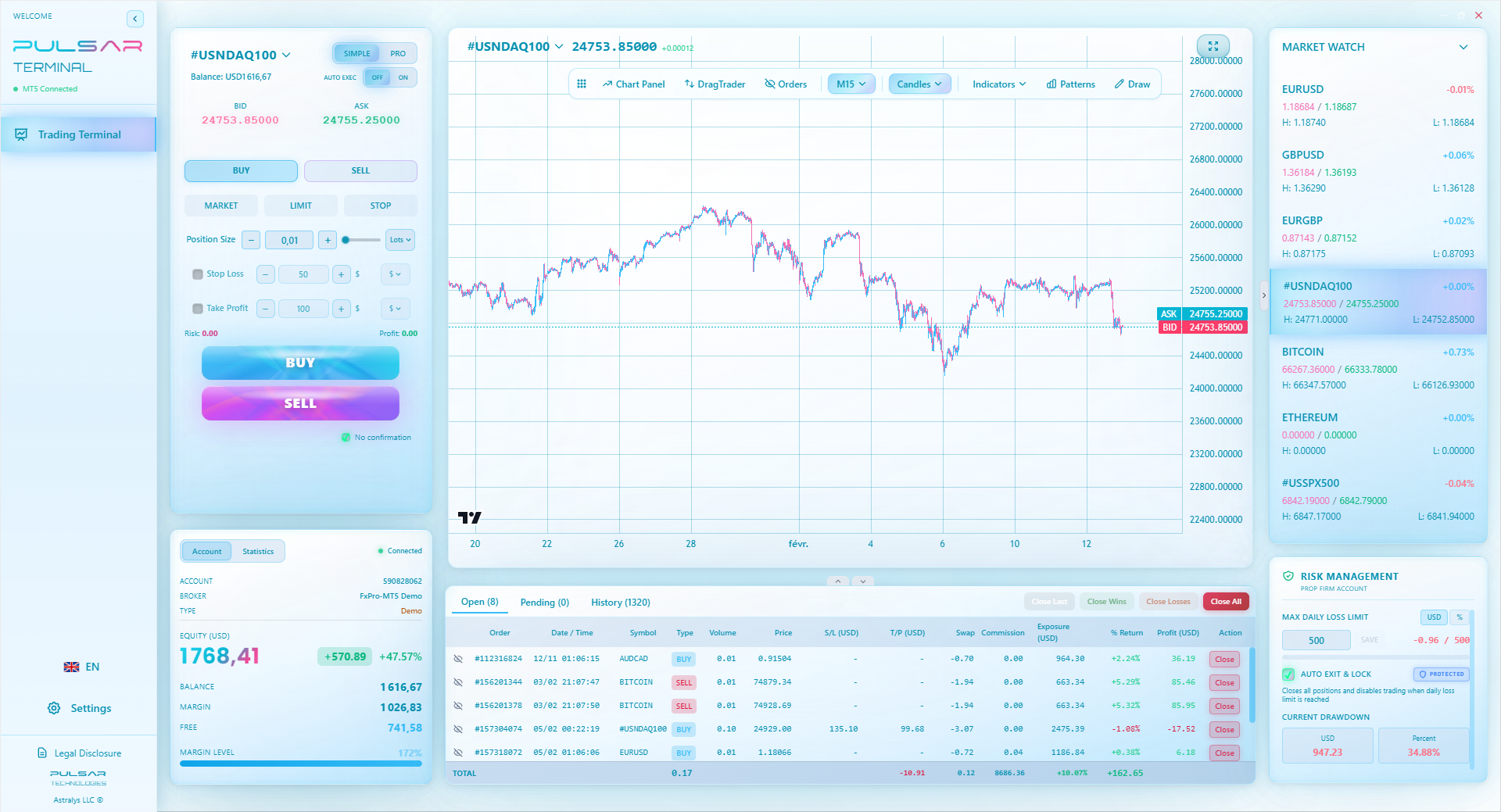
Manually moving stops to breakeven and managing partial profits on volatile pattern breakouts is stressful; Pulsar Terminal automates this with its multi-TP/SL and breakeven functions directly on your MT5 chart.
“Your own trade journal is worth a thousand downloaded PDFs. Build your edge from your own screenshots, not someone else's examples.”
Stop collecting PDFs. Start building your own journal. This is the single most powerful thing you can do.
Step 1: Screenshot Everything. When you see a pattern forming on your chart (USD/ZAR, Gold/XAUUSD, anything), take a screenshot. Mark it up. What timeframe? What was the preceding trend?
Step 2: Record the Outcome. Did it break out as expected? Was it a false breakout? How far did it travel? What was the volume like? Note the date and time.
Step 3: Review Weekly. Every weekend, I go through my screenshots from the past week. I look for commonalities. Maybe triangles work 70% of the time on EUR/ZAR 4H chart, but only 40% of the time on GBP/ZAR 1H chart. This is your personal edge, tailored to your psychology and the pairs you watch. My own library showed me that wedge patterns fail more often for me than flags, so I now approach wedges with much more caution and smaller position sizes.
This process turns abstract patterns from a forex chart patterns pdf into concrete, personal experience. It builds your intuition. After a while, you'll see a pattern starting to form and you'll get a gut feeling - not from magic, but from the hundreds of examples you've reviewed in your own market.

Pro Tip: Don't just journal the wins. Journal the losses twice as diligently. My most valuable pages are the trades where the pattern failed. Analyzing why it failed (false breakout, fundamental news, wrong timeframe) is what leads to real improvement.
“A pattern during the London/New York overlap is trustworthy. The same pattern during a quiet Jo'burg afternoon is often a fakeout.”
Once you've mastered identifying and trading the classic patterns, the real art begins. This is where you graduate from the PDF.
Combine Patterns with Price Action Concepts: A triangle pattern is good. A triangle pattern that forms right at a key Fibonacci retracement level (like the 61.8% level) and shows a pin bar rejection at the support trendline before breaking out? That's a high-probability setup. You're layering multiple confluent factors.
Use Indicators as Confirmation, Not Drivers: The MACD indicator histogram crossing above zero can confirm a breakout from a consolidation pattern. The RSI moving out of oversold territory can confirm a double bottom reversal. But let the pattern be the primary signal. The indicator is the supporting actor.
Understand Pattern Psychology: Why does a head and shoulders work? It represents a final failed attempt by the bulls (right shoulder) to push price higher after the main momentum (the head) has exhausted. When you understand the battle between buyers and sellers that the pattern represents, you stop seeing it as a magical shape and start seeing it as a story on the chart. This mindset shift is crucial for knowing when to break the rules - because sometimes the story changes mid-way.
Finally, remember that patterns are a piece of the puzzle, not the whole picture. Your broker choice, your mental state, local regulations from the FSCA, and global risk sentiment all play a part. Keep learning, keep journaling, and for goodness' sake, stop downloading those generic forex chart patterns pdfs. Build your own knowledge from the ground up, right here in the South African market.
FAQ
Q1Are forex chart patterns reliable for trading the South African Rand (ZAR)?
They can be, but with major caveats. ZAR pairs (like USD/ZAR, EUR/ZAR) are more volatile and less liquid than majors like EUR/USD. This means patterns form faster, breakouts can be more explosive, but false breakouts are also more common. Reliability increases significantly when you trade patterns on higher timeframes (4-hour or daily) and confirm them with volume or major support/resistance levels. A pattern during the London/New York overlap is more trustworthy than one during quiet Johannesburg afternoon hours.
Q2What is the best timeframe to use for chart patterns in South Africa?
It depends on your style, but for most South African retail traders, the 4-hour chart is the sweet spot. It's slow enough to filter out the noise from ZAR's volatility but fast enough to provide several trade opportunities per month. Daily charts are excellent for swing trading major patterns. Avoid relying solely on patterns below the 1-hour chart for ZAR pairs - the spreads and market noise will eat you alive. Always perform multiple timeframe analysis.
Q3Do I need to pay for a forex chart patterns PDF or course?
Absolutely not. All the foundational information on classic patterns (head and shoulders, triangles, flags) is freely available. The real value isn't in a secret pattern; it's in learning how to apply them to your specific market (ZAR pairs) with proper risk management. Instead of paying for a PDF, spend that money on a demo account with a good FSCA-regulated broker and practice. Your own trade journal will be more valuable than any purchased course.
Q4How does the FSCA impact how I should use chart patterns?
The FSCA doesn't regulate your analysis, but it does regulate who you trade with. Always use an FSCA-licensed broker. This ensures your funds are segregated and you have a legal recourse. More practically, FSCA-regulated brokers like those we review (e.g., IC Markets, Pepperstone) provide reliable, transparent pricing. A pattern's breakout level is useless if your broker has unreliable quotes or massive slippage. Regulation gives you a baseline of trust in the chart you're looking at.
Q5What's the biggest mistake South African traders make with chart patterns?
Ignoring the spread and position sizing. They'll see a 100-pip profit target on a USD/ZAR pattern and think it's a great trade, not realizing the spread is 50 pips. They also fail to adjust their position size for the larger stop losses that volatile ZAR pairs require. Using a fixed lot size for every pattern trade is a fast track to blowing up your account. Always calculate your risk in Rands first.
Q6Can I use automated pattern recognition software?
You can, but don't trust it blindly. Use it as a scanner or alert system. The software might identify a potential 'double top' based on geometry, but it can't tell if that pattern is forming at a key historical resistance level or during a major news event. Always do your own manual confirmation. Treat the software like a helpful assistant, not a boss giving you orders.
Pelajaran Prof. Winston
:
- ✓Trade ZAR patterns on 4H+ timeframes to reduce noise.
- ✓Always factor in the wide spread (25-60 pips) on ZAR pairs.
- ✓Use a pattern as a signal, but volume as your confirmation.
- ✓Journal every pattern trade, especially the losers.
Sejauh mana artikel ini berguna?
Klik bintang untuk menilai
Pandangan Dagangan Mingguan
Analisis & strategi mingguan percuma. Tiada spam.
Tentang Penulis
David van der Merwe
Pedagang Pasaran Membangun
Pedagang berpangkalan di Johannesburg dengan 11 tahun dalam mata wang pasaran membangun. Pakar dalam pasangan ZAR, dagangan terkawal FSCA, dan analisis pasaran Afrika Selatan.
Komen
Anda mungkin juga suka

Cara Trading Forex Sukses: 7 Prinsip dari Trader Profesional
Cara trading forex sukses dengan 7 prinsip trader pro: manajemen modal, disiplin, journal trading, backtest. Data nyata, bukan janji profit palsu.
Jam Trading Forex Terbaik untuk Trader Indonesia: Panduan Lengkap dengan Tabel Waktu
Panduan jam trading forex untuk trader Indonesia. Tabel 4 sesi dunia, jam emas 20:00-00:00, sesi mana yang harus dihindari. Data akurat + tips dari trader berpengalaman.
Top 5 Sàn Forex Uy Tín Nhất 2026: Review Jujur dari Trader Indonesia
Top 5 sàn forex uy tín 2026 untuk trader Indonesia. Review jujur: spread, deposit, withdraw, dukungan lokal. Exness, XM, IC Markets & lebih.
All these calculators are built into Pulsar Terminal with real-time data from your MT5 account. One-click position sizing, automatic risk management, and instant calculations.
