


I lost $1,200 in 2018 because I didn't understand what a 'forex company' really was.

Olumide Adeyemi
Perintis Dagangan Afrika Barat ·  Nigeria
☕ 11 minit baca
Apa yang akan anda pelajari:
- 1What Exactly Is a 'Forex Company'? (It's Not What You Think)
- 2The Legal & Tax Reality for Nigerian Traders
- 3How to Pick Your Forex Company: A 5-Point Checklist
- 4Deposits & Withdrawals: The Practical Guide
- 5Scams & Red Flags: Protecting Your Capital
- 6Two Trades That Taught Me About Broker Quality
- 7Getting Started: A Realistic Roadmap
- 8The Future: Nigeria's Evolving Forex Landscape
I lost $1,200 in 2018 because I didn't understand what a 'forex company' really was. I'd deposited with a slick platform promising 'CBN approval,' only to find my withdrawals stuck for weeks during a volatile Naira swing. The support tickets went unanswered, and by the time I got my capital back (minus 'administrative fees'), the perfect EUR/NGN setup I'd spotted was long gone. That painful lesson cost me more than money, it cost me opportunity. Here's everything I wish I'd known before trusting my funds to any broker.
Most new traders hear 'forex company' and picture a Nigerian firm with a fancy Lagos office. That's rarely the case. In reality, you're almost always dealing with an international broker that provides you with a trading platform and market access. They are not the market itself, they're your gateway.
The critical distinction is between a regulated broker and a bucket shop. A regulated broker executes your trades in the real interbank market (or a close equivalent). A bucket shop simply takes the other side of your trade, betting you'll lose. They have a direct incentive for you to fail. I learned this the hard way with a now-defunct 'company' called TradeFXNaija. My winning trades on USD/NGN would often mysteriously 'slip' at execution, while losses were instant. The spread would widen from 5 pips to 20 the moment I clicked buy. That's not bad luck, that's a conflict of interest built into their model.
Your primary relationship with any forex company is through their trading server. Your deposit, your orders, your profits, all flow through them. That's why their integrity isn't just important, it's everything. Don't get swayed by who has the flashiest local seminar. Look at who holds their license and where your money actually goes. For a deep dive on a major currency pair many Nigerians trade, our EUR/USD guide breaks down its unique dynamics.

Warning: If a 'forex company' actively encourages you to trade huge sizes with bonus money, offers 'guaranteed' profits, or pressures you to deposit more to 'unlock' withdrawals, run. These are hallmarks of a scam, not a legitimate broker.

💡 Petua Winston
A broker's regulation is your life jacket. Never trade without one. A fancy website is cheaper than a financial services license.
Let's clear the air. Yes, forex trading is legal for individuals in Nigeria. No, you won't get arrested for it. The Central Bank of Nigeria (CBN) and the Securities and Exchange Commission (SEC) are the main overseers, but here's the crucial bit you must understand: there are no specific local regulations for the online retail forex trading you're doing.
This regulatory gap is a double-edged sword. It means you have the freedom to choose from top global brokers. But it also means you have zero protection from the CBN if your international broker goes under or scams you. You're relying entirely on that broker's home regulator (like the FCA in the UK or ASIC in Australia). Your recourse is with them, not in Abuja.
The 10% Tax Rule Nobody Talks About
Here's where I got a nasty surprise. All profit from forex trading is considered a capital gain by the Federal Inland Revenue Service (FIRS). The tax rate is 10% on your gross profit. If you make a ₦1,000,000 profit in a year, you owe FIRS ₦100,000. It's your responsibility to declare this. I know dozens of traders who ignore this, but the risk is real as your account grows. Keep detailed records of all your trades.
Funding Your Account: The CBN's Red Line
The CBN is crystal clear on one point: you cannot use official foreign exchange windows (like your bank's official rate) to fund a forex trading account. Your deposit must come from already-existing foreign currency (like domiciliary account funds) or through payment processors. This is why brokers offer local bank transfers in Naira, which they then convert. Understanding your margin requirements before you deposit is key to not overextending yourself.
“The CBN is crystal clear: you cannot use official foreign exchange windows to fund a forex trading account.”
After my early disasters, I developed a checklist. I won't trade with a company unless it ticks all these boxes.
- Strong International Regulation: This is non-negotiable. Look for licenses from the Financial Conduct Authority (FCA) in the UK, the Australian Securities and Investments Commission (ASIC), or the Cyprus Securities and Exchange Commission (CySEC). These are tier-1 regulators with strict client fund segregation rules. This means your money is held in separate bank accounts, not mixed with the company's operational funds. I trust brokers like IC Markets and Pepperstone because of their top-tier ASIC regulation.
- Reasonable Minimum Deposit: If a company asks for more than $200-$500 to open a standard account, be skeptical. You don't need thousands to start. A realistic amount lets you practice proper position sizing without risking your livelihood. Some brokers offer micro accounts from $10, which is great for testing their platform.
- Reliable Naira Deposit/Withdrawal: Test the withdrawal process before you make a large deposit. How many days does it take? What are the fees? A good broker processes withdrawals in 1-3 business days. If it takes weeks, that's a major red flag. Look for local payment options like bank transfer or USSD.
- Tight Spreads on Major Pairs: For pairs like EUR/USD, the spread (the difference between buy and sell price) should be low, often under 1 pip for ECN accounts. Wide spreads silently eat your profits. Compare the live spreads during the London and New York sessions before you sign up.
- Functional MT4/MT5 Platform: Most serious traders use MetaTrader. Ensure the broker's MT4/MT5 servers are stable, especially during high-impact news events. There's nothing worse than your platform freezing when the US Non-Farm Payroll data hits.

Pro Tip: Open a demo account with your shortlisted brokers for at least two weeks. Execute the same trades on each. Compare the execution speed, slippage, and platform stability. It's the closest you'll get to a test drive.
This is where the rubber meets the road. All the profits in the world mean nothing if you can't get your money out.
Depositing: Most brokers catering to Nigeria offer direct Naira bank transfers, debit/credit cards (Visa/Mastercard), and e-wallets like Skrill or Neteller. The Naira transfer is often the simplest. You'll get a local account number to send Naira to, the broker converts it at their rate, and it reflects in your trading account. The conversion rate is key, always check it against the official and parallel market rates to see the markup.
Withdrawing: This should be the reverse of your deposit. You request a withdrawal in your account currency, and they send it back. Always withdraw using the same method you deposited with. This reduces delays and anti-money laundering checks. My rule is to do a small test withdrawal of $50-$100 immediately after my first deposit clears. If that comes through smoothly and quickly, I have more confidence.
I remember trying to withdraw $2,500 from an offshore broker in 2020. They asked for a utility bill, my ID, a selfie with my passport, and then a 'verification fee' of $50. It was a nightmare. Contrast that with my experience with XM, where a $1,000 withdrawal hit my domiciliary account in 24 hours with no questions, because I had verified my account fully when I opened it. Do the paperwork upfront.

Example: You deposit ₦150,000. The broker's conversion rate is ₦1,200/$. You get $125 in your trading account. You trade and grow it to $200. You withdraw. They convert at ₦1,180/$, giving you ₦236,000. The difference between the buy/sell rate is their hidden fee. Always be aware of it.
💡 Petua Winston
Test the exit before you enter. Do a small withdrawal before a large deposit. If they can't give you $50 back smoothly, they'll never give you $5,000.
“The goal of your first year isn't to get rich. It's to not blow up your account.”
Nigerian traders are prime targets for scams. Here are the schemes I've seen (and sadly, fallen for once).
The 'Fund Manager' or Signal Seller Scam: Someone on WhatsApp or Instagram shows screenshots of massive profits. They offer to manage your account or sell you signals for a monthly fee. They often use a profit split model. I paid a 'guru' $300/month for signals in 2019. His trades were reckless, 5-lot positions on GBP/JPY with no stop loss. When I blew my account, he vanished and blocked me. Your best scalping strategy is the one you develop and understand yourself.
The Fake Investment (Ponzi) Scheme: This promises fixed daily returns (e.g., '2% daily guaranteed'). They use new deposits to pay 'profits' to earlier investors, creating an illusion of success. It collapses when new money stops flowing in. MMM Forex was a classic example that wiped out savings.
The Unregulated Broker 'Bonus' Trap: You deposit $1,000 and get a '$1,000 bonus'. Sounds great. But the terms state you must trade a volume of 100 lots before you can withdraw any money, including your own deposit. This forces you to trade huge sizes until you inevitably blow up. Legitimate brokers like Exness might offer deposit bonuses, but the terms are clear and achievable.
Red Flag Summary:
- Guaranteed profits or no risk.
- Pressure to deposit more to withdraw.
- Withdrawal delays with constant 'processing' excuses.
- Company registered offshore with no clear regulation.
- They contact you first via social media with unbelievable results.
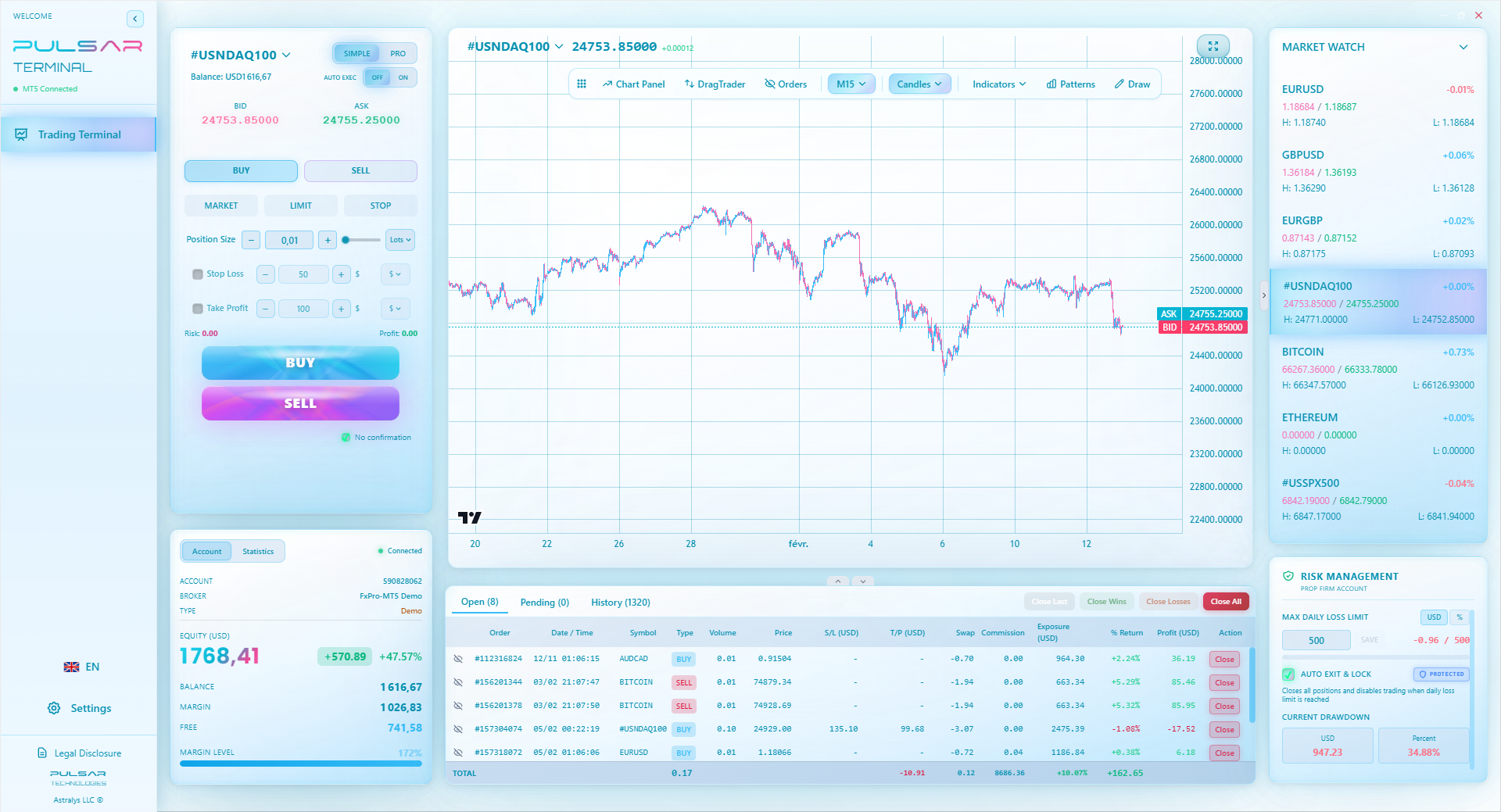
Managing the strict daily loss limits of a prop firm challenge is where a tool like Pulsar Terminal shines, automating your risk rules directly on MT5 so you can focus on the trade, not the rulebook.
Let me show you how your choice of forex company directly impacts your P&L.
Trade 1: The Good Execution (XAU/USD - Gold)
- Date: March 2023
- Broker: IC Markets (ASIC Regulated)
- Setup: I was watching for a breakout above a key weekly resistance at $1950 on XAU/USD. The US CPI data was due.
- Action: I placed a buy stop order at $1952, with a stop loss at $1945, targeting $1965.
- What Happened: CPI came in hot. Price spiked. My order was filled at $1952.1, a slippage of just 0.1 dollars. The platform didn't freeze. I moved my stop to breakeven at $1952.1 as price rallied, and took partial profit at $1960. The trade ran to my target.
- Lesson: A stable platform and honest execution during volatility let the trade play out as planned. The 0.1 slippage was fair.
Trade 2: The Bad Execution (A Failed Scalp)
- Date: Earlier, in 2021
- Broker: An unregulated bucket shop.
- Setup: I identified a tight scalping opportunity on EUR/USD using the RSI indicator and a 1-minute chart. Price was coiling.
- Action: Market buy order for 0.5 lots at 1.1320, aiming for 3 pips.
- What Happened: The moment I clicked, the platform lagged. My order was filled at 1.1327 - a 7-pip slippage on a 3-pip target! Before I could even react, price ticked down and hit my tight stop loss. I lost on a trade where my analysis was correct.
- Lesson: The forex company's poor infrastructure (or deliberate manipulation) turned a winning setup into an instant loss. This is why broker quality isn't an afterthought, it's the foundation.
“A stable platform and honest execution during volatility let the trade play out as planned.”
If I were starting again today in Nigeria, here's my exact plan.
- Education First, Money Last: Spend 3-6 months learning. Understand what a pip is, what spread means, and how use works. Paper trade.
- Choose One Regulated Broker: From my list, pick one with a low minimum deposit. Don't spread $100 across three brokers.
- Start with a Micro Account: Deposit the equivalent of $100-$200. This is real money, so you'll feel the emotions, but it's an amount you can afford to lose while learning.
- Develop a Simple Strategy: Don't try to master 10 indicators. Start with price action and one oscillator like the MACD. Define your entry, stop loss, and take-profit rules clearly.
- Risk Max 1% Per Trade: On a $200 account, that's $2. It feels tiny, but it keeps you in the game. Use a position size calculator for every single trade.
- Journal Religiously: Write down every trade. Why you took it, your emotion, the outcome. This is how you improve.
- Plan for Taxes: From day one, set aside 10% of your net profits in a separate account. Don't let a tax bill blindside you.
The goal of your first year isn't to get rich. It's to not blow up your account. If you can survive 12 months, you're ahead of 90% of beginners. Then you can explore more advanced styles like swing trading.
💡 Petua Winston
Your first profit target should be 12 months of survival. Consistency beats a lucky 100% return every single time.
Things are changing. The CBN's new Nigeria Foreign Exchange Code (2025) aims to bring more transparency to the wholesale market. While not directly about retail trading, a more stable and liquid underlying Naira market is good for everyone.
The rise of prop firms is also a game-changer for Nigerian traders. These firms give you capital to trade if you pass a challenge. It's a way to trade larger sizes without risking your own savings. The catch? Their rules are strict. You must manage daily loss limits perfectly. This is where technology becomes vital. Managing a prop firm challenge manually is incredibly stressful. You need tools that can automate risk rules.
Looking ahead, I expect more Nigerian fintechs to partner with international brokers to offer seamless services. But the core principle will remain: your safety lies in the strength of the international regulator behind your chosen forex company. Build your knowledge, choose your partner wisely, and always, always protect your capital first. That's the only way to last in this game.
FAQ
Q1Is forex trading illegal in Nigeria?
No, it's completely legal for individuals. The Central Bank of Nigeria (CBN) does not prohibit you from trading forex with international brokers. However, you cannot use official CBN foreign exchange windows to fund your trading account.
Q2Which forex company is the best for beginners in Nigeria?
There's no single 'best.' Look for a company with strong international regulation (like FCA or ASIC), a low minimum deposit ($100-$200), reliable Naira deposit/withdrawal methods, and a user-friendly platform like MT4. Brokers like IC Markets, Exness, and XM are popular choices among Nigerians for these reasons.
Q3How much money do I need to start forex trading in Nigeria?
You can technically start with as little as $10 on a micro account. However, I strongly recommend starting with at least $200-$500. This allows for proper position sizing and risk management (e.g., risking 1% or $2-$5 per trade) without your account being wiped out by a few small losses or high relative spreads.
Q4How do I pay tax on my forex trading profits?
Forex trading profits are classified as capital gains. You are required to declare your annual net profit to the Federal Inland Revenue Service (FIRS) and pay a 10% tax on the gross profit. It is your responsibility to keep records and file.
Q5What is the safest way to fund my forex trading account?
The safest way is to use the local Naira bank transfer option provided by your broker. Ensure the broker is reputable and regulated. Avoid funding your account with credit card debt or money you cannot afford to lose entirely. Always do a small test withdrawal first to confirm the process works.
Q6Can the CBN help me if my international forex broker scams me?
No, most likely not. The CBN regulates the Nigerian banking system and the wholesale FX market, not international online retail brokers. If you have an issue with a broker regulated in another country (e.g., the UK), your complaint must be filed with that country's financial regulator (e.g., the UK's FCA). This is why choosing a broker with top-tier regulation is your first line of defense.
Q7Are forex trading bonuses a good idea?
Generally, no. Bonuses often come with restrictive trading volume conditions (like trading 100 lots before withdrawal) that force you to take excessive risk. It's better to choose a broker with low spreads and no bonus, so you have clear and straightforward withdrawal terms. Your profit should come from trading, not from a bonus.
Pelajaran Prof. Winston
:
- ✓Prioritize brokers with FCA, ASIC, or CySEC regulation above all else.
- ✓Always perform a sub-$100 test withdrawal before committing significant capital.
- ✓Set aside 10% of all net profits immediately for FIRS capital gains tax.
- ✓Start with a minimum of $200 to allow for realistic 1% risk management.
Sejauh mana artikel ini berguna?
Klik bintang untuk menilai
Pandangan Dagangan Mingguan
Analisis & strategi mingguan percuma. Tiada spam.
Tentang Penulis
Olumide Adeyemi
Perintis Dagangan Afrika Barat
Salah seorang pendidik dagangan forex paling aktif di Nigeria. 8 tahun pengalaman dagangan dari Lagos. Pakar dalam strategi modal rendah dan cabaran prop firm untuk pedagang Afrika.
Komen
Anda mungkin juga suka

Cara Trading Forex Sukses: 7 Prinsip dari Trader Profesional
Cara trading forex sukses dengan 7 prinsip trader pro: manajemen modal, disiplin, journal trading, backtest. Data nyata, bukan janji profit palsu.
Jam Trading Forex Terbaik untuk Trader Indonesia: Panduan Lengkap dengan Tabel Waktu
Panduan jam trading forex untuk trader Indonesia. Tabel 4 sesi dunia, jam emas 20:00-00:00, sesi mana yang harus dihindari. Data akurat + tips dari trader berpengalaman.
Top 5 Sàn Forex Uy Tín Nhất 2026: Review Jujur dari Trader Indonesia
Top 5 sàn forex uy tín 2026 untuk trader Indonesia. Review jujur: spread, deposit, withdraw, dukungan lokal. Exness, XM, IC Markets & lebih.
All these calculators are built into Pulsar Terminal with real-time data from your MT5 account. One-click position sizing, automatic risk management, and instant calculations.
