


Here’s a sobering fact: if you start with R10,000 and manage a consistent 5% return per month, you’d have over R1.7 million in three years through compounding.

David van der Merwe
Pedagang Pasaran Membangun ·  South Africa
☕ 11 minit baca
Apa yang akan anda pelajari:
Here’s a sobering fact: if you start with R10,000 and manage a consistent 5% return per month, you’d have over R1.7 million in three years through compounding. Sounds incredible, right? That’s the seductive power of compound growth. But here’s the other side of that coin: a 5% loss each month would wipe out 95% of that same account in the same timeframe. In South Africa, where forex is buzzing but proper guidance is scarce, understanding forex compounding isn't about getting rich quick. It's about survival math. Let's strip away the YouTube fantasy and talk about how this actually works for us, with our brokers, our Rand, and our very real market risks.
Forex compounding is simple in theory: you reinvest your trading profits back into your account, so you're trading with a larger capital base. Your profits start earning their own profits. It's not a strategy in itself, but a capital management rule you apply to whatever trading method you use.
Where most new traders get it wrong is in the expectation. They see those exponential growth charts and think it's a guaranteed path to wealth. It's not. Compounding is a magnifying glass. It will magnify consistent gains beautifully. But it will also magnify inconsistent performance, mistakes, and losses just as fast, if not faster. I learned this the hard way early on. I had a great three months, grew a R20,000 account by 25%, and got greedy. I recalculated my position sizes based on the new, higher balance but didn't tighten my risk per trade. One bad week of overtrading wiped out four months of compounded gains. The loss felt double because it wasn't just my initial capital gone, it was 'my' profits too.
In the South African context, you're also compounding against costs unique to us. Your broker's spread on USD/ZAR, any conversion fees from ZAR to USD for trading, and swap rates all eat into the net profit you have available to compound. Ignoring these is like trying to fill a bucket with a hole in the bottom.

Warning: Compounding is not a strategy to recover losses. The classic mistake is to double your risk after a loss to "get back to even." This is the opposite of compounding and is a surefire way to a margin call.

💡 Petua Winston
The market doesn't care about your compounded goals. Your risk rule is your only protector. Never negotiate with it.
“Compounding is a magnifying glass. It will magnify consistent gains beautifully. But it will also magnify mistakes just as fast.”
Let's get specific with numbers, because vague promises are worthless. The core formula you need is the compound interest formula: A = P (1 + r)^n.
- A = the future value of your investment/account
- P = the principal investment amount (your starting balance)
- r = your periodic rate of return (your monthly or weekly gain percentage)
- n = the number of periods (months, weeks)
Realistic Return Scenarios
Let's use a starting capital of R15,000, which is a common entry point for many South Africans. Look at the difference a few percentage points make over two years (24 months):
| Monthly Return Rate | Account Value After 24 Months | Total Return |
|---|---|---|
| 3% | R30,570 | +103.8% |
| 5% | R48,253 | +221.7% |
| 7% | R76,122 | +407.5% |
| 10% | R158,497 | +956.6% |
📊 Example: Using the formula for a 5% monthly return: A = 15000 * (1 + 0.05)^24. That's 15000 * (1.05)^24. Calculate 1.05^24 first (it's about 3.225), then multiply by 15000 to get ~R48,375.
The 10% figure looks insane, and it is. Achieving a consistent 10% per month is the realm of the elite few, not the retail trader. The 3-7% range is where realistic, disciplined swing trading or systematic approaches might land. Notice how doubling the return rate from 5% to 10% doesn't just double the outcome, it creates nearly five times the final profit. That's the exponential power.
The Drawdown Destroyer
Now, the brutal side. Losses compound too. A 5% loss requires a 5.26% gain to break even. A 20% loss needs a 25% gain. A 50% loss? You need a 100% gain just to get back to where you started. This is why protecting your capital is infinitely more important than chasing high returns. Your first compounding rule should be: Compound profits, never compound losses.

Pro Tip: Don't guess your position size. Use a position size calculator religiously. If your account grows from R10,000 to R11,000, your 1% risk per trade grows from R100 to R110. Recalculate for every single trade based on your current balance.
“Your first compounding rule should be: Compound profits, never compound losses.”
A plan without rules is just a wish. Here’s how to build yours, step-by-step, for the local market.
Step 1: Set Your Baseline and Rules
- Start with What You Can Lose: Your compounding journey begins with risk capital. Not rent money, not savings for a car. This is crucial for psychological stability.
- Define Your Risk Per Trade: This is your anchor. I never, ever risk more than 1% of my current account balance on any single trade. Most pros recommend 0.5%-2%. This rule automatically adjusts your position size as your account compounds. If you have a R20,000 account, your max risk is R200. At R22,000, it's R220.
- Choose Your Compounding Frequency: Will you recalculate your position sizes after every trade? Every week? Every month? Monthly is a solid, manageable rhythm for most. It lets profits accumulate and smooths out daily volatility.
- Set a Realistic Target Return: Based on your strategy's historical performance (you are backtesting, right?), set a target. Aiming for a consistent 3-5% per month is far more sustainable and impressive in the long run than chasing 20% and blowing up.
Step 2: The Mechanics – How to Physically Do It
You don't manually withdraw and redeposit profits. The process is mental and administrative:
- Track Your Balance: At your chosen frequency (e.g., month-end), note your account balance.
- Update Your Trading Journal: This is non-negotiable. Your journal entry should state: "As of [Date], account balance is RXX,XXX. New base capital for risk calculations. 1% risk = RXXX."
- Adjust Your Calculator: In your position size calculator, you now input the new account balance for all future trades until the next compounding point.
Step 3: Incorporating Local Factors
- ZAR Accounts: If you trade with a ZAR-denominated account (like those offered by Exness or XM locally), your profit and loss are already in Rands. This simplifies things - no mental forex conversion on your returns.
- Tax Implications: In South Africa, profits from trading are generally considered capital gains or income tax, depending on your trading frequency and the SARS's perception of your activity. While I'm not a tax advisor, you must keep careful records of your trades and compounded balance for tax purposes. The onus is on you.
- Broker Choice: You need a stable, well-regulated broker. I've used IC Markets for their raw spreads, which is vital because high costs kill compounding. Every pip saved on the spread is a pip that can compound. Always verify FSCA regulation.
💡 Petua Winston
View your trading account like a small business. Your monthly profit isn't a salary to spend; it's retained earnings to reinvest for growth.
“A 5% loss requires a 5.26% gain to break even. A 50% loss needs a 100% gain. This is why protecting capital is everything.”
Let me save you some pain and money by sharing where I and countless others have gone wrong.
Pitfall 1: Overleveraging After a Win Streak. This is the killer. You make 15% in a month. Your brain says, "I'm a genius! My strategy is infallible!" You start risking 2% or 3% per trade instead of 1% because your bigger balance can handle it. Mathematically, you've just doubled or tripled your risk of ruin. One mean reversion move in the market, like a surprise SARB announcement, can wipe out your streak. Stick to your percentage risk rule, no matter what.
Pitfall 2: Ignoring the Impact of Costs. Compounding a 5% gross return is very different from compounding a 4% net return after spreads, commissions, and swaps. If you're a high-frequency scalping trader, these costs are your primary enemy. Choose a broker with tight spreads on your preferred pairs. For example, trading the EUR/USD with a 3-pip spread versus a 0.2-pip spread makes a monumental difference over hundreds of trades.
Pitfall 3: No Drawdown Protocol. What happens when you have a losing month? Do you keep compounding? My rule, forged in a bad 2022, is this: If my account draws down 10% from its last highest compounded balance, I pause. I stop compounding. I revert to trading with the balance before the drawdown until I recover the loss. This prevents compounding losses and forces a period of conservative recovery.
Pitfall 4: Emotional Withdrawals. You compound for six months, build a nice 35% profit, and then see something shiny - a new phone, a holiday deposit. You withdraw the "profit." You've just broken the compounding cycle and reset your growth trajectory. Decide on a withdrawal schedule upfront (e.g., once a year, withdraw 20% of profits) and stick to it like a robot.
Warning: The most dangerous period is after a series of wins. Overconfidence is a more common account destroyer than fear.
“A 5% loss requires a 5.26% gain to break even. A 50% loss needs a 100% gain. This is why protecting capital is everything.”
The Toolbox
You can't do this with a notepad and hope.
- A Solid Trading Platform: MT4/MT5 is the standard. The real edge comes from how you use it. Having tools that help you manage risk automatically is a game-saver.
- A Detailed Trading Journal: Not just "bought EUR/USD." You need entries for your balance at each compounding interval, your emotional state, and analysis of what's working. This journal is your compounding roadmap.
- A Position Size Calculator: This is your most important tool after your brain. Never trade without it.
- Analytical Tools: Basic indicators like the RSI indicator or MACD indicator can help define your edge, but they are just components of a system.
The Mindset
This is the real work. Compounding is boring. It's about discipline over months and years. You will have months where you make 1%. You will have losing months. The goal is a smooth equity curve upward, not a vertical line. You must be process-oriented, not outcome-oriented on any single trade. Your job is to execute your plan perfectly, not to make money today. The money is the byproduct of consistent execution over time.
I had to learn to celebrate a month where I followed all my rules and broke even more than a month where I broke my rules and made 10%. The first is sustainable. The second is luck.
Pro Tip: Backtest your entire strategy, including your compounding and risk rules, over several years of data. See what the maximum drawdown would have been. If you can't stomach that drawdown in reality, your risk percentage is still too high.
💡 Petua Winston
The most powerful force in compounding is time, not rate of return. A 3% monthly gain for 5 years turns R10k into over R57k. Consistency beats genius every time.
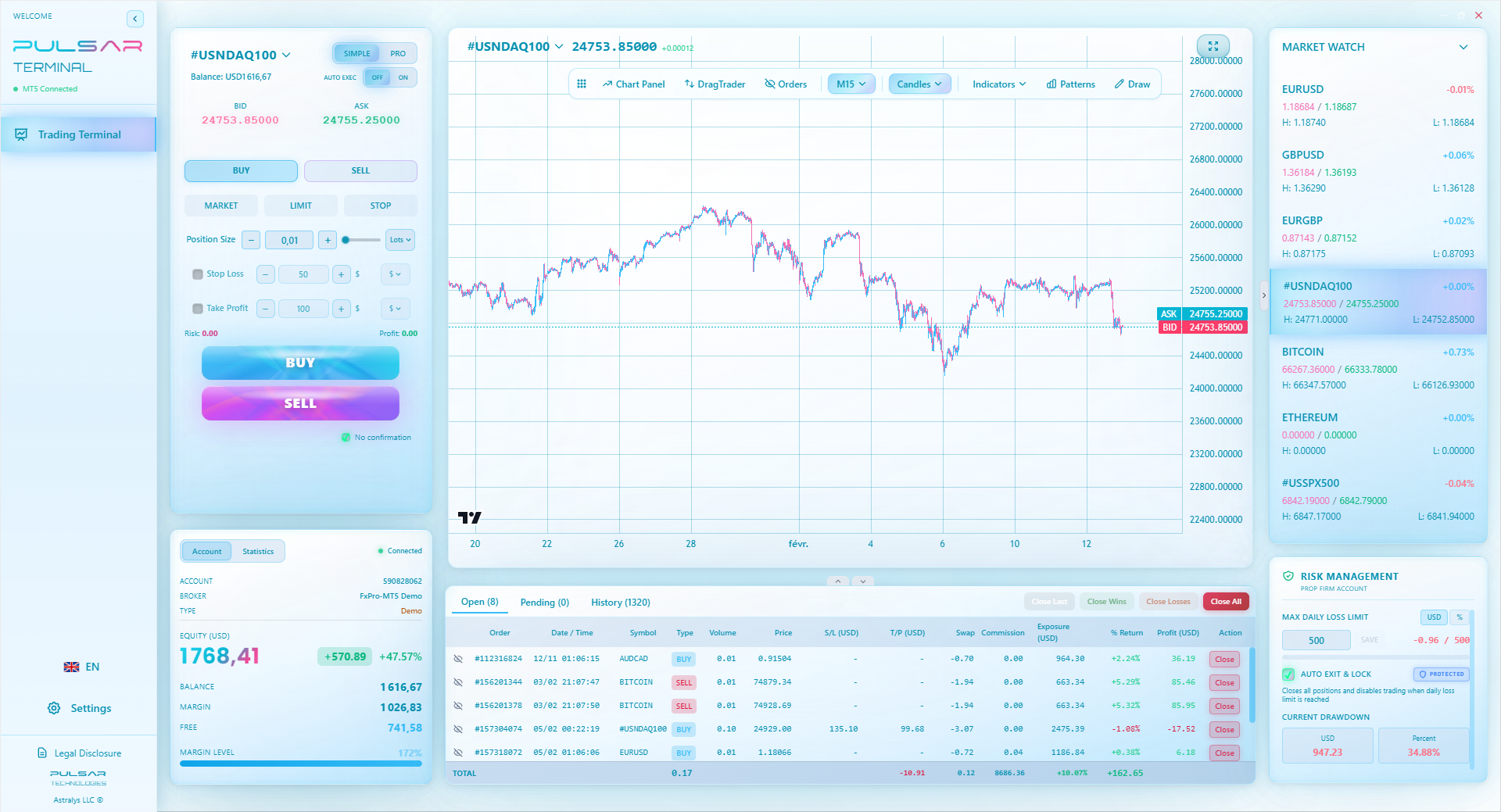
Sticking to your compounding rules requires iron discipline, and tools like Pulsar Terminal for MT5 automate critical risk management tasks like setting multi-level take-profits and trailing stops directly on your chart.
“The most dangerous period is after a series of wins. Overconfidence is a more common account destroyer than fear.”
Let's walk through a simplified, realistic 12-month scenario for Thabo, a disciplined trader in Johannesburg.
Starting Point (Jan 2024):
- Starting Capital: R25,000 in a ZAR account with an FSCA-regulated broker.
- Risk Rule: Max 1.5% of current balance per trade.
- Compounding Frequency: Monthly.
- Realistic Monthly Target: 4% net return.
- Trading Style: Swing trading XAU/USD and EUR/USD, 5-8 trades per month.
The Year Unfolds:
- Month 1-3: He hits his stride, averaging 5% per month. His balance compounds to ~R28,940. His per-trade risk allowance grows from R375 to about R434.
- Month 4: A tough month. He takes two losing trades and finishes down -2%. Balance: ~R28,361. He doesn't panic. He sticks to his 1.5% rule, which is now R425 risk per trade.
- Month 5-8: Steady recovery and growth. Averages 3.5%. Balance compounds to ~R32,150.
- Month 9: His best month, a 7% gain from a well-captured gold rally. Balance: ~R34,400.
- Month 10-12: Returns to average, around 4%. Year-End Balance: ~R38,600.
The Result: A 54.4% net return for the year. Not 1000%. Not get-rich-quick. But he turned R25,000 into R38,600 by being consistent, managing risk, and letting compounding work. He never blew up. He can now start year two with nearly R39,000, where a 1.5% risk is R585 per trade, allowing for slightly larger, more efficient positions.
The key wasn't magical trades. It was the system: the unbreakable risk rule, the monthly recalculation, and the emotional discipline to stick to it through a losing month. That's the real secret to forex compounding. It's a marathon of disciplined decisions, not a sprint to the moon.
FAQ
Q1What is a realistic monthly return to expect for compounding in South Africa?
For a disciplined retail trader, a consistent 3-6% net return per month is an excellent and realistic target. Anything higher often involves unsustainable risk. Remember, a 5% monthly return compounds to over 79% annually. Chasing 20% monthly is the fastest path to losing everything.
Q2Should I use a ZAR or USD trading account for compounding?
For most South Africans, a ZAR-denominated account is simpler. Your deposits, profits, and losses are all in Rands, so you're not compounding returns that then get affected by USD/ZAR exchange rate fluctuations when you withdraw. It removes a layer of currency risk from your compounding equation.
Q3How do I handle taxes on compounded forex profits?
You are responsible for declaring trading profits to SARS. The key is careful record-keeping. Log every trade, your monthly compounded balance statements, and all withdrawals. Profits are typically taxed as income if you're seen as a frequent trader. Consult a South African tax professional who understands trading. Don't guess on this.
Q4Can I use compounding with a prop firm challenge?
Extremely carefully. Prop firm challenges have strict drawdown limits (like 5-10% max). Aggressive compounding can push you closer to that limit faster if you have a losing streak. It's often wiser to pass the challenge using very conservative, non-compounded risk (e.g., 0.5% per trade). Once you have a funded account, you can then implement a gentle compounding plan.
Q5What's the biggest mistake beginners make with compounding?
Increasing their trade size (rand risk) too quickly after a few wins, without it being a calculated result of their percentage-based rule. They go from risking R100 per trade to R200 because they feel confident, not because their account grew from R10,000 to R20,000. This is overleveraging and breaks the mathematical safety of compounding.
Q6How often should I compound my forex profits?
Monthly is a great standard rhythm. It's frequent enough to capture growth but not so frequent that you're micromanaging or reacting to every small win or loss. Weekly can work for very active traders, but it requires more discipline. Quarterly is too slow to capture the exponential benefits. Choose a schedule and automate the process in your journal.
Pelajaran Prof. Winston
:
- ✓Risk a fixed percentage (0.5-2%), never a fixed Rand amount.
- ✓Aim for consistent 3-6% monthly returns, not lottery tickets.
- ✓Compound monthly; it's the sweet spot between frequency and noise.
- ✓Pause compounding during a 10% drawdown from your last high.
Sejauh mana artikel ini berguna?
Klik bintang untuk menilai
Pandangan Dagangan Mingguan
Analisis & strategi mingguan percuma. Tiada spam.
Tentang Penulis
David van der Merwe
Pedagang Pasaran Membangun
Pedagang berpangkalan di Johannesburg dengan 11 tahun dalam mata wang pasaran membangun. Pakar dalam pasangan ZAR, dagangan terkawal FSCA, dan analisis pasaran Afrika Selatan.
Komen
Anda mungkin juga suka

Cara Trading Forex Sukses: 7 Prinsip dari Trader Profesional
Cara trading forex sukses dengan 7 prinsip trader pro: manajemen modal, disiplin, journal trading, backtest. Data nyata, bukan janji profit palsu.
Jam Trading Forex Terbaik untuk Trader Indonesia: Panduan Lengkap dengan Tabel Waktu
Panduan jam trading forex untuk trader Indonesia. Tabel 4 sesi dunia, jam emas 20:00-00:00, sesi mana yang harus dihindari. Data akurat + tips dari trader berpengalaman.
Top 5 Sàn Forex Uy Tín Nhất 2026: Review Jujur dari Trader Indonesia
Top 5 sàn forex uy tín 2026 untuk trader Indonesia. Review jujur: spread, deposit, withdraw, dukungan lokal. Exness, XM, IC Markets & lebih.
All these calculators are built into Pulsar Terminal with real-time data from your MT5 account. One-click position sizing, automatic risk management, and instant calculations.
