


Most forex day trading advice is garbage, especially for Canadians.

James Mitchell
Penganalisis Dagangan Kanan ·  Canada
☕ 14 minit baca
Apa yang akan anda pelajari:
- 1The Canadian Rulebook: CIRO, CIPF, and Why 1:50 use is a Gift
- 2The Real Costs: Spreads, Commissions, and the CRA's Cut
- 3Trading the Loonie: USD/CAD Isn't Your Only Option
- 4A Canadian Day Trading Framework That Works With 1:50 use
- 5Picking Your Canadian Broker: Beyond the Marketing
- 6The Psychology of Trading With a use Limit
- 7Mistakes I Made (So You Don't Have To)
- 8Your Canadian Forex Day Trading Launch Checklist
Most forex day trading advice is garbage, especially for Canadians. It ignores our 1:50 use cap, the CIPF protection fund, and how the CRA actually taxes your profits. I've traded through IIROC's transition to CIRO, blown up an account underestimating the CAD's volatility, and finally built a consistent approach that respects our unique rules. This isn't about getting rich quick. It's about navigating a regulated market where 74-89% of retail accounts still lose. I'll show you how to be in the minority.
Forget everything you've read about 1:500 use. In Canada, you're playing a different game, and honestly, it's one that might save your account. Our regulator, the Canadian Investment Regulatory Organization (CIRO), sets the tone. Formed from the merger of IIROC and the MFDA, it's the only body that matters for forex brokers here.
The headline rule is use: a maximum of 1:50 for majors like USD/CAD and 1:20 for minors. When I first started, I saw this as a handicap. I was wrong. It's a forced risk management tool. On a $10,000 account, 1:50 use means you can control $500,000. That's still enormous power, but it prevents the kind of catastrophic, margin-call-in-five-minutes blowout that's common with higher use. You have to be more selective with your trades, which is a good thing.

Warning: Always verify your broker's CIRO membership using their AdvisorReport tool. If they're not listed, they're not legally serving you, and your funds have zero protection.
The other critical piece is the Canadian Investor Protection Fund (CIPF). If your CIRO-regulated broker goes under, your eligible assets are protected up to $1 million. This isn't some vague promise; it's real insurance. It means you can focus on trading, not on broker solvency. Just remember, this protects against broker failure, not your own losing trades.
Finally, know that promotional bonuses for forex and CFDs are banned here. CIRO killed that practice. Your broker can't lure you in with a "50% deposit bonus" that comes with impossible withdrawal terms. What you see is what you get, which creates a more transparent, if less flashy, trading environment.

💡 Petua Winston
The 1:50 use limit isn't a cage, it's a teacher. It forces you to master position sizing and patience - the two skills that separate pros from gamblers.
Let's talk numbers. Your profitability isn't just about entry and exit; it's about what gets taken off the top. With Canadian brokers, you typically have two account types: standard (wider spread, no commission) and raw/ECN (tighter spread, plus commission).
Broker Spreads in Practice
From my own tracking, here’s what you can realistically expect during the London-New York overlap, when liquidity is best:
| Currency Pair | Standard Account Spread | Raw/ECN Account Spread + Commission |
|---|---|---|
| USD/CAD | 1.2 - 1.8 pips | 0.3 - 0.5 pips + ~$7 per 100k lot |
| EUR/USD | 0.8 - 1.2 pips | 0.1 - 0.3 pips + ~$7 per 100k lot |
| CAD/JPY | 1.5 - 2.5 pips | 0.5 - 1.0 pips + ~$7 per 100k lot |
I used to think the raw account was always better. It's not. If you're a lower-volume trader or prefer smaller, more frequent trades, the commission on a raw account can eat you alive. I did the math after a rough month: on my scalping strategy, paying $7 per round turn on a 5-lot trade meant I needed the price to move 1.4 pips just to break even on EUR/USD. On a standard account with a 1-pip spread, I only needed 1 pip. For my style, standard worked better.
The Tax Man Cometh
This is the big one everyone forgets. The Canada Revenue Agency (CRA) doesn't have a "forex trading" category. They have two boxes: capital gains or business income.
- Capital Gains: If your trading is sporadic, more of an investment hobby, 50% of your net profit is taxable. This is the better rate.
- Business Income: If you're day trading - frequent trades, short holding periods, using use - the CRA will almost certainly view it as a business. I learned this the hard way after my first profitable year. My accountant sat me down and said, "You're a business." That means 100% of your net profit is taxable as income. The upside? You can deduct legitimate business expenses: platform fees, data subscriptions, a portion of home office costs, and education. More importantly, business losses can be applied against other income, which can be a lifesaver in a bad year.

Pro Tip: Keep a detailed trading journal from day one. Note every trade, the rationale, and all related expenses. It's your first line of defense if the CRA ever asks questions. It also makes tax time infinitely easier.

“If you're day trading, the CRA will almost certainly view it as a business. That means 100% of your net profit is taxable as income.”
As Canadians, we have a natural edge with CAD pairs, but that doesn't mean we should only trade them. I made that mistake for years, hyper-focusing on USD/CAD and missing clearer setups elsewhere.
The CAD is a commodity currency. It moves with oil, lumber, and metals. If WTI crude is rallying, CAD often strengthens against currencies like the JPY or CHF. I once caught a great 120-pip move on CAD/JPY by watching oil break a key resistance level, not just the forex chart. You need a multi-screen setup or a good news feed.
Optimal Trading Windows
Liquidity is your friend in forex day trading. For CAD pairs, the sweet spot is 8:00 AM to 12:00 PM ET. This is when Toronto and New York are fully open, and London is still active. The volume spikes, spreads tighten, and you get clean, technical moves. After noon, it can get choppy and unpredictable. I used to try to trade the Asian session on CAD/JPY. It was a waste of time - tiny ranges and wide spreads that killed any potential profit.
Don't ignore the majors. Some of my most consistent trades have been on EUR/USD and GBP/USD. The liquidity is unmatched, and the technical levels are respected by the entire market. A clean break of a daily high on EUR/USD during the London open often has more follow-through than a similar move on USD/CAD. Use a tool like the MACD indicator on the 15-minute chart to gauge momentum during these sessions.
My biggest lesson? Be currency-agnostic. Let the chart and the setup dictate the trade, not your passport. If EUR/USD has a perfect pin bar at a key support level and USD/CAD is stuck in a messy range, trade the EUR. Your broker, whether it's one like Interactive Brokers or OANDA, gives you the global market. Use it.

You can't import a strategy built for 1:200 use and expect it to work here. The psychology and position sizing are completely different. Here’s the framework I've settled on after a lot of trial and error.
The 1% Rule, Recalibrated
With lower use, you might be tempted to break the golden rule of risk. Don't. I still risk a maximum of 1% of my account per trade. But because my buying power is lower, my position size for a given stop-loss distance is smaller. This forces me to look for trades with better risk-to-reward ratios. I'm not chasing 5-pip scalps anymore; I'm looking for 15-30 pip moves where I can place a sensible 10-pip stop. This requires more patience. I use a position size calculator before every single trade to lock in the numbers and remove emotion.
My Two Favorite Setups
- London Breakout Retest: I watch the 1-hour chart for a consolidation range that forms ahead of the London open (2-3 AM ET). When price breaks out with volume at the open, I wait for the first pullback to the breakout level. That's my entry, with a stop just below the range. The target is at least 1.5 times the range height. This works beautifully on GBP/USD and EUR/USD.
- US Data Play on USD/CAD: Major US data (NFP, CPI) causes volatility. I don't trade the initial spike. I wait 15-30 minutes for the market to settle into a new direction. I then draw a quick trend line on the 5-minute chart and enter on a pullback to that line. My stop is tight, just on the other side. The key is that the move after the news often has legs, and you can catch a ride without the initial chaos.

Example: Account: $10,000. Risk: 1% = $100. Trading USD/CAD, I identify a stop-loss distance of 12 pips. Since 1 pip on USD/CAD is roughly $10 per standard lot, I can trade a position size of 0.83 lots ($100 / (12 pips * $10)). My broker's platform will do this math, but you must understand it.
This approach is less about frenetic action and more about precision. It fits the Canadian regulatory environment perfectly. It's sustainable. For longer-term plays, the principles of swing trading apply, but you need to be even more mindful of overnight financing charges.
💡 Petua Winston
Always know your break-even pip count. Add your spread to your commission cost in pips. If you need a 2-pip move just to cover costs, you're not trading, you're donating.
“Sustainable growth here is 5-10% a month, compounded. That seems boring until you do the math.”
The list of CIRO-regulated brokers is your starting point, not your finishing line. I've had accounts with several. Here’s what you won't find in their glossy ads.
Platform is King: You will live on this software. MT4/MT5 is the safe, ubiquitous choice. But brokers like CMC Markets have invested heavily in their own platforms (like 'Next Generation'), which often have better charting, faster execution, and more intuitive interfaces than MT5. FOREX.com's platform is solid for pure forex. Test their demo accounts extensively. How easy is it to place a trailing stop? Can you see the order book? How quickly do charts update?
Execution Quality: This is critical for day trading. A "0.0 pip spread" is meaningless if your market orders get slipped 2 pips every time. Look for brokers that publish execution statistics. During volatile periods, does the platform freeze? I once missed a crucial exit on an older platform during a BoC announcement - the price shot past my stop, and the platform didn't execute until 8 pips later. That loss stung. Now I prioritize brokers known for strong infrastructure, even if their spreads are a fraction of a pip higher.
Customer Service in Your Timezone: When you have a margin question at 9 AM ET, you don't want to wait 8 hours for an email reply from another continent. The best Canadian brokers have phone and live chat support that aligns with North American hours. Test this on the demo account. Call them. See how long it takes to get a competent human.
Deposit and withdrawal ease is also huge. Interac e-Transfer should be a standard option. It's how we move money. If a broker makes funding difficult, it's a red flag. My experience with brokers like Pepperstone (through their global entity) has been positive for execution, but for pure Canadian focus, the local giants like the CIRO-regulated arms of FOREX.com or CMC are hard to beat for peace of mind.

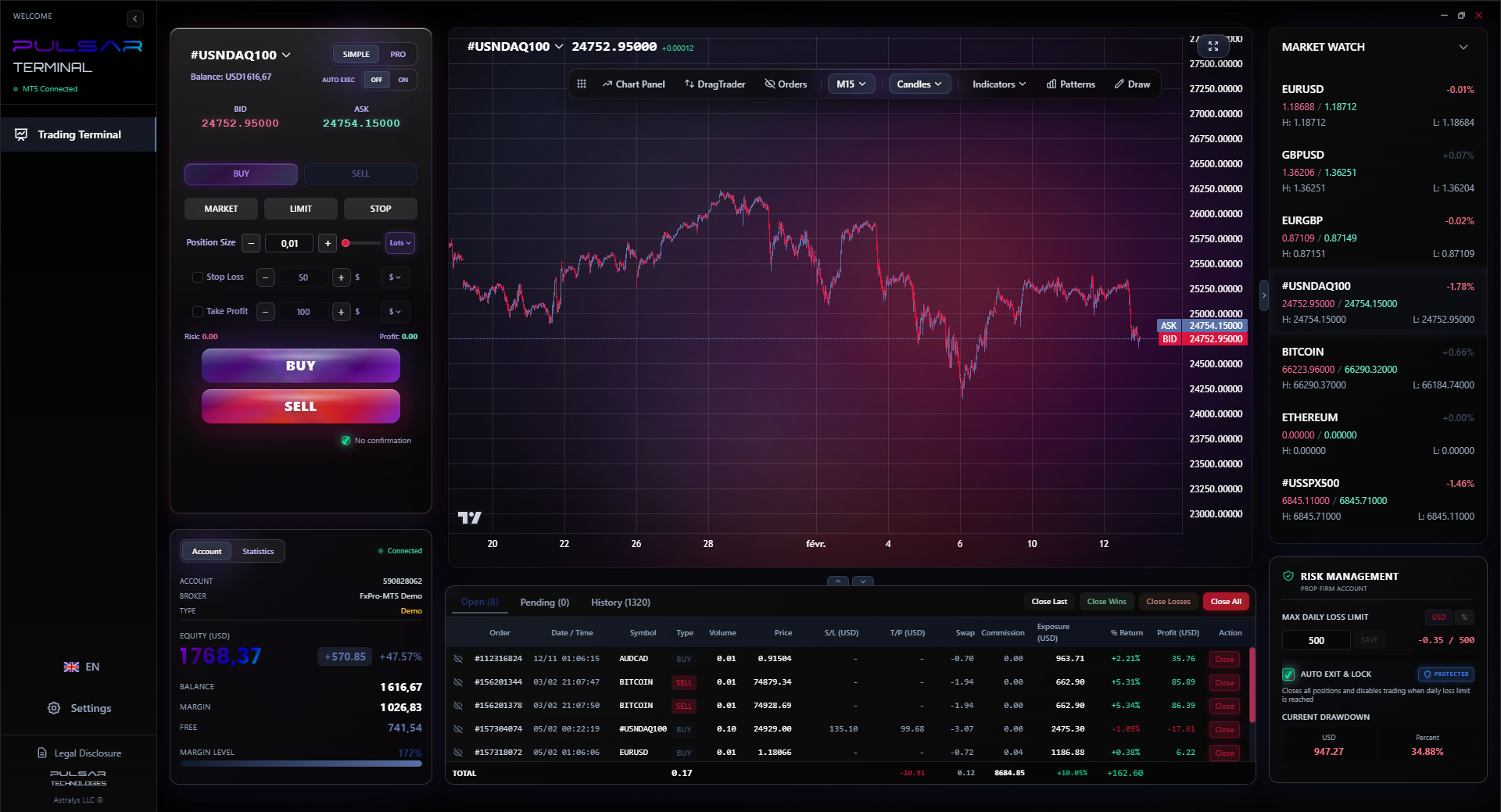
Managing multiple trades and precise stop-losses is critical with Canada's leverage rules, and Pulsar Terminal's drag-and-drop orders and multi-TP/SL tools on MT5 make executing that discipline effortless.
This might be the most important section. The 1:50 limit creates a specific psychological trap: the feeling that you need to "max out" to be successful. You see a perfect setup and think, "If only I had 1:200, this trade would be worth so much more." That's a dangerous road. It leads to over-trading and forcing setups that aren't there, just to use your available margin.
I had to reframe my thinking. The use isn't a target to be used; it's a ceiling for emergencies. My average effective use is closer to 1:10 or 1:15. The rest is a buffer that prevents a margin call from a single bad trade or a period of drawdown. It allows you to breathe.
The other mental shift is accepting slower account growth. You won't double your account in a month (and if you do, it's pure luck and will be given back). Sustainable growth here is 5-10% a month, compounded. That seems boring until you realize that 10% a month, compounded, turns $10,000 into over $30,000 in a year. That's realistic with discipline.
You also have to become comfortable with being in fewer trades. With higher use, you can take 10 tiny trades a day. Here, each trade carries more weight in your portfolio. This forces better quality control. You'll spend more time analyzing and waiting, and less time clicking the buy/sell button. It turns trading from a reaction game into a planning game.
“The use isn't a target to be used; it's a ceiling for emergencies. My average effective use is closer to 1:10.”
Let me be brutally honest about where I went wrong. Learning from your own mistakes is expensive.
1. Ignoring the Loonie's Drivers: I took a long USD/CAD position because the chart looked good, completely ignoring that the Bank of Canada was giving dovish signals and oil was tanking. The trade was technically sound but fundamentally doomed. I lost 45 pips before I cut it. Now, I always check the economic calendar and the 5-minute chart of USOIL (WTI crude) before touching a CAD pair.
2. Chasing News Volatility: When Canada's jobs report would hit, I'd see a 40-pip spike in USD/CAD and FOMO in. The spread would widen to 10 pips, and by the time I was filled, the move was reversing. I'd be down instantly. I learned to either trade the setup before the news (if I had a strong view) or wait for the post-news consolidation, as I described earlier.
3. Underestimating the Cost of Overnight Positions: Even for a day trader, sometimes a trade goes your way and you want to hold it. With CAD pairs, the rollover (swap) rates can be significant. I once held a long CAD/JPY position over a Wednesday night (when triple swaps are charged) and saw a $15 fee on a single mini lot - that wiped out a third of my paper profit. Always check the swap rates in your platform before considering holding past 5 PM ET.
4. Not Planning for Taxes: My first profitable year, I had a great run. I reinvested all the profits, thinking I was smart. Then tax season came, and I had a $12,000 tax bill with no cash set aside to pay it. I had to liquidate positions at a bad time. Now, I automatically transfer 30% of any monthly net profit to a separate savings account. The CRA gets paid first, no exceptions. Treat it like a business expense.
💡 Petua Winston
Your most important trade happens before the market opens: the decision to set aside your tax money. Treat the CRA as your most reliable trading partner - they always collect.

If you're starting from zero, follow these steps in order. I wish I had.
- Education First, Money Last: Spend at least 3 months on a demo account. Not just clicking buttons, but journaling every simulated trade, testing the strategies in section 4, and getting a feel for the platform. Most brokers, like XM or others, offer unlimited demo accounts.
- Choose a CIRO Broker: From the list in the research. Open a demo AND a live micro account simultaneously. Fund the live account with the absolute minimum - say, $250. This gets you used to the psychology of real money without serious risk.
- Define Your Rules: Write down your trading plan. What pairs will you trade? What's your maximum daily loss? What's your risk per trade (start with 0.5%, not 1%)? What time of day will you trade? Print this and keep it by your screen.
- Set Up Your Tools: Get your charts ready. Learn how to place stops and limits. Set up a simple RSI indicator or moving average. Keep it simple. Don't get lost in 20 indicators.
- Track Everything: From day one, use a spreadsheet or trading journal software. Record date, pair, direction, entry, exit, P/L, and most importantly, the reason for the trade. Review this weekly.
- Connect with a Community: Find a forum or group of Canadian traders. Not for signal-chasing, but for discussing CIRO rules, tax questions, and broker experiences. The shared context is useful.
- Talk to an Accountant: Before your first profitable year, have a 30-minute consult with an accountant who understands trading. Understand how you'll file. It will save you immense stress later.
Forex day trading in Canada is a marathon on a track with guardrails. The guardrails (CIRO) might feel restrictive, but they keep you from running off a cliff. Embrace the discipline they impose. Your goal isn't to be a hero for one trade; it's to be a consistent professional for hundreds of them.

FAQ
Q1Is forex day trading legal in Canada?
Yes, it's completely legal. It's regulated by the Canadian Investment Regulatory Organization (CIRO). You must use a broker that is a member of CIRO to be legally protected.
Q2What is the maximum use I can use in Canada?
For retail traders, CIRO caps use at 1:50 for major currency pairs (like USD/CAD, EUR/USD) and 1:20 for non-major pairs. This is a hard rule for all regulated brokers.
Q3How are my forex trading profits taxed in Canada?
If you are day trading (frequent, short-term trades), the CRA will likely consider it business income. This means 100% of your net profit is taxable at your marginal income tax rate. If trading is very infrequent, it may be considered capital gains, where only 50% of the profit is taxable. Assume you're a business.
Q4Can I use international brokers like Pepperstone or IC Markets?
You can, but they must be registered with CIRO to serve you legally and hold your funds in Canada. Many international brands have a separate Canadian entity (e.g., Forex.com Canada) that is CIRO-regulated. Using their global site may bypass Canadian investor protections (CIPF).
Q5What's the best time of day to trade forex in Canada?
The most liquid and volatile time is during the overlap of the London and New York sessions, from about 8:00 AM to 12:00 PM Eastern Time. This is especially true for CAD pairs like USD/CAD.
Q6Do I need $25,000 to day trade forex in Canada?
No. Canada does not have a Pattern Day Trader rule like the US. Your broker will have its own minimum deposit requirement (often $100-$500), but there is no legal minimum. However, to trade effectively within the 1:50 use rules, a larger capital base is strongly recommended for proper risk management.
Q7What happens if my Canadian forex broker goes bankrupt?
If your broker is a CIRO member, your assets are protected by the Canadian Investor Protection Fund (CIPF) up to $1 million. This is a key reason to only use a CIRO-regulated broker.
Pelajaran Prof. Winston
:
- ✓Risk max 1% per trade, recalc for 1:50 use
- ✓Trade 8am-12pm ET for CAD liquidity
- ✓Set aside 30% of profits for CRA immediately
- ✓CIPF protects $1M if your CIRO broker fails
Sejauh mana artikel ini berguna?
Klik bintang untuk menilai
Pandangan Dagangan Mingguan
Analisis & strategi mingguan percuma. Tiada spam.
Tentang Penulis
James Mitchell
Penganalisis Dagangan Kanan
Berpangkalan di New York dengan lebih 9 tahun pengalaman perdagangan. Fokus pada pasangan USD utama, cabaran prop firm, dan landskap peraturan AS.
Komen
Anda mungkin juga suka

Cara Trading Forex Sukses: 7 Prinsip dari Trader Profesional
Cara trading forex sukses dengan 7 prinsip trader pro: manajemen modal, disiplin, journal trading, backtest. Data nyata, bukan janji profit palsu.
Jam Trading Forex Terbaik untuk Trader Indonesia: Panduan Lengkap dengan Tabel Waktu
Panduan jam trading forex untuk trader Indonesia. Tabel 4 sesi dunia, jam emas 20:00-00:00, sesi mana yang harus dihindari. Data akurat + tips dari trader berpengalaman.
Top 5 Sàn Forex Uy Tín Nhất 2026: Review Jujur dari Trader Indonesia
Top 5 sàn forex uy tín 2026 untuk trader Indonesia. Review jujur: spread, deposit, withdraw, dukungan lokal. Exness, XM, IC Markets & lebih.
All these calculators are built into Pulsar Terminal with real-time data from your MT5 account. One-click position sizing, automatic risk management, and instant calculations.
