


Let me be straight with you: a forex demo trading app is the most dangerous tool a new Nigerian trader can pick up.

Olumide Adeyemi
Perintis Dagangan Afrika Barat ·  Nigeria
☕ 10 minit baca
Apa yang akan anda pelajari:
- 1The Demo Account Illusion (And Why It's Lying to You)
- 2Picking the Right Forex Demo Trading App for Nigeria
- 3A 90-Day Structured Practice Plan (No More Random Trades)
- 4Bridging the Psychology Gap Between Demo and Live
- 5The Hard Truth: When Are You Actually Ready to Go Live?
- 6Top 5 Nigerian Trader Pitfalls with Demo Apps (And How to Avoid Them)
- 7Advanced Techniques: Using Your Demo Like a Pro

Let me be straight with you: a forex demo trading app is the most dangerous tool a new Nigerian trader can pick up. It's not because it's bad. It's because it makes you feel like a genius right up until the moment you switch to a live account and lose your rent money. I've seen it a hundred times. You'll crush it on the demo, make millions of Naira in pretend profits, and then reality hits. This guide isn't about how to download an app. It's about how to use one to actually learn something, not just to feed your ego. I'll show you the mistakes, the right way to practice, and how to know when you're ready to risk real cash.
Your first experience with a forex demo trading app feels like magic. You deposit $10,000 or $50,000 of virtual dollars, place a trade, and watch the profits roll in. The problem? It's a perfect simulation of a world that doesn't exist. The real market has friction you never feel in the demo. The most dangerous lie is slippage. On a demo, your stop-loss gets filled at the exact price you set. In Lagos during a news event? Your stop on USD/NGN pairs might get filled 20 pips worse, turning a small loss into a disaster. I learned this the hard way. On a demo, I perfected a scalping strategy that required tight stops. My first live trade on the same setup? Slippage blew through my stop and took twice the loss I'd planned for. The demo didn't prepare me for that gut punch.
Then there's liquidity. A demo app executes every order instantly. Try buying a decent size of US dollars during a volatile period on your local broker. You might not get filled at the price you see, or at all. The demo makes you think you're a sniper, when in reality, you're trying to thread a needle in a moving car. It also completely ignores the psychological weight of real money. Watching a $100 loss on a demo is a number. Watching 50,000 Naira disappear from your account you worked for? That changes your decision-making on the next trade, every single time.
“A forex demo trading app is the most dangerous tool a new Nigerian trader can pick up.”
Not all demo apps are created equal. Your goal is to simulate reality as closely as possible, not just play a video game. Here’s what to look for, specifically for us trading from Nigeria.
Platform is Everything
You must use the demo of the actual platform you'll trade on live. If you plan to use MetaTrader 5 (MT5), practice on an MT5 demo. Don't use some generic app and then switch. The buttons, the order types, the charting - it all needs to be muscle memory. Most major international brokers like IC Markets, Pepperstone, and Exness offer full-featured MT4/MT5 demo accounts. Their demo spreads and execution are usually close to their live environment, which is crucial.
Naira-Based Reality Check
Start with a realistic demo balance. If you only have 100,000 Naira to fund a live account someday, don't demo with $100,000. Demo with the Naira equivalent of what you'll actually risk. This forces you to think about proper position size calculator use from day one. A 2% risk on a $100,000 demo is $2,000 - a meaningless figure. A 2% risk on a 100,000 Naira demo is 2,000 Naira. That feels real, and it teaches you scale.

Warning: Avoid demo apps from unregulated bucket shops that offer insane use like 1:2000 just to attract you. Their demo might be smooth, but their live platform will requote you to death. Stick to demos from reputable, regulated brokers, even if their max use is lower (and safer).

💡 Petua Winston
A demo account is a mirror. If you're reckless with pretend money, you'll be a disaster with real money. The habits you build there are the ones you'll die with.
“The moment you feel frustrated by a demo loss, or excited by a demo win, you're starting to bridge the psychology gap.”
Opening a demo and just trading randomly is a waste of time. You need a drill. Here's a 90-day plan I wish someone had given me.
Weeks 1-4: The Mechanics Drill. Don't even try to make profit. Your only job is to learn the platform. Place trades just to practice setting stop-loss and take-profit orders. Use the EUR/USD guide to understand one major pair. Practice calculating pip value and position size for every single trade, manually, before you hit the button. Get used to losing. Intentionally place 10 trades with a tight stop-loss, expecting to lose 8 of them. The goal is to desensitize yourself to the red on the screen.
Weeks 5-12: Strategy Backtesting & Forward Testing. Pick ONE simple strategy. Maybe it's a basic support/resistance swing trading method. Go back on the chart and mark every single setup for the last 6 months. Write down the entry, stop, target, and result. This is backtesting. Then, for the next month, trade that strategy in real-time on the demo but with real-time analysis. This is forward testing. Don't deviate. Your goal is to see if your historical analysis matches live performance. I did this with a simple MACD indicator crossover on Gold. Backtest showed a 55% win rate. My 30-day forward test on the demo? 52%. That told me the edge was real, but small.

Example: You have a 50,000 Naira demo. Your strategy risks 1% per trade (500 Naira). On EUR/USD, with a stop-loss of 20 pips, your position size must be calculated so that a 20-pip loss equals 500 Naira. This is the core skill you're building.

“The moment you feel frustrated by a demo loss, or excited by a demo win, you're starting to bridge the psychology gap.”
This is the Grand Canyon of trading. On demo, you're cool, calm, and logical. On live, fear and greed take the wheel. The only way to bridge this gap on a demo is to introduce real stakes and real consequences.
The Penalty System: For every losing trade on your demo, you have to do 20 push-ups. Or put 100 Naira in a jar. Attach a minor physical or financial cost to the loss. It sounds silly, but it starts to wire your brain to dislike losses, which is healthy.
The Journal is Non-Negotiable. For every trade, you must write down:
- The setup (e.g., "RSI indicator oversold on H1, bounce off support")
- Your emotional state ("Felt impatient, entered before confirmation")
- The outcome
After 100 trades, you'll see patterns. I found that 80% of my biggest losses came from trades I entered when I was bored, not when my strategy signaled. The demo won't show you that unless you force yourself to look.
The moment you feel frustrated by a demo loss, or excited by a demo win, you're starting to bridge the gap. If the numbers are just numbers, you're still in video game mode.
💡 Petua Winston
The goal of a demo is not to be right. It's to be consistent. A consistently wrong trader who manages risk can be taught. An inconsistent 'genius' is just lucky, and luck always runs out.
“If you can't protect virtual money, you have no chance with real money.”
Most people go live way too early. They have two good weeks on a demo and think they've cracked the code. Here are my non-negotiable criteria, honed from watching traders blow up.
-
Consistent Profit Over 3 Months: You need a minimum of 3 months of structured demo trading, following your plan, with a consistently profitable outcome. Not a lucky week. Three full months. Your equity curve should generally slope upwards, not be a rollercoaster.
-
You've Hit Your Drawdown Limit: Set a max demo drawdown (e.g., 15%). If you hit it, you reset the demo and start the 3-month clock over. This simulates a margin call and teaches capital preservation. If you can't protect virtual money, you have no chance with real money.
-
You're Bored. This is the best signal. When placing a demo trade feels like a mundane administrative task - checking the setup, calculating risk, placing the order, setting stops - you're ready. The excitement is gone. You're executing a business plan. The first time I felt genuinely bored on a demo was the first time I lasted more than 6 months with a live account.

Pro Tip: Before going live, fund your real account with the absolute minimum - maybe $50 or 25,000 Naira. Trade your normal strategy with micro lots. The goal for your first month live is not to profit. The goal is to execute your plan without deviation. If you can do that while seeing real money values, you've graduated.
“If you can't protect virtual money, you have no chance with real money.”
We have specific cultural habits that work against us in trading. Here’s what I see constantly.
| Pitfall | Why It's Deadly | The Fix |
|---|---|---|
| Demo Balance Too High | You trade 10 lots because you can. This builds reckless size habits. | Demo with the exact capital you have for live trading. No exceptions. |
| Ignoring Spread & Commission | You scalp on a demo with raw spreads. Live, you’re killed by the spread definition and fees. | On your demo, add 1-2 pips to the spread shown to simulate real cost. |
| No Risk Management Practice | You let losses run because 'it's not real money'. | Implement and stick to a 1-2% risk-per-rule rule on the demo. Treat it as law. |
| Jumping Strategies | You try a new indicator every day after a loss. You learn nothing. | Pick one pair (like XAU/USD guide) and one strategy. Test it for 100 trades. |
| Trading During Blackouts | Practicing when local internet or power is stable, not when you actually can trade live. | Practice on the demo using the same mobile data and at the same times you’d have to trade live. Simulate the frustration. |
The biggest one? Overconfidence. A demo win streak feels like skill. It’s mostly luck. The market hasn’t taken your money yet, so it hasn’t shown you its teeth. Stay humble.
💡 Petua Winston
When you can accurately predict your own emotional reaction to a demo loss, you're halfway to managing it with real money. Journal everything.

Manually tracking complex prop firm daily loss limits or multiple take-profit levels on a demo is error-prone; Pulsar Terminal automates these rules directly on your MT5 platform, turning your practice into precise, repeatable drills.
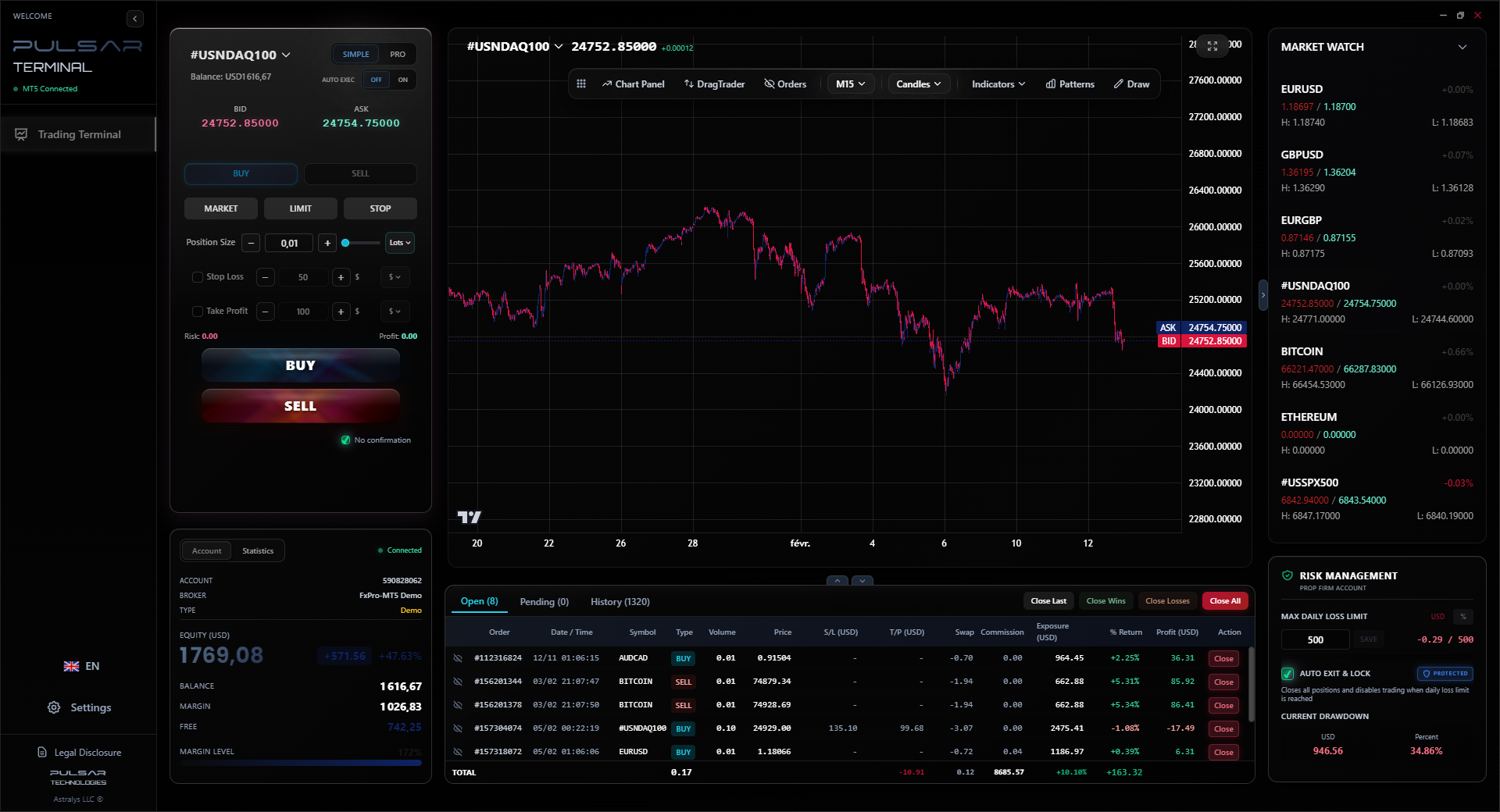
“The demo's perfect execution is a training wheel that gets pulled away when you go live.”
Once you've mastered the basics, use the demo for advanced preparation. This is where you build an unfair advantage.
Scenario Planning: Use your demo to game out worst-case scenarios. What if there's a sudden spike in USD/NGN? What if your internet drops right after you enter a trade? Have a written plan for each, and practice executing it on the demo. Where do you place your stop? How do you hedge if you can?
Prop Firm Challenge Simulation: Many Nigerians are trying prop firm challenges. These have strict drawdown rules. Use your demo to simulate the exact challenge rules. If the challenge says max 5% daily loss, set that as a hard limit on your demo. Practice trading under that pressure. The rules are different from normal trading, and you need to be robotic. Tools that automate this risk management can be a lifesaver here.
Testing New Markets: Want to try commodities or indices? Don't use your live account as a lab. Fund a separate demo and treat it as a research project. I used a demo for 6 months to understand the peculiar rhythms of gold (XAU/USD guide) before risking a single dollar. It saved me from at least five predictable, expensive mistakes.
The forex demo trading app is your laboratory, your flight simulator, and your proving ground. But a simulator only works if you respect the possibility of a real crash. Trade it like your future depends on it, because it does.
FAQ
Q1How long should I use a forex demo trading app before going live?
Absolute minimum is 3 months of consistent, structured trading with a proven strategy and a positive result. Most people need 6 months. If you're impatient to go live, you're not ready. The demo is where you pay with time, so you don't pay with money later.
Q2Are demo account spreads and execution the same as live accounts?
Not always, and this is a trap. On a good broker's demo, it's close. But during high volatility or low liquidity, live accounts often experience slippage and wider spreads that demos smooth over. Always assume real trading will be slightly more costly.
Q3I'm profitable on demo but keep failing prop firm challenges. Why?
Prop firm rules (like max daily loss) add immense psychological pressure that a normal demo doesn't replicate. You're likely breaking your own rules under stress. Use your demo to strictly simulate the challenge's exact rules, including a hard stop if you hit the daily loss limit. It's a different game.
Q4What's a realistic starting demo balance for a Nigerian trader?
Match it to your real capital. If you have 200,000 Naira to start trading, use a demo balance of 200,000 Naira (or its dollar equivalent). This trains you in correct position sizing from the beginning. Starting with $50,000 is fantasy and builds bad habits.
Q5Can I use a demo to test automated trading robots (EAs)?
Yes, it's the only safe way. But you must forward-test the EA on a demo for months, across different market conditions. An EA that made money in a trending market might explode in a ranging one. The demo is your crash-test dummy for the robot.
Q6My demo trades always fill instantly. Is that realistic?
No, and this is a major illusion. On live accounts, especially with larger orders or during news events, you may get partial fills, delayed execution, or requotes. The demo's perfect execution is a training wheel that gets pulled away when you go live.
Pelajaran Prof. Winston
:
- ✓Demo with your actual live capital amount.
- ✓Require 3 months of consistent demo profits.
- ✓Practice with a 1-2% risk rule as law.
- ✓Journal every trade's logic and emotion.
- ✓Simulate prop firm rules exactly on demo.
Sejauh mana artikel ini berguna?
Klik bintang untuk menilai
Pandangan Dagangan Mingguan
Analisis & strategi mingguan percuma. Tiada spam.
Tentang Penulis
Olumide Adeyemi
Perintis Dagangan Afrika Barat
Salah seorang pendidik dagangan forex paling aktif di Nigeria. 8 tahun pengalaman dagangan dari Lagos. Pakar dalam strategi modal rendah dan cabaran prop firm untuk pedagang Afrika.
Komen
Anda mungkin juga suka

Cara Trading Forex Sukses: 7 Prinsip dari Trader Profesional
Cara trading forex sukses dengan 7 prinsip trader pro: manajemen modal, disiplin, journal trading, backtest. Data nyata, bukan janji profit palsu.
Jam Trading Forex Terbaik untuk Trader Indonesia: Panduan Lengkap dengan Tabel Waktu
Panduan jam trading forex untuk trader Indonesia. Tabel 4 sesi dunia, jam emas 20:00-00:00, sesi mana yang harus dihindari. Data akurat + tips dari trader berpengalaman.
Top 5 Sàn Forex Uy Tín Nhất 2026: Review Jujur dari Trader Indonesia
Top 5 sàn forex uy tín 2026 untuk trader Indonesia. Review jujur: spread, deposit, withdraw, dukungan lokal. Exness, XM, IC Markets & lebih.
All these calculators are built into Pulsar Terminal with real-time data from your MT5 account. One-click position sizing, automatic risk management, and instant calculations.
