


You see the Instagram posts, don't you? The guy in a sharp suit next to a rented Lamborghini, talking about 'disrupting wealth' while sipping a latte.

David van der Merwe
Pedagang Pasaran Membangun ·  South Africa
☕ 9 minit baca
Apa yang akan anda pelajari:
- 1What a Forex Gentleman Actually Is (And Isn't)
- 2The South African Rulebook: Your FSCA Bible
- 3The Real Numbers: Costs, Capital, and Keeping it Real
- 4Trading the ZAR: Local Knowledge is Your Edge
- 5Building the Gentleman's Trading Plan
- 6Tools of the Trade: Execution Over Gimmicks
- 7The Path: From Beginner to Forex Gentleman
- 8Pitfalls That Will Strip Your Title
You see the Instagram posts, don't you? The guy in a sharp suit next to a rented Lamborghini, talking about 'disrupting wealth' while sipping a latte. He calls himself a forex trader. Let me ask you directly: is that what you're trying to become? Another clout-chaser blowing up accounts for content? Or are you aiming for something quieter, more substantial, and frankly, more South African? I'm talking about becoming a forex gentleman. Not a show-off, but a professional. Someone who understands that real trading isn't about the flex; it's about FSCA regulations, managing ZAR volatility, and a discipline so rigid it would make a Springbok coach proud. This is the guide for the second type. The one who wants to build something that lasts.
Let's kill the fantasy right now. A forex gentleman isn't defined by his bank balance or his car. I've met traders with R2 million in their account who are absolute gamblers, and guys trading with R20,000 who operate with surgeon-like precision. The difference is in the approach.
A forex gentleman is a mindset. It's the trader who treats the market with respect, not as a lottery. He knows the rules of the game - both the market's and the regulator's. In South Africa, that means knowing the Financial Sector Conduct Authority (FSCA) isn't just a bunch of letters; it's your first line of defence against scammers. A gentleman only uses FSCA-regulated brokers. Full stop. No offshore 'bucket shops' promising 500:1 use. That's not trading; it's donating your money.
The core pillars? Discipline over emotion. Risk management over greed. Education over hype. A gentleman has a trading plan and sticks to it. He uses a position size calculator for every single trade, so a string of losses doesn't cripple him. He knows that preserving capital is job one. Making profits is job two.

Warning: If your primary 'analysis' comes from Telegram groups promising '100% sure shots,' you're not a trader. You're a customer. The real forex gentleman does his own work.
Trading here isn't the wild west. We have a sheriff, and it's the FSCA. Ignoring them is a surefire way to lose more than just a trade.
Why Regulation Matters to You
Your broker being FSCA-regulated means your funds are held in segregated accounts. That's not marketing fluff. It means if the broker goes belly-up (it happens), your money is separate from their operating capital and should, in theory, be safe. It also means they have to follow strict conduct rules. They can't just manipulate your platform or refuse withdrawals without cause.
I learned this the hard way early on. I deposited R10,000 with an unregulated 'international' broker because they offered a 100% deposit bonus. Sounded great. When I tried to withdraw my R15,000 profit? Endless delays, requests for 'verification' documents I'd already sent, and finally, radio silence. That money is gone. Consider it my R10,000 lesson: regulation isn't a nice-to-have; it's the only way to play.
The Brokers That Make the Cut
So who's legit? Look for the big names that have gone through the hassle of getting local licensing. Exness and XM have strong local presences. IC Markets and Pepperstone are also popular choices among serious South African traders for their raw spreads and reliable execution. Your first check before depositing a single cent? Find their FSCA license number on their South African website and verify it on the FSCA's own database. A forex gentleman does his homework.

💡 Petua Winston
Your first R10,000 profit is the most dangerous. It convinces you you're smarter than the market. Withdraw half of it. Let your ego cash the cheque, not your bank account.
“Starting too small teaches you bad habits - like taking oversized risks to make the money 'worth it.'”
Let's talk rands and cents, because that's where dreams get tested. Forget the 'trade with R100' nonsense. You can, but you'll learn nothing except how to blow tiny accounts.
The True Cost of a Trade:
- Spreads: This is your main fee. On EUR/USD, a good raw spread account might see 0.1 pips, but you'll pay a commission. A standard account might have a 1.0 pip spread, all-in. On the ZAR pairs (like USD/ZAR), spreads are wider - 5 to 15 pips is normal. That's the cost of trading our local, less-liquid market.
- Commission: Often $3-$7 per standard lot (100k units).
- Swap/Overnight Fees: Holding a trade past 10 PM GMT? You'll pay or earn interest. For a forex gentleman doing more swing trading, this needs to be factored in.
Starting Capital: The Honest Truth With a R1,500 account, a sensible 1% risk is R15 per trade. In our volatile market, that's one bad tick away from a margin call. It's psychologically brutal and practically useless.
My strong opinion? Don't start with less than R10,000. Here's why: With R10k, a 1% risk is R100. If your stop-loss is 50 pips on USD/ZAR (where a pip is worth roughly R0.54 on a mini lot), you can trade a 0.18 mini lot size. That's a real, meaningful position where you can actually practice risk management. Starting too small teaches you bad habits - like taking oversized risks to make the money 'worth it.'

Example: You trade USD/ZAR with a R10,000 account. You risk 1% (R100). Your stop-loss is 40 pips away. Pip value on a standard lot is ~R54. So, R100 risk / (40 pips * R54) = 0.046 lots. You'd round down to 0.04 lots. That's your position. Not exciting, but professional.
This is where you, as a South African, can have an actual edge. While everyone else is staring at EUR/USD, you understand the rhythms of the rand.
USD/ZAR isn't just another pair. It's a sentiment gauge for emerging markets and a direct play on local politics and commodities. Load-shedding announcements, SARB interest rate decisions, platinum and gold prices - they all move our currency. A forex gentleman pays attention to the news, not to react emotionally, but to understand the context of the price action.
I remember a specific trade in 2022. SARB hiked rates by 75bps, more than expected. The initial knee-jerk was ZAR strength. But I saw the underlying macro: global risk-off, oil soaring. I waited for that initial pop to fade, then went long USD/ZAR at R17.20. The rationale? The hike was a defensive move against inflation, not a sign of strength. I rode it to R17.85 over two weeks. The lesson? Understand the why behind the local news.
Instruments Beyond Forex
A true market gentleman diversifies his understanding. XAU/USD (gold) is crucial for us. South Africa is a major producer. Often, when gold rallies, the ZAR finds some support (not always, but it's a correlation to watch). Don't just trade one thing. Understand the environment.
“Your trading plan should be boring. If it gets your adrenaline pumping, you've written a gambling manifesto.”
A plan isn't a vague idea. It's a written contract with yourself. If it's not written down, it doesn't exist.
1. The Strategy: Are you a scalper or a swinger? Pick one and master it. My niche is swing trading based on daily chart structure. I use the MACD indicator for trend momentum and the RSI indicator on the 4-hour chart for overbought/oversold clues within the trend. I might only take 2-3 trades a month. That's my lane. Scalping requires a different temperament and tools.
2. Risk Management Rules: This is the cornerstone. My non-negotiables:
- Maximum 1% risk per trade.
- Maximum 5% total capital risk across all open trades.
- Stop-loss is placed BEFORE entry, every time. No 'seeing how it goes.'
3. The Psychology Clause: Write down your emotional triggers. Mine was revenge trading after a loss. My plan now states: 'After a losing trade, close charts for 2 hours. No re-entry.' It sounds silly, but it saved me thousands.

Pro Tip: Your trading plan should be boring. If it gets your adrenaline pumping, you've written a gambling manifesto, not a business plan.
💡 Petua Winston
If you can't explain your trade setup in one simple sentence ('I'm buying because price held the daily support with a bullish RSI divergence'), you don't have a setup. You have a hope.
You don't need a Bloomberg terminal. You need a reliable platform (MT4/MT5), a stable internet connection, and tools that help you execute your plan flawlessly, not distract you from it.
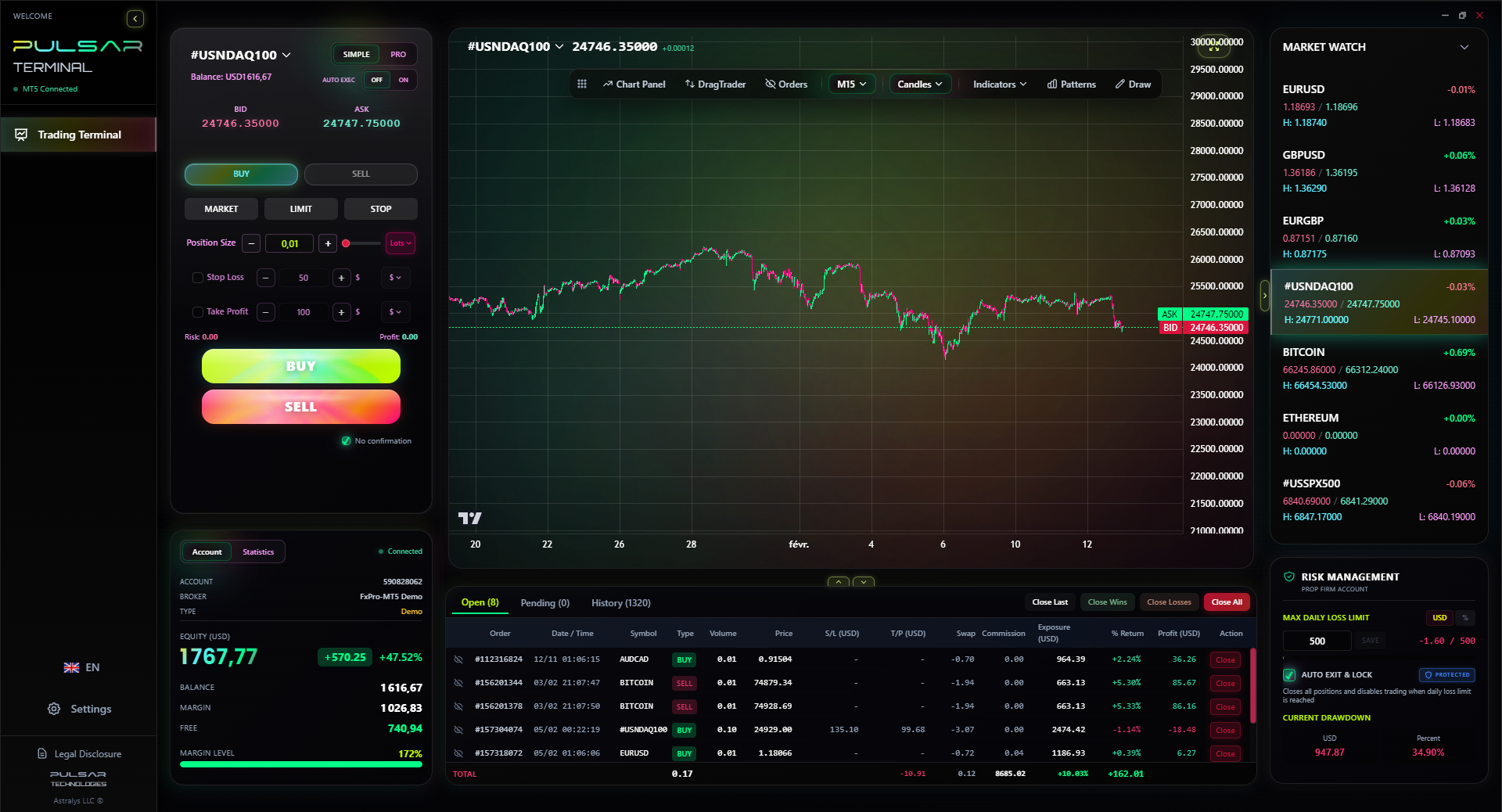
Focus on order execution. Do you know the difference between a market order and a limit order? When to use a stop-limit? A gentleman understands his entry and exit mechanics cold. He also uses basic tools to manage trades efficiently. A trailing stop, for instance, lets you lock in profits as a trend moves your way. Setting multiple take-profit levels lets you bank partial profits and reduce risk as the trade develops.
This is where the right toolkit separates the professional from the amateur. Manual management of complex exits is prone to emotion and error.
Managing complex exits like multiple take-profits and trailing stops manually is where discipline often fails; a tool like Pulsar Terminal automates these rules directly on your MT5 chart, removing emotion from the equation.
“The title of forex gentleman isn't given. It's earned daily, through every disciplined click of the mouse.”
This isn't a weekend transformation. It's a grind. Here's the phased approach I wish I'd had.
Phase 1: Education & Simulation (Months 1-3) Open a demo account with an FSCA broker. Don't try to make 'fake' money. Try to execute your budding plan perfectly. Your goal is 3 consecutive months of disciplined, rule-following demo trading. Not profitability - discipline.
Phase 2: Live Micro-Testing (Months 4-6) Deposit the minimum - say R500 or R1000. The goal is to feel the psychological weight of real money while the financial risk is minimal. Your focus is on executing your plan under live conditions. The P&L is irrelevant.
Phase 3: Graduated Scaling (Month 7+) Once you can show a consistent, disciplined process in your micro account, then and only then, fund your proper R10k+ account. Start trading your full strategy with your proper 1% risk. This is where the journey of the forex gentleman truly begins.
The entire time, you're studying. You're reviewing your trades. You're comparing your broker's spread to others. You're acting like the professional you want to become, long before the money reflects it.
💡 Petua Winston
Keep a 'stupidity journal.' Write down every time you break your own rules. The cost, and the emotional trigger. Review it monthly. You'll see the same expensive patterns.
Even with the best plan, you'll be tested. Here's what knocks guys out of the gentleman's club.
Over-use: This is the number one killer. Just because your broker offers 500:1 doesn't mean you should use more than 10:1. use amplifies losses faster than gains. Chasing Losses: That feeling after a loss where you just want to 'get it back now'? That's your enemy. It leads to doubling down, ignoring stops, and blowing accounts. My rule is hard: two losses in a day, walk away. Ignoring Macro: In 2020, I was short EUR/USD based on a nice technical setup. I ignored the building COVID panic and the Fed's potential response. They announced massive stimulus, the dollar dumped, and I took a full 1% loss. The chart pattern was right, but the world changed. A gentleman respects the bigger picture. Isolation: Trading is lonely. Find a community of other serious traders - not signal groups, but people who discuss concepts and psychology. It keeps you sane and accountable.
The title of forex gentleman isn't given. It's earned daily, through every disciplined click of the mouse, every respected stop-loss, and every avoided temptation. It's the quiet confidence of knowing how the game is played, on your own terms.
FAQ
Q1What is the minimum realistic amount to start forex trading in South Africa?
While you can technically start with R500, it's a psychological trap. You can't practice proper risk management. A realistic minimum to learn meaningfully is R5,000. To trade your full strategy with sensible position sizing, aim for R10,000 or more. Starting too small forces you to risk too much percentage-wise to see any gain.
Q2Is forex trading taxable in South Africa?
Yes. The South African Revenue Service (SARS) views trading profits as income if you're trading frequently (seen as carrying on a business) or as capital gains if it's more incidental. You must declare your net profits. Keep detailed records of all trades, deposits, and withdrawals. A real forex gentleman is tax-compliant.
Q3Can I become a full-time forex trader in South Africa?
It's possible, but it's a marathon, not a sprint. Don't even consider it until you have at least 2-3 years of consistent, documented profitability on a live account, and a capital base large enough that your average monthly returns can cover your living expenses while still leaving most of your capital to trade with. For most, it's a serious part-time pursuit first.
Q4What's the most important ZAR pair to watch?
USD/ZAR is the most liquid and significant. It's the primary benchmark for the Rand's strength. EUR/ZAR and GBP/ZAR are also important, but they often take cues from USD/ZAR and the EUR/USD or GBP/USD cross rates. Watch USD/ZAR for local market sentiment.
Q5How do I verify if my broker is really FSCA regulated?
Go directly to the FSCA's website (www.fsca.co.za). Use their 'Search for an authorised Financial Services Provider (FSP)' tool. Enter the broker's company name or the FSP number they provide. If they don't list an FSP number on their South African site, that's a major red flag.
Q6Why are spreads on USD/ZAR so much wider than on EUR/USD?
Liquidity. EUR/USD is the most traded financial instrument in the world. USD/ZAR is an emerging market currency pair with far less trading volume. Lower liquidity means brokers face higher costs to execute your trade, which they pass on as a wider spread. It's the cost of trading our home currency.
Q7What's the biggest mistake new South African traders make?
Two tied for first: 1) Using excessive use because they started with too little capital, and 2) jumping into live trading without a written, tested plan. They treat it like a casino, not a skilled profession. The market punishes that approach every single time.
Pelajaran Prof. Winston
:
- ✓FSCA regulation is non-negotiable for capital protection.
- ✓Start with at least R10k to practice real risk management.
- ✓Risk a maximum of 1% of your capital on any single trade.
- ✓USD/ZAR spreads of 5-15 pips are normal; factor it in.
- ✓A written trading plan is your contract with discipline.
Sejauh mana artikel ini berguna?
Klik bintang untuk menilai
Pandangan Dagangan Mingguan
Analisis & strategi mingguan percuma. Tiada spam.
Tentang Penulis
David van der Merwe
Pedagang Pasaran Membangun
Pedagang berpangkalan di Johannesburg dengan 11 tahun dalam mata wang pasaran membangun. Pakar dalam pasangan ZAR, dagangan terkawal FSCA, dan analisis pasaran Afrika Selatan.
Komen
Anda mungkin juga suka

Cara Trading Forex Sukses: 7 Prinsip dari Trader Profesional
Cara trading forex sukses dengan 7 prinsip trader pro: manajemen modal, disiplin, journal trading, backtest. Data nyata, bukan janji profit palsu.
Jam Trading Forex Terbaik untuk Trader Indonesia: Panduan Lengkap dengan Tabel Waktu
Panduan jam trading forex untuk trader Indonesia. Tabel 4 sesi dunia, jam emas 20:00-00:00, sesi mana yang harus dihindari. Data akurat + tips dari trader berpengalaman.
Top 5 Sàn Forex Uy Tín Nhất 2026: Review Jujur dari Trader Indonesia
Top 5 sàn forex uy tín 2026 untuk trader Indonesia. Review jujur: spread, deposit, withdraw, dukungan lokal. Exness, XM, IC Markets & lebih.
All these calculators are built into Pulsar Terminal with real-time data from your MT5 account. One-click position sizing, automatic risk management, and instant calculations.
