


I remember staring at my screen in 2019, watching a USD/ZAR trade go completely against me.

David van der Merwe
Pedagang Pasaran Membangun ·  South Africa
☕ 11 minit baca
Apa yang akan anda pelajari:
I remember staring at my screen in 2019, watching a USD/ZAR trade go completely against me. I was up R4,200 and got greedy, thinking the rand would just keep weakening. I didn't set a proper stop-loss. Next thing I knew, some positive local economic data hit the wires, the rand snapped back, and I watched my profit evaporate and turn into a R3,000 loss. That trade taught me a brutal lesson about the volatility of our local currency and why understanding the broader market - beyond just pairs - is crucial. In South Africa, when we talk about a 'forex index', we're really talking about two things: trading the ZAR against majors and accessing global stock indices through CFDs. Let's break down how you can do both successfully.
Alright, let's clear this up first. You won't find a single instrument called 'The South African Forex Index' on your trading platform. The term is a bit of a mash-up. In our context, it refers to two main avenues for traders here.
First, there's trading the South African Rand itself. The USD/ZAR is the most liquid pair locally, and its movement is a de facto index of the rand's strength against the world's reserve currency. Trading it is a direct bet on South Africa's economic health, commodity prices, and political stability.
Second, and this is where most of the action is, it's about trading global stock market indices as Contracts for Difference (CFDs). Think of the US S&P 500 (US500), Germany's DAX (GER40), or the UK's FTSE 100 (UK100). These aren't forex in the traditional sense, but they are the most popular 'indices' traded by forex brokers here. You're speculating on the overall direction of a basket of stocks, which is a fantastic way to get diversified exposure without buying individual shares.

Example: Let's say you trade the US500. If you buy (go long) at 5,200 points and it rises to 5,250, that's a 50-point move. If your CFD contract is worth $10 per point, that's a $500 profit (before spreads and commissions).
The beauty for us is that through FSCA-regulated brokers like IC Markets or Pepperstone, we can trade these global indices in rand-denominated accounts, often with competitive use. It bridges the gap between pure currency trading and investing in the world economy.
If you're going to trade the rand, you need to respect it. The USD/ZAR isn't for the faint-hearted. I've seen it move 300 pips in a single session on nothing but a rumor from the ANC conference. That kind of volatility can make or break an account quickly.
What Moves the Rand?
Forget textbook forex theory for a second. The ZAR dances to a very specific tune. The biggest driver? Commodity prices. We're a resource-rich economy. When gold and platinum prices rise, the rand often strengthens because it increases our export revenue. Bad news from a major mine can send it south. Political headlines are a close second. Budget speeches, credit rating announcements, and even power utility Eskom's load-shedding schedule have immediate effects.
A Real Trade Gone Wrong (And Right)
Here's a personal one. In April 2025, when USD/ZAR shot up near that 19.93 all-time high everyone was talking about, I got caught in the frenzy. I went long USD/ZAR at 19.85, convinced it would break 20.00. I used a 50-pip stop. A few days later, the SARB made a surprisingly hawkish comment, the pair dipped to 19.55, and I was stopped out. Loss: R1,850 on a standard lot.
The lesson? Chasing extremes is dangerous. A better play for me has been swing trading the pair during less manic periods, using the RSI indicator to spot overbought/oversold conditions. A few months later, I bought USD/ZAR at 18.20 with a 150-pip stop, targeting 18.80. It took two weeks, but it hit my target. Profit: R6,000. Patience and wider stops often work better with the ZAR's wild swings.

Warning: The high use offered here (up to 1:500 or more) is a double-edged sword with USD/ZAR. A 100-pip move against you on a 1-lot position at 1:500 use can wipe out a huge chunk of your margin. Always, always use a position size calculator.

💡 Petua Winston
The rand doesn't care about your opinion. Trade the price on the chart, not your hope for the country's economy.
“Assume SARS views your trading profits as ordinary income. The 'capital gains' argument is a battle you'll probably lose.”
This is where I've personally found more consistent opportunities. Trading the US500 or GER40 can feel less chaotic than riding the ZAR rollercoaster. The markets are deeper, news is more predictable (earnings seasons, central bank meetings), and trends can be clearer.
Choosing Your Index
You don't need to trade them all. Pick one or two and learn their personality.
- US500 (S&P 500): The big kahuna. Moves on US tech earnings, Fed policy, and economic data. Great for trend-following strategies.
- GER40 (DAX): Europe's industrial powerhouse. Sensitive to EU economic data, auto industry news, and energy prices (especially given the Russia situation).
- UK100 (FTSE): Packed with commodity and financial stocks. Often moves with oil and metal prices.
My Go-To Setup for Indices
I'm not a fancy trader. For indices, I keep it simple. I use the 4-hour chart and look for these conditions:
- Price is above the 200-period Exponential Moving Average (for a long bias) or below it (for a short bias).
- The MACD indicator shows a clear crossover in the direction of the trend.
- I enter on a pullback to a key support or resistance level, or a break of a recent consolidation.
I once caught a nice move on the GER40 using this. Price was above the 200 EMA on the 4H chart, MACD was bullish, and it pulled back to a previous resistance-turned-support level at 15,800. I went long with a 50-point stop. It ran up to 16,200 over the next week. A 400-point move on a €1-per-point contract was a sweet €400 profit.
The key with indices is managing your session times. The US500 is most active during New York hours (3:30 PM - 10:00 PM SAST). If you're a scalping strategy fan, that's your window. For swing trades, you can place orders anytime.
This is the practical stuff that makes or breaks your trading. The South African market is unique because we have access to both top-tier international brokers and local FSCA-licensed ones. As of now, the FSCA is cracking down hard, so an FSCA license is non-negotiable for safety.
Where to Trade
Brokers like Exness, XM, and IC Markets are hugely popular here for good reason. They offer ZAR accounts, local bank deposit options, and most importantly, they are properly regulated. I've used a few over the years. The spreads on major indices like the US500 can be as low as 0.4 points during peak hours on an ECN account, which is excellent.
The Platforms: MT5 is King
For trading indices, MetaTrader 5 (MT5) is superior to MT4. Why? It has more timeframes, a better economic calendar, and is built to handle more asset types, including proper stock and index data. Most brokers offer it. cTrader is also a fantastic, sleek alternative offered by brokers like Pepperstone.
The Cost Breakdown (It's Not Just the Spread)
Let's talk numbers. Say you trade one standard lot (100,000 units) of USD/ZAR.
- Spread: On a standard account, expect 1.8 to 3.0 pips. At 3 pips, that's R30 cost to enter the trade (1 pip on USD/ZAR is roughly R10, depending on the rate).
- Commission: On a raw/ECN account, you might pay $3.50 per lot per side, but the spread could be 0.1. So your cost is the commission plus the tiny spread.
- Swap/Overnight Financing: This is the big one people forget. Holding a USD/ZAR position overnight pays or charges a swap rate. If you're long USD/ZAR (earning the higher US interest rate), you might get paid a small amount. If you're short, you'll pay. For indices, the swap can be more significant, especially if you're shorting. Always check the swap rates on your platform before holding a trade for multiple days.
Minimum deposits are all over the shop. Some brokers let you start with $5 (about R90), which is great for testing. Others require $100 (R1800) or more for their standard accounts. Don't feel pressured to deposit more than you're willing to lose in the learning phase.
💡 Petua Winston
Your trading journal is more important than any indicator. If you're not reviewing your mistakes, you're just donating to the market.
“My best, most profitable years have been boring: sticking to my plan, managing risk, and letting compounding do its work.”
I made a costly mistake in my second year of trading: I didn't keep proper records. When tax season came, I had a nightmare trying to reconstruct my P&L from three different broker statements. SARS didn't care about my excuses.
How SARS Sees Your Trading
If you're trading frequently, SARS views your profits as ordinary income. That means it gets added to your salary and taxed at your marginal rate (18% to 45%). The "capital gains" argument is very hard to win unless you're making a handful of trades a year as a long-term investment. Assume it's income tax.
You must register as a provisional taxpayer. This means you pay estimated tax twice a year (end of August and end of February). You settle the final amount when you file your annual return.
What You Can Claim
Here's the good news. You can deduct legitimate business expenses. I've successfully claimed:
- A portion of my internet and electricity (based on a reasonable % of trading time).
- Trading software subscriptions (like advanced charting tools).
- Laptop and monitor used primarily for trading.
- Educational courses and books directly related to improving trading.
- Broker fees, spreads, and commissions (these are already factored into your net profit/loss on most statements).
Keep a simple spreadsheet: Date, Instrument, Entry, Exit, P/L, and running total. Save your monthly broker statements. A good accountant who understands trading is worth every cent.
The Regulatory Safety Net
Trading with an FSCA-licensed broker means your funds should be in segregated accounts. This means if the broker goes under, your money isn't mixed with their company money to pay off their debts. It's a fundamental layer of protection. Always verify the broker's FSCA license number on the FSCA's own website, not just their marketing material.
So how do you blend ZAR pairs and global indices into a coherent strategy? You don't have to trade everything at once. In fact, you shouldn't.
Start With One Market
Pick either the USD/ZAR or one major index (I'd suggest the US500). Paper trade it for a month. Learn its rhythm, what news moves it, when its most active hours are. Get comfortable with the pip definition and point value. Only when you can consistently identify good setups on a demo should you risk real money.
Risk Management is Your Job #1
This is the most important section. Your strategy means nothing without this.
- Risk Per Trade: Never risk more than 1-2% of your account balance on a single trade. If you have a R10,000 account, that's R100-R200 max risk.
- Stop-Losses: Always use them. No debate. If your analysis is wrong, the stop saves you. Place it at a level that, if hit, proves your trade idea was invalid.
- Beware of Over-use: Just because you can use 1:500 use doesn't mean you should. High use on volatile pairs like USD/ZAR is a fast track to a margin call.

Pro Tip: Treat your trading like a business. Set weekly "trading hours." Review your trades every Sunday. What worked? What didn't? Journal it. This self-analysis is what separates the consistent traders from the gamblers.
A Balanced Portfolio Approach
As you grow, you might allocate your capital differently. For example:
- 70% in Global Indices: For more stable, trend-based opportunities (e.g., US500, GER40).
- 30% in Currency Speculation: For shorter-term, higher-volatility plays on USD/ZAR or even XAU/USD (gold), which often correlates with the ZAR.
This way, you're not overexposed to South African-specific risk. When the rand is calm, your index trades might be moving. It provides balance.
Remember, this is a marathon. My worst years were when I chased losses on the ZAR trying to get rich quick. My best, most profitable years have been boring: sticking to my plan on the indices, managing risk, and letting compounding do its work over time.
💡 Petua Winston
Treat high use like a power tool. In skilled hands, it builds wealth. In reckless hands, it amputates accounts.
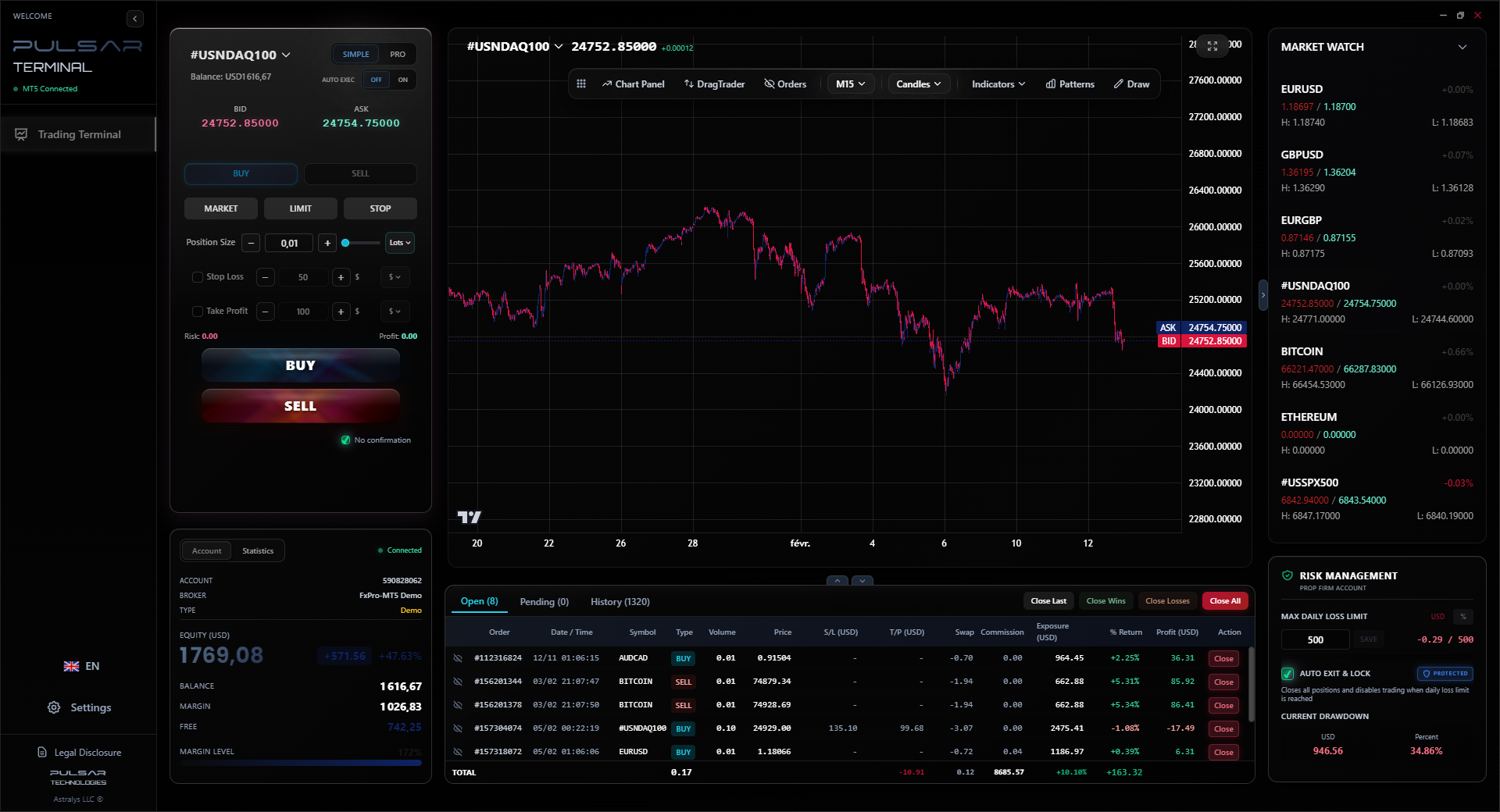
Managing multiple trades and strict risk limits is easier with tools that automate partial closures and trailing stops directly on your MT5 charts.
FAQ
Q1Is forex and index trading legal in South Africa?
Yes, it's completely legal. It's regulated by the Financial Sector Conduct Authority (FSCA). The key is to only use brokers that are licensed by the FSCA to ensure your funds are protected under South African law.
Q2How much tax do I pay on my forex trading profits?
If you trade actively, SARS will likely treat your profits as ordinary income, taxed at your marginal tax rate (from 18% up to 45%). You must register as a provisional taxpayer and pay estimated taxes twice a year. Keep detailed records of all trades, profits, losses, and related expenses.
Q3What's the minimum amount I need to start trading?
It varies by broker. Some FSCA-regulated brokers allow you to open an account with as little as $5 (roughly R90), which is perfect for learning. Others have minimum deposits of $100 (R1800) or more. Start with a demo account first, then with a very small real amount you can afford to lose.
Q4What's more volatile, USD/ZAR or the US500 index?
The USD/ZAR is generally far more volatile. It can be driven by local politics, commodity prices, and sudden shifts in sentiment. The US500 (S&P 500) is a massive, deep market. While it can have big moves, they are usually less erratic than the rand's, making it slightly more predictable for technical analysis.
Q5Can I trade the JSE Top 40 as a CFD?
Yes, many international and local brokers offer the JSE Top 40 (often listed as J200 or ZA40) as a CFD. This lets you speculate on the direction of the South African stock market without owning the actual shares.
Q6What's the single biggest mistake new traders make in South Africa?
Using excessive use, especially on USD/ZAR. They see they can control a R500,000 position with only R1,000 and don't understand that a 2% move against them (1000 pips on USD/ZAR) will wipe out their entire deposit. They also neglect tax planning until it's too late.
Pelajaran Prof. Winston
:
- ✓Never risk more than 2% of your account on a single ZAR trade.
- ✓FSCA regulation is non-negotiable for fund safety.
- ✓Trade global indices (US500) for clearer trends than ZAR pairs.
- ✓Start with a demo account for at least one full month.
- ✓Register as a provisional taxpayer from day one.
Sejauh mana artikel ini berguna?
Klik bintang untuk menilai
Pandangan Dagangan Mingguan
Analisis & strategi mingguan percuma. Tiada spam.
Tentang Penulis
David van der Merwe
Pedagang Pasaran Membangun
Pedagang berpangkalan di Johannesburg dengan 11 tahun dalam mata wang pasaran membangun. Pakar dalam pasangan ZAR, dagangan terkawal FSCA, dan analisis pasaran Afrika Selatan.
Komen
Anda mungkin juga suka

Cara Trading Forex Sukses: 7 Prinsip dari Trader Profesional
Cara trading forex sukses dengan 7 prinsip trader pro: manajemen modal, disiplin, journal trading, backtest. Data nyata, bukan janji profit palsu.
Jam Trading Forex Terbaik untuk Trader Indonesia: Panduan Lengkap dengan Tabel Waktu
Panduan jam trading forex untuk trader Indonesia. Tabel 4 sesi dunia, jam emas 20:00-00:00, sesi mana yang harus dihindari. Data akurat + tips dari trader berpengalaman.
Top 5 Sàn Forex Uy Tín Nhất 2026: Review Jujur dari Trader Indonesia
Top 5 sàn forex uy tín 2026 untuk trader Indonesia. Review jujur: spread, deposit, withdraw, dukungan lokal. Exness, XM, IC Markets & lebih.
All these calculators are built into Pulsar Terminal with real-time data from your MT5 account. One-click position sizing, automatic risk management, and instant calculations.
