


How do you know when a trend is about to flip? You stare at the charts, the price keeps pushing in one direction, and that little voice in your head starts asking, 'Is this it? Is this where it turns?' For us traders, that moment of potential change is everything.

David van der Merwe
Pedagang Pasaran Membangun ·  South Africa
☕ 11 minit baca
Apa yang akan anda pelajari:
- 1What Are Forex Reversal Patterns, Really?
- 2The Top Reversal Patterns You Need to Know
- 3Trading Reversals on ZAR Pairs: The Local Reality
- 4Entry, Exit, and Risk: The Make-or-Break Details
- 5Don't Go Naked: Combining Patterns with Other Tools
- 6Common Pitfalls (And How We South Africans Fall Into Them)
- 7Putting It All Together: A Sample Trading Plan
How do you know when a trend is about to flip? You stare at the charts, the price keeps pushing in one direction, and that little voice in your head starts asking, 'Is this it? Is this where it turns?' For us traders, that moment of potential change is everything. It's where the real money is made, and lost, if you get it wrong. In this guide, we're going to break down the most reliable forex reversal patterns, but we're doing it through a South African lens. We'll talk about how these patterns work on our beloved (and sometimes brutal) ZAR pairs, what the local rules mean for your trading, and I'll share a few trades where spotting the pattern early saved my bacon, and one where it got me absolutely smoked.
Let's cut through the jargon. A forex reversal pattern isn't a magic crystal ball. It's simply a recognizable shape that forms on a price chart, suggesting the current trend is running out of steam and a move in the opposite direction is becoming more likely. Think of it like the market taking a deep breath before changing direction.
The key word here is 'suggesting.' These patterns don't guarantee anything. I've seen textbook-perfect patterns fail spectacularly, especially during major news events. Their real power is in giving you a structured framework for making a decision. Instead of guessing, you're looking for a specific sequence of events: slowing momentum, a test of a key level that gets rejected, and then a confirmed break of a trend line or neckline.
For us in South Africa, understanding these patterns is doubly important. Our market can be thin on liquidity sometimes, especially on the exotics like EUR/ZAR or GBP/ZAR. These conditions can make false breakouts more common, so you need the extra confirmation a solid reversal pattern provides. It's not just about spotting a shape; it's about understanding the market mechanics behind it.

Warning: A pattern is only confirmed once price closes beyond its critical level (like the neckline on a head and shoulders). Trading the 'potential' shape before confirmation is a great way to lose money. Patience is non-negotiable.

💡 Petua Winston
A pattern isn't confirmed until the market closes beyond its defining line. That daily or weekly close is the market's signature. Don't antecipate the signature.
“A reversal pattern isn't a magic crystal ball. It's the market taking a deep breath before changing direction.”
The Head and Shoulders (and Inverse)
This is the king. You'll see it everywhere once you know what to look for. A head and shoulders top forms in an uptrend. You get a peak (left shoulder), a higher peak (head), and then a lower peak (right shoulder). The line connecting the lows between them is the neckline. The sell signal triggers when price breaks and closes below that neckline.
The inverse head and shoulders is the same thing flipped for a downtrend. I caught a beauty on USD/ZAR in early 2023. Price had been sliding for weeks, then formed a clear inverse pattern. The neckline was around R17.80. When it broke above on a daily close, I entered long. The target, measured from the head low to the neckline, projected a move to about R18.40. It hit it within two weeks. That was a clean 600-pip trade.
Double Tops and Double Bottoms
These are simpler but just as powerful. A double top looks like an 'M' at the top of an uptrend. Price hits a resistance level, pulls back, rallies back to the same level, and fails again. The reversal is confirmed on a break below the swing low between the two tops.
My mistake with this one? I used to place my stop-loss just above the twin peaks. Got stopped out too many times on those final wicks that kiss the level one last time. Now, I give it a 10-15 pip buffer on majors, and a much wider 30-50 pip buffer on ZAR pairs because of their volatility. A tool like our position size calculator is crucial here to adjust your lot size for that wider stop.
Rising and Falling Wedges
These are sneaky. A rising wedge in an uptrend is actually a bearish reversal signal. Price is making higher highs and higher lows, but it's getting squeezed into a narrowing triangle. It shows buying momentum is fading. The break is typically sharp. The same logic applies to a falling wedge in a downtrend signaling a bullish reversal.
The Rounding Bottom (or Saucer)
This is a slower, more gradual pattern. It indicates a long-term shift in sentiment from bearish to bullish. You won't trade this for a quick scalp; it's for the swing trading crew. The buy signal comes on a break above the resistance level that formed at the top of the 'saucer' rim.

Example: Let's say you're looking at a double top on EUR/USD. The two tops are at 1.0950. The swing low between them is at 1.0850. The pattern height is 100 pips. A confirmed break below 1.0850 gives you a minimum projected target of 1.0750 (1.0850 - 100 pips). That's your textbook profit target.
“Trading USD/ZAR is a different beast. Your patterns need to project for much bigger moves just to cover the spread.”
Trading USD/ZAR or EUR/ZAR is a different beast compared to EUR/USD. The patterns are the same, but the environment changes everything.
First, the spreads. On a major pair, you might pay 0.8 pips. On USD/ZAR, a good spread is 5-8 pips at a broker like Pepperstone. On EUR/ZAR, it can be 12-18 pips. This means your trade is in a hole from the second you enter. A 5-pip spread on a 100-pip target eats 5% of your potential profit before you even start. Your patterns need to project for much bigger moves to be worthwhile. A 50-pip projected reversal on USD/ZAR? Probably not worth the risk. Look for patterns that suggest 150-300 pip moves.
Second, liquidity. These pairs can gap like crazy, especially around South African budget speeches, SARB interest rate decisions, or political news. A beautiful head and shoulders pattern can get obliterated by a single headline. I learned this the hard way with a GBP/ZAR short a few years back. The pattern was perfect, but a surprise diplomatic announcement sent the Rand tumbling, and my perfect trade reversed into a stop-out in minutes.
My advice? Use longer timeframes. Daily and 4-hour charts smooth out some of the noise. And always, always know the economic calendar. Don't set a reversal trade the night before a major SARB announcement.

Pro Tip: When trading ZAR pairs, consider using a broker with local presence and tight spreads on exotics. Check out our reviews for IC Markets and XM to see how they handle these instruments. It makes a tangible difference to your bottom line.
💡 Petua Winston
On exotic pairs, the spread is your first opponent. If your projected profit isn't at least 3-5 times the spread, find another trade. The maths must work before the chart does.
“Trading USD/ZAR is a different beast. Your patterns need to project for much bigger moves just to cover the spread.”
Spotting the pattern is only 30% of the work. The other 70% is how you trade it.
Entry: Don't jump the gun. Wait for the close. On a daily chart head and shoulders, wait for the daily candle to close firmly below the neckline. That patience has saved me from countless false breaks. Some traders enter on a retest of the broken neckline (which now becomes resistance). It's a higher-probability entry, but you risk missing the move if it doesn't retest.
Stop-Loss Placement: This is critical. For a head and shoulders top, your stop should go above the right shoulder. For a double top, place it above the highest peak. This defines your risk. If price can push past that point, the reversal thesis is invalid. Let's say your stop is 80 pips away. Use your position size calculator to figure out how many lots you can trade so that 80 pips equals 1-2% of your account. This discipline stops one bad trade from wrecking you.
Take Profit: The classic method is to measure the height of the pattern and project that distance from the breakout point. For a head and shoulders, it's the distance from the head peak to the neckline. I often take 50% of my position off at that first target and then trail the rest with a moving average or a manual trailing stop. Never risk a winning trade turning into a loser. The concept of a margin call should be a distant nightmare, not a regular occurrence.
One of my best trades was a falling wedge on Gold (XAU/USD) – you can read more about that specific instrument in our XAU/USD guide. The pattern projected a 120-dollar move. I took half off at the target and let the rest run with a 50-period EMA as a trailing guide. It rode another 60 dollars. That's the power of a clear plan.
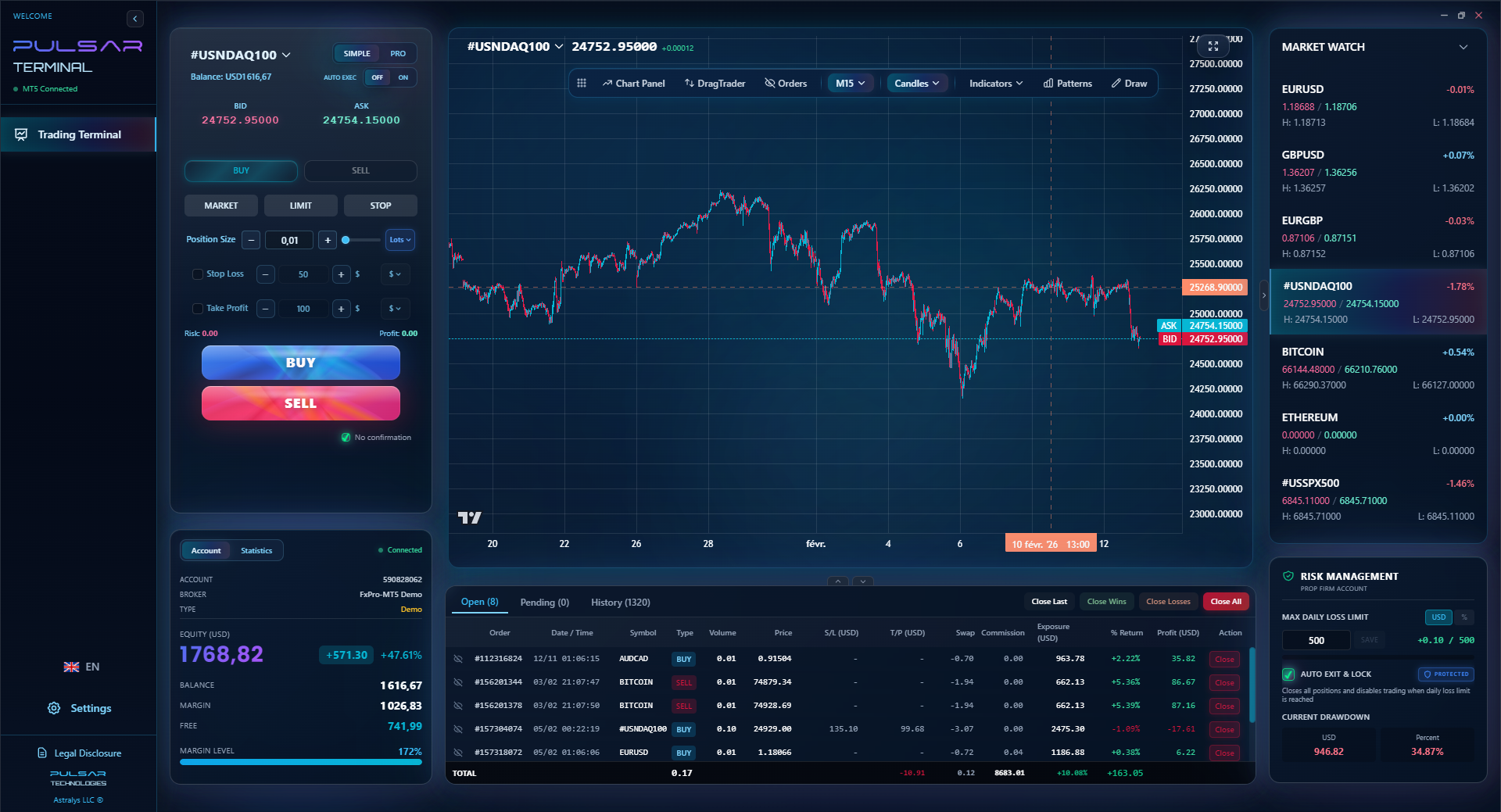
Managing multiple take-profit levels and trailing stops on a manual chart is stressful; Pulsar Terminal automates this directly on your MT5, letting you focus on finding the next reversal pattern.
“Spotting the pattern is only 30% of the work. The other 70% is how you trade it.”
A reversal pattern in isolation is a soldier without a weapon. You need backup.
Volume: This is a huge confirmator. On a true breakout from a pattern, you should see volume spike. If price breaks the neckline on low volume, be suspicious. It might be a fakeout.
Momentum Indicators: I always glance at the RSI indicator and MACD indicator. Is the RSI showing divergence? As price made a higher high on a double top, was the RSI making a lower high? That's bearish divergence and a strong confirmation. The MACD histogram can show weakening momentum as the pattern forms.
Support and Resistance: Is the neckline of your head and shoulders also a major historical support level? If yes, that breakout is even more significant. Always zoom out and see how your pattern fits into the bigger picture.
I used to ignore this step, thinking the pattern was enough. Then I got chopped up in a ranging market where 'patterns' formed every few hours but led nowhere. Now, I won't take a pattern trade unless it's at a clear higher-timeframe support/resistance zone and has at least one indicator backing it up. It filters out maybe 60% of my potential trades, but the quality of the remaining 40% is infinitely higher.
“Spotting the pattern is only 30% of the work. The other 70% is how you trade it.”
We have some unique traps here. Let's be honest about them.
- Overleveraging on ZAR Pairs: The FSCA caps use at 30:1, which is sensible. But even 30:1 on a volatile pair like USD/ZAR is massive. A 100-pip move against you can hurt. New traders see the big numbers (Rands per pip) and get greedy. They forget that a pip definition on USD/ZAR is worth more in ZAR terms than on EUR/USD. Use lower use on exotics, full stop.
- Ignoring SARB and Politics: Trading EUR/ZAR during a period of local political uncertainty is like trading blindfolded. The technical pattern might be perfect, but fundamentals will trump it every time. Schedule matters.
- Chasing Reversals in Strong Trends: This is a global mistake, but we do it too. The USD/ZAR is in a powerful multi-month uptrend, and you try to pick the top with a small double top on the 1-hour chart. That's not trading, that's gambling against the tide. Reversal patterns work best after a sustained, mature trend, not in the middle of a parabolic move.
- Not Accounting for the Cost: That wide spread definition on exotics turns break-even trades into losers. Your profit target must be significantly larger than the spread to make the risk/reward work. If the spread is 10 pips, looking for a 30-pip profit is a mug's game.
💡 Petua Winston
Your most important tool isn't an indicator, it's your trading journal. Write down every pattern trade: the setup, your reasoning, the outcome. Your failures are your best tuition.
“We have unique traps here. Overleveraging on ZAR pairs with their high volatility is a local specialty for blowing up accounts.”
Let's walk through a hypothetical trade on USD/ZAR using a daily chart.
- Identification: USD/ZAR has been in a downtrend for 2 months. Price begins to consolidate, forming three troughs: a lower low (head) between two higher lows (shoulders). An inverse head and shoulders pattern is taking shape. The neckline resistance is at R18.50.
- Confirmation: We wait for a daily candle to close above R18.50. Volume on that breakout day is higher than average. The weekly RSI is also showing bullish divergence.
- Entry & Risk: We enter on the next candle's open at R18.55. The head of the pattern is at R17.80. The pattern height is 70 cents (R18.50 - R17.80). Our stop-loss is placed below the right shoulder at R18.15. That's a 40-cent (400 pip) risk.
- Targets: Minimum projected target: R18.50 + 70c = R19.20. We decide to split the position. Target 1: R19.00 (take 50% profit). Target 2: R19.20 (take 25% profit). We will trail the remaining 25% with a 20-period EMA on the 4-hour chart.
- Review: Win or lose, we journal why. Was the spread acceptable? Did local news interfere? This feedback loop is how you improve.
This structured approach removes emotion. It turns the art of spotting forex reversal patterns into a measurable, repeatable process. It's not about being right every time; it's about being disciplined enough to follow a plan that makes money over many, many trades.
FAQ
Q1What is the most reliable forex reversal pattern?
Most pros would point to the head and shoulders (and its inverse). It's the most widely recognized and has clear rules for entry, stop-loss, and profit targets. However, 'reliable' depends on context. A head and shoulders on a daily chart at a major support level is far more reliable than one on a 5-minute chart in the middle of nowhere.
Q2Why do my reversal patterns keep failing on USD/ZAR?
Two main reasons: liquidity and spreads. ZAR pairs are less liquid, leading to more false breakouts and 'whip saws.' Also, the wide spread (5+ pips) means the price has to move significantly just for you to break even, making small, textbook-perfect patterns unprofitable. Focus on larger patterns on higher timeframes that project bigger moves.
Q3Can I use reversal patterns for scalping?
You can, but it's tricky. Patterns on very short timeframes (like 1 or 5-minute charts) are noisy and fail often. If you want to try, combine them with other tools like the RSI indicator on a 1-minute chart and have a very tight stop-loss. Honestly, I found scalping strategy more stressful than it's worth with patterns. They work better for swing trades.
Q4How does South African regulation affect trading these patterns?
The FSCA's 30:1 use limit is the big one. It forces you to use proper position sizing, which is a good thing. It means you can't overleverage on a hopeful reversal play. Also, remember you can't directly speculate against the Rand with a foreign broker; you need a local bank or FSCA-licensed entity for certain transactions.
Q5Should I trade the breakout or wait for a retest?
It's a trade-off. Trading the breakout gets you in early for maximum profit potential, but you risk a false breakout. Waiting for a retest offers higher confirmation and a better risk/reward (tighter stop), but you might miss the entire move if it doesn't pull back. I often split the difference: a small entry on the breakout, and a larger one if it retests.
Q6What timeframes are best for trading reversal patterns?
Start with the higher timeframes. Daily and 4-hour charts provide the cleanest, most significant signals. They filter out market noise. Once you're comfortable, you can look for the same patterns forming on 1-hour charts within the context of the daily trend. Avoid anything below 15 minutes when you're learning.
Pelajaran Prof. Winston
:
- ✓Wait for the close. A breakout intra-bar is just noise.
- ✓Measure pattern height for targets, but always take partial profits.
- ✓Place stops beyond the pattern's structure, not just beyond the highs/lows.
- ✓On USD/ZAR, add 30-50 pips to your standard stop distance.
- ✓No pattern trade without higher-timeframe support/resistance.
Sejauh mana artikel ini berguna?
Klik bintang untuk menilai
Pandangan Dagangan Mingguan
Analisis & strategi mingguan percuma. Tiada spam.
Tentang Penulis
David van der Merwe
Pedagang Pasaran Membangun
Pedagang berpangkalan di Johannesburg dengan 11 tahun dalam mata wang pasaran membangun. Pakar dalam pasangan ZAR, dagangan terkawal FSCA, dan analisis pasaran Afrika Selatan.
Komen
Anda mungkin juga suka

Cara Trading Forex Sukses: 7 Prinsip dari Trader Profesional
Cara trading forex sukses dengan 7 prinsip trader pro: manajemen modal, disiplin, journal trading, backtest. Data nyata, bukan janji profit palsu.
Jam Trading Forex Terbaik untuk Trader Indonesia: Panduan Lengkap dengan Tabel Waktu
Panduan jam trading forex untuk trader Indonesia. Tabel 4 sesi dunia, jam emas 20:00-00:00, sesi mana yang harus dihindari. Data akurat + tips dari trader berpengalaman.
Top 5 Sàn Forex Uy Tín Nhất 2026: Review Jujur dari Trader Indonesia
Top 5 sàn forex uy tín 2026 untuk trader Indonesia. Review jujur: spread, deposit, withdraw, dukungan lokal. Exness, XM, IC Markets & lebih.
All these calculators are built into Pulsar Terminal with real-time data from your MT5 account. One-click position sizing, automatic risk management, and instant calculations.
