


I watched the USD/BDT chart on my demo platform in 2015, feeling like a genius.

Daniel Harrington
Ketua Kandungan
☕ 10 minit baca
Apa yang akan anda pelajari:
- 1What Exactly Is a Forex Demo Account?
- 2Why You Absolutely Need One (Especially in Bangladesh)
- 3The Psychological Trap: Why Demo Trading Lies to You
- 4How to Use a Demo Account Correctly (A Step-by-Step Plan)
- 5The Dangerous Jump: Transitioning to Live Trading
- 6Common Demo Account Mistakes Bangladeshi Traders Make
- 7Demo vs. Live: The Brutal, Honest Differences
- 8Final Verdict: Are Demo Accounts Useless or Essential?

I watched the USD/BDT chart on my demo platform in 2015, feeling like a genius. I'd just 'made' ৳1,20,000 in a week by shorting the dollar against the taka. My confidence was sky-high. I funded a live account with ৳50,000, executed the same trade, and was stopped out for a ৳8,000 loss in 48 hours. The market didn't change. My broker didn't cheat me. The only thing that changed was the money. That's the brutal, unspoken truth about demo trading. It's a necessary lie, and if you don't understand its limitations, it will set you up for a spectacular failure.
A forex trading demo account is a practice account funded with virtual money. It mirrors a broker's live trading platform in almost every way. You get access to real-time price feeds, charts, and all the order types. The key word is 'almost.'
Think of it like a flight simulator for pilots. It teaches you the controls, what the buttons do, and how to react to basic scenarios. But no pilot, no matter how many simulator hours they have, expects their first real landing in a storm to feel the same. The simulator doesn't replicate the gut-churning fear, the physical pressure, or the consequence of a mistake.
In Bangladesh, brokers like Exness, IC Markets, and XM offer these demo accounts freely. They're a marketing tool, sure, but they're also the single best way to learn a platform's mechanics without risk. You can practice placing market orders, setting stop-losses, and using pending orders until it's second nature. This is non-negotiable. You should never touch a live market until you can execute a trade on your demo platform blindfolded.

Warning: The biggest trap is believing demo success equals live success. I've seen traders with 90% win rates on demo blow three live accounts in a row. The missing ingredient is always psychology, which virtual money cannot simulate.

Let's be blunt: if you're in Bangladesh and want to trade forex, starting without a demo account is financial suicide. Here’s why it's more critical for us.
Testing Your Broker's Conditions
Not all brokers are created equal, especially when it comes to connectivity from Dhaka or Chittagong. A demo account lets you test the actual spreads, execution speed, and slippage you'll experience. I once signed up with a broker that advertised 0.1 pip spreads on EUR/USD. On demo, it was true. But the moment I went live during Asian session volatility, the spreads widened to 3 pips on entry. That's a 30-fold difference. The demo had shown me the best-case scenario, not the real one. Always test during the market hours you plan to trade.
Learning Platform Nuances
MT4/MT5 might seem standard, but each broker's implementation differs. How do you deposit? Withdraw? Does their version support all the indicators? A demo account is your sandbox to figure this out. You don't want to be fumbling with a withdrawal request or a margin call alert when real money is on the line.
Developing Your Initial Plan
This is the demo's core purpose. You need to answer questions: Are you a scalper or a swing trader? What's your daily loss limit? How do you react when a trade goes 50 pips against you? A demo lets you simulate these scenarios. Use the position size calculator with your virtual balance to understand what a 1% risk really looks like. Try out a scalping strategy and see if you have the temperament for it.

💡 Petua Winston
A demo account is a laboratory, not a casino. Your goal is to collect data on your strategy's behavior, not to see a big number on a screen.
“The demo account is a perfect environment for developing terrible habits.”
This is where most Bangladeshi traders get wrecked. The demo account is a perfect environment for developing terrible habits.
You take massive risks because it's 'play money.' A 5-lot trade on a ৳10,000 demo balance? Why not! In reality, that trade would trigger an instant margin call. You hold losing positions for weeks, waiting for a rebound, because there's no real pain. You become addicted to the thrill of big, virtual wins.
I'll give you a personal example. On demo, I perfected a high-frequency strategy on GBP/JPY. It was volatile, perfect for my method. I had a 70% win rate over two months. I put ৳2,00,000 into a live account with Pepperstone. On my third live trade, the price spiked 15 pips against me in a second. On demo, I'd have ridden it out. With real money, I panicked and hit 'close' at a loss of ৳15,000. The fear of losing my own capital completely broke my discipline. The strategy was sound. My psychology was not.

Pro Tip: To combat this, impose real consequences on your demo trading. If your demo balance drops by 10%, stop for the week. Write down every trade reason. Treat the virtual ৳1,00,000 as if it's the last money you have.

Don't just trade aimlessly. Follow this structured plan to extract real value.
Phase 1: Platform Familiarization (1-2 Weeks)
- Learn every order type: Market, Limit, Stop, Stop-Limit.
- Practice setting stop-loss (SL) and take-profit (TP) orders instantly.
- Understand the trade ticket, how to calculate pip value, and how margin works.
- Test the mobile app versus the desktop platform.
Phase 2: Strategy Testing (1 Month Minimum)
- Choose ONE strategy. Maybe it's based on RSI indicator divergence or MACD indicator crossovers.
- Define your rules with absolute clarity: Entry, SL, TP, time of day.
- Execute at least 50 trades following these rules exactly. No deviations.
- Record every trade in a journal. The goal isn't profit, it's adherence to the plan.
Phase 3: Stress Testing & Scaling (2-4 Weeks)
- Now, trade your strategy with a realistic position size. If your live capital will be ৳1,00,000, risk no more than ৳1,000 (1%) per trade on your demo.
- Simulate a losing streak. After 3 losses in a row, do you deviate? Do you increase your size to 'make it back'? This test is priceless.
- Practice swing trading by holding trades over simulated weekends. Does the platform handle rollover swaps as you expect?
When to Stop: You are ready to transition when your demo trading becomes boringly mechanical. When a winning trade feels the same as a losing trade - just another entry in the journal - you're getting closer to the right mindset.
💡 Petua Winston
The moment you feel like a 'demo god' is the moment you are most dangerous to your own live capital. Hubris is the fastest path to the margin call.

“Your goal for the first month of live trading is not to make money. Your goal is to execute your plan with real money on the line and observe your emotions.”
This is the cliff edge. You've made virtual profits, your plan is solid. Now you deposit ৳50,000 from your bKash or bank account. This is where 80% of traders fail within the first month.
The market will test you immediately. Your first live trade will likely be a loss. It has to be. It needs to teach you that real trading involves losing real money. If your first trade wins, it's often more dangerous - it reinforces the demo mindset that this is easy.
My advice? Start obscenely small. Ridiculously small.
Deposit your live capital, but only trade with micro lots (0.01). Your goal for the first month is not to make money. Your goal is to execute your plan with real money on the line and observe your emotions. Did you move your stop-loss? Did you close early out of fear? This live feedback, with very small amounts, is worth more than a year of demo trading.

Example: You have ৳1,00,000. Instead of risking ৳1,000 (1%) per trade, risk ৳100 (0.1%). Trade 0.01 lots on EUR/USD. A 10-pip loss will be about ৳80. This lets you feel the loss without crippling your account. Once you can take 5 of these small losses in a row without changing your plan, then consider scaling up to your full 1% risk.
Also, choose your broker wisely based on your demo experience. If you liked the conditions on your IC Markets demo, use them live. Consistency matters.
Let's cut through the noise. Here are the specific pitfalls I see every week.
1. The Unlimited Demo Refill: You blow your ৳10,000 demo balance, so you just get another one. This destroys any concept of capital preservation. In reality, when you lose your ৳1,00,000, it's gone. Treat your demo balance as finite.
2. Ignoring Spreads and Slippage: You enter and exit at perfect prices. Live markets aren't like that. Pay attention to the spread on your demo, especially during news events. If the demo shows a 0.5 pip spread on XAU/USD (gold), expect 2-3 pips live.
3. Trading Unrealistic Sizes: This is the killer. Trading 5 standard lots on a demo makes a 10-pip move equal to ৳50,000. It creates a dopamine addiction to huge numbers. When you then make ৳500 on a live trade, it feels pointless, so you increase your risk prematurely.
4. No Record Keeping: If you're not journaling your demo trades, you're just playing a video game. You must review what worked and what didn't. Which session (Asian, London, New York) was most profitable for your strategy? The demo gives you the data, but you have to analyze it.
5. Assuming Prop Firm Challenges Are Like Demo: Many traders use demo to practice for prop firm evaluations. This is smart, but remember: prop firms have strict daily loss limits and drawdown rules. Your demo doesn't enforce these. You need to self-impose them, which is much harder.
💡 Petua Winston
Your first 20 live trades should be so small that the profit or loss feels trivial. You are trading to audit your emotions, not to make money.
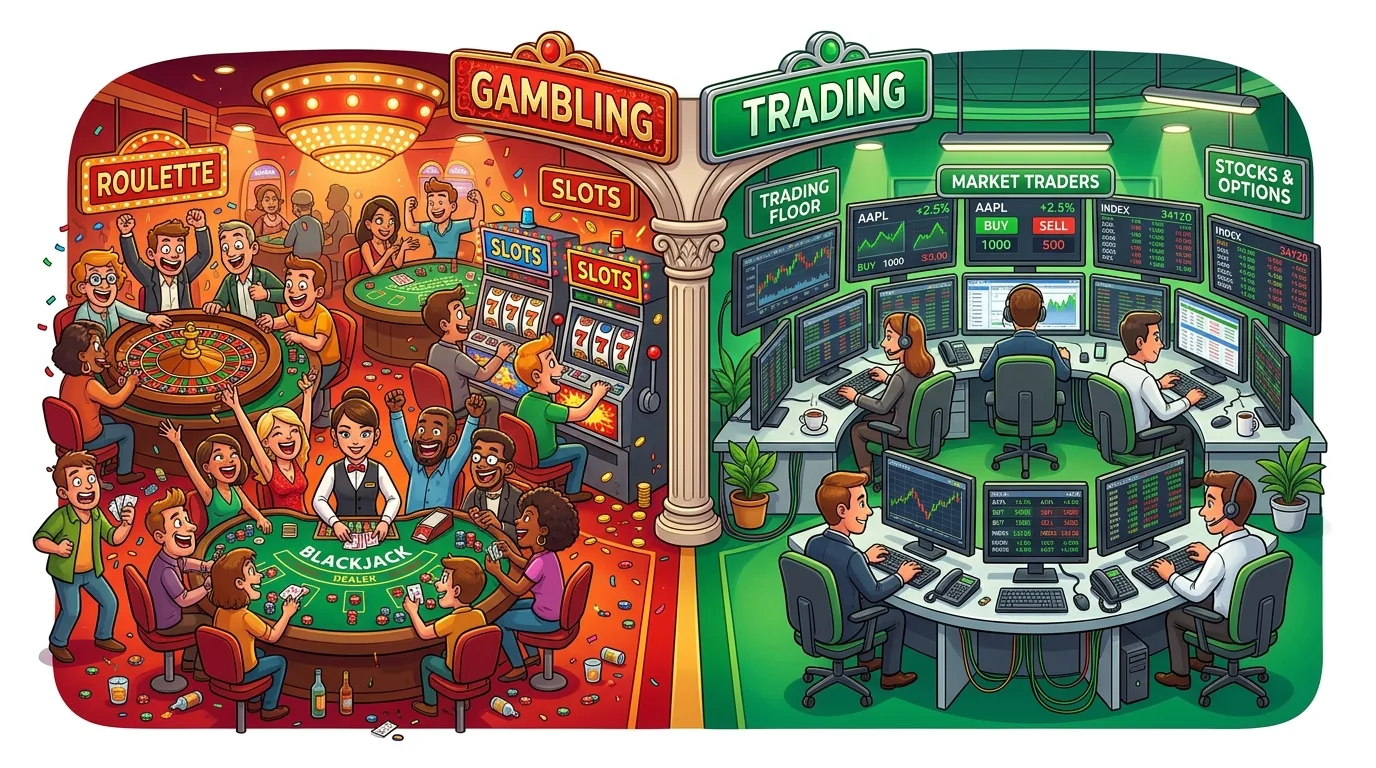
“A demo account is an essential tool for learning and a useless predictor of live success. That's the paradox you must accept.”
Here’s a table that breaks down the fantasy versus the reality.
| Feature | Demo Account (The Fantasy) | Live Account (The Reality) |
|---|---|---|
| Emotion | Zero emotional weight. It's a game. | Every tick triggers fear or greed. Psychology is 80% of the battle. |
| Order Execution | Often instant, perfect fills at requested price. | Slippage is common. Your market order might fill 2 pips away from where you clicked. |
| Spreads | Usually show the tightest, best-case scenario spreads. | Widens significantly during news, volatility, and off-peak hours. |
| Capital Pressure | Infinite refills. No consequence to blowing up. | Losses hurt. Paying bills depends on this capital. Pressure affects every decision. |
| Goal | Learn mechanics, test strategies. | Preserve capital, then generate consistent returns. Survival first. |
Notice the theme? The demo account is a technical simulator. The live account is a psychological battleground. You can have the best strategy in the world, but if you haven't prepared for the emotional onslaught, you will fail. Tools that help manage this psychology in live trading become critical. For example, setting a trailing stop can lock in profits without you needing to stare at the screen. Automating parts of your process removes emotional decision points.
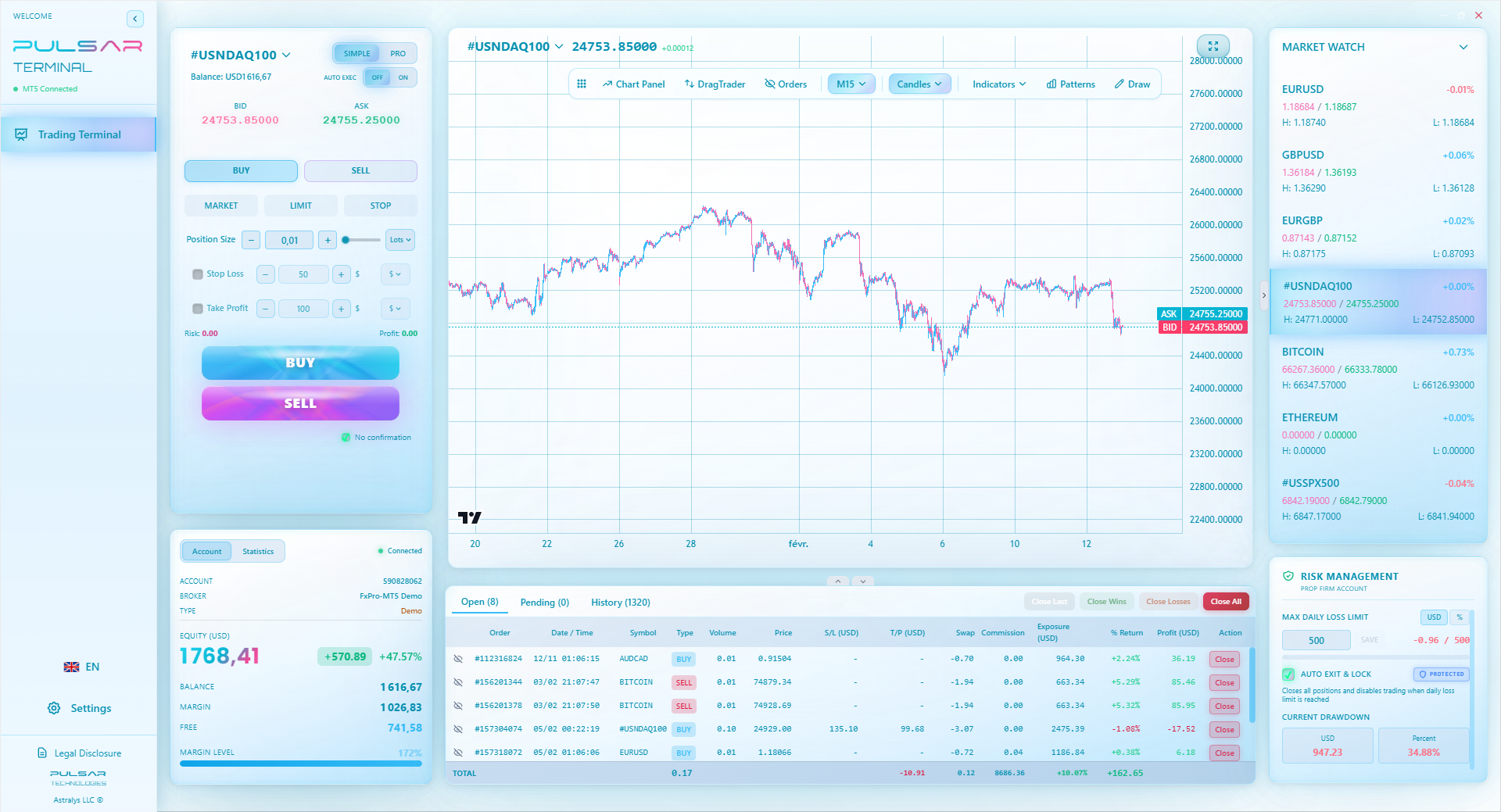
Managing the psychological gap between demo and live trading often requires automating your rules, which is where a tool like Pulsar Terminal excels by letting you set advanced order types directly on your MT5 charts.
They're both. A demo account is an essential tool for learning and a useless predictor of live success. That's the paradox you must accept.
Use it for its intended purpose: to remove the variable of platform ignorance. To test if your broker's connection from Bangladesh is stable. To drill your entry and exit mechanics until they're automatic.
Then, abandon it for its false promises. It will not teach you patience. It will not teach you humility. It will not teach you how you'll react when a trade that represents a month's salary moves against you in three minutes.
For that, there is no simulation. You have to step into the ring with small, manageable amounts of real capital and get punched in the face a few times. That's the only teacher that matters. Start your demo today, use it wisely, but never forget it's just the training wheels. The real ride, with all its bumps and falls, begins when you click 'Deposit' and trade with your own hard-earned Taka.
FAQ
Q1How long should I use a forex trading demo account before going live?
There's no fixed time, but a minimum of 2-3 months of disciplined, journaled trading is a good baseline. You're ready when you can execute at least 50-100 trades following a strict plan without deviation, and the process feels mechanical, not exciting. The switch should happen when you're bored of demo, not when you're excited by your virtual profits.
Q2Is demo trading with virtual money a waste of time?
Only if you use it wrong. If you treat it like a casino game, taking huge risks with no plan, it's worse than a waste of time - it builds bad habits. If you use it as a structured simulator to learn platform mechanics and test a strategy's rules, it's useful. The waste of time is jumping into live trading without it.
Q3Why do I keep winning on demo but losing with real money?
This is the universal experience. On demo, you have no emotional skin in the game. You follow your rules perfectly because there's no fear. With real money, fear of loss and greed for profit cause you to break your own rules: you move stop-losses, take profits too early, or overtrade. The strategy is the same; the mind executing it is completely different.
Q4Can I use a demo account to practice for a prop firm challenge?
Absolutely, it's the best way. But you must self-impose the prop firm's rules strictly on your demo. If the challenge has a 5% daily loss limit, you must stop trading the moment your demo account hits a 5% loss for the day. Most traders fail because they practice on demo without these constraints, then can't handle them live.
Q5Do brokers manipulate demo accounts to make trading look easier?
Not typically through price manipulation, but the conditions are almost always ideal. Spreads are tighter, execution is faster, and slippage is minimal. This creates a best-case scenario that can set unrealistic expectations. Always check the broker's live account specifications separately and expect slightly worse conditions in the real world.
Q6What's the best demo account for beginners in Bangladesh?
Choose a demo from a reputable, internationally regulated broker that accepts Bangladeshi clients, like Exness, IC Markets, or XM. Their demos use the same platforms (MT4/MT5) as their live accounts. Most importantly, pick one and stick with it - hopping between demos prevents you from developing deep familiarity with one system.
Q7Should I use multiple demo accounts at once?
No. This fragments your learning. Master one platform, one broker's environment, and one strategy at a time. Juggling multiple demos leads to confusion and prevents you from developing the muscle memory needed for consistent execution under pressure.
Pelajaran Prof. Winston
:
- ✓Demo success is 90% mechanics, live success is 90% psychology.
- ✓Test brokers in demo during YOUR trading hours for real spread data.
- ✓Impose real, painful consequences on your demo trading to simulate loss.
- ✓Start live trading with risk sizes that feel laughably small (0.1%).
Sejauh mana artikel ini berguna?
Klik bintang untuk menilai
Pandangan Dagangan Mingguan
Analisis & strategi mingguan percuma. Tiada spam.
Tentang Penulis
Daniel Harrington
Ketua Kandungan
Ketua kandungan di The Trading Mentor. Pedagang berpengalaman yang bersemangat menjadikan konsep dagangan kompleks mudah difahami. Meliputi topik global, strategi, dan panduan platform.
Komen
Anda mungkin juga suka

Cara Trading Forex Sukses: 7 Prinsip dari Trader Profesional
Cara trading forex sukses dengan 7 prinsip trader pro: manajemen modal, disiplin, journal trading, backtest. Data nyata, bukan janji profit palsu.
Jam Trading Forex Terbaik untuk Trader Indonesia: Panduan Lengkap dengan Tabel Waktu
Panduan jam trading forex untuk trader Indonesia. Tabel 4 sesi dunia, jam emas 20:00-00:00, sesi mana yang harus dihindari. Data akurat + tips dari trader berpengalaman.
Top 5 Sàn Forex Uy Tín Nhất 2026: Review Jujur dari Trader Indonesia
Top 5 sàn forex uy tín 2026 untuk trader Indonesia. Review jujur: spread, deposit, withdraw, dukungan lokal. Exness, XM, IC Markets & lebih.
All these calculators are built into Pulsar Terminal with real-time data from your MT5 account. One-click position sizing, automatic risk management, and instant calculations.
