


You're scrolling through headlines, seeing 'CBN Announces New Policy' or 'US Inflation Data Beats Forecasts.' You know this forex trading news should matter to your trades, but how? Do you buy the rumor and sell the fact? Do you stay out entirely? I used to get this wrong all the time, jumping in too early or misreading the impact.

Olumide Adeyemi
Perintis Dagangan Afrika Barat ·  Nigeria
☕ 12 minit baca
Apa yang akan anda pelajari:
- 1Why News Matters More for Nigerian Traders
- 2The News That Actually Moves Markets (A Tier List)
- 3Setting Up Your News Trading Plan: A Step-by-Step Guide
- 4Mistakes I've Made (So You Don't Have To)
- 5Essential Tools & Resources for 2026
- 6Putting It All Together: A Week in the Life
- 7Final Thoughts: Managing Expectations

You're scrolling through headlines, seeing 'CBN Announces New Policy' or 'US Inflation Data Beats Forecasts.' You know this forex trading news should matter to your trades, but how? Do you buy the rumor and sell the fact? Do you stay out entirely? I used to get this wrong all the time, jumping in too early or misreading the impact. Let me show you how to filter the noise, understand what truly moves prices for a Nigerian trader, and build a news-based strategy that doesn't rely on luck.
Trading from Nigeria isn't like trading from London or New York. Our context changes everything. The most obvious factor is the Naira. You might not be trading NGN/USD directly on your broker's platform (most international brokers don't offer it), but its health dictates your real purchasing power. When the CBN makes a move, it doesn't just affect the official rate. It shakes confidence, impacts import costs, and can trigger capital flight. This creates indirect volatility in the pairs you are trading, like EUR/USD or GBP/USD, as global sentiment toward emerging markets shifts.
Then there's the infrastructure. Power outages, internet instability – these aren't just inconveniences; they're direct trading risks. You can't afford to be in a high-impact trade like a Non-Farm Payroll release when 'NEPA takes light.' News trading requires precision timing, and our environment adds a layer of difficulty many textbooks ignore. I learned this the hard way during a major ECB announcement a few years back. My analysis was spot on, my entry was good. Then, a blackout. By the time I got my generator running and reconnected, my profitable trade had reversed and hit my stop-loss. The news didn't beat me; Lagos did.
Finally, there's access. We're often trading with international brokers like Exness or IC Markets, which is great for execution. But it means we're one step removed from the primary liquidity pools. During extreme volatility, spreads on these brokers can widen dramatically, sometimes turning what looked like a good entry into an instant loser. Understanding news helps you anticipate and avoid these moments.
Not all news is created equal. Treating a minor economic revision the same as a central bank rate decision is a recipe for blown accounts. Here’s how I categorize them after years of watching the charts react.
Tier 1: The Market Shakers
These are the events that can cause 100+ pip moves in minutes. You either trade them with a specific plan or you stay out. No in-between.
- Central Bank Interest Rate Decisions & Statements (FED, ECB, BOE, CBN): This is the big one. The rate change itself is important, but the accompanying statement and press conference (especially the 'forward guidance') are where the real volatility lives. The market prices in expectations, so the change from expectations causes the move.
- US Non-Farm Payrolls (NFP): The first Friday of every month. It's a jobs report, but it's treated like a holy text for the US Dollar. I've seen EUR/USD swing 80 pips in 10 seconds on a big miss or beat. Liquidity can dry up right before, causing insane spreads.
- CPI (Inflation) Data from Major Economies: In the current high-inflation era, this is as important as the NFP. A hot CPI print makes traders bet on more aggressive central bank hikes, strengthening that currency.
- Major Geopolitical Events (Elections, Wars, Trade War Announcements): These are unpredictable but create long-term trends. The initial knee-jerk reaction is often reversed, so jumping in immediately is risky.
Tier 2: The Trend Confirmers
These releases can cause 30-70 pip moves and often provide the fuel for sustained trends.
- Retail Sales, GDP, PMI Data: They paint a picture of economic health. A string of strong PMIs from a region can build a case for a stronger currency over weeks.
- Central Bank Speaker Speeches: A single hawkish or dovish comment from a Fed Governor outside of a scheduled meeting can swing markets. You need to follow key figures like Powell or Lagarde.
Tier 3: The Background Noise
Minor data revisions, low-impact sentiment surveys. They might cause a 10-15 pip wiggle but rarely reverse a trend. I mostly ignore these unless I'm already in a very short-term scalping strategy.

Warning: The CBN's announcements are a unique Tier 1 event for us, even if the global market barely blinks. A change in the official exchange rate window or a new circular on diaspora remittances can cause massive parallel market volatility, affecting your cost of living and overall trading capital stability. Always watch CBN press releases.

💡 Petua Winston
The 'forecast' number is your real adversary, not the 'actual.' Price moves on the difference between the two. Spend 80% of your prep time understanding market expectations.
“News trading requires precision timing, and our environment adds a layer of difficulty many textbooks ignore.”
Trading news without a plan is gambling. Here’s the framework I use, born from many costly lessons.
Step 1: The Calendar is Your Bible. Don't rely on random Twitter alerts. Use a proper economic calendar. I have mine set to GMT+1 (West Africa Time). Filter for high-impact events only. The key column isn't the 'Actual' figure, but the 'Forecast.' Your job is to anticipate how price will react to the difference between Actual and Forecast.
Step 2: Pre-News Analysis. At least an hour before the release, I do three things:
- Identify the Key Level: Where is price trading relative to recent support and resistance? Is it sitting right at a major technical level? News often acts as the catalyst for a breakout or rejection from these zones.
- Check Sentiment: What is the market expecting? Is the consensus strongly for a 0.50% rate hike, or is it split? I read a few analyst summaries to gauge the mood.
- Decide My Stance: Will I trade the breakout, the reversal, or will I sit out? For events like NFP, I often choose to sit out the initial 2-minute spike and wait for the market to find a new range to trade from.
Step 3: Execution Rules (My Hard-Earned Rules).
- No Market Orders Just Before: The spread will murder you. Use limit or stop orders if you must enter pre-news, or wait for the initial chaos to settle (usually 1-3 minutes).
- Set Wider Stops: Volatility is high. A normal 20-pip stop can get taken out by mere noise. For a Tier 1 event, I might use a 50-80 pip stop, but I reduce my position size proportionally using a position size calculator to keep risk constant.
- Have a Scenario Plan: If data is much higher than forecast, I will look for a break above resistance X. If it's in line, I expect a fade of any initial move. Write it down.
Step 4: Post-News Management. The news is out. The first move happens. Now what? This is where most fail. If you're in a trade, move your stop to breakeven as soon as reasonably possible. The market often retraces. If you missed the entry, don't FOMO (Fear Of Missing Out). There will be other opportunities. Sometimes the best trade after big news is to wait 15 minutes for a clear MACD indicator or RSI indicator signal on the 5-minute chart.

Example: Trading a Fed Rate Decision. Forecast: +0.25%. Actual: +0.50%. This is a hawkish surprise. USD should strengthen. EUR/USD is trading at 1.0850, just above support at 1.0830. My plan: I will NOT enter on the immediate spike down. I will wait to see if price breaks and closes a 5-minute candle below 1.0830. If it does, I enter a sell with a stop at 1.0860 (30 pips) and a target at 1.0780. My position size is calculated so that 30 pips = 1% of my account.
Let's get real. I've lost money so you can learn. Here are the classic errors, especially in our Nigerian context.
1. Trading Every Red Calendar Icon. Early on, I thought I had to be in a trade for every high-impact event. It led to overtrading, frustration, and losses from conflicting signals. Now, I pick my battles. Maybe 2-3 key events per month.
2. Ignoring the 'Whisper Number.' Sometimes, the official 'Forecast' is 100k jobs for NFP, but late leaks or sophisticated analyst models point to 130k. The market moves on the 130k 'whisper.' When the actual prints at 125k (beating the official forecast but missing the whisper), price can actually sell off. I got caught in this trap multiple times. Now I check financial news sites in the 30 minutes before the release for any last-minute sentiment shifts.
3. Underestimating the 'Sell the Fact' Reaction. This one cost me $400 on a single trade. The ECB was widely expected to be dovish. EUR/USD sold off for two days ahead of the meeting ('buy the rumor'). When the dovish statement came out exactly as expected, the pair spiked higher ('sell the fact'). All the weak sellers had already sold, and profit-taking kicked in instantly. The lesson: When an outcome is 90% priced in, the actual event often triggers a reversal.
4. Not Accounting for Broker Execution. During the Swiss Franc shock in 2015, many brokers had massive slippage and margin call issues. While that's extreme, I've had my own issues with slower execution during NFP on some brokers compared to others. This is why I now only use brokers with proven, reliable execution during news, like Pepperstone or IC Markets. It's worth checking reviews like this IC Markets review for insights on news execution.
5. Letting CBN News Spook Non-NGN Trades. A bad CBN announcement would put me in a negative, fearful mindset. I'd then avoid perfectly good setups on EUR/USD or XAU/USD guide because my local economic anxiety was bleeding into my global trading psychology. I had to learn to compartmentalize.
💡 Petua Winston
Your first loss during a news event is often your smallest. If your thesis is wrong, get out. Don't average down into a volatility storm. I've seen accounts wiped out in 90 seconds that way.
“When an outcome is 90% priced in, the actual event often triggers a reversal. This is the 'sell the fact' reaction that wrecks new traders.”
You can't do this with just your broker's platform. Here's my toolkit.
Economic Calendars:
- ForexFactory.com: The classic. Free, customizable, shows previous/forecast/actual. Set your timezone.
- Investing.com: Has a good calendar and integrates news headlines well.
News Aggregators:
- Reuters / Bloomberg Terminal (if you can afford it): The gold standard.
- TradingView Newsfeed: Built into the charts, which is handy.
- Follow Key Central Banks on Twitter (X): @federalreserve, @ecb, @centralbank_ng. Turn on notifications for major announcements.
The Nigerian Specifics:
- CBN Website: Bookmark the 'Press Releases' section. Read every one. The language is formal, but you need to understand the direction of policy.
- Nairametrics & BusinessDay: For local analysis of how global events and CBN policy intersect. They often explain the 'why' behind the numbers.
Trading Tools:
- A reliable VPN. Sometimes, news sites or even trading platforms can be finicky.
- An Uninterruptible Power Supply (UPS) for your router and computer. This is non-negotiable.
- A platform that allows fast, precise order management. Manually dragging stops on MT5 during volatility is stressful. This is where tools that enhance MT5 become useful.

Pro Tip: Create a 'News Day' checklist. Mine includes: 1) Check calendar at market open. 2) Set phone alarms 30 mins before key events. 3) Ensure UPS is charged. 4) Pre-calculate position sizes for possible scenarios. 5) Close all unrelated browser tabs to focus.
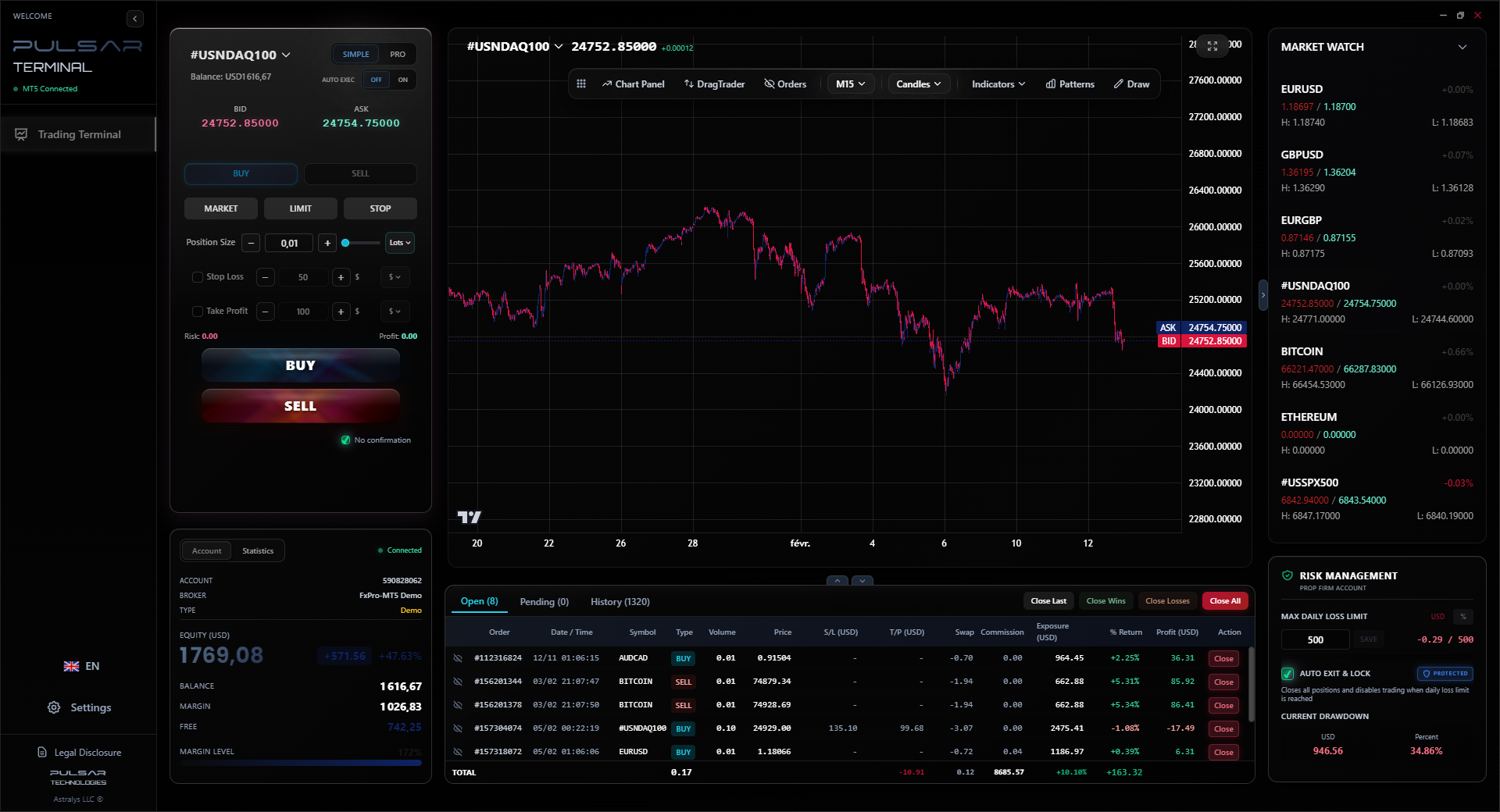
Managing multiple take-profit levels and moving stops to breakeven during volatile news events is critical, and Pulsar Terminal automates this directly on your MT5 platform.
Let's walk through a hypothetical week, like the one coming up.
Monday: Quiet day. Only Tier 2/3 data. I focus on technical analysis on longer timeframes for swing trading setups. I note that EUR/USD is approaching a key resistance at 1.0950. I check the calendar: US CPI is on Wednesday, ECB decision on Thursday.
Tuesday: I start preparing for CPI. Forecast is 3.1% year-on-year. Market seems jittery. I draw my key levels on the chart: resistance at 1.0950, support at 1.0880. I decide my plan: A hotter-than-expected print (e.g., 3.3%) should boost USD, so I'll look for a break below 1.0880. A cooler print (e.g., 2.9%) should weaken USD, so I'll look for a break above 1.0950. I calculate my position size for a 50-pip stop.
Wednesday (CPI Day): 1:30 PM WAT. At 1:00 PM, I do nothing. No new trades. I'm just watching. Data drops: CPI comes in at 3.4% - hotter than forecast. USD spikes. EUR/USD plummets from 1.0900. I don't chase. It crashes through 1.0880. I wait for the first 5-minute candle to close below it. It does at 1.0875. I enter a sell. Stop at 1.0925 (just above the pre-news swing). The move continues down to 1.0830. I take half profit at 1.0835 and move stop to breakeven.
Thursday: ECB day. My breakeven stop on the remaining half of my EUR/USD sell is hit on a pre-ECB bounce. I'm out with profit on half, scratch on the rest. Good outcome. I then sit out the ECB volatility as I have no clear edge.
Friday: NFP day. I'm usually exhausted from the week's volatility. I often take this day off from news trading, or I might use a very small size to practice my execution. I review my trades, journal what worked (CPI plan was clear) and what didn't (got stopped on the ECB bounce).
The key is rhythm. Not every event is a trade. Patience is the most important skill in news trading.
💡 Petua Winston
If you can't explain in one sentence what the market expects from an event and how price will react if it's wrong, you have no business being in the trade. Clarity before exposure.
“Your job is to listen, plan, and execute with discipline. Everything else is just noise on your screen.”
Forex trading news is a skill, not a magic bullet. It won't make you rich overnight. In fact, when you start, it might make you poor quite quickly. The goal is to use news to understand why the market is moving, to find high-probability, high-reward setups, and to avoid getting caught on the wrong side of a tsunami.
For us in Nigeria, it adds another layer: understanding how global events filter down to affect the Naira, your capital, and your mindset. A strong USD from a Fed hike might mean your profits buy more Naira when you withdraw, but it also means fuel and rice get more expensive. You have to trade the global charts while living in a local reality.
Start small. Paper trade news events first. Then trade with microscopic real money. Focus on one or two currency pairs, like EUR/USD guide or GBP/USD. Get to know how they react. Build your checklist. Refine your plan.
Remember, the news is just a catalyst. The market's reaction is the truth. Your job is to listen, plan, and execute with discipline. Everything else is just noise on your screen.
FAQ
Q1What is the best time to trade news in Nigeria?
The most volatile news (US data) typically drops between 1:30 PM and 3:30 PM West Africa Time (WAT). European data comes out between 9:00 AM and 11:00 AM WAT. Set your calendar to WAT and set alarms for 30 minutes before high-impact events to prepare.
Q2Should I trade the Naira on the black market using forex news?
Absolutely not. That's not forex trading; it's currency speculation in an unregulated, often illegal parallel market. The spreads are enormous, the counterparty risk is high, and it's fraught with security and legal issues. This article focuses on trading major currency pairs (EUR/USD, GBP/USD etc.) through regulated international brokers.
Q3How much money do I need to start trading news?
More than you think. The volatility requires wider stops, so you need a larger account to maintain proper risk management. If your stop is 50 pips and you risk 1% of your account, you need $10 per pip. That means a 1% risk requires a $500 account size for that single trade. I'd recommend at least $1,000 to start trading news with any realistic risk parameters, and even that is tight.
Q4Can I use a robot (EA) to trade news for me?
I strongly advise against it. News creates chaotic, low-liquidity conditions where most EAs fail spectacularly. They can't interpret a central bank governor's tone or understand a 'whisper number.' The slippage and spread widening can trigger multiple erroneous orders. News trading requires human discretion.
Q5Why does my broker's spread get so wide during news?
This is normal. Liquidity providers (the big banks) pull back their quotes because the risk of a sudden, massive price gap is high. Your broker is simply reflecting this market reality. It's a protection mechanism for them. This is why using market orders right before news is so dangerous - you might get filled at a terrible price. Always check the typical spread definition for your broker during calm times and volatile times.
Q6Is trading CBN announcements profitable?
Not directly on a forex platform, as you can't trade NGN pairs. However, understanding CBN policy can give you an edge in trading other assets. For example, a CBN rate hike to defend the Naira might signal broader EM currency strength, potentially boosting pairs like USD/ZAR or USD/MXN. It's more about contextual awareness than direct trading.
Pelajaran Prof. Winston
:
- ✓Trade the market's reaction, not the headline.
- ✓Wider stops, smaller size during news volatility.
- ✓The 'Whisper Number' often matters more than the official Forecast.
- ✓If you're confused, stay out. Clarity is your edge.
Sejauh mana artikel ini berguna?
Klik bintang untuk menilai
Pandangan Dagangan Mingguan
Analisis & strategi mingguan percuma. Tiada spam.
Tentang Penulis
Olumide Adeyemi
Perintis Dagangan Afrika Barat
Salah seorang pendidik dagangan forex paling aktif di Nigeria. 8 tahun pengalaman dagangan dari Lagos. Pakar dalam strategi modal rendah dan cabaran prop firm untuk pedagang Afrika.
Komen
Anda mungkin juga suka

Cara Trading Forex Sukses: 7 Prinsip dari Trader Profesional
Cara trading forex sukses dengan 7 prinsip trader pro: manajemen modal, disiplin, journal trading, backtest. Data nyata, bukan janji profit palsu.
Jam Trading Forex Terbaik untuk Trader Indonesia: Panduan Lengkap dengan Tabel Waktu
Panduan jam trading forex untuk trader Indonesia. Tabel 4 sesi dunia, jam emas 20:00-00:00, sesi mana yang harus dihindari. Data akurat + tips dari trader berpengalaman.
Top 5 Sàn Forex Uy Tín Nhất 2026: Review Jujur dari Trader Indonesia
Top 5 sàn forex uy tín 2026 untuk trader Indonesia. Review jujur: spread, deposit, withdraw, dukungan lokal. Exness, XM, IC Markets & lebih.
All these calculators are built into Pulsar Terminal with real-time data from your MT5 account. One-click position sizing, automatic risk management, and instant calculations.
