


Let's cut through the noise.

Rajesh Sharma
Penganalisis Forex Kanan ·  India
India
☕ 11 minit baca
Apa yang akan anda pelajari:
- 1The Indian Legal Minefield: What You Can Actually Trade
- 2Realistic Daily Profit Expectations: From Fantasy to Math
- 3The Silent Killers: Costs That Eat Your Profit
- 4From My Trading Journal: Two Real Trades
- 5Building a Sustainable Strategy, Not a Daily Lottery Ticket
- 6Tools and Brokers for the Indian Trader
- 7The Path Forward: Your First Steps
Let's cut through the noise. When I started, I believed the ads promising thousands of dollars a day. The reality? In my first year, I lost ₹2.8 lakhs. The truth about daily profit in forex isn't a number, it's a percentage game played on a field of strict Indian regulations. Most retail traders lose, and the RBI's rules make the path even narrower. This isn't about getting rich quick. It's about understanding what's legally possible, mathematically probable, and psychologically sustainable for a trader in India.
Before we talk profit, we have to talk legality. This is the single biggest mistake I see Indian traders make, and I made it myself early on. I signed up with an offshore broker to trade EUR/USD, lured by the liquidity. It felt like the real market. I didn't get caught, but the constant low-grade anxiety wasn't worth it. Knowing what I know now about FEMA penalties, I wouldn't touch it.
The rules are clear, but confusing. The Reserve Bank of India (RBI) and SEBI are the gatekeepers. For the average retail trader like you and me, the playing field is tiny. You are only permitted to trade INR-based currency futures and options on exchanges like the NSE and BSE. Think USD/INR, EUR/INR, GBP/INR, JPY/INR. That's it.
Trading the majors like EUR/USD or GBP/USD through an international broker? That's prohibited for speculative purposes. The Liberalised Remittance Scheme (LRS) explicitly excludes it. The RBI even publishes an 'Alert List' of unauthorized entities. Getting caught can mean penalties up to three times the transaction amount. I've met guys who've had their bank accounts frozen for moving money to unapproved brokers.
There's one loophole, the GIFT City. You can use the LRS to invest through an IFSC-registered broker there for access to global markets. It's legal, but it's a more complex setup for most beginners. For 95% of us, the legal route is the four INR pairs on a SEBI-regulated broker like Zerodha or Upstox. Your entire strategy for a realistic forex trading profit per day must be built within this box.
“The truth about daily profit in forex isn't a number, it's a percentage game played on a field of strict Indian regulations.”
Okay, let's get to the number you're here for. What's a realistic forex trading profit per day? I'll give you the industry secret: consistent pros don't think in daily rupees. They think in monthly percentages. A daily target is a fast track to overtrading and blowing up your account. I learned that the hard way.
The Percentage Reality
For a skilled, disciplined trader using their own capital, a realistic target is 2-5% per month. Not per day, per month. Let's do the math. If you have a ₹1,00,000 account, a 3% month is ₹3,000. That's an average of about ₹150 per trading day. That's the sobering reality. It doesn't sound glamorous, does it? But compounding that over a year turns ₹1 lakh into ~₹1,42,000. That's sustainable growth.

Example: Account: ₹2,00,000 Realistic Monthly Return: 4% Monthly Profit: ₹8,000 Average Daily Profit (20 days): ₹400 Annual Compounded (approx.): ~₹3,04,000
Professional traders at funds might target 5-10% monthly. The studies are brutal: only 10-20% of retail traders are consistently profitable. The rest break even or lose. Your primary goal isn't profit on day one. It's survival. Your first profit target should be zero: don't lose money. I journaled every trade for two years before my equity curve stopped looking like a heart attack monitor.
The Scalping Trap
Many new traders gravitate to scalping strategy, thinking it's a way to grind out daily income. On USD/INR, the average daily range can be 30-50 pips. After accounting for the spread and slippage, trying to scalp 5-10 pips multiple times a day is a high-stress, low-reward game that often just feeds the broker. I burned through ₹50,000 in a month trying to scalp Nifty before I accepted it didn't suit my psychology.

💡 Petua Winston
Your daily profit target should be zero pips. Your goal is to execute your plan flawlessly. The money is a lagging indicator of your discipline.
“A daily target is a fast track to overtrading and blowing up your account. I learned that the hard way.”
Your broker isn't your partner. They're a business. Every tick of profit you make is fought against a tide of costs. If you don't understand these, you'll wonder why your winning trades feel so small.
Spreads & Commissions: This is your direct cost of trading. On INR pairs, the spread isn't always tiny. You might see a 0.5 to 1 pip spread on USD/INR futures. That doesn't sound like much, but if your average profit target is only 15 pips, you're giving up 3-7% of your potential profit right at the entry. On international brokers (for the prohibited pairs), you see ads for 'zero spread' accounts. They charge a commission instead, like $3.50 per lot. You have to calculate the all-in cost.
Slippage: This is the hidden monster, especially around news events. You place a market order to buy USD/INR, but by the time it's filled, the price has moved 2 pips against you. On a ₹10 lakh position, that's ₹200 gone before you even start. I once had a ₹1,500 slippage on a large GBP/INR order during Brexit chaos. It felt like being pickpocketed.
Platform & Data Fees: Some advanced platforms or real-time data feeds for the NSE/BSE come with monthly charges. It's a small leak, but leaks sink ships.
Here’s a simple comparison of how costs impact two hypothetical trades:
| Cost Factor | Trade A (Ignored Costs) | Trade B (Accounted For) |
|---|---|---|
| Intended Profit | 20 pips (₹2,000) | 20 pips (₹2,000) |
| Spread Cost | -1 pip (₹100) | -1 pip (₹100) |
| Slippage | -2 pips (₹200) | -0.5 pips (₹50) waited for liquidity |
| Net Profit | 17 pips (₹1,700) | 18.5 pips (₹1,850) |
That ₹150 difference is your lunch money. Over 100 trades, it's ₹15,000. Always, always use a position size calculator that includes your estimated slippage and spread. It changes everything.
“A daily target is a fast track to overtrading and blowing up your account. I learned that the hard way.”
Theory is cheap. Let me show you two real trades from my journal. One a humble win, one a stupid loss. This is what the daily profit grind actually looks like.
Trade 1: The 'Boring' Win (USD/INR Futures)
- Date: Oct 15, 2023
- Thesis: Price bounced off a clear weekly support level on the chart. RBI intervention talk was causing volatility, but the technical level held.
- Action: Bought 1 lot of USD/INR Nov Future at 83.15. My risk was 20 pips (to 82.95). My target was 40 pips (83.55). A simple 1:2 risk-reward.
- Management: I moved my stop to breakeven at 83.20 once price moved 10 pips in my favor. This is a habit that saved me countless times.
- Result: Price hit my target two days later. Exit at 83.55.
- Profit: 40 pips. On 1 lot (which is $1000 * 83.15 = ~₹83,150 notional), a pip is roughly ₹1. So, ₹400 profit.
- Lesson: I didn't get greedy. I followed my plan. ₹400 in two days. That's the grind. I used the MACD indicator on the hourly chart just for confluence, but the level was the key.
Trade 2: The 'Genius' Loss (EUR/INR Options)
- Date: Nov 5, 2023
- Mistake: I sold a put option, thinking EUR/INR couldn't go lower. I was trying to be clever and collect premium for 'extra' daily profit.
- Action: Sold 84.00 Put for a credit of ₹1,200. My risk was theoretically unlimited.
- The Disaster: Unexpected ECB comments sent the pair crashing. My small credit was wiped out in hours. I didn't have a hard stop because 'it's an option, it'll come back.'
- Result: Panic-bought back the option at a loss of ₹4,800.
- Loss: ₹4,800. It wiped out 12 of my 'boring' USD/INR wins.
- Lesson: Never, ever trade without a defined, automated stop. Trying to be fancy for extra income destroyed a week's discipline. This is why prop firms use margin call rules – to stop this exact behavior.
💡 Petua Winston
Calculate your 'all-in' cost per trade: spread + potential slippage + commission. If it's more than 25% of your target profit, your strategy is feeding the broker, not you.
“Your broker isn't your partner. They're a business. Every tick of profit you make is fought against a tide of costs.”
Chasing a fixed rupee amount every day is a strategy for ruin. You need a system that works in the Indian context, across different market conditions.
Capital & Position Size: Your Foundation
This is the most important math you'll do. How much should you risk per trade? The old rule is 1-2% of your capital. On a ₹1 lakh account, that's ₹1,000-2,000 risk per trade. Not per day, per trade. If you're swing trading INR pairs over a few days, your stop-loss might be 30 pips. That means your position size should only be about ₹33,000 notional (₹1000 risk / 30 pips). Most beginners trade 5x that size and are shocked by a single loss.

Warning: Funding an international broker account with your savings to chase EUR/USD dreams violates FEMA. You're not just risking market loss, you're risking legal penalties. Build your skill legally first.
Timeframe Alignment
Are you a day trader or a swing trader? Your profit-per-day expectation changes completely. A day trader might aim for 1-2 successful small trades a day. A swing trader might have 2-3 trades active all week, with no profit realized on most days. I'm a swing trader by nature. Trying to force myself to find daily setups led to terrible trades. Find your rhythm.
The Psychological Daily Target
Your only daily targets should be process-based:
- Did I follow my trading plan?
- Did I manage my risk correctly?
- Did I journal my trades?
If you hit these three, you won the day, even if you lost money on a trade. The profits will follow over weeks and months. I track my weekly net pips, not my daily rupee balance. It removes the emotional noise.
“Your broker isn't your partner. They're a business. Every tick of profit you make is fought against a tide of costs.”
Your tools are your use. In a restricted market, you need efficiency.
For Legal INR Trading (SEBI-Regulated): You need a broker that gives you access to the currency derivatives segment on NSE/BSE. Zerodha's Kite platform is clean and efficient. Upstox Pro is another solid choice. Angel One, ICICI Direct – they all provide the necessary access. Their spreads are built into the exchange pricing. Focus on platform reliability, margin requirements, and educational support.
For Charting & Analysis: Most Indian broker platforms have basic charts. For serious analysis, I use TradingView connected to my broker's data. The drawing tools and community ideas are useful. For pattern recognition and volume analysis, which is crucial in the less-liquid INR pairs, having advanced tools is key.
International Brokers (A Grey Area Note): Brokers like XM, IC Markets, and Pepperstone offer fantastic platforms like MT5 with low spreads on global pairs. But remember, using them for spot forex as an Indian resident is against RBI rules. Some use them for GIFT City access or trade other instruments like global indices. Know the risk you're taking.
The right tool automates your discipline. A good platform lets you set stop-loss and take-profit orders instantly, calculates your position size, and keeps you from making emotional mistakes. When I finally started using a tool that let me set a trailing stop easily, it changed my swing trading results. I could lock in profits without babysitting the screen.
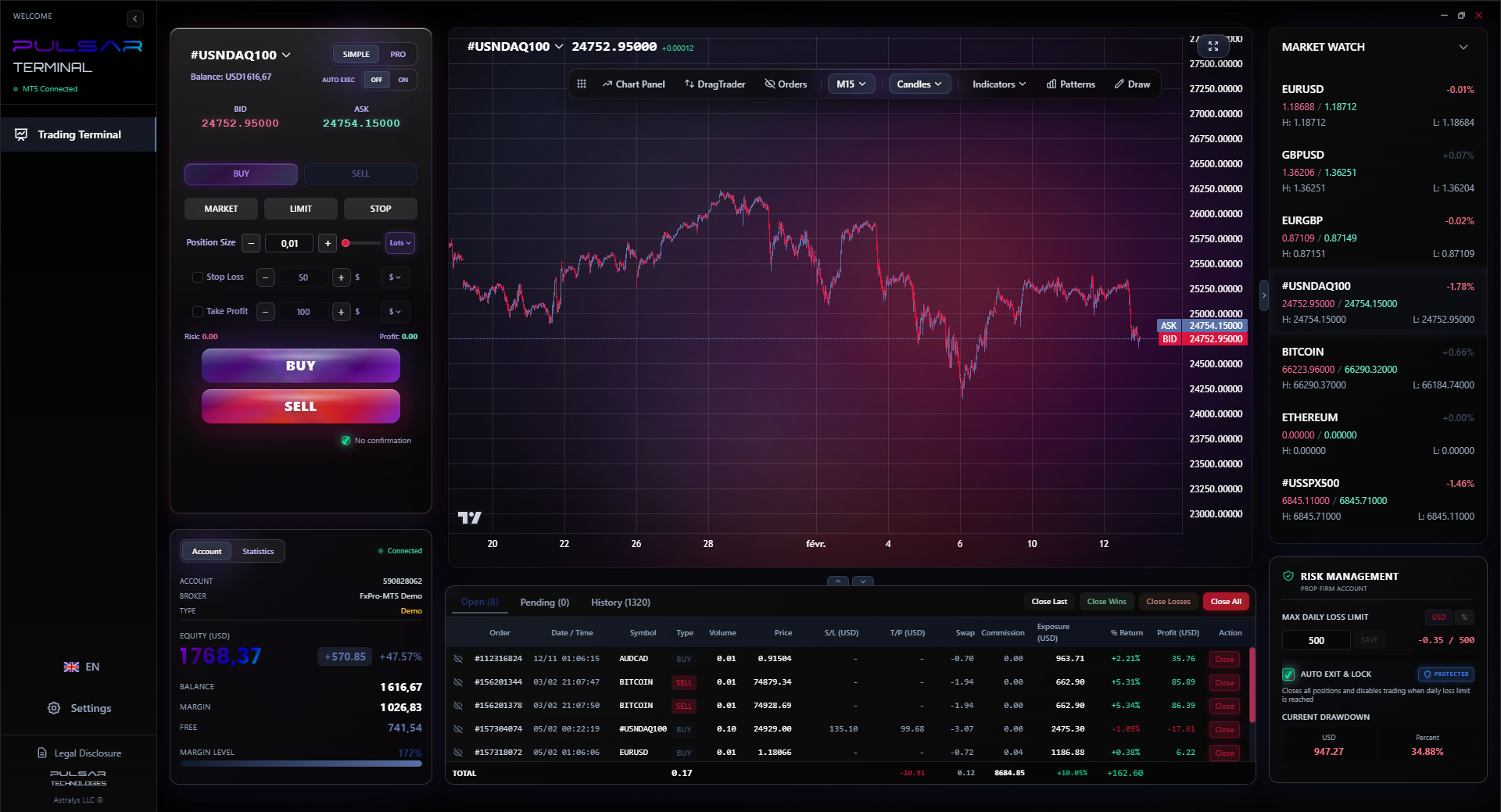
Executing a disciplined plan requires tools that remove emotion, like Pulsar Terminal's one-click order entry and automated trade management on MT5.
“Forget profit per day for the next six months. Your goal is education and simulation.”
Forget profit per day for the next six months. Your goal is education and simulation.
- Open a Demo Account: Use Zerodha's demo or TradingView's paper trading. Don't even think about real money. Trade the USD/INR pair exclusively. Your job is to get used to its rhythm, its spread, its news sensitivity.
- Develop a Simple Plan: Pick one setup. Maybe a bounce from a key support/resistance level on the 4-hour chart. Define your entry, stop-loss, and take-profit rules. Write them down. Trade only that setup for 100 demo trades. Record every outcome.
- Calculate Your Stats: After 100 trades, what's your win rate? Your average win vs. average loss? Your expectancy ( (Win% * Avg Win) - (Loss% * Avg Loss) )? If it's not positive, go back to step 2. You have no business with real capital.
- Start Microscopically: When you go live, start with the smallest possible position. Your first real trade should feel boring. Your goal is to execute your plan perfectly, not to make money. If you can't handle the emotion of a ₹50 loss, you can't handle a ₹5000 loss.
The market will be here tomorrow. The opportunity to preserve your capital is today. I wish someone had told me that. I had to learn it the expensive way. Focus on the percentage, protect your capital, and let the daily profits be a quiet, cumulative result of your discipline, not a screaming target that destroys you.
FAQ
Q1Is it legal to trade forex for daily profit in India?
Yes, but only in a very specific way. You can legally trade currency derivatives (futures and options) involving the Indian Rupee (like USD/INR, EUR/INR) on SEBI-regulated exchanges like the NSE and BSE through brokers like Zerodha or Upstox. Trading major global pairs like EUR/USD through international brokers for speculation is not permitted under RBI's FEMA rules.
Q2What is a realistic daily profit percentage in forex trading?
Thinking in daily percentages is dangerous and leads to overtrading. A realistic and sustainable target for a skilled trader is 2-5% profit per month on their trading capital. That might average out to 0.1-0.25% per trading day. Consistency over months and years is far more important than any single day's gain.
Q3Can I make Rs 5000 per day from forex trading in India?
It depends entirely on your capital. To make Rs 5000 per day consistently (say, 20 days a month), you'd need to generate Rs 1,00,000 monthly. With a very good 5% monthly return, you'd need a trading capital of Rs 20,00,000. With a more common 3% return, you'd need over Rs 33,00,000. It's not about the daily amount, it's about the capital and the percentage return.
Q4Why do most traders fail to make consistent daily profits?
They focus on the wrong thing. They chase a fixed rupee amount, which forces bad trades. They ignore massive costs like spreads and slippage. They don't manage risk, often risking 5-10% of their capital on a single trade. They trade without a proven plan, emotionally reacting to the market. Profit is a byproduct of a good process, not a direct target.
Q5Should I use a robot or EA for daily forex profits?
I'm deeply skeptical, especially in the Indian context. Most EAs are sold as 'set-and-forget' money machines, but they fail in changing market conditions. They're also typically built for highly liquid pairs like EUR/USD, not USD/INR. You'd be handing your capital to a black box that doesn't understand RBI policy shifts. Learn to trade yourself first.
Q6How much capital do I need to start aiming for daily income?
If by 'daily income' you mean replacing a job, you need significant capital. Even aiming for a modest Rs 30,000 per month (Rs 1500/day) with a 3% monthly return requires Rs 10,00,000 in risk capital. Start with what you can afford to lose completely - often suggested as Rs 50,000-1,00,000 for learning - and focus on growing it by a percentage, not extracting a daily salary.
Pelajaran Prof. Winston
:
- ✓Think in monthly percentages (2-5%), not daily rupees.
- ✓Legal trading in India is restricted to 4 INR pairs (USD/INR, EUR/INR, etc.).
- ✓Risk a maximum of 1-2% of your capital on any single trade.
- ✓Your primary daily goal is perfect plan execution, not profit.
Sejauh mana artikel ini berguna?
Klik bintang untuk menilai
Pandangan Dagangan Mingguan
Analisis & strategi mingguan percuma. Tiada spam.
Tentang Penulis
Rajesh Sharma
Penganalisis Forex Kanan
Lebih 10 tahun berdagang di pasaran India dan Asia Selatan. Bermula dengan derivatif mata wang NSE sebelum beralih ke forex antarabangsa. Pakar dalam pasangan USD/INR dan pasaran membangun.
Komen
Anda mungkin juga suka

Cara Trading Forex Sukses: 7 Prinsip dari Trader Profesional
Cara trading forex sukses dengan 7 prinsip trader pro: manajemen modal, disiplin, journal trading, backtest. Data nyata, bukan janji profit palsu.
Jam Trading Forex Terbaik untuk Trader Indonesia: Panduan Lengkap dengan Tabel Waktu
Panduan jam trading forex untuk trader Indonesia. Tabel 4 sesi dunia, jam emas 20:00-00:00, sesi mana yang harus dihindari. Data akurat + tips dari trader berpengalaman.
Top 5 Sàn Forex Uy Tín Nhất 2026: Review Jujur dari Trader Indonesia
Top 5 sàn forex uy tín 2026 untuk trader Indonesia. Review jujur: spread, deposit, withdraw, dukungan lokal. Exness, XM, IC Markets & lebih.
All these calculators are built into Pulsar Terminal with real-time data from your MT5 account. One-click position sizing, automatic risk management, and instant calculations.
