


You've got a trading strategy, you've picked a broker, and you're ready to go.

David van der Merwe
Pedagang Pasaran Membangun ·  South Africa
☕ 11 minit baca
Apa yang akan anda pelajari:
- 1What Exactly Is a 'Forex Wallet' in South Africa?
- 2The Legal Rules You Can't Ignore: FSCA & SARB
- 3Funding Your Account: Speed, Costs, & Practical Steps
- 4The Moment of Truth: Withdrawing Your Profits
- 5Common Pitfalls & Costly Mistakes
- 6Choosing a Broker: The Wallet-First Checklist
- 7Beyond the Transfer: Managing Your Trading Capital
You've got a trading strategy, you've picked a broker, and you're ready to go. But how do you actually get your money in and out of the market? That's your forex wallet - the entire system of deposits, withdrawals, and the legal framework that governs every rand you move. If you think it's just clicking 'deposit' and hoping for the best, you're setting yourself up for a nasty surprise. I've seen too many traders get tripped up by exchange control, unexpected fees, or slow withdrawals. Let's break down exactly how your South African forex wallet works, from the SARB's rules to the fastest way to get your profits back.
Forget the fancy term. In plain English, your 'forex wallet' isn't a physical thing or a single app. It's the entire financial pipeline connecting your South African bank account to your trading account and back again. It includes the broker's payment systems, the regulatory hoops you jump through, and the actual movement of currency across borders.
Think of it in three parts:
- The Gateway: How you deposit funds (EFT, credit card, digital wallet).
- The Holding Tank: Your trading account balance with an FSCA-licensed broker, where client funds should be segregated (a non-negotiable safety feature).
- The Return Path: How you withdraw profits, and the tax and exchange control implications.
The critical layer over all of this is regulation. Trading with an unregulated offshore broker might seem easier, but when you need to withdraw a large profit, you have zero protection. I learned this the hard way early on. I used a flashy international broker, made a decent R80,000 profit on a EUR/USD guide swing trade, and then spent six weeks fighting for my withdrawal. Their 'processing time' was a black hole. With an FSCA-regulated broker, there are clear rules and recourse.
Your wallet's health depends entirely on the integrity of this pipeline. A broken gateway or a clogged return path means your trading capital is stuck.

💡 Petua Winston
Your first deposit with any broker should be a test run. Send the minimum, then immediately try to withdraw it. If that process is slow or opaque, imagine what it'll be like with real profits.
“Your forex wallet isn't an app; it's the entire financial pipeline from your bank account to your broker and back, wrapped in SARB regulations.”
This is where most tutorials gloss over the details, and it's why you need to pay attention. South Africa has a dual-layer regulatory system that directly controls your forex wallet.
The FSCA: Your Broker's Rulebook
The Financial Sector Conduct Authority licenses and oversees your broker. An FSCA license isn't just a sticker on a website; it mandates:
- Client Fund Segregation: Your money is held in separate bank accounts from the broker's operating funds. If the broker goes bankrupt, your capital isn't part of their estate to pay creditors.
- use Caps: For retail traders, use is capped at 30:1 on major pairs. This is a hard rule for South African-based brokers. It feels restrictive, but it's there to stop you from blowing up your account in two trades. I used to chase 500:1, and it only ever magnified my losses.
- Transparency on Costs: They must clearly show spreads, commissions, and fees. No hidden charges.
Always verify the FSCA license number on the broker's site and cross-check it on the FSCA's official register. Brokers like Pepperstone review and IC Markets review have FSCA-regulated entities specifically for South African clients.
The SARB: The Gatekeeper of the Rand
The South African Reserve Bank, through its Financial Surveillance Department (FinSurv), controls how much money leaves the country and why. This isn't about trading rules; it's about national currency controls.
You have two key annual allowances:
| Allowance | Limit (2026) | Primary Use | SARS Tax Clearance Needed? |
|---|---|---|---|
| Single Discretionary Allowance | R1 million | Travel, gifts, online subscriptions, funding trading accounts. | No |
| Foreign Investment Allowance | R10 million | Offshore investments (stocks, property). | Yes, for amounts over R1 million |

Warning: Your forex trading deposits typically fall under the Single Discretionary Allowance. This is crucial. You do NOT need a SARS tax clearance certificate to fund your trading account, as long as your total annual outflows for all discretionary purposes stay under R1 million. Any broker or 'financial advisor' telling you otherwise is misinformed or lying.
It is illegal to use unauthorized channels (like 'bucket shops' or informal forex dealers) to move money offshore for trading. Stick to your broker's official, FSCA-approved deposit methods.
“Using your full R1 million discretionary allowance for trading is legal, but using your R10 million investment allowance for it is asking for a tax audit.”
Let's get practical. You're sitting with R5,000 or R50,000 you want to trade with. Here's how it works.
Minimum Deposits Vary Wildly:
- Low Barrier: Brokers like XM or FBS have minimums as low as $5 (roughly R90). This is great for testing.
- Standard Range: Most serious brokers ask for $100-$250 (R1,800 - R4,500). Exness review and others often sit in this range.
- Local Specialist: Khwezi Trade, a local FSCA broker, has a minimum of just R500.
Deposit Methods (From Fastest to Slowest):
- Credit/Debit Card: Instant or within minutes. The most common method. Your bank will convert ZAR to USD/EUR at their rate, plus a fee (usually 2-3%).
- Digital Wallets (Skrill, Neteller, etc.): Also very fast. Useful if you already have foreign currency in them. Watch their own FX fees.
- Local EFT (Electronic Funds Transfer): Can take 1-3 business days. Often the cheapest method, with just your bank's EFT fee (around R50). This is my go-to for larger amounts. The broker receives it in ZAR and converts it.
- International Bank Wire: Slow (3-5 days), expensive (R200+ fees), and overkill for most retail traders.

Pro Tip: Do a small test deposit first. Send R500. See how long it takes, what the final amount in your trading account is after all conversions, and how easy the process is. This avoids headaches with your main capital.
The Hidden Cost: The Spread on Deposit. When your broker converts your ZAR to USD, they don't use the interbank rate. They use their commercial rate, which includes a markup. On a R20,000 deposit, a 1% markup is R200 gone before you place a single trade. Factor this into your initial position size calculator settings.
💡 Petua Winston
The 'spread' you pay on your deposit currency conversion is a silent killer of returns. On a R50k deposit, a 2% fee is R1,000 lost before the starting gun. Factor it into your risk calculations.
“Using your full R1 million discretionary allowance for trading is legal, but using your R10 million investment allowance for it is asking for a tax audit.”
This is the part everyone looks forward to, and where the system can get frustrating. Withdrawing is the deposit process in reverse.
The Process:
- You request a withdrawal in your broker portal back to your original funding method (this is an FSCA requirement for anti-money laundering).
- The broker processes it. FSCA brokers typically quote 1-3 business days.
- The foreign currency (USD, EUR) is converted back to ZAR.
- The Rand lands in your South African bank account.
The Two Big Delays:
- Broker Processing Time: Some are slick (24 hours), others drag their feet. This is where regulated brokers shine - they have service level expectations.
- Local Bank Clearing: Your South African bank might hold the incoming international payment for 'clearing' for another 1-3 days. You can sometimes speed this up by calling them with the SWIFT reference.
The Tax Question: This is the million-rand question. Profits from forex trading are generally considered capital gains for South African tax residents. You have an annual exclusion of R40,000 on capital gains. Gains above that are included in your taxable income, but at a lower effective rate (max 18%).
However, if SARS deems your trading to be frequent, systematic, and profit-seeking like a business (speculative trading), they could tax 100% of your profits as ordinary income. The line is blurry. Keeping a detailed trading journal isn't just for strategy review; it's your first line of defense if SARS ever asks questions.
A real example: In the 2022 tax year, I withdrew R245,000 in net profits. After my R40k exclusion, I included the remaining R205,000 in my capital gains calculation. My accountant handled the inclusion rate, but having every trade logged from my scalping strategy sessions made it straightforward.
“The fastest way to test a broker isn't their demo account; it's depositing and withdrawing a small amount of real money.”
I've made these, my students have made these. Let's save you the trouble.
1. Ignoring Total Acquisition Cost: You see a 0.1 pip definition spread on EUR/USD and think you've found a goldmine. But if that broker charges a $3.50 commission per lot and has a terrible ZAR deposit conversion fee, you're worse off. Calculate the all-in cost of a typical trade, including funding costs.
2. Chasing 'No Fee' Deposits: Some brokers advertise 'no deposit fees.' What they mean is they don't charge a fee. Your bank or payment gateway still will. The money has to come from somewhere.
3. Withdrawing Small Amounts Frequently: Each withdrawal has a fixed cost component (bank fees). Withdrawing R1,000 ten times will eat a much larger percentage of your profit than withdrawing R10,000 once. Let your profits compound in the account for a bit.
4. Not Understanding use & Margin: That 30:1 use isn't a target. Using it all on one trade is a surefire way to get a margin call. On a $10,000 account, 30:1 lets you control a $300,000 position. A mere 0.33% move against you wipes out your margin. I once lost R15,000 in 20 minutes on a XAU/USD guide trade by being over-leveraged. It was a brutal lesson.
5. Using Unregulated Brokers for 'Better' Conditions: They might offer 1000:1 use and crazy bonuses. When you want to withdraw, they'll ask for impossible paperwork, delay endlessly, or simply disappear. Your forex wallet with them is a black box. The FSCA can't help you.
💡 Petua Winston
Withdraw profits regularly. It creates a tangible reward cycle, reinforces discipline, and most importantly, it proves the broker's payment system works. Profits on a screen are just numbers.
“The fastest way to test a broker isn't their demo account; it's depositing and withdrawing a small amount of real money.”
Beyond charts and platforms, you must vet a broker on wallet logistics. Here’s your checklist.
Regulation & Safety:
- Primary: FSCA license (non-negotiable).
- Secondary: Respectable offshore regulation (like ASIC, CySEC) is a good backup, but ensure they have a dedicated entity for SA clients.
Deposit/Withdrawal Practicalities:
- Local EFT? Does the broker accept direct ZAR EFTs? This is often the cheapest method.
- Processing Time: What's their published withdrawal processing time? Look for user reviews specifically about withdrawals.
- Fees Table: Find their explicit schedule of fees for deposits, withdrawals, and currency conversion.
Trading Conditions:
- Spreads: Check average spreads on the pairs you'll actually trade, like EUR/USD, not just the advertised 'from' figure. Use a site that does live spread monitoring.
- Platform: MT4/MT5 is standard. But does the broker offer a reliable mobile app for managing your wallet on the go?
A Note on Prop Firms: The prop firm challenge model is huge now. They have strict daily loss limits. Managing that manually is stressful. A tool that can automatically enforce your max daily loss protects your challenge account - which is your audition wallet.
Brokers like XM review are popular here for their low minimums, while others like FP Markets are known for tight raw spreads. There's no single 'best' - it's about which one's wallet system aligns with your size and style.
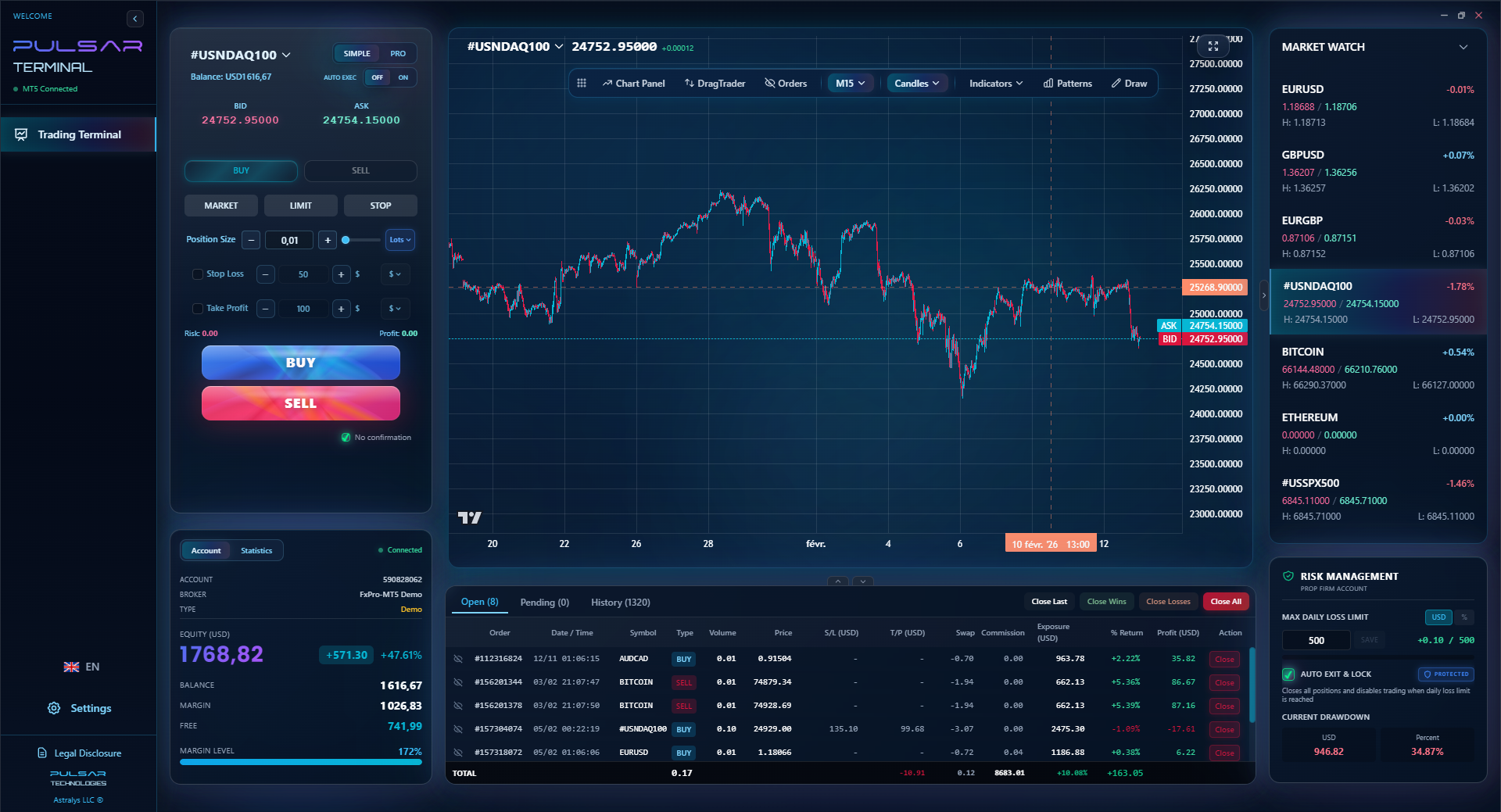
Managing your capital and protecting your wallet from a single bad trade is the priority, and Pulsar Terminal's automated risk management features like Daily Loss Protection enforce your rules directly on MT5.
“If you think of your trading balance as 'money to spend,' you've already lost. It's risk capital, nothing more.”
Your forex wallet isn't a set-and-forget thing. It's the fuel tank for your trading engine, and it needs monitoring.
The Core Principle: Your trading account balance is not 'money' in the spending sense. It is risk capital. You must mentally separate it from your rent money, your savings, your life money. This psychological shift is the difference between a trader and a gambler.
Active Management Tasks:
- Weekly Reconciliation: Once a week, log your balance, compare it to your starting weekly balance, and note your P&L. Do this in a simple spreadsheet. It forces accountability.
- Withdrawal Strategy: Have a rule. Mine is: 'If the account balance grows 25% above its baseline after a funding round, withdraw the profit above the baseline.' This takes emotion out of it and actually gets money into my real bank account.
- Fee Audit: Every few months, look at your deposit/withdrawal history. Add up all the fees and conversion losses. Is it costing you 2% per round trip? 5%? That's a huge drag on returns. Maybe it's time to switch to a broker with cheaper local EFT options.
The Tool Mindset: Advanced platforms aren't just for analysis. They're for capital protection. Setting a trailing stop isn't just a trade management technique; it's a wallet protection system. Automating a breakeven stop locks in the safety of your initial capital. When you're in a trade, your number one job is to protect the money in your wallet that's at risk.
Finally, remember the MACD indicator or RSI indicator won't save you from a bad withdrawal process or a tax headache. Your forex wallet is the foundation. Get this part solid, and you give your trading strategy a real chance to work.
FAQ
Q1Do I need a tax clearance certificate from SARS to deposit money with a forex broker?
No, not for typical trading deposits. Funding your forex trading account generally falls under your Single Discretionary Allowance (R1 million per year). You only need a SARS tax clearance certificate for your Foreign Investment Allowance (R10 million), which is for formal offshore investments like stocks or property, not for margin trading accounts.
Q2What is the fastest way to withdraw profits from my forex account?
Requesting a withdrawal back to your Visa/Mastercard debit or credit card is usually the fastest, often within 24-48 hours once the broker processes it. Local EFT is common but can add an extra 1-2 days for bank clearing. Always use the same method you deposited with to avoid delays and extra checks.
Q3Are my profits from forex trading taxable in South Africa?
Yes. For most individual traders, profits are taxed as capital gains. You get an annual exclusion of R40,000. Gains above that are included in your taxable income at an effective rate up to 18%. However, if your trading is very frequent and systematic, SARS could argue it's speculative income and tax it at your full income tax rate. Keep detailed records.
Q4Can I use my full R10 million Foreign Investment Allowance for forex trading?
It's risky and likely not intended for that. The Foreign Investment Allowance is designed for traditional offshore investments. Using it to fund a leveraged margin trading account could raise red flags with both your bank (the authorized dealer) and SARS. It's safer and simpler to use your R1 million Single Discretionary Allowance for trading purposes.
Q5What happens if my forex broker goes bankrupt?
If your broker is FSCA-licensed, your client funds should be held in segregated accounts at reputable banks. This means your money is legally separate from the broker's company funds. In theory, it should be safe and returned to you. If the broker is unregulated, your funds are likely gone, treated as part of the bankrupt company's assets.
Q6Why does the amount that arrives in my bank account differ from my withdrawal request?
Two reasons: 1) Fees: Your broker or intermediary bank may deduct a withdrawal fee. 2) Exchange Rate: The broker converts your USD/EUR profits to ZAR at their commercial selling rate, which is worse than the interbank rate you see online. This 'spread' on the conversion is a hidden cost.
Q7Is it legal to use international brokers not regulated by the FSCA?
It is not illegal for you as a South African resident to sign up with them. However, it is highly risky. They operate outside South African law. If you have a dispute, the FSCA cannot assist you, and you'll be subject to the often weaker consumer protection laws of their home country (if any). You also assume all exchange control responsibility.
Pelajaran Prof. Winston
:
- ✓Verify FSCA license first; unregulated brokers are a withdrawal nightmare.
- ✓Use your R1m discretionary allowance for deposits, not the R10m investment allowance.
- ✓Factor in the 1-3% currency conversion fee on every deposit and withdrawal.
- ✓Withdraw profits routinely to test the system and take real money off the table.
- ✓Taxable profits are likely capital gains, but keep a detailed trade journal for SARS.
Sejauh mana artikel ini berguna?
Klik bintang untuk menilai
Pandangan Dagangan Mingguan
Analisis & strategi mingguan percuma. Tiada spam.
Tentang Penulis
David van der Merwe
Pedagang Pasaran Membangun
Pedagang berpangkalan di Johannesburg dengan 11 tahun dalam mata wang pasaran membangun. Pakar dalam pasangan ZAR, dagangan terkawal FSCA, dan analisis pasaran Afrika Selatan.
Komen
Anda mungkin juga suka

Cara Trading Forex Sukses: 7 Prinsip dari Trader Profesional
Cara trading forex sukses dengan 7 prinsip trader pro: manajemen modal, disiplin, journal trading, backtest. Data nyata, bukan janji profit palsu.
Jam Trading Forex Terbaik untuk Trader Indonesia: Panduan Lengkap dengan Tabel Waktu
Panduan jam trading forex untuk trader Indonesia. Tabel 4 sesi dunia, jam emas 20:00-00:00, sesi mana yang harus dihindari. Data akurat + tips dari trader berpengalaman.
Top 5 Sàn Forex Uy Tín Nhất 2026: Review Jujur dari Trader Indonesia
Top 5 sàn forex uy tín 2026 untuk trader Indonesia. Review jujur: spread, deposit, withdraw, dukungan lokal. Exness, XM, IC Markets & lebih.
All these calculators are built into Pulsar Terminal with real-time data from your MT5 account. One-click position sizing, automatic risk management, and instant calculations.
