


Back in 2019, nearly 40% of new South African traders I coached signed up because of a 'free no deposit bonus' ad.

David van der Merwe
Pedagang Pasaran Membangun ·  South Africa
☕ 11 minit baca
Apa yang akan anda pelajari:
- 1What Was a 2019 No-Deposit Bonus, Really?
- 2The South African Regulatory Shift: FSCA Steps In
- 3The Current Bonus Landscape (2024/2025)
- 4The Hidden Terms & Volume Trap
- 5A Smarter Use for Your Time & Capital
- 6Red Flags: How to Spot a Bonus Scam
- 7Practical Steps If You Decide to Proceed Anyway
- 8The Final Verdict for South African Traders
Back in 2019, nearly 40% of new South African traders I coached signed up because of a 'free no deposit bonus' ad. Five years later, maybe two of them are still trading profitably. That's the dirty secret nobody selling you 'free money' wants to admit. These bonuses aren't a golden ticket; they're a marketing hook with more fine print than a cellphone contract. Let's strip away the hype and look at what a free no deposit bonus forex 2019 really meant, how the landscape has changed with the FSCA's tighter grip, and whether you should even bother with them today.
Forget the flashy ads. In 2019, a 'free no deposit bonus forex' offer was a demo account with one crucial difference: you could potentially withdraw profits. But that 'potentially' was doing a lot of heavy lifting.
Brokers like InstaForex, XM, and others would credit a small amount - usually between $10 and $100 - to a verified live account. The catch? You couldn't just withdraw it. You had to trade a specific volume, often 20 to 50 times the bonus amount, before any profits became yours. The bonus itself was never withdrawable.

Warning: This is the core mechanic they don't highlight. That $30 bonus? You'd need to turn over $600 to $1,500 in trade volume just to unlock your profits. On a micro account, that's a mountain of trades.
I remember a student, let's call him Thabo, who got a $50 bonus in late 2019. He was ecstatic. He traded EUR/USD aggressively, turned it into $180. Then he hit the withdrawal button. Denied. He hadn't read clause 4.2b about the volume requirement. He kept trading to meet it, got emotional, and blew the entire account. He started with 'free money' and ended up depositing R2,000 of his own to try and recover. A classic, expensive lesson.
The goal for brokers was simple: get you in the door, get you trading with 'house money' to trigger the psychological thrill of a real P&L, and hope you'd deposit more of your own cash once you were hooked. It was customer acquisition, plain and simple.

💡 Petua Winston
A bonus is a test of your ability to follow instructions, not your trading skill. If you can't be bothered to read the 15-page terms, you've already failed.
The wild west days of 2019 are over, thank goodness. The Financial Sector Conduct Authority (FSCA) has been cleaning house. Their view on bonuses? They're not fans of anything that looks like it's luring people in with unrealistic promises.
Stricter Rules on Promotions
Today, the FSCA mandates extreme transparency. Any broker offering a promotion to South African clients must make the terms crystal clear - no more hiding the volume requirements in a 20-page PDF. They've also cracked down on 'guaranteed profit' claims and excessive use, now capped at 30:1 for retail traders. This changed the bonus game. The offers became less generous, and the rules more front-and-center.
Why This Matters for You
This regulatory muscle is your best friend. It means when you see a no-deposit bonus from an FSCA-regulated entity, there's a higher chance it's not an outright scam. The broker has to play by rules designed to protect you, at least a bit. It also pushed many of the shadier offshore bonus factories to the sidelines, though they still try to target South Africans.
The key takeaway? If you're looking at a bonus in 2024/2025, your first question shouldn't be 'how much?' It should be 'are you FSCA regulated?' Your second should be, 'where is my money held?' Segregated client accounts are non-negotiable. Check our Exness review and IC Markets review for examples of how proper brokers structure this.
“The size of the bonus is inversely proportional to how easy it is to actually keep.”
So, do these relics from the free no deposit bonus forex 2019 era still exist? Yes, but they've evolved. They're less of a headline act and more of a side offer.
Here’s a snapshot of what’s actually out there for South African traders now:
| Broker | Typical No-Deposit Offer (2024) | Key Condition (The Catch) | FSCA Regulated? |
|---|---|---|---|
| XM | $30 | Trade volume requirement (e.g., 5 lots per $1 bonus) | Yes (Global entity) |
| InstaForex | Up to $1000 (StartUp program) | Extremely high volume requirements | No (Offshore) |
| Tickmill | $30 Welcome Account | Withdrawal of profits only after volume met | Yes (FSCA License) |
| FBS | Up to $100 | Complex turnover rules | No (Offshore) |
Notice a pattern? The regulated brokers (XM, Tickmill) offer smaller, more manageable amounts. The huge, eye-popping $1,000 bonuses? Almost always from offshore brokers with laxer rules. That's not a coincidence; it's risk management.

Pro Tip: The size of the bonus is inversely proportional to how easy it is to actually keep. A $30 bonus with clear terms from a regulated broker is almost always a better deal than a $500 bonus from a shady outfit you can't trust.
My advice? Use the XM or Tickmill $30 offer for one thing only: to test the broker's execution, platform speed, and customer service with zero risk. Don't view it as a way to make money. View it as a paid product demo.
This is where most traders get slaughtered. You see '$30 free!' and your brain stops reading. Let me restart it for you. Here’s what you MUST find in the Terms & Conditions before you even think of clicking 'claim'.
1. The Turnover Requirement (The Big One): This states you must trade a multiple of the bonus amount before withdrawing any profits. Formula: Bonus Amount x Multiplier = Required Volume. A $30 bonus with a 30x multiplier means you must trade $900 worth of volume. Not profit - just volume.
2. Time Limits: You might have 30, 60, or 90 days to hit that volume. Fail, and they claw back the bonus and any profits you made. The clock starts ticking the second you accept.
3. Tradable Instruments: Often, you can only use the bonus on major forex pairs. Trying to hit your volume on exotic pairs like USD/ZAR or EUR/ZAR? Might not count. Check.
4. Maximum Withdrawal from Bonus Profits: Some brokers cap how much you can withdraw from bonus-generated profits. You turn $30 into $300? You might only be allowed to take $100.
I learned this the hard way early on. I took a $100 bonus, traded gold (XAU/USD) brilliantly, grew it to $700. Went to withdraw. Denied. The terms specified 'major forex pairs only.' My gold trades didn't count toward the volume. I had to frantically scalp EUR/USD for a week to try and meet the target, messed up my rhythm, and gave back most of the profit. I won the battle (met the volume) but lost the war (wasted time and stress). Use a position size calculator from the start to plan your volume grind rationally, if you must do it.
💡 Petua Winston
The market doesn't care if your capital was 'free' or borrowed. It will take it just as quickly. Risk management applies to every cent on your screen.
“Building a R10,000 account from a R500 deposit through skill is infinitely more valuable than extracting R400 from a bonus maze.”
Let's be brutally honest. The mental energy and time you'll spend navigating bonus terms to maybe make $50 profit is better spent almost anywhere else. Here’s what I tell my students now.
Forget the bonus. Focus on the broker's core offering.
- Compare Real Trading Costs: What's the spread on EUR/USD? What's the commission? A broker offering a $30 bonus but charging a 2-pip spread on majors is robbing you with one hand while giving you a lollipop with the other. Check our spread definition guide to understand this fully.
- Test Execution & Slippage: Deposit a small, real amount - R500 or $100. Place a few trades during news events. Does your stop-loss get respected? How much do you slip? This intel is worth more than any bonus.
- Learn on a Proper Demo Account: A true demo account with virtual $50,000 is a superior learning tool. No psychological pressure of 'losing the bonus,' no hidden terms. You can practice swing trading strategies for months without a single real-world consequence.
Building a R10,000 account from a R500 deposit through skill is infinitely more valuable and teachable than extracting R400 from a bonus maze. The former builds a trader. The latter builds a coupon-clipper.
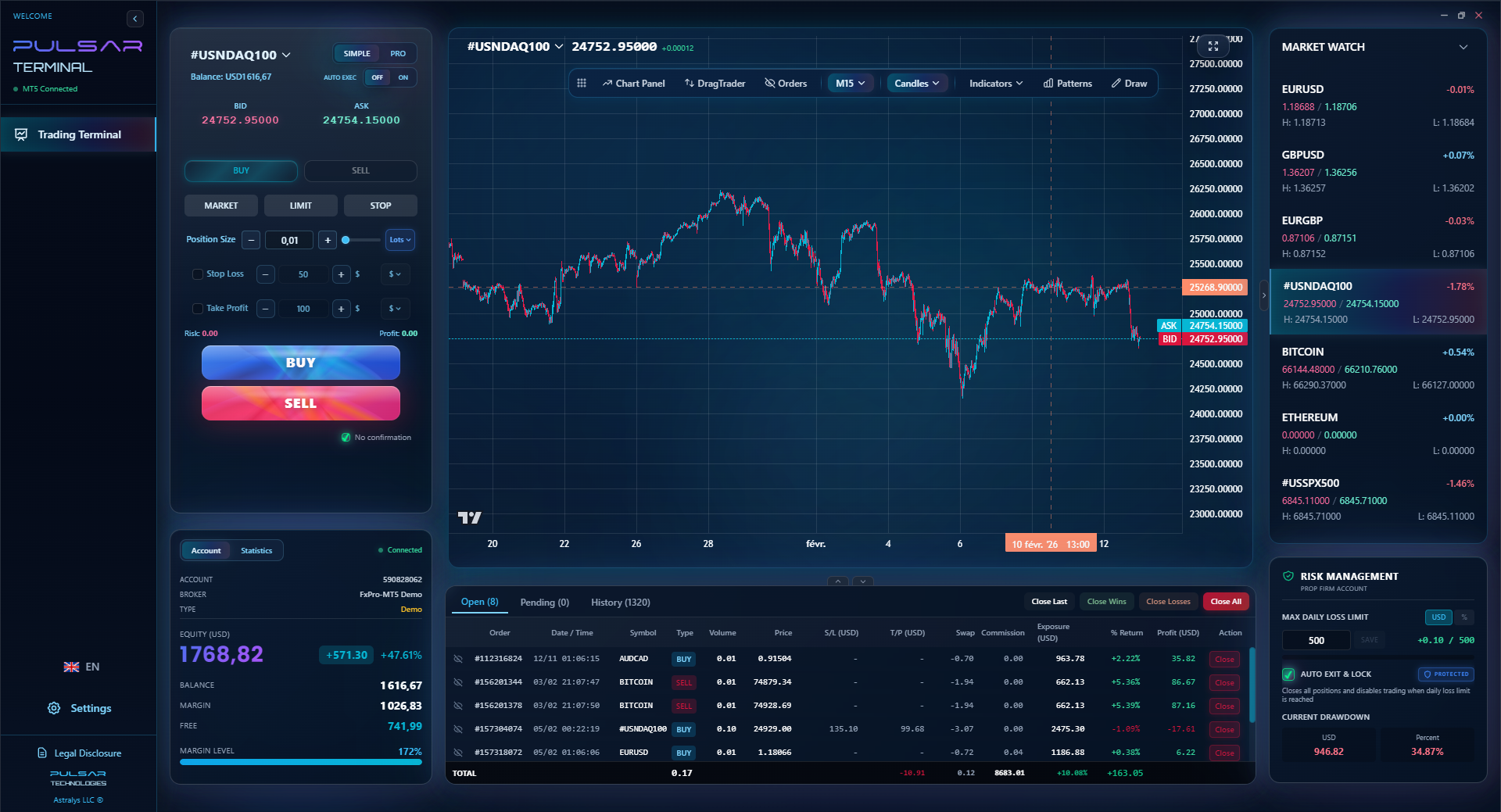
Managing the forced volume trades from a bonus offer is a mechanical grind, which is exactly the kind of repetitive task Pulsar Terminal's drag-and-drop order system and one-click templates are built to streamline on your MT5 platform.
South Africa has over 190,000 forex traders. Scammers see a target-rich environment. Here’s how not to be their next mark, especially when chasing 'free' money.
- The Broker Isn't FSCA Regulated: This is the brightest red flag. If they can't be bothered to get local regulation to protect you, walk away. No bonus is worth the risk of your deposit vanishing.
- They Contact YOU First: Legitimate brokers don't cold-call or WhatsApp you offering 'exclusive bonus deals.' That's a boiler-room tactic.
- Guaranteed Profits: Any ad or rep that uses the words 'guaranteed,' 'risk-free,' or 'sure win' in connection with a bonus is lying. The FSCA prohibits this for a reason.
- Pressure to Deposit More: You get the bonus, lose it (as most do), and immediately get a call offering a '100% deposit bonus' if you fund your account now. This is the classic funnel. They get you with 'free,' then hook you with your own money.
- Impossible Withdrawal Process: You meet all the terms, request a withdrawal, and then get hit with endless 'verification' delays or new, previously unstated fees. If you see many online complaints about withdrawals, believe them.
Stick to known, reviewed entities. We've done deep dives on brokers like Pepperstone and XM for a reason - they have track records you can investigate.
“Your energy is your most valuable trading asset. Don't waste it decoding bonus legalese.”
Alright, I see that stubborn look. You're going to try it. Fine. Let's at least minimize the damage and maximize the learning. Follow this drill.
Step 1: The Document Dig. Before you sign up, find the full bonus Terms & Conditions. Not the marketing page - the legal document. Print it. Highlight the volume multiplier, time limit, and eligible instruments.
Step 2: The Volume Calculator. Let's say it's a $30 bonus, 30x volume, 30-day limit. Required volume: $900. You have 30 days. That's $30 of volume per day. Plan for it. Use a micro lot (1,000 units). One micro lot on EUR/USD is a $0.10 move per pip. You'd need to capture 300 pips of movement per day just to break even on the volume requirement. See how quickly this becomes a stressful, forced-trading job?
Step 3: The Trade Journal Entry. Your first journal entry for this account should be: "Objective: Test broker execution and meet volume requirement for bonus X. NOT to make profits." This mental framing is critical.
Step 4: Use Conservative, Boring Trades. This isn't the time for heroics. Place small, sensible trades on major pairs during high-liquidity hours. Your goal is to survive and hit the volume, not to hit a home run. Treat it like a mundane task, not a treasure hunt.
If you get through this process and actually withdraw a profit, congratulations. You've passed a test in discipline and attention to detail. Just know that the prize is usually smaller than the effort required.
💡 Petua Winston
Spend an hour comparing spreads and commissions instead of hunting for bonuses. Saving 0.5 pip per trade will make you more money in the long run than any $30 giveaway.
So, what's the bottom line on the free no deposit bonus forex 2019 model in today's market?
They're largely a distraction. The regulated market has matured, and the FSCA has rightly forced the focus onto sustainable trading conditions, not promotional gimmicks. The tiny amount of 'free' capital comes shackled to conditions designed to make you trade more, often recklessly, which is the exact opposite of what a developing trader needs.
Your energy is your most valuable trading asset. Don't waste it decoding bonus legalese. Invest it in understanding price action, mastering your emotions, and finding a broker with tight spreads, solid execution, and a platform you like - whether that's MT5, cTrader, or something else.
Start small with your own money. The psychological lesson of risking and managing your own R500 is a more powerful teacher than any bonus-funded pseudo-success. Learn what a margin call feels like with your own cash on the line (on a demo first, ideally). That sting teaches risk management faster than any textbook.
The brokers still offering these bonuses in 2024 aren't evil; they're just using an old marketing playbook. It's your job to be smarter than the playbook. Focus on becoming a trader, not a bonus hunter. The market will reward the former and eventually bankrupt the latter.
FAQ
Q1Can I actually make money from a no-deposit bonus in South Africa?
Technically, yes. Realistically, it's very difficult and rarely worth the effort. You have to overcome high volume requirements within strict time limits, all while trading well enough to generate a profit. Most traders either fail to meet the terms or blow the account trying. The potential profit is usually small (under $100) for a disproportionate amount of work and risk.
Q2Are no-deposit bonuses from 2019 still available today?
The specific 2019 promotions are gone, but the product still exists in a more regulated form. Brokers like XM and Tickmill offer similar $30 no-deposit bonuses to South African clients in 2024/2025. The key difference is that FSCA oversight now demands clearer terms and conditions, making the offers slightly more transparent but not necessarily easier to profit from.
Q3What's the biggest mistake traders make with these bonuses?
Not reading the Terms & Conditions. They see 'free $30' and start trading aggressively, completely unaware of the volume multiplier (e.g., 30x), time limit, or restricted instruments. This leads to frantic, poor-quality trading to hit an arbitrary target, which usually results in losing the bonus and any profits.
Q4Is it safer to use an FSCA-regulated broker for a bonus?
Absolutely. An FSCA-regulated broker must adhere to stricter rules on client fund segregation, transparent marketing, and fair treatment. While the bonus terms might still be tough, your deposit is safer, and the broker is less likely to be an outright scam. Always verify the broker's FSP number on the FSCA's website.
Q5What should I look for in the bonus terms and conditions?
Find these three things immediately: 1) The Turnover Multiplier (e.g., '30x the bonus amount'), 2) The Time Limit to achieve it (e.g., 30 days), and 3) The Eligible Trading Instruments (often only major forex pairs). If you can't find these clearly stated, assume the worst and avoid the offer.
Q6As a beginner, should I start with a no-deposit bonus?
I strongly advise against it. Beginners need to learn in a pressure-free environment. A no-deposit bonus adds psychological pressure (to not lose the 'free' money) and forces you into a volume game. You're better off using a full-featured demo account to learn the platform and test strategies, then starting with a small real deposit (like R500) when you're ready.
Pelajaran Prof. Winston
:
- ✓Volume requirements are the real cost (e.g., 30x bonus = $900 turnover).
- ✓FSCA regulation is non-negotiable for safety.
- ✓Use bonuses only to test execution, not to profit.
- ✓A demo account is a superior, pressure-free learning tool.
Sejauh mana artikel ini berguna?
Klik bintang untuk menilai
Pandangan Dagangan Mingguan
Analisis & strategi mingguan percuma. Tiada spam.
Tentang Penulis
David van der Merwe
Pedagang Pasaran Membangun
Pedagang berpangkalan di Johannesburg dengan 11 tahun dalam mata wang pasaran membangun. Pakar dalam pasangan ZAR, dagangan terkawal FSCA, dan analisis pasaran Afrika Selatan.
Komen
Anda mungkin juga suka

Cara Trading Forex Sukses: 7 Prinsip dari Trader Profesional
Cara trading forex sukses dengan 7 prinsip trader pro: manajemen modal, disiplin, journal trading, backtest. Data nyata, bukan janji profit palsu.
Jam Trading Forex Terbaik untuk Trader Indonesia: Panduan Lengkap dengan Tabel Waktu
Panduan jam trading forex untuk trader Indonesia. Tabel 4 sesi dunia, jam emas 20:00-00:00, sesi mana yang harus dihindari. Data akurat + tips dari trader berpengalaman.
Top 5 Sàn Forex Uy Tín Nhất 2026: Review Jujur dari Trader Indonesia
Top 5 sàn forex uy tín 2026 untuk trader Indonesia. Review jujur: spread, deposit, withdraw, dukungan lokal. Exness, XM, IC Markets & lebih.
All these calculators are built into Pulsar Terminal with real-time data from your MT5 account. One-click position sizing, automatic risk management, and instant calculations.
