


Here's a sobering fact: most traders who try to use harmonic patterns get them wrong.

David van der Merwe
Pedagang Pasaran Membangun ·  South Africa
☕ 11 minit baca
Apa yang akan anda pelajari:
- 1What Are Harmonic Patterns, Really?
- 2The Patterns You Need to Know (And One to Avoid)
- 3Trading Harmonics from South Africa: Local Realities
- 4My Step-by-Step Process for a Harmonic Trade
- 5The Three Mistakes That Wreck Harmonic Traders
- 6Tools and Platforms for the South African Trader
- 7The Mindset: Patience is Your Edge
Here's a sobering fact: most traders who try to use harmonic patterns get them wrong. They see a shape that looks close enough, jump in, and get stopped out. I know because I was one of them for years. The truth is, harmonic patterns forex trading isn't about spotting pretty shapes; it's about measuring precise Fibonacci ratios to find high-probability reversal zones. For us trading from South Africa, with the ZAR's unique volatility, getting this right can be the difference between a steady income and blowing up your account. Let's cut through the noise and talk about how to actually use these patterns to make money.
Forget the fancy name for a second. Harmonic patterns are just specific price structures that repeat in the markets. They're built on the idea that these moves have geometric and Fibonacci ratio relationships. The core idea is that markets move in waves, and these waves have measurable relationships to each other.
Unlike a simple head and shoulders, harmonics require specific measurements. You can't just eyeball it. Each turning point (labeled X, A, B, C, D) must align with Fibonacci retracement and extension levels. When they do, the Potential Reversal Zone (PRZ) at point D gives you a spot where price is likely to turn.
Why do they work? It's less about magic and more about collective human psychology and the behavior of large institutional algorithms. These ratios represent areas where profit-taking and fresh opposing orders tend to cluster. In the South African context, where liquidity in pairs like USD/ZAR can be thinner, these zones can be even more pronounced.

Warning: The biggest mistake is forcing a pattern. If the ratios aren't within 0.05 of the ideal number (e.g., a 0.618 retracement is okay, 0.57 is not), it's not a valid harmonic pattern. Walk away.
“Harmonic patterns aren't about spotting pretty shapes; they're about measuring precise Fibonacci ratios to find high-probability reversal zones.”
You'll see dozens of patterns online, but you only need to master three or four. I focus on the ones that give the cleanest signals and appear most often on the 4-hour and daily charts, which fit a swing trading style better than frantic lower timeframes.
The Gartley (or "Gartley 222")
This is the grandfather. The key levels are:
- AB should retrace to 0.618 of XA.
- BC should retrace 0.382 to 0.886 of AB.
- The critical one: CD should be a 1.272 extension of BC, AND it should retrace 0.786 of XA. Point D is your entry zone. I look for bullish Gartleys after a sustained downtrend. A real example: I caught a beautiful Gartley on EUR/USD in late 2023. XA was a drop from 1.0765 to 1.0550. Point D formed at 1.0672 (within the 0.786 retracement zone). I went long with a stop below X, and price rallied to the 1.0950 area. That was a 280-pip move.
The Bat Pattern
My personal favorite for its accuracy. The Bat has a deeper retracement at point B.
- AB retraces 0.382 or 0.500 of XA (shallower than Gartley).
- BC can retrace 0.382 to 0.886 of AB.
- CD is a sharp 1.618 to 2.618 extension of BC, and it should retrace 0.886 of XA. That 0.886 retracement is the Bat's signature. It often leads to very sharp, violent reversals.
The Crab Pattern
This is for the big, ambitious moves. The Crab aims for extreme extensions.
- Point B retraces 0.382 to 0.618 of XA.
- The CD leg is a massive 2.618, 3.14, or even 3.618 extension of BC.
- Most importantly, point D is a 1.618 extension of the XA leg. The Crab's PRZ is often the last stand before a major trend change. The stop loss can be wide, so your position size calculator is your best friend here.
The One to Ignore: The Butterfly
You'll see it in textbooks. I'm telling you to ignore it. The Butterfly pattern requires an extreme 1.272 extension of XA, and in my 12 years, the false breakouts far outnumber the clean reversals. It's a pattern that looks great in hindsight but will burn you in real time. Focus on the Bat and Gartley first.

💡 Petua Winston
A pattern is only valid if the Fibonacci ratios align within a 0.05 tolerance. If your 0.618 retracement is actually 0.59, it's not a harmonic, it's a hope.
“The biggest mistake is forcing a pattern. If the ratios aren't right, walk away.”
Trading any strategy from SA comes with its own set of considerations. Your broker, the pairs you trade, and even your internet stability matter more than you think.
First, you need a platform that lets you draw precise Fibonacci tools. Most of us use MetaTrader 4 or 5. It's ubiquitous and does the job. Some brokers offer fancier charting, but MT5 is the standard for a reason. When choosing a broker, regulation is non-negotiable. Only use an FSCA-regulated broker like Exness or XM. I learned this the hard way early on with an unregulated outfit; withdrawing profits became a months-long nightmare.
Currency Pairs and the ZAR
You might be drawn to trading USD/ZAR. Be careful. The spread on ZAR pairs is often huge - think 15 to 50 pips. If your harmonic pattern's PRZ is only 30 pips wide, a 20-pip spread eats your entire potential profit margin before you even start. I use harmonic patterns primarily on major pairs like EUR/USD, GBP/USD, and XAU/USD (gold). The spreads are tight (often under 1 pip on ECN accounts), and the liquidity is massive, so the patterns play out more cleanly. I'll analyze the EUR/USD guide for fundamental context, but the harmonic gives me the precise level.
Costs That Bite
Remember, you're paying the spread on entry and exit. If you're using a broker with a commission, factor that in. Let's say you trade a Bat pattern on GBP/USD with a 0.8 pip spread on an ECN account like IC Markets offers. You pay that 0.8 pip plus a $7 commission per lot. On a 2-lot trade, that's $14.80 in costs before you're in profit. Your profit target needs to be significantly beyond the PRZ to cover this. Overnight swap fees can also add up if you hold for several days waiting for the reversal to mature.
“The biggest mistake is forcing a pattern. If the ratios aren't right, walk away.”
Here’s exactly what I do, from scan to exit. This discipline took me from losing money on harmonics to making them a core part of my strategy.
- Scan for Potential Legs: I don't stare at charts waiting for patterns. I use a scanner (or just manually look) for clear, impulsive XA legs on the daily or 4H chart. A strong, relatively straight price move is what you want.
- Draw and Measure: Once I see a potential AB retracement, I draw my Fibonacci retracement tool on XA. I'm looking for that 0.382, 0.5, or 0.618 retracement for a Bat or Gartley. If price hits one of those and turns, I label point B.
- Wait for BC and Project CD: This is the patience test. I watch the BC leg. Then, using the Fibonacci extension tool on AB, I project where a 1.272, 1.618, or 2.618 BC extension would land. I also have the 0.786 or 0.886 retracement of XA marked. The confluence zone of these levels is the Potential Reversal Zone (PRZ).
- Entry and Stop Loss: I never enter at the first touch of the PRZ. I wait for price to enter the zone and show a rejection candle - a pin bar, a bullish/bearish engulfing, or a doji. My entry is on a break of that candle's high/low. My stop loss is placed just beyond the extreme of the pattern (beyond point X). This is crucial. If the pattern is invalidated by price moving beyond X, the whole structure is broken.
- Take Profit: I use a multi-tier approach. I'll take 50% of my position off at the first logical resistance (often the 0.382 retracement of AD), move my stop to breakeven, and let the rest run, trailing a stop. This is where a tool that manages multiple take-profit levels automatically saves you from emotional decisions.

Example: On a Bat pattern, if my risk (distance from entry to stop loss) is 80 pips, my first profit target is at least 80 pips (1:1 risk-reward). The second target aims for 160+ pips. If the market only gives you 80, you still break even on the trade after costs.
💡 Petua Winston
Your stop loss belongs beyond point X, not point D. Protecting your capital is more important than being proven right about the pattern's shape.
“Your edge comes from waiting for only the highest-quality setups. In a market full of chasers, your willingness to do nothing is a superpower.”
I've made all of these. Repeatedly.
- Ignoring the PRZ Confluence: The most common error is seeing a pattern where only one ratio lines up. A true PRZ requires at least two Fibonacci projections to cluster in the same price zone (e.g., the 0.886 XA retracement AND the 1.618 BC extension). If they're 30 pips apart, it's not a valid zone. It's just a fuzzy area.
- Misplacing the Stop Loss: Placing your stop loss too tight, just beyond point D, will get you stopped out by market noise. The pattern's invalidation point is beyond point X. That's where your stop goes. Yes, it means a larger stop and a smaller position size. That's proper risk management. A margin call often starts with stops that are too tight, leading to over-leveraging to make the trade 'worth it.'
- Trading on Low Timeframes: Harmonic patterns on the 5-minute or 15-minute chart are mostly noise. The ratios get distorted by spreads and random volatility. I only trade harmonics on the 1-hour chart and above, with 4-hour and daily providing the most reliable setups. The patterns need space to develop. Chasing them on lower timeframes is a sure way to burn through capital.
Also, don't become a pattern zombie. Harmonic patterns are a piece of the puzzle, not the whole picture. Check for major support/resistance levels, or use a momentum indicator like the MACD indicator to see if it's diverging at the PRZ, adding another layer of confirmation.
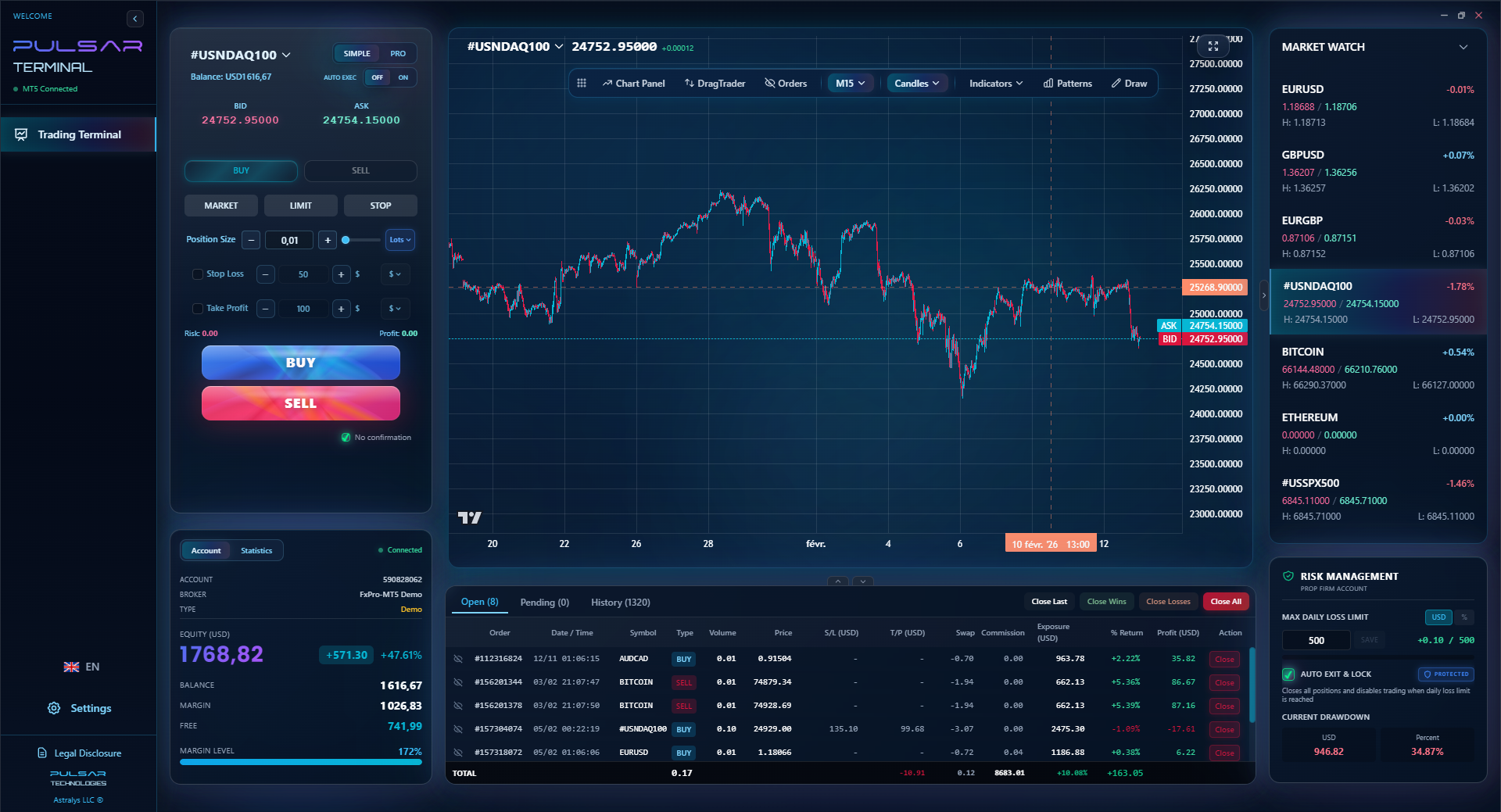
Managing the multi-take-profit and trailing stop strategy crucial for harmonic trades is far easier with a tool that automates it directly on your MT5 platform.
“Your edge comes from waiting for only the highest-quality setups. In a market full of chasers, your willingness to do nothing is a superpower.”
You don't need expensive software, but you do need the right basics.
Platform: MT4/MT5 is the go-to. Every reputable FSCA-regulated broker offers it. The drawing tools are sufficient. Some brokers, like Pepperstone, offer premium add-ons like Autochartist which can scan for patterns, but I've found manual identification forces a better understanding.
Essential Tools:
- Fibonacci Retracement Tool (built into MT4/5).
- Fibonacci Extension Tool (this is separate in MT4, make sure you use it).
- A good understanding of what a pip definition is for your specific pair, as your risk is measured in them.
Pattern Recognition Software: Be skeptical. Many "harmonic scanners" are laggy and mark up every squiggle as a pattern. The best scanner is your own trained eye. However, having a platform that helps you manage the trade once you're in is a game-saver. Imagine being able to set a trailing stop that automatically moves, or to close a portion of your position at a target without watching the screen all day. That kind of automation removes emotion, which is half the battle.
Deposits and Withdrawals: Stick to local methods. Most good brokers offer instant EFTs via banks like FNB or Standard Bank, or services like Ozow. Funding in ZAR avoids costly conversion fees. Withdrawing should be just as easy back to your South African bank account. If it isn't, that's a red flag.
💡 Petua Winston
The market's job is to make patterns look perfect right before they fail. Always wait for price action confirmation (a rejection candle) in the PRZ before entering.
“I only trade harmonics on the 1-hour chart and above. Patterns on lower timeframes are mostly noise disguised as opportunity.”
This is the most important section. Harmonic pattern trading is 20% identification, 80% psychology.
You will go days, sometimes weeks, without seeing a perfect setup. The temptation is to lower your standards, to trade a "close enough" pattern. This is how accounts die. Your edge comes from waiting for only the highest-quality setups where all the ratios align beautifully. In a market full of people chasing every move, your willingness to do nothing is a superpower.
I keep a trading journal. Every potential pattern I see, I screenshot it and mark what I would have done. Then I let it play out on the chart without taking the trade. This trains your eye without risking money. You'll quickly see which patterns were valid and which were traps.
Remember, you're not paid for how many trades you take. You're paid for being right and managing risk when you are. A single, well-executed harmonic trade with a solid 2:1 reward-to-risk ratio can pay for a dozen small losses. But you have to be patient enough to let that one trade come to you.

Pro Tip: When you identify a perfect pattern and take the trade, turn off your charts. Set your take-profit and stop-loss orders, and walk away. The urge to micromanage it will lead to early exits. Trust your analysis.
FAQ
Q1What is the most accurate harmonic pattern?
In my experience, the Bat pattern tends to be the most reliable, specifically because of its deep 0.886 retracement at point D. This level often acts as a final exhaustion point before a reversal. The Crab can offer huge rewards but has a lower strike rate. Start by mastering the Bat and the Gartley.
Q2Can I use harmonic patterns for scalping?
I strongly advise against it. Harmonic patterns need time and space to develop and validate. The lower timeframes (like 1-minute or 5-minute charts) are too noisy, and the spreads become a much larger percentage of your target. Harmonic patterns are better suited for swing trading on the 1-hour to daily charts.
Q3Which time frame is best for harmonic patterns?
The 4-hour and daily timeframes are the sweet spots. The patterns are clearer, and the moves from the reversals are substantial enough to justify the risk. You can use the 1-hour chart, but be more selective. Anything below that is generally unreliable for this specific strategy.
Q4Do I need special software to find harmonic patterns?
No. You can identify them manually using the Fibonacci tools built into MetaTrader 4 or 5. While there are pattern recognition scanners, they often generate false signals. Manually drawing the patterns will give you a much deeper understanding and better judgment, which is critical for long-term success.
Q5How do I manage risk with harmonic patterns?
Always place your stop loss beyond point X of the pattern, as that's the point of invalidation. Because this stop can be wide, you must use a position size calculator to ensure your risk is a small percentage of your account (e.g., 1-2%). Never risk more because the pattern 'looks perfect.' Also, use a multi-take-profit approach to bank partial profits and reduce risk as the trade moves in your favor.
Q6Are harmonic patterns profitable in forex?
They can be, but not as a standalone magic bullet. Profitability comes from combining accurate pattern identification with strict risk management, patience to wait for ideal setups, and solid trade execution. They provide a high-probability framework for finding reversals, but you still need the discipline to follow your rules. No pattern works 100% of the time.
Q7Should South African traders focus on USD/ZAR with harmonics?
Be cautious. While it's tempting to trade your home currency, the wide spreads on USD/ZAR (often 15-50 pips) can severely undermine the risk-reward of a harmonic setup. The PRZ might only be 40 pips wide. I've found more consistent results applying harmonics to major pairs like EUR/USD or GBP/USD where spreads are often below 1 pip on good ECN accounts.
Pelajaran Prof. Winston
:
- ✓Master the Bat & Gartley patterns first; ignore the Butterfly.
- ✓Stop loss goes beyond point X, always.
- ✓Wait for price action confirmation in the PRZ.
- ✓Trade majors, not ZAR pairs, due to spread costs.
- ✓Patience for perfect setups is your real edge.
Sejauh mana artikel ini berguna?
Klik bintang untuk menilai
Pandangan Dagangan Mingguan
Analisis & strategi mingguan percuma. Tiada spam.
Tentang Penulis
David van der Merwe
Pedagang Pasaran Membangun
Pedagang berpangkalan di Johannesburg dengan 11 tahun dalam mata wang pasaran membangun. Pakar dalam pasangan ZAR, dagangan terkawal FSCA, dan analisis pasaran Afrika Selatan.
Komen
Anda mungkin juga suka

Cara Trading Forex Sukses: 7 Prinsip dari Trader Profesional
Cara trading forex sukses dengan 7 prinsip trader pro: manajemen modal, disiplin, journal trading, backtest. Data nyata, bukan janji profit palsu.
Jam Trading Forex Terbaik untuk Trader Indonesia: Panduan Lengkap dengan Tabel Waktu
Panduan jam trading forex untuk trader Indonesia. Tabel 4 sesi dunia, jam emas 20:00-00:00, sesi mana yang harus dihindari. Data akurat + tips dari trader berpengalaman.
Top 5 Sàn Forex Uy Tín Nhất 2026: Review Jujur dari Trader Indonesia
Top 5 sàn forex uy tín 2026 untuk trader Indonesia. Review jujur: spread, deposit, withdraw, dukungan lokal. Exness, XM, IC Markets & lebih.
All these calculators are built into Pulsar Terminal with real-time data from your MT5 account. One-click position sizing, automatic risk management, and instant calculations.
