


I lost GHS 4,200 in a single week back in 2018.

Olumide Adeyemi
Perintis Dagangan Afrika Barat
☕ 12 minit baca
Apa yang akan anda pelajari:
- 1The Basics: Currency Pairs and Price Action
- 2Ghana's Regulatory Reality: What You're Signing Up For
- 3The Real Costs: Spreads, Commissions, and Hidden Fees
- 4Choosing a Broker and Funding Your Account
- 5Trading Strategies That Fit the Ghanaian Context
- 6Common Pitfalls and How to Avoid Them
- 7Getting Started: Your First 30 Days
I lost GHS 4,200 in a single week back in 2018. I thought I understood how forex trading works - buy low, sell high, simple, right? I'd piled into USD/GHS short, convinced the Cedi couldn't weaken further. The Bank of Ghana intervened, and the pair ripped higher. My account was wiped out because I didn't understand the local market mechanics, the real costs, or how to protect myself. That painful lesson cost me real money, but it taught me everything. Here’s how forex trading actually works for us in Ghana, with all the specifics you won't find in a generic textbook.
At its core, forex trading is about exchanging one currency for another, betting on the change in their relative value. You're always trading a pair. For us in Ghana, the most direct pair is USD/GHS. The price tells you how many Cedis it costs to buy one US Dollar.
If the quote is 15.0000, that's GHS 15 for $1. If you believe the Cedi will strengthen (get more valuable), you sell the pair. You're selling USD and buying GHS. If the price drops to 14.5000, you were right. You can buy back the USD for less GHS than you sold it for, pocketing the difference. That's a profit.
The market is open 24/5, but liquidity - the ease of buying and selling - varies. The sweet spot for us is around 2 PM to 6 PM Ghana time. That's when the London and New York sessions overlap. More banks and funds are active, which means tighter spreads and cleaner price moves. Trading at 3 AM? You're mostly watching paint dry, unless you're specifically trading the Asian session open.
Understanding Pips and Lots
A pip is usually the fourth decimal place in a quote. A move from 15.0000 to 15.0001 in USD/GHS is one pip. For major pairs like EUR/USD, it's the same. A standard lot is 100,000 units of the base currency. Trading one standard lot of EUR/USD means each pip movement is worth about $10. Most of us start with micro lots (1,000 units) or mini lots (10,000 units). I strongly advise using a position size calculator for every single trade. My GHS 4,200 loss? That was a classic case of a position way too large for my account.

Warning: Don't confuse trading USD/GHS on an international broker with changing money at a forex bureau. The broker's price is a CFD (Contract for Difference). You never physically own the dollars. You're speculating on the price change. This is crucial for understanding the tax implications later.
“You have the freedom to trade, but you bear the full responsibility for due diligence. There's no local safety net yet.”
This is the most important section for any Ghanaian trader. Forex trading is legal here. But the protection you have is very different from a trader in the UK or Australia.
The Bank of Ghana (BoG) regulates the formal financial sector. They set the official interbank rate. As I write this, that rate is about GHS 10.99/USD. The forex bureau rate is around GHS 11.50/USD. That spread is their profit. The BoG's main concern is unlicensed entities operating as forex bureaus or investment schemes within Ghana. They aren't regulating the online MetaTrader platform on your phone where you trade EUR/USD.
The Securities and Exchange Commission (SEC) Ghana is stepping in. In February 2026, they presented draft guidelines to regulate digital forex trading. This is a big deal. It means formal oversight is coming, which should help weed out scams. But right now, it's a draft. The current landscape is a grey area. You can legally sign up with an international broker, but if you have a dispute with that broker, you can't walk into the SEC office in Accra to file a complaint.
You are relying on that broker's home regulator - like the FSCA in South Africa or ASIC in Australia. That's why choosing a properly regulated international broker is non-negotiable. I only use brokers with top-tier regulation. My go-to for execution is IC Markets (regulated by ASIC) because their raw spreads on majors are consistently tight. For learning, I often point beginners to XM due to their educational focus.
The key takeaway? You have the freedom to trade, but you bear the full responsibility for due diligence. There's no local safety net yet.

💡 Petua Winston
Your first profitable month is your most dangerous. It breeds overconfidence. Stick to your 1% risk rule like your life depends on it.
“use offered up to 1:500 is a trap for the inexperienced. I never use more than 1:30 now.”
Your broker isn't a charity. They make money from your trading, and you need to know exactly how. This is where many new traders get a nasty surprise.
The Spread: This is the difference between the buy (ask) and sell (bid) price. It's your primary cost of entry. If USD/GHS is quoted as 15.0000 / 15.0005, the spread is 0.5 pips. You start your trade already 0.5 pips in the red. For major pairs like EUR/USD, expect spreads from 0.5 to 1.5 pips on a good ECN account. During volatile news events, spreads can widen to 10 pips or more, which can instantly trigger stop-losses.
Commissions: Some accounts have raw spreads plus a commission. For example, you might pay 0.1 pip spread + $3.50 per standard lot per side. That means opening and closing a 1-lot trade costs you $7 in commissions. This model is often cheaper for high-volume traders.
Swap Fees (Overnight Funding): If you hold a position past 5 PM EST, you pay or receive interest. It's based on the interest rate differential between the two currencies. If you're long USD/GHS (buying USD, selling GHS), you might pay a daily fee because Ghanaian interest rates are typically higher. These fees triple on Wednesdays to cover the weekend.

Example: Let's say you go long 1 mini lot (10,000 units) of USD/GHS at 15.0000. The spread is 1 pip (GHS 10 cost). You hold for 3 days, including a Wednesday. Your swap fee might be -GHS 15 per night. That's -GHS 45 in financing costs. Your trade needs to move over 5.5 pips just to break even on costs alone.
Withdrawal Fees: This is a local specific. Commercial banks here charge a 5% fee on forex withdrawals from accounts credited by electronic transfer. If you withdraw $1,000 in profit to your Ghanaian bank account, the bank may take $50. Always check your broker's and your bank's fee schedules. I use mobile money withdrawals where possible to avoid this.
Taxes? The Ghana Revenue Authority sees trading profits as income. You are responsible for declaring it. Keep a detailed trade journal. My 2018 loss was actually a tax benefit - it offset other income that year.
“use offered up to 1:500 is a trap for the inexperienced. I never use more than 1:30 now.”
Your broker is your gateway. Getting this wrong is like building a house on sand. I've tested dozens over the years.
What to look for:
- Strong International Regulation: ASIC, FCA, FSCA. This is your first filter.
- Reasonable Costs: Compare spreads on the pairs you'll actually trade. Don't just look at EUR/USD; check USD/GHS or GBP/GHS if you trade those.
- Deposit/Withdrawal Methods: In Ghana, this means Mobile Money. MTN MoMo and Vodafone Cash are essential. The process should be instant or within a few hours.
- Platform: MT4 or MT5 are the standards. Ensure they work smoothly on your phone and computer.
Brokers I've Used Personally:
- IC Markets: My main platform for serious trading. Their raw spreads are excellent, and deposits via MoMo hit my trading account in under 10 minutes. Their MT5 support is solid.
- Exness: I used them for a scalping phase. Their instant withdrawals are real. I once withdrew $300 at 10 PM and had it in my MoMo wallet by 10:01 PM. That reliability is worth something.
- Pepperstone: Fantastic for scalping strategies due to their razor-thin spreads on the Razor account. Their customer service has been top-notch the few times I needed it.
The Funding Process: You'll deposit Cedis. The broker instantly converts it to USD (or your account base currency) at their offered rate. This is a conversion cost. When you withdraw, they convert back. Be aware of this hidden exchange rate spread. I always calculate the effective rate I'm getting versus the interbank rate to understand the true cost.

Pro Tip: Start with the smallest possible deposit to test the broker's systems. Make a deposit, place a few tiny trades, and then request a withdrawal. If that process is smooth, you can fund more confidently. I learned this after a broker "lost" my first withdrawal request for two weeks.
💡 Petua Winston
If you can't explain your trade setup in one simple sentence, you don't have a setup. You have a hope.
“Your first profitable month is your most dangerous. It breeds overconfidence.”
You can't just copy a strategy from a YouTube trader in New York. Our context is different: internet stability, power cuts, market hours that align with our day jobs.
Swing Trading: This worked best for me. Holding trades for days or weeks means you don't need to be glued to the screen. You can analyze in the evening, set your orders, and manage them with stop-losses. It fits around a 9-to-5 job. I combined support/resistance levels with the MACD indicator on the 4-hour chart for this. The key is patience. A good swing trading setup might only appear 2-3 times a month per pair.
Day Trading: Possible, but demanding. You need reliable, fast internet and uninterrupted time. The London session overlap (2 PM - 6 PM Ghana time) is your window. This is where a tool for managing multiple take-profit levels is useful, as you're often scaling out of positions. Scalping requires the lowest spreads possible, which is why I used Pepperstone for that phase.
Trading USD/GHS Directly: This is a different beast. It's less liquid than majors, spreads are wider (often 5-10 pips), and it's heavily influenced by local BoG policy, inflation data, and IMF news. It can trend relentlessly for months. I got caught in 2018 trying to fight the trend. The lesson? With local pairs, you trade the macro story, not the five-minute chart. Use wider stops and smaller position sizes.
Risk Management is Your Strategy: This isn't a secondary point. It is the strategy. Never risk more than 1-2% of your account on a single trade. Use a stop-loss on every trade, no exceptions. My catastrophic loss happened because I didn't use a stop, thinking "I just need to wait for it to come back." It didn't.
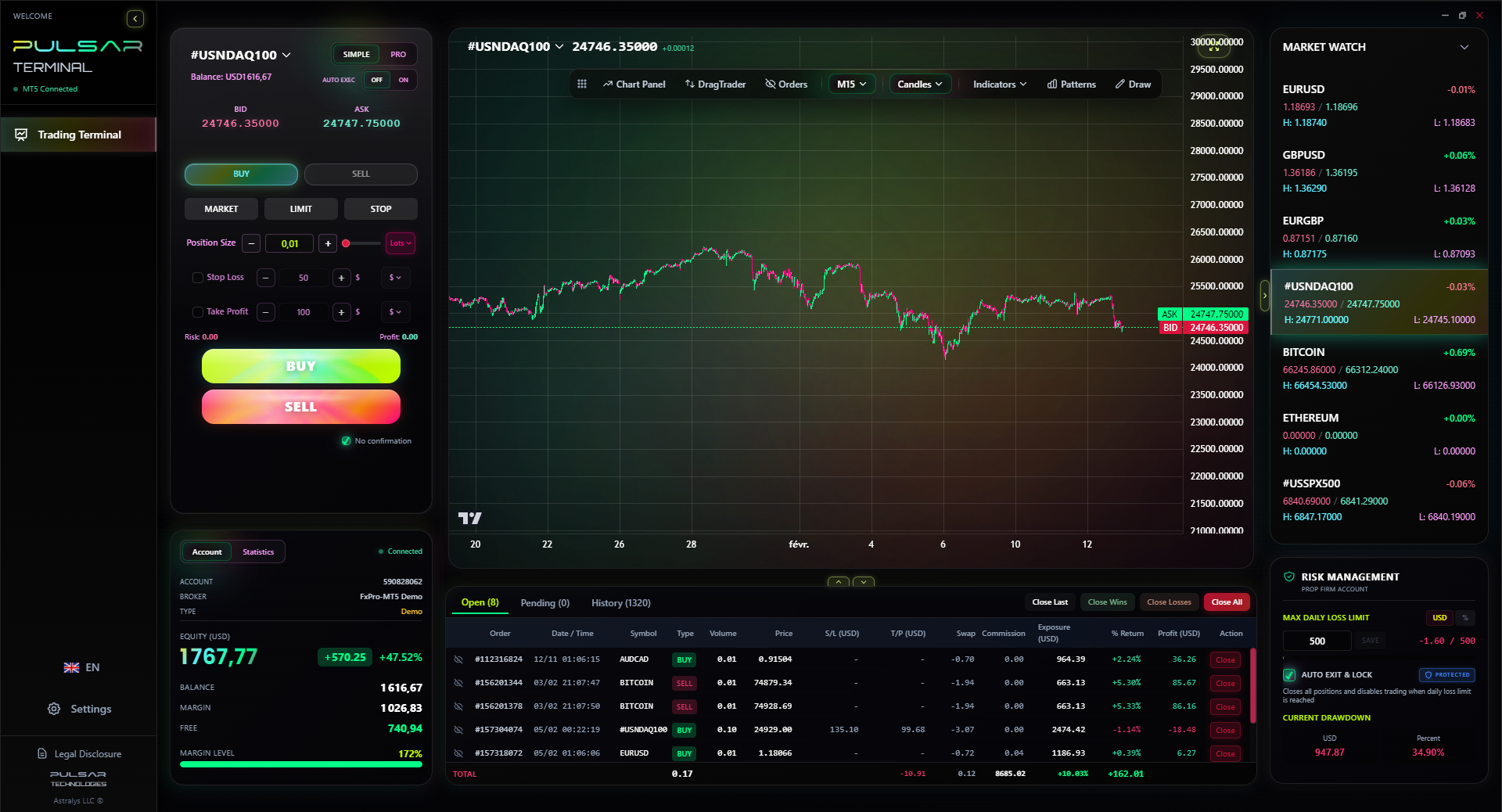
Managing multiple take-profit levels and trailing stops manually is stressful; Pulsar Terminal automates this directly on your MT5 chart, letting you focus on the analysis, not the clicks.
“Your first profitable month is your most dangerous. It breeds overconfidence.”
Let me save you some money and heartache by listing the mistakes I see repeated constantly.
1. Chasing "Sure Thing" Tips: WhatsApp groups and social media are full of "gurus" selling signals. I bought into one early on. The signal said "BUY GBP/USD." It went down. The guru said "double down, it's a sure reversal." It went down more. I lost GHS 800 in an hour. If their strategy was so sure, they'd be trading it, not selling it for GHS 50 a month.
2. Overleveraging: Brokers here offer up to 1:500 use. That's a trap for the inexperienced. With a GHS 1,000 account and 1:500 use, you can control GHS 500,000. A 0.2% move against you wipes your account. I never use more than 1:30 now, even on my largest account. use amplifies losses faster than gains.
3. Ignoring the Economic Calendar: The Cedi moves on BoG meetings, inflation reports, and Eurobond news. If you're in a trade when high-impact news drops, you can be stopped out instantly by a spike in volatility and spread widening. I learned to close positions or widen stops before major announcements.
4. No Trading Plan: You wouldn't start a business without a plan. Trading is a business. Your plan should state: What pairs you trade, what timeframe, your entry/exit rules, and your daily loss limit. Write it down. Stick to it. Emotion kills traders, and a plan is your antidote.
5. Revenge Trading: After a loss, the urge to "make it back fast" is overwhelming. You take a bigger, sloppier trade. This is how a bad day becomes a blown account. My rule now: two consecutive losses, and I'm done for the day. I close the platform and walk away.
💡 Petua Winston
The market doesn't care about your rent, your bills, or your pride. Trade the price, not your personal needs.
“Forex trading isn't a get-rich-quick scheme. It's a skill, and it's paid for in time, money, and emotional resilience.”
Here's a concrete, step-by-step plan based on what I wish I'd done.
Week 1: Education & Paper Trading. Don't deposit real money. Open a demo account with a broker like XM or IC Markets. Learn the platform. Practice placing market orders, limit orders, and setting stop-loss and take-profit levels. Understand what a pip is and how to calculate your position size. Follow the price of EUR/USD or XAU/USD (gold) for a week without trading. Just watch.
Week 2-3: Develop a Simple Strategy. Pick one strategy. Maybe it's trading bounces off a key moving average on the 1-hour chart. Maybe it's using the RSI indicator to spot overbought/oversold conditions. Test it relentlessly on your demo account. Keep a journal. Note every trade: why you took it, your emotion, the outcome. Aim for consistency, not huge wins.
Week 4: Go Live (Small). Deposit the absolute minimum - maybe $50 (about GHS 650). Trade micro lots (0.01). Your goal is not to make money. Your goal is to experience the psychology of real risk. Feel the fear when a trade goes against you. Feel the greed when it's in profit. Practice executing your plan with real, but insignificant, money. The goal here is to survive and learn.
Beyond: Only add more capital once you have a proven, journaled record of profitability over at least 2-3 months on your small live account. This process filters out emotion and builds discipline. It's boring, but it's how you build a foundation that lasts.
Forex trading isn't a get-rich-quick scheme. It's a skill. It takes time, money, and emotional resilience to learn. But with the right local knowledge, a disciplined approach, and an understanding of how forex trading really works in Ghana, it's a viable way to engage with the global financial markets. Start slow, stay safe, and always keep learning.
FAQ
Q1Is forex trading legal and safe in Ghana?
Yes, it's legal for individuals to trade with international brokers. However, 'safe' depends on you. There's no specific local regulator for online retail forex yet (though the SEC is working on it), so you don't have local investor protection. Your safety comes from choosing a broker regulated by a reputable foreign authority (like ASIC or FSCA) and practicing strict personal risk management.
Q2What is the minimum amount I need to start forex trading in Ghana?
You can start with as little as $5-$10 (approx. GHS 65-GHS 130) with some brokers like XM or Exness. However, I strongly advise starting with a demo account for at least a month. When you go live, treat your first deposit as tuition fees, not investment capital. A more realistic starter amount that allows for proper position sizing is $100-$200.
Q3How do I deposit and withdraw money with a forex broker in Ghana?
Mobile Money (MTN MoMo, Vodafone Cash) is the most common and fastest method. Deposits are often instant. Bank transfers work but take 1-3 business days. Withdrawals back to Mobile Money are usually within 24 hours. Be aware that your local bank may charge a 5% fee on incoming foreign currency withdrawals from electronic transfers.
Q4Do I pay tax on my forex trading profits in Ghana?
Yes. The Ghana Revenue Authority (GRA) considers trading profits as taxable income. You are responsible for declaring this income in your annual tax filings. Keep detailed records of all your trades, including losses, as these can offset profits. Consult a local tax advisor for specific guidance.
Q5What are the best trading times for someone living in Ghana?
Q6Can I trade the Ghanaian Cedi (GHS) directly?
Yes, but not as widely as major pairs. Some international brokers offer USD/GHS, EUR/GHS, and GBP/GHS. Be aware that these pairs often have wider spreads (5-10 pips or more) and are influenced heavily by local economic events and Bank of Ghana policies, making them potentially more volatile and unpredictable for new traders.
Q7What is use and how much should I use?
use is borrowed capital from your broker that lets you control a large position with a small deposit. While brokers may offer up to 1:500, this is extremely dangerous. I recommend beginners use no more than 1:10 to 1:30. High use can lead to a margin call and rapid account loss. It magnifies both profits and losses.
Pelajaran Prof. Winston
:
- ✓Start with a demo account for a full month
- ✓Never risk more than 1-2% per trade
- ✓Mobile Money is your best deposit method
- ✓Trade the London-New York overlap (2-6 PM)
- ✓Choose only ASIC or FSCA regulated brokers
Sejauh mana artikel ini berguna?
Klik bintang untuk menilai
Pandangan Dagangan Mingguan
Analisis & strategi mingguan percuma. Tiada spam.
Tentang Penulis
Olumide Adeyemi
Perintis Dagangan Afrika Barat
Salah seorang pendidik dagangan forex paling aktif di Nigeria. 8 tahun pengalaman dagangan dari Lagos. Pakar dalam strategi modal rendah dan cabaran prop firm untuk pedagang Afrika.
Komen
Anda mungkin juga suka

Cara Trading Forex Sukses: 7 Prinsip dari Trader Profesional
Cara trading forex sukses dengan 7 prinsip trader pro: manajemen modal, disiplin, journal trading, backtest. Data nyata, bukan janji profit palsu.
Jam Trading Forex Terbaik untuk Trader Indonesia: Panduan Lengkap dengan Tabel Waktu
Panduan jam trading forex untuk trader Indonesia. Tabel 4 sesi dunia, jam emas 20:00-00:00, sesi mana yang harus dihindari. Data akurat + tips dari trader berpengalaman.
Top 5 Sàn Forex Uy Tín Nhất 2026: Review Jujur dari Trader Indonesia
Top 5 sàn forex uy tín 2026 untuk trader Indonesia. Review jujur: spread, deposit, withdraw, dukungan lokal. Exness, XM, IC Markets & lebih.
All these calculators are built into Pulsar Terminal with real-time data from your MT5 account. One-click position sizing, automatic risk management, and instant calculations.
