


You've made a good trade.

David van der Merwe
Pedagang Pasaran Membangun ·  South Africa
☕ 12 minit baca
Apa yang akan anda pelajari:
- 1The Three Layers of Delay: It's Never Just the Broker
- 2Payment Method Breakdown: What's Actually Fastest?
- 3The SARB Tax Compliance Trap (The 2025 Rule Change)
- 4How to Avoid Withdrawal Headaches: A Pre-Checklist
- 5What to Do If Your Withdrawal Is Stuck
- 6FSCA Protections and Your Rights
- 7Planning Your Cashflow: Don't Let Withdrawals Dictate Your Trading
You've made a good trade. The profit is sitting in your trading account. You hit 'withdraw'. Now what? In South Africa, the answer to 'how long does a forex withdrawal take' is rarely simple. I've seen traders wait 24 hours and others sweat for 10 business days. The difference isn't luck. It's understanding the three silent partners in every withdrawal: your broker's compliance team, the SARB's exchange controls, and your own bank's back office. Let's cut through the marketing promises and look at what actually happens.
When your withdrawal is pending, you're not waiting on one entity. You're waiting on a chain. Break one link, and everything stops.
Layer 1: Broker Processing (1-48 hours) This is the part brokers advertise. 'Same-day withdrawals!' 'Instant processing!' In my experience, a reputable, FSCA-regulated broker like Exness or XM will typically process a clean request within a business day. 'Clean' means your account is verified, the withdrawal method matches your deposit method (a critical anti-money laundering rule), and you're not trying to withdraw bonus funds you haven't met the turnover requirements for. I once had a withdrawal with IC Markets held up for 36 hours because I'd used a different card to deposit years prior. They needed a new statement. Annoying, but correct.
Layer 2: The SARB & Exchange Control Highway (The Wild Card) This is the uniquely South African layer. The South African Reserve Bank's Financial Surveillance Department must approve the movement of Rands out of the country to pay an international broker. Your broker's local payment partner (an Authorised Dealer) handles this. Usually, it's smooth. But if there's a query, a missing tax compliance PIN (more on that later), or just high volume, it adds days. There's no 'status update' for this. You just wait.
Layer 3: Your Bank's Processing (1-3 Business Days) Once the Rands are released locally, they hit the South African banking system. A standard EFT can take 1-3 business days. If you withdraw on a Friday afternoon, don't expect funds until Wednesday. This is bank time, not broker time.

Warning: The advertised '2-4 hour' withdrawal time from some brokers usually only covers their internal processing (Layer 1). It does not include the SARB or local bank clearing times (Layers 2 & 3). Your total wait is the sum of all three layers.

💡 Petua Winston
The market's liquidity and your bank's liquidity are different beasts. A trade closes in milliseconds. A withdrawal moves at the speed of bureaucracy. Plan for the latter.
Your choice of withdrawal method is the single biggest factor you control. Here’s the real-world timeline, based on hundreds of client reports and my own withdrawals over the years.
| Method | Typical Total Time (to your pocket) | Realistic Best Case | The Catch |
|---|---|---|---|
| Instant EFT / Local Bank Transfer | 1-3 Business Days | Same day (rare) | This is the standard. The broker pays a local South African entity in ZAR, who then EFTs you. Most reliable for larger amounts. |
| E-Wallets (Skrill, Neteller) | 24-48 Hours | 12 hours | Often the fastest overall. But check fees! Some brokers charge for e-wallet withdrawals, and converting ZAR back from the wallet can have poor rates. |
| Credit/Debit Card | 2-5 Business Days | 48 hours | Funds must return to the card you deposited with. If that card is closed, you have a major problem. Can be slower than bank transfers. |
| Cryptocurrency | Under 24 Hours | 2 hours | The speed king. Broker sends crypto to your wallet, you sell on a local exchange for ZAR. However, you take on crypto volatility risk during the process and must understand self-custody. |
| International Wire | 3-7 Business Days | 3 days | Avoid unless necessary. Expensive fees (often $25-$50) and longest delays due to correspondent banking. |
My Personal Experience with Speed
In 2023, I did a test. I withdrew R5,000 from three different FSCA-regulated brokers using a local bank transfer.
- Broker A (Advertised '2-hour withdrawals'): Funds reflected in my FNB account in 2 business days.
- Broker B: Processed in 24 hours, funds arrived in 3 business days (hit a Friday).
- Broker C: Took 48 hours to process, then 1 business day to arrive.
The takeaway? 'Fast' is relative. E-wallets consistently won for pure speed. For a large R50,000 withdrawal of trading profits last year, I used a local bank transfer. I submitted Monday 10 AM, it was processed by the broker Tuesday, and the money was in my account Thursday morning. That's the standard you should plan for.

Pro Tip: If speed is critical, use an e-wallet. But for your main profit withdrawals, stick to a local bank transfer. It's the most transparent and audit-friendly method for your position size calculator profits.
“Your withdrawal isn't stuck at the broker; it's in a queue at a bank, waiting on a compliance officer, or lost in the SARB's exchange control system.”
This is the new hurdle that's catching everyone off guard. In October 2025, the SARB tightened the rules for non-residents receiving South African-source income. Here’s why that matters to YOU, a resident trader.
When your international broker (like Pepperstone) needs to send Rands to their local South African payment agent to pay you, that agent is an 'Authorised Dealer.' The new rules require that dealer to confirm the broker's payment agent is tax compliant with SARS before sending funds offshore to them.
What does this mean in practice? If your broker's payment partner hasn't done their SARS homework, the entire payment chain can freeze. You, the client, are left waiting with no clear explanation. The broker says 'processed,' the local agent says 'waiting on compliance.'
This doesn't mean you need a tax PIN for a standard withdrawal. It's a back-end compliance issue. However, it introduces a new point of potential delay that didn't exist a few years ago. The brokers with the smoothest, fastest withdrawals today are those with established, compliant local South African payment partners. This is a key reason I lean towards brokers with a strong physical presence here.
Warning: If you are a non-resident trading on a South African broker's platform (like Khwezi Trade) and want to withdraw profits overseas, you WILL need a SARS Tax Compliance Status PIN. This is a separate, more complex process.
Most delays are preventable. Before you even place your first trade, set yourself up for smooth exits. This checklist has saved me weeks of frustration.
- Verify Your Account Completely, Upfront. Don't just submit a copy of your ID. Give them your proof of residence (a recent utility bill or bank statement), and a clear copy of both sides of the card you'll use for deposits. Get it all approved before you fund the account. A pending verification is the number one reason for a first withdrawal delay.
- Use ONE Primary Deposit Method. This is non-negotiable. If you deposit with your FNB Visa card, use that card for withdrawals. If you start mixing in EFTs, Skrill, and Bitcoin, you raise red flags. Compliance will need to source each deposit, and your withdrawal will be held until they do.
- Know Your Broker's Cut-Off Times. If your broker processes withdrawals daily at 2:00 PM SAST, a request at 2:05 PM goes into tomorrow's queue. That's already a 24-hour delay. I missed a cut-off once by 10 minutes and had to wait an extra day.
- Withdraw to the Same Account Name. The name on your trading account must match the name on your bank account or e-wallet exactly. 'J. Smith' vs 'John Smith' can cause a manual review.
- Keep a Buffer for Margin. If you have open trades, ensure your free margin is well above the withdrawal amount. Some systems will automatically reject a request that puts your open positions at risk of a margin call.
- Document Everything. Take a screenshot when you submit the withdrawal request showing the reference number. Save all confirmation emails. If you need to follow up, you have the exact details.
Following these steps won't guarantee a 2-hour withdrawal, but it will prevent a 2-week investigation. Your goal is to make your transaction look boring and routine to the compliance officer.
💡 Petua Winston
Your withdrawal speed is a direct test of your broker's operational integrity. Consistent delays are a red flag for deeper problems. A good broker moves money as efficiently as it executes trades.
“'Fast withdrawals' is a marketing term. 'Reliable withdrawals' is what you need to look for in a broker.”
It's been 5 business days. Nothing. Your stomach is in knots. Don't panic, escalate systematically.
Step 1: Check the Obvious (5 Minutes) Log into your trading account. What is the withdrawal status?
- Pending: It's with the broker's finance team. Move to Step 2.
- Processed/Completed: The broker has done their job. The delay is now with the payment system (SARB, bank, e-wallet). You need to contact the broker's support for the transaction reference number for the next step.
- Rejected/Cancelled: There will be a reason. Usually it's an account verification issue or a mismatch with your deposit method.
Step 2: Contact Broker Support (The Right Way) Don't just send an angry email. Open a live chat or phone ticket. Be polite but direct. "Hi, my name is [Your Name], account number [Your Number]. I submitted a withdrawal for [Amount] via [Method] on [Date], reference [Ref]. It's still pending. Can you please confirm if there are any issues on your side or any documents you need from me?"
This gives them everything they need to check instantly. Note the ticket number.
Step 3: The 48-Hour Follow-Up If they give a vague 'it's processing' answer, wait 48 business hours. Then reply to the same ticket: "Following up on ticket #[Number]. Can you please provide a specific update or an expected completion date?" This creates a paper trail.
Step 4: Formal Escalation If another 2 business days pass with no movement or clear explanation, escalate. Ask for the withdrawal to be reviewed by the finance or compliance department head. Mention that you will be filing a query with the FSCA if the matter is not resolved promptly. This is not a threat; it's a statement of fact. The FSCA exists for this reason.
My Stuck Withdrawal Story: In 2019, a withdrawal to an old Neteller account was 'processed' but never arrived. Support was useless. After 7 days, I emailed the broker's official complaints address (found in their FSCA license details) with the full timeline. The money was in my account within 4 hours, with an apology. Sometimes you just need to find the right door.
Trading with an FSCA-licensed broker isn't just a suggestion; it's your main shield. Here’s what that license actually means for your money.
Segregated Client Funds: By law, your trading capital must be held in a separate bank account from the broker's own operating funds. If the broker goes bankrupt (unlikely with major firms, but possible), your money should be protected and returned to you. It's not a guarantee, but it's a massive layer of security you don't get with unregulated entities.
A Clear Path to Complaints: If you have a serious, unresolved issue with a withdrawal, you can file a formal complaint with the FSCA. The broker is obligated to cooperate with this process. I've known traders who got stuck in endless support loops until an FSCA query suddenly made the broker's legal team responsive.
Realistic Expectations: The FSCA ensures fair treatment, not instant gratification. They will expect you to have followed the broker's complaints procedure first. They also can't force a bank to clear a transfer faster. Their power is in ensuring the broker followed their own advertised procedures and treated you fairly.
Using an FSCA broker like those in our Exness review or IC Markets review means you have this recourse. Trading with an offshore broker not licensed here means you're on your own. When it comes to getting your money back, that's a risk I've never been willing to take.
“The traders who panic about withdrawal times are the ones who traded with money they couldn't afford to have locked up.”
This is the core risk management lesson most traders ignore. Your trading strategy and your cashflow strategy are two separate things. Blowing them together is how you make desperate, stupid trades.
You should never have a trading position open because you 'need' the money to pay a bill next week. That's not trading; it's gambling with your rent. The market doesn't care about your deadlines.
How to manage it:
- Operate with a Buffer: Your live trading account should be capital you can afford to have locked for 3-6 months. This sounds extreme, but it removes all psychological pressure. The profits you withdraw are truly excess.
- Withdraw on a Schedule, Not an Impulse: I withdraw profits quarterly. It forces me to think in terms of sustained performance, not one lucky scalping strategy win. It also means I'm never surprised by a 5-day processing time.
- Factor Time into Your Goals: If your financial plan requires R10,000 from trading on the 1st of the month, you need to have that withdrawal initiated by the 20th of the previous month at the latest. The market gives you the profit; the banking system controls the timeline.
I learned this the hard way early on. I had a car payment due, closed a nice XAU/USD swing trade to cover it, and initiated the withdrawal. It took 7 business days. I had to borrow money at a stupid rate. The trade was good. My cashflow management was amateur. The profit was wiped out by the interest. Don't be me.
Pro Tip: Treat your trading account like a business. Pay yourself a 'salary' via scheduled, predictable withdrawals. This separates your emotional need for money from your analytical job of finding good setups on the EUR/USD or other pairs.
💡 Petua Winston
If you find yourself constantly checking a withdrawal status, your position size is too large. Your trading capital should be money you can afford to forget about for a month.
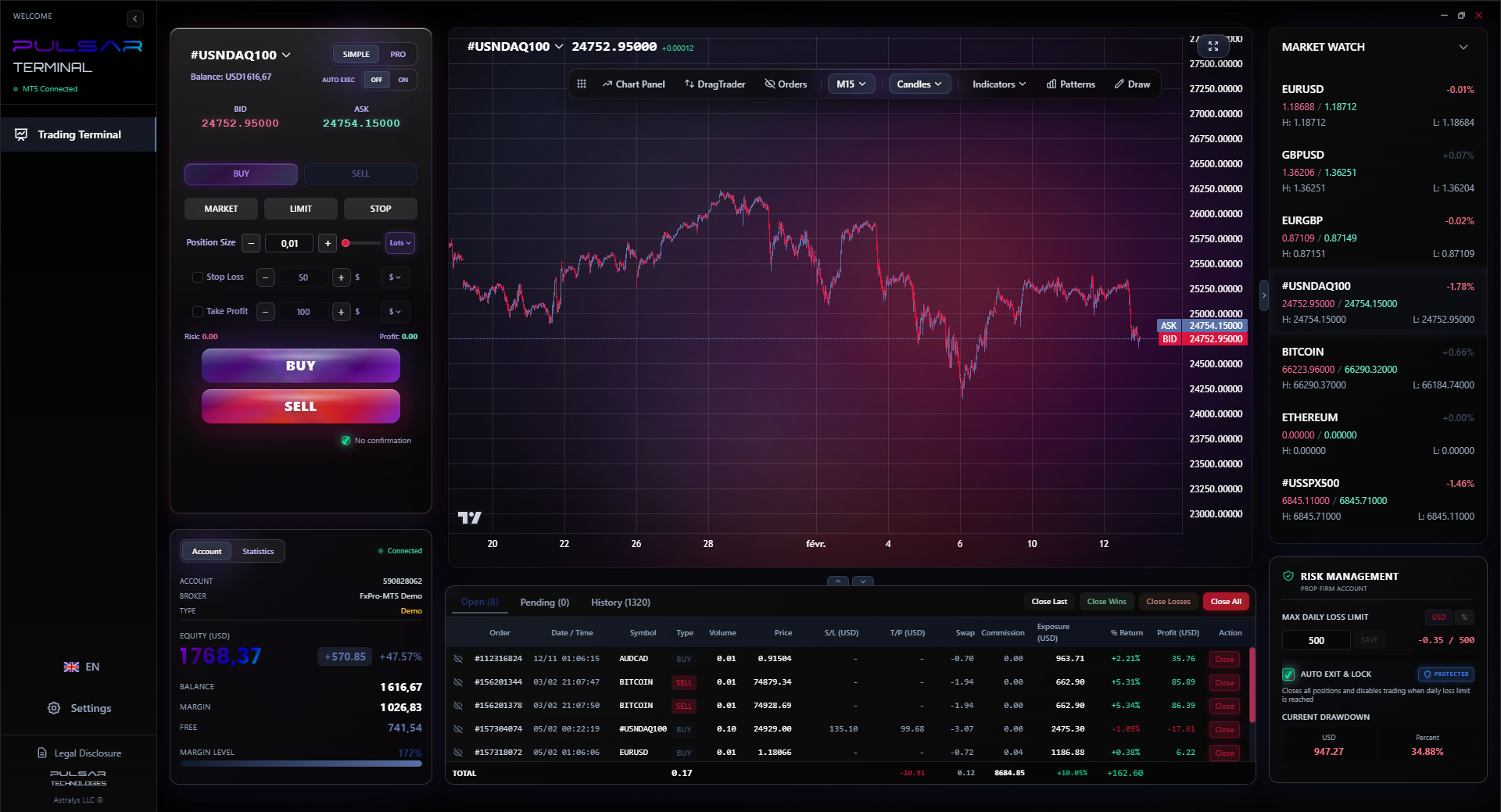
Managing your trading psychology is easier when you're not stressed about cashflow, and tools like Pulsar Terminal help you execute your strategy with precision, so you can focus on the trade, not the transfer.
FAQ
Q1What is the absolute fastest way to get money from my forex broker in South Africa?
Using a cryptocurrency withdrawal (like Bitcoin) is typically the fastest, often under 24 hours from request to you having sellable crypto. However, for most traders, e-wallets like Skrill or Neteller offer the best balance of speed (24-48 hours total) and simplicity without crypto volatility risk.
Q2Why does my broker say 'processed' but my bank shows nothing?
'Processed' means the broker has approved and sent the instruction to their payment partner. The money is now in the financial pipeline - going through SARB exchange control clearance (if applicable) and then the 1-3 business day South African bank clearing process. The delay is no longer with your broker.
Q3Are there any withdrawal limits for South African traders?
Yes, but they're high. You have a R1 million annual foreign investment allowance and a R10 million discretionary allowance. For almost all retail traders, these won't be a constraint. The limits that matter more are your broker's internal per-transaction limits, which you can check in their terms.
Q4Can my withdrawal be taxed?
The withdrawal itself is not taxed. However, the profits you are withdrawing are likely subject to income tax in South Africa. It's your responsibility to declare your trading profits to SARS. The broker doesn't withhold tax for you.
Q5What's the biggest mistake that causes withdrawal delays?
Using multiple deposit methods. If you fund your account with a credit card, then an EFT, then Skrill, and later try to withdraw to your bank account, you trigger mandatory anti-money laundering checks. The broker must verify the source of all funds before releasing money to a new destination. Stick to one method.
Q6Do FSCA-regulated brokers really return money faster?
Not necessarily faster in pure processing hours, but infinitely more reliably. With an FSCA broker, you have legal recourse, segregated funds, and they are motivated to maintain their license. An unregulated broker can simply ignore you or shut down, with you having no way to chase them.
Q7How long should I wait before complaining about a withdrawal?
Follow this timeline: After 3 business days for e-wallets/crypto, or 5 business days for bank transfers, contact support politely for an update. If you get no clear resolution after 2 more business days, escalate to a formal complaint with the broker. If that fails, the FSCA is your next step.
Pelajaran Prof. Winston
:
- ✓Plan for a 3-5 business day standard for bank withdrawals.
- ✓Use one deposit/withdrawal method only to avoid AML delays.
- ✓FSCA regulation is non-negotiable for fund security.
- ✓Never trade with money needed for imminent expenses.
Sejauh mana artikel ini berguna?
Klik bintang untuk menilai
Pandangan Dagangan Mingguan
Analisis & strategi mingguan percuma. Tiada spam.
Tentang Penulis
David van der Merwe
Pedagang Pasaran Membangun
Pedagang berpangkalan di Johannesburg dengan 11 tahun dalam mata wang pasaran membangun. Pakar dalam pasangan ZAR, dagangan terkawal FSCA, dan analisis pasaran Afrika Selatan.
Komen
Anda mungkin juga suka

Cara Trading Forex Sukses: 7 Prinsip dari Trader Profesional
Cara trading forex sukses dengan 7 prinsip trader pro: manajemen modal, disiplin, journal trading, backtest. Data nyata, bukan janji profit palsu.
Jam Trading Forex Terbaik untuk Trader Indonesia: Panduan Lengkap dengan Tabel Waktu
Panduan jam trading forex untuk trader Indonesia. Tabel 4 sesi dunia, jam emas 20:00-00:00, sesi mana yang harus dihindari. Data akurat + tips dari trader berpengalaman.
Top 5 Sàn Forex Uy Tín Nhất 2026: Review Jujur dari Trader Indonesia
Top 5 sàn forex uy tín 2026 untuk trader Indonesia. Review jujur: spread, deposit, withdraw, dukungan lokal. Exness, XM, IC Markets & lebih.
All these calculators are built into Pulsar Terminal with real-time data from your MT5 account. One-click position sizing, automatic risk management, and instant calculations.
