


Most people who try to learn forex in South Africa get it completely backwards.

David van der Merwe
Pedagang Pasaran Membangun ·  South Africa
☕ 11 minit baca
Apa yang akan anda pelajari:
Most people who try to learn forex in South Africa get it completely backwards. They jump straight into charts, download a dozen indicators, and blow up their first account within months. I did exactly that. The truth is, studying forex isn't about memorising candlestick patterns first. It's about understanding the local playing field - the rules, the costs, and the very real Rand-based math that determines if you sink or swim. I'll show you the structured, less glamorous path that actually builds lasting skill.
Before you even look at a EUR/USD chart, you need to know the local rulebook. Trading in South Africa isn't the wild west. The Financial Sector Conduct Authority (FSCA) is your watchdog. Trading with an FSCA-licensed broker isn't just a suggestion, it's your first line of defence. I learned this the hard way early on, almost depositing with a flashy offshore outfit that later vanished. Check the FSCA's website. It's boring admin, but it's non-negotiable.
The FSCA also caps use for us retail traders at 30:1. That means for every R1,000 in your account, you can control a position worth R30,000. It sounds limiting compared to the 500:1 you might see advertised elsewhere, but trust me, it's a blessing in disguise. It forces you to build proper capital. The other big rule? Exchange controls. You can't just ship millions of Rands overseas willy-nilly. Moving over R1 million requires an Approval of International Transfer from SARS. For most starters, this isn't an issue, but it's good to know the fences of our sandbox.

Warning: An unregulated broker might offer you 1000:1 use and "guaranteed" profits. What they're really offering is a direct line to losing your entire deposit with zero recourse. Always verify the FSCA license first.
“Studying forex isn't about memorising candlestick patterns first. It's about understanding the local playing field.”
This is where most tutorials gloss over the details. How you study forex must include a ruthless focus on costs, because they eat directly into your Rands. Let's break down what you're really paying.
The Spread: Your First Trade's Hidden Tax
The spread is the difference between the buy and sell price. It's not a separate fee, it's baked into every single trade you open. In South Africa, what you pay varies wildly:
| Broker & Account Type | Typical EUR/USD Spread | What it means for a R10,000 trade* |
|---|---|---|
| Premium ECN/RAW Account | 0.1 - 0.3 pips | R1 - R3 cost to open the trade |
| Standard Commission-Free Account | 0.8 - 1.5 pips | R8 - R15 cost to open the trade |
*Assuming 1 pip = R10 on a standard lot. Use a position size calculator to work this out for your own trades.
I used to trade on a standard account with a 1.2 pip spread. I was paying R12 before my trade even had a chance to move. Switching to a raw spread account with a small commission (like Tickmill's model) saved me thousands over a year. You need to study these numbers for your broker.
Commissions, Swaps, and Inactivity Fees
- Commissions: Some brokers charge per trade. For example, R3 per side on a 100k (standard lot) trade. It sounds small, but it adds up fast if you're into scalping strategy.
- Swap Rates: Hold a trade overnight? You'll pay or earn interest. For a ZAR pair, this can be significant. I once held a USD/ZAR short position over a weekend and got a pleasant R45 credit. The reverse can also hurt.
- Inactivity Fees: Life happens. If you don't trade for 3 months, a broker like AvaTrade can charge a $50 fee. Alfa Financials charges 100 USD or 1500 ZAR per month after inactivity. Read the fine print.

Example: Let's say you make 20 trades a month on a standard account with a 1-pip average spread on EUR/USD. If your average position size is 0.5 lots (where 1 pip = R5), your monthly cost just from spreads is: 20 trades * 1 pip * R5 = R100. That's R1,200 a year, gone, before you've made a cent of profit.

💡 Petua Winston
Your first R10,000 in the market is tuition, not investment. Expect to learn, not to earn.
“A 30-pip stop-loss should be a lesson, not a life event. That only happens if your position size is sane.”
Okay, you know the rules and the costs. Now, how do you actually study forex the right way? You build a foundation, brick by brick. Forget the get-rich-quick YouTube strategy for a second.
First, master the absolute basics: what a pip definition is, what spread definition means, and how margin works. Then, get intimately familiar with the South African Rand pairs. USD/ZAR is the big one. It's volatile, liquid, and reacts strongly to local politics and SARB interest rate decisions. It's also where that 30:1 use feels its most potent. I remember my first USD/ZAR trade. I bought at 18.50, it dipped to 18.42, and I got a margin call warning because my position was too big for my small account. Lesson learned the hard way.
Your study plan should look like this:
- Weeks 1-2: Demo account only. Learn to place orders, set stop-losses, and read basic charts. No real money.
- Weeks 3-6: Paper trade one concept. Maybe just support and resistance on EUR/USD. Write down every single trade idea and why.
- Weeks 7-8: Add one simple indicator, like the RSI indicator, to your analysis. See how it confirms or contradicts your price levels.
The goal isn't profit in the demo. The goal is consistency in your process. When I finally went live, I started with a tiny R500 account on a micro lot broker. My goal wasn't to make money. My goal was to execute my plan correctly for one month without deviating. That mental shift changed everything.
“A 30-pip stop-loss should be a lesson, not a life event. That only happens if your position size is sane.”
Your broker is your gateway. Picking the wrong one makes studying forex ten times harder. Based on our market, here’s a straight talk comparison of some major FSCA-regulated players.
I've traded with a few of these over the years. Exness review shows they're popular for their low spreads and variety of accounts, which is great for testing strategies with small money. IC Markets review highlights their raw spreads and reputation as a true ECN, which was my go-to when I started scaling up my size. For beginners who want a simpler start, XM review offers tons of educational resources and a low minimum deposit.
But here's my personal take: Don't get hung up on "the best." Get hung up on "the best for you right now."
- Starting out with R1,000? Look for a broker with a cent account or micro lots. You need to make trades where a 10-pip loss feels like a R10 lesson, not a R1,000 disaster. Brokers like XM or HFM are solid here.
- Ready to get serious with R10,000+? Now spread costs matter more. Look at the raw spread accounts from IC Markets or Pepperstone review. The commission model will be cheaper overall.
- Funding matters. How easy is it to deposit your Rands? Do they offer instant EFT? How long do withdrawals take back to your FNB or Standard Bank account? This is practical stuff that affects your life.

Pro Tip: Open demo accounts with 2-3 different brokers. Test their platform, see their real spreads during the London open (when EUR/USD is most active), and practice depositing and withdrawing the demo money. It reveals a lot about their systems.
💡 Petua Winston
The spread is a toll bridge. You pay it on the way in and on the way out. Choose your broker like you'd choose a route home - looking for the least traffic.
“Your trade journal is your single most important study tool. If you're not writing it down, you're not studying.”
Here's a specific, one-week drill I give to every trader I mentor. This is how to study forex by doing, not just reading.
The USD/ZAR & Gold Correlation Drill:
South Africa is a commodity economy. The Rand (ZAR) often moves inversely to gold (XAU/USD). When global uncertainty hits, gold goes up, and the Rand often weakens (USD/ZAR goes up). Your drill:
- Monday-Wednesday (Observation): Open charts for USD/ZAR and XAU/USD guide. Don't trade. Just watch. Draw horizontal lines at obvious daily highs and lows. Note the time (JST is UTC+2). Does USD/ZAR spike at 10:00 JST when the JSE opens? Does it get jumpy during US data at 16:30 JST?
- Thursday (Paper Trade): On your demo, place ONE trade idea based on this correlation. Example: If gold breaks above a key resistance level, look for USD/ZAR to also be rising and consider a small buy order. Set a stop-loss of 50 pips (about R50 on a micro lot) and a take-profit of 100 pips. Write down your reasoning.
- Friday (Review): Did the trade work? Why or why not? Was the correlation clean, or did local politics (a speech by the Finance Minister) override it?
This drill teaches you to study one relationship in depth. It forces you to consider time zones, external assets, and local events. It's infinitely more valuable than scrolling through 100 different indicators. When I did this drill back in 2019, I paper-traded a USD/ZAR long based on a gold breakout. It hit my target. The next week, I tried the same logic with real money and lost because I ignored a SARB warning. The lesson wasn't that the correlation was wrong, it was that no single rule works all the time. That's a core truth you only learn through structured practice.
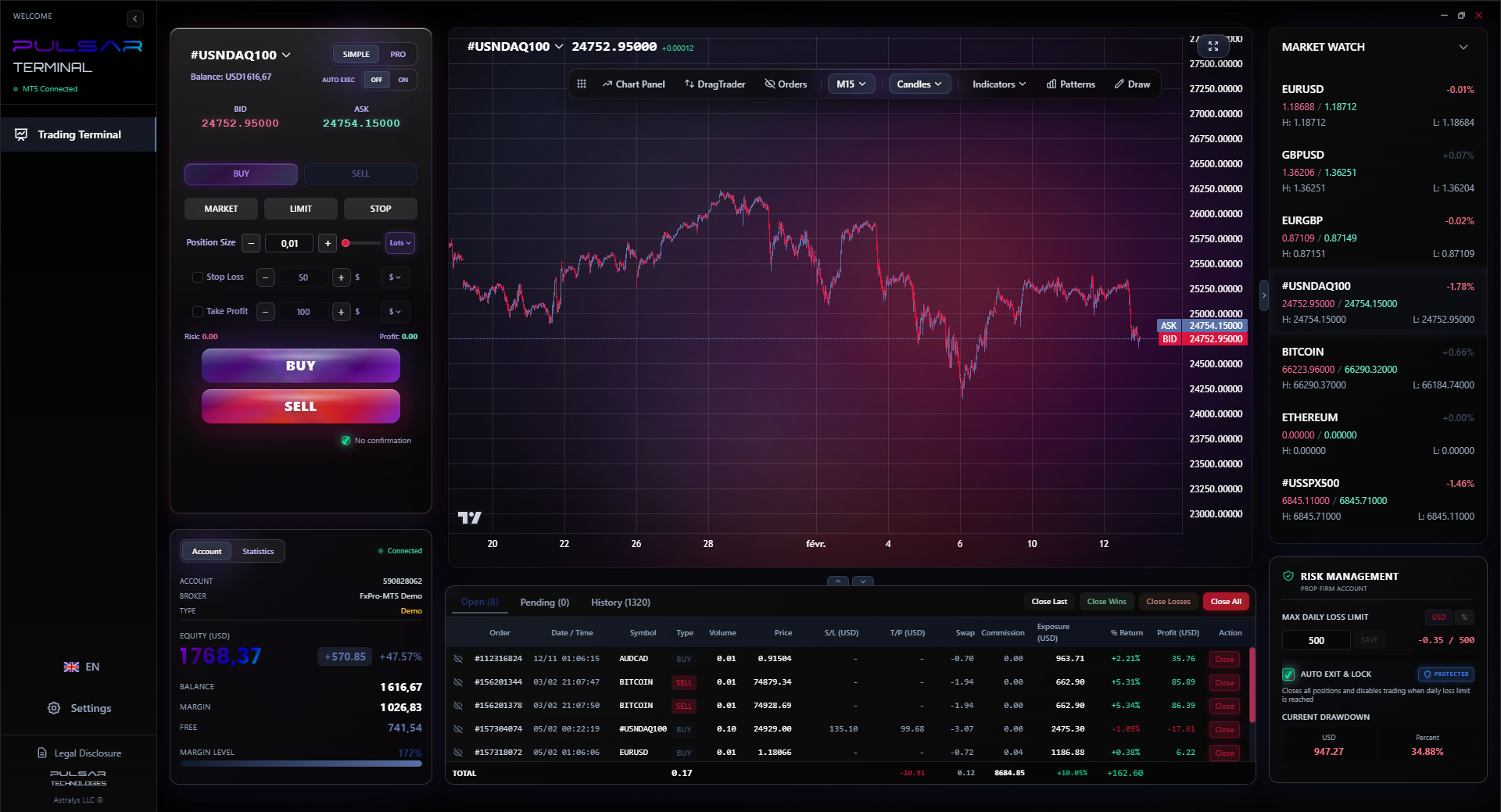
When you're ready to move from theory to disciplined execution, a tool like Pulsar Terminal for MT5 lets you pre-plan your entire trade—with multiple take-profit levels and an automatic trailing stop—so you can stick to the rules you studied.
“Your trade journal is your single most important study tool. If you're not writing it down, you're not studying.”
Let's be honest. You're going to make mistakes. I certainly did. Here are the big ones so you can sidestep them.
Pitfall 1: Overleveraging with Small Capital. This is the killer. You have R2,000. With 30:1 use, you can control R60,000. That's a standard 0.6 lot on USD/ZAR, where 1 pip = R6. A 30-pip move against you is R180, nearly 10% of your account. I did this. I put on a 0.5 lot EUR/USD trade with a R1,500 account. A 25-pip stop-loss took out over 8% of my capital in one go. It was emotionally crushing and unnecessary. Start with 0.01 lots. Seriously.
Pitfall 2: Chasing "The Secret Indicator." There isn't one. I spent months and thousands of Rands buying "algos" and systems. The MACD indicator is free on MT4. Learn what it actually shows - momentum and potential turns - and use it to support your price action decisions, not replace them.
Pitfall 3: Ignoring the Journal. If you're not writing it down, you're not studying. Your trade journal isn't just "bought EUR/USD, made 50 bucks." It's: "Entry: 1.0850. Reason: Daily support confluence with 61.8% Fib. Risk: 1.0820 (30 pips). Target: 1.0900 (50 pips). Emotion: Impatient, entered before full candle close. Outcome: Stopped out. Lesson: Wait for confirmation." This log is your single most important study tool.
Pitfall 4: Switching Timeframes Like a Channel Surfer. Are you a swing trading holding for days, or a scalper in and out in minutes? Pick one to study first. I tried to be both and just got confused, taking swing trades on a 5-minute chart and scalping on the daily. It was a mess. Master one timeframe before you add another.
💡 Petua Winston
A trade journal is a mirror. If you don't like what you see, the problem isn't the mirror.
“One focused hour a day is better than five distracted hours. Consistency builds skill, not marathon sessions.”
Here’s a actionable, 90-day roadmap to transform from a complete beginner to a competent, disciplined trader who understands the South African context.
Month 1: The Foundation (All Demo)
- Week 1-2: Broker setup & basics. Open 2 demo accounts. Learn to buy, sell, set stop-loss, take-profit. Understand what a lot size is. Play with a position size calculator.
- Week 3-4: Focus on ONE pair. Probably EUR/USD guide for its liquidity and clean trends. Learn to identify obvious support and resistance on the H4 and Daily charts. No indicators yet.
Month 2: Adding Layers (Demo + Micro Live)
- Week 5-6: Introduce one indicator. The RSI is perfect. Study overbought/oversold and divergence. Apply it only to your chosen pair on the H4 chart.
- Week 7-8: Incorporate fundamental awareness. Follow the SA economic calendar. See how USD/ZAR reacts to local CPI data or US Non-Farm Payrolls (at 16:30 JST!).
- Week 8: Fund a live micro account with an amount you can afford to lose (R500-R1000). Execute 5 trades of 0.01 lots only. Your goal is to follow your plan, not to profit.
Month 3: Integration & Discipline (Live Micro Account)
- Week 9-10: Run the USD/ZAR & Gold correlation drill from the previous section with real micro lots.
- Week 11-12: Review your first month of live trading. What was your win rate? Your average win vs. average loss? Are you sticking to your risk rules (never risk more than 1-2% per trade)? This is where you diagnose your real habits.
Stick to this plan, and in 90 days you'll have more genuine, applicable knowledge than most people who've been randomly trading for two years. You'll have made mistakes with small money, learned local market rhythms, and developed a process. That's how you build something that lasts.
FAQ
Q1What is the minimum amount I need to start studying forex with real money in South Africa?
Technically, some brokers let you start with R70-R150 using cent accounts. But for serious study without immediate panic, I'd recommend a minimum of R1,500. This lets you trade micro lots (0.01) where a 50-pip loss is about R7.50, not R750. It's enough to feel the psychological pressure of real money, but not enough to ruin you while you learn.
Q2Is forex trading taxable in South Africa?
Yes. The South African Revenue Service (SARS) views trading profits as income if you're trading frequently (seen as a revenue-generating activity). You need to declare your net profit (profits minus losses and trading costs) on your annual tax return. Keep careful records of all your trades, deposits, and withdrawals from day one.
Q3Which forex pair is best for South African beginners to study?
Start with EUR/USD. It's the most liquid, has the tightest spreads, and trends well. It lets you focus purely on learning chart patterns and risk management without the extra volatility of ZAR pairs. Once comfortable, then move to studying USD/ZAR to understand how local factors and commodity prices impact our currency.
Q4How many hours a day do I need to study forex?
Quality over quantity. One focused hour a day is better than five distracted hours. In your first month, plan for 1-2 hours: 30 minutes reviewing the past day's charts and news, 30 minutes planning for the upcoming session, and 30 minutes in a demo practicing your drill. Consistency is key.
Q5Can I study forex successfully while working a full-time job in SA?
Absolutely. In fact, it can be an advantage. It forces you into higher timeframes like the 4-hour or daily charts, which are better for swing trading. You can do your analysis in the evening, set your orders with stop-losses, and check in once a day. Trying to scalp the 1-minute chart while at work is a recipe for disaster and getting fired.
Q6Do I need a fancy computer or fast internet to study forex?
No. A basic laptop and a stable internet connection are all you need. The fancy setups come later if you get into algorithmic trading. Initially, your brain is the most important tool. Don't get sucked into buying expensive hardware or multiple monitors before you've even mastered a single trading strategy.
Q7What's the biggest waste of time when first learning?
Searching for a "holy grail" trading system or indicator. I wasted over a year and a lot of money on this. The truth is, price action and risk management are 90% of the game. Spend your time learning to read candlestick patterns, support/resistance, and how to place a stop-loss properly. Everything else is just decoration.
Pelajaran Prof. Winston
:
- ✓Verify FSCA license before depositing a single cent.
- ✓Start with micro lots (0.01); risk under 2% per trade.
- ✓Master EUR/USD before touching volatile USD/ZAR.
- ✓A 90-day structured plan beats 2 years of random effort.
- ✓Your first R10k is tuition - budget for learning.
Sejauh mana artikel ini berguna?
Klik bintang untuk menilai
Pandangan Dagangan Mingguan
Analisis & strategi mingguan percuma. Tiada spam.
Tentang Penulis
David van der Merwe
Pedagang Pasaran Membangun
Pedagang berpangkalan di Johannesburg dengan 11 tahun dalam mata wang pasaran membangun. Pakar dalam pasangan ZAR, dagangan terkawal FSCA, dan analisis pasaran Afrika Selatan.
Komen
Anda mungkin juga suka

Cara Trading Forex Sukses: 7 Prinsip dari Trader Profesional
Cara trading forex sukses dengan 7 prinsip trader pro: manajemen modal, disiplin, journal trading, backtest. Data nyata, bukan janji profit palsu.
Jam Trading Forex Terbaik untuk Trader Indonesia: Panduan Lengkap dengan Tabel Waktu
Panduan jam trading forex untuk trader Indonesia. Tabel 4 sesi dunia, jam emas 20:00-00:00, sesi mana yang harus dihindari. Data akurat + tips dari trader berpengalaman.
Top 5 Sàn Forex Uy Tín Nhất 2026: Review Jujur dari Trader Indonesia
Top 5 sàn forex uy tín 2026 untuk trader Indonesia. Review jujur: spread, deposit, withdraw, dukungan lokal. Exness, XM, IC Markets & lebih.
All these calculators are built into Pulsar Terminal with real-time data from your MT5 account. One-click position sizing, automatic risk management, and instant calculations.
