


I remember staring at my screen in late 2023, my FTMO challenge account down 7% in a single session on a wild Nifty 50 move.

Rajesh Sharma
Penganalisis Forex Kanan ·  India
India
☕ 10 minit baca
Apa yang akan anda pelajari:

I remember staring at my screen in late 2023, my FTMO challenge account down 7% in a single session on a wild Nifty 50 move. The pressure was immense. That's when the ads started popping up: 'Get Funded Instantly, No Challenges!' The promise of skipping that grueling evaluation phase was incredibly tempting. But here's what I learned the hard way about instant funding prop firms. They're not the cheat code they seem to be, especially for us trading from India.
Let's cut through the marketing fluff. A traditional prop firm, like the ones in our Exness review or IC Markets review, makes you pass a trading challenge first. You prove you can be profitable and manage risk under specific rules. Only then do you get a funded account.
An instant funding prop firm flips that script. You pay a fee, and they give you a simulated account with 'real' capital to trade immediately. There's no weeks-long evaluation. You start trading what looks like a $10,000 or $50,000 account right away. Your profits are then split with the firm, often starting from a very first profitable trade.
It sounds perfect, right? No more sweating through a challenge drawdown. But this model changes the fundamental relationship. The firm's primary incentive isn't to find long-term talented traders anymore. It's to collect those upfront fees. That subtle shift creates a whole different set of risks you need to understand.

Warning: The term 'instant funding' is a bit of a misnomer. You are not being handed real money from a company's treasury. You are trading in a simulated environment where the firm agrees to pay you a share of the simulated profits. The legality and enforcement of these payouts in India is a grey area.
“The instant funding model changes the firm's fundamental incentive from finding talent to collecting fees.”
When you see an ad saying 'Get a $10,000 account for ₹8,000,' your brain does a quick conversion. That's a small fee for big use! But that's just the entry ticket. The real cost structure is where they get you.
The Fee Trap
That initial fee is often a monthly or bi-weekly subscription. Stop trading for a month? Your account might be deactivated unless you pay again. I tried one of these models in 2022. I paid a $99 (roughly ₹8,200 at the time) 'activation fee' for a $25k account. I made a small profit of $300 in the first two weeks. But then I had a flat week. The next monthly fee was due before I could request a payout. I was trading just to cover my subscription.
Profit Splits and Scaling
Most instant firms offer a low starting profit split, like 50/50. To get to an 80% or 90% split, you need to hit certain profit targets consistently. This is harder than it sounds without the discipline a challenge phase instills. Also,, the rules for scaling your account - increasing your simulated capital - are often tied to aggressive profit targets that encourage over-trading.
The Hidden Cost: Your Psychology
This is the biggest one. Skipping the evaluation removes a crucial pressure-testing phase. You haven't proven you can handle the psychological weight of a drawdown under specific rules. Jumping straight into a 'funded' account, even a simulated one, can give you a false sense of security. When a real loss hits, you're more likely to revenge trade or blow the account because you never built that mental muscle. A good position size calculator is useless if your mindset is fragile.

💡 Petua Winston
A shortcut often leads back to the start, just with less fuel in your tank. The market rewards process, not haste.

“Skipping the evaluation removes a crucial pressure-testing phase for your psychology.”
Don't just take my word for it. Let's lay it out clearly. This table breaks down why the traditional model, while harder to start, is often safer for your capital and sanity in the long run.
| Feature | Instant Funding Prop Firm | Traditional Prop Firm (Challenge) |
|---|---|---|
| Entry Barrier | Pay a fee, start immediately. | Pass a 1 or 2-phase evaluation challenge. |
| Primary Goal | Collect subscription fees & find traders who can pay consistently. | Find consistently profitable, disciplined traders. |
| Trader Psychology | Untested. Risk of false confidence. | Tested under challenge rules. More resilient. |
| Profit Split Start | Often lower (e.g., 50%). | Usually higher from the start (e.g., 80% or 90%). |
| Capital Risk | You risk your subscription fees repeatedly. | You risk only the one-time challenge fee. |
| Payout Reliability | Untested, newer business model. Higher risk of non-payment. | Established track record from major firms. |
| Best For | Experienced traders who understand the model's risks and can be immediately profitable. | Traders needing structure, proven discipline, and a more secure path. |
As you can see, the instant model is geared for volume. They need lots of traders signing up and paying fees. The traditional model is geared for quality. They need a smaller number of traders who will make them money over years. Your job is to decide which system actually aligns with your goals.

“Skipping the evaluation removes a crucial pressure-testing phase for your psychology.”
The prop firm space, especially the instant side, is the wild west. Here are specific red flags I've learned to watch for, particularly for companies targeting Indian traders.
1. Too-Good-To-Be-True use: Offering 1:500 use on a $100,000 instant account? That's a disaster waiting to happen and a sign they don't care if you blow up. They already have your fee. Responsible firms, even instant ones, should offer sane use.
2. Vague or No Payout Proof: If their website or social media is all screenshots of 'trader dashboards' showing huge profits but zero evidence of actual bank transfers or UPI receipts to Indian accounts, be very skeptical. Ask for proof in Indian Rupee terms.
3. No Clear Rulebook: A legitimate firm, instant or not, has a crystal-clear document outlining all rules: profit split, withdrawal process, prohibited strategies (like scalping strategy restrictions), and what constitutes a violation. If it's all in flashy videos with no written terms, run.
4. Pressure to 'Scale Up' Immediately: They contact you a week in, pushing you to upgrade to a $200k account for a bigger fee. This is a classic upsell tactic prioritizing their revenue over your readiness.
5. Ignoring Indian Regulations: While prop firm trading exists in a grey area, a firm that blatantly claims 'no RBI rules apply' or promises ways to bypass FEMA limits is playing with fire. You don't want your payout trail leading to a regulatory crackdown.

Pro Tip: Before paying any fee, go to their website's 'Terms & Conditions' or 'Client Agreement.' Do a Ctrl+F search for the words 'simulated,' 'demo,' or 'not real money.' If you find them buried in the legal text, you know exactly what you're buying.
💡 Petua Winston
If you wouldn't risk your own ₹50,000 on your strategy, a simulated ₹50 lakh account is just an expensive video game.

“If you can't pass a traditional prop firm challenge, you likely can't be profitable in an instant model.”
Maybe you're an experienced trader with a solid system, and you just want faster access to larger position sizes. I get it. If you decide to try an instant funding prop firm, this is how to not get burned.
Treat It Like a Business Expense: That monthly fee is a business cost. Your first goal isn't to buy a new bike with profits. Your first goal is to be consistently profitable enough to cover that fee and then some. Track it like you would office rent.
Start Small, Prove It First: Never start with the largest account. Buy the smallest, cheapest plan they have. Your mission is to request and receive a successful payout. Not a dashboard number, a real payout hitting your bank account. I made this mistake - going for the $50k account first. Prove the model works with the $10k account.
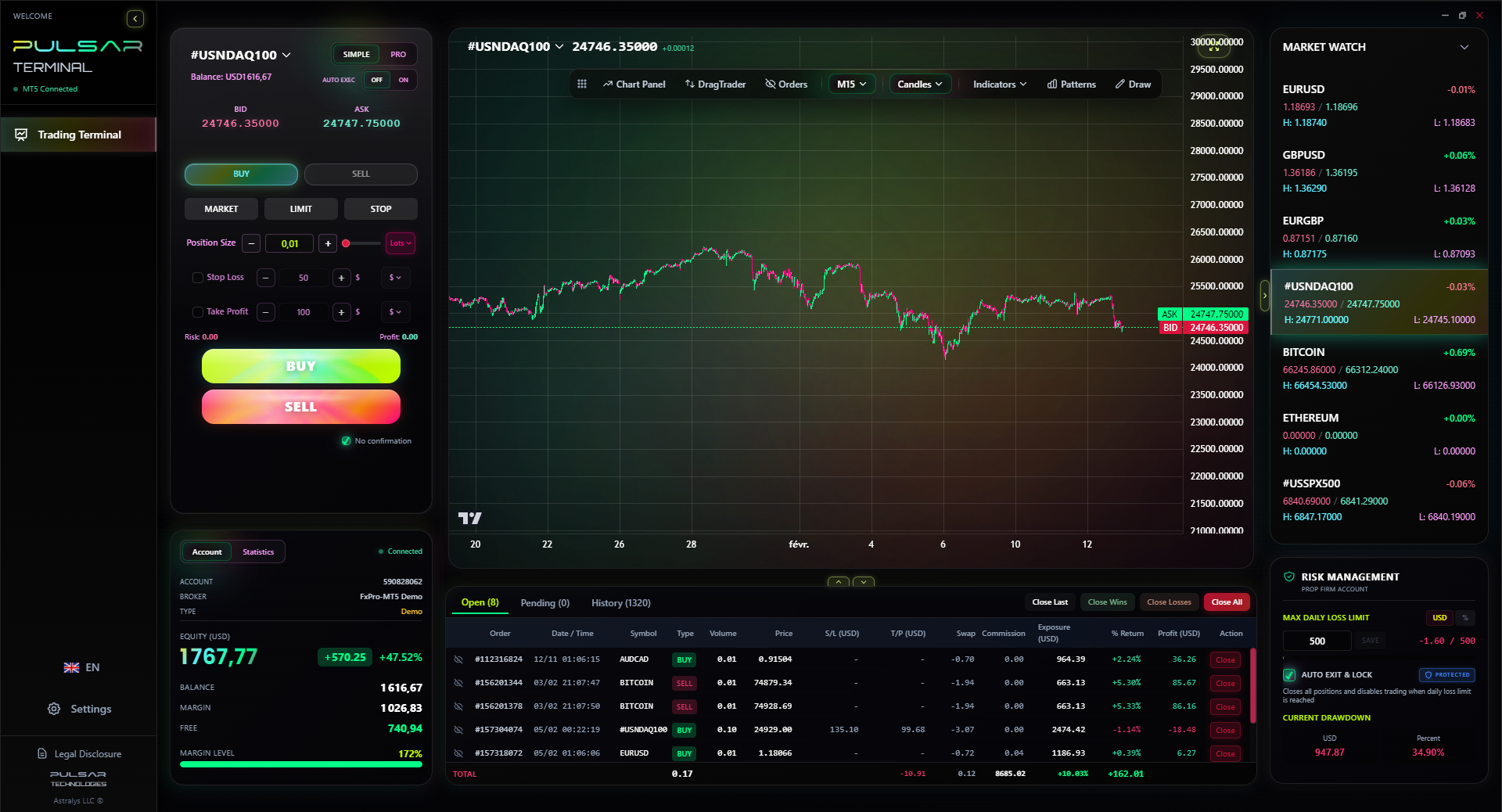
Use Tighter Risk Management: Since your psychology is untested in their system, use half your normal risk. If you usually risk 1% per trade on your personal account, risk 0.5% here. The goal is longevity, not a jackpot. A tool that can help automate this discipline is crucial. Managing a daily loss limit is a core rule for many firms, and doing it manually is stressful.
Document Everything: Screen record your trade entries, your dashboard, and your payout requests. If anything feels off, you have evidence. This saved me in a dispute once where a firm claimed I violated a rule on a winning XAU/USD guide trade. My recording showed I followed all their published rules.
Have an Exit Strategy: Decide on a loss limit for your fees. If you pay ₹15,000 in total subscription fees over 3 months without a single successful payout, walk away. You're funding their marketing budget, not your trading career.

Sticking to strict daily loss limits is non-negotiable for prop firms, and Pulsar Terminal automates this protection directly on your MT5 chart, removing emotional decisions.
“If you can't pass a traditional prop firm challenge, you likely can't be profitable in an instant model.”
Before you click 'buy now' on that instant funding offer, pause. Consider these paths that might serve you better in the long run.
1. The Traditional Prop Firm Route: Yes, the challenge is hard. That's the point. Firms like FTMO, The5%ers, or FundedNext have stood the test of time. The one-time fee for a challenge is often similar to 2-3 months of an instant firm's subscription. If you pass, you're on a much better profit split with a more reputable partner. The discipline you learn is useful. It taught me more about handling a margin call scenario than any book ever did.
2. Master a Smaller Personal Account: This is the most underrated path. Can you consistently grow a ₹50,000 account? If not, why do you think you'll handle a simulated $50,000 account? Use tools like the MACD indicator or RSI indicator to build a simple, repeatable system on a small scale. Compound growth is real. Turning ₹1 lakh into ₹1.5 lakh is a 50% return. Focus on percentage, not rupee size.
3. Swing Trading with Indian Stocks: The prop firm world is mostly forex and indices. If you have a knack for reading charts, consider swing trading Indian equities. The use is lower (F&O), but the market moves are significant, and you're trading in a well-regulated, familiar environment. You keep 100% of the profits.
4. Save for a Larger Personal Capital Base: Instead of paying ₹5,000 monthly to an instant firm, put that money in a separate savings account for 12 months. You now have ₹60,000 plus interest to add to your trading capital. You have complete control, zero rules, and 100% of the profit. It's slower, but it's solid.
💡 Petua Winston
The most valuable capital you'll ever manage is your patience. No fee can buy it.

“Your first goal with an instant firm isn't a payout for a bike, it's a payout that covers your own fees.”
So, are instant funding prop firms a complete scam? Not always. But they are a high-risk, fee-centric model that preys on impatience. For 95% of Indian traders starting out, they are a distraction at best and a money pit at worst.
The brutal truth is this: if you don't have the discipline or skill to pass a traditional prop firm challenge, you almost certainly don't have the discipline or skill to be profitable in an instant funding model. You're just paying more for the same lesson.
I've been there, lured by the speed. I lost about ₹40,000 in total across various fees and subscriptions to different 'instant' models before I admitted it wasn't the shortcut I wanted. That money would have been better spent on two solid traditional prop firm challenges, where the failure would have at least been educational.
Your time and capital are precious. Invest them in proving your edge in the most rigorous way you can stomach. Build your skills, build your psychology, and build your own capital. That's the only 'instant' fix that lasts in this game - the instant you decide to do the hard work properly.
FAQ
Q1Are instant funding prop firms legal in India?
They operate in a significant regulatory grey area. The RBI does not authorize foreign prop firms to solicit Indian residents for forex trading. You are trading a simulated account with a foreign entity, and payouts may violate FEMA rules on foreign remittances. There is a real risk of payment blockage or account freezes by your bank.
Q2What is the biggest risk with instant funding firms?
Beyond losing subscription fees, the biggest risk is non-payment. Since you haven't gone through a verifiable challenge, the firm has less incentive to pay out. If they get too many profitable traders, their simulated liability becomes unsustainable. Many newer firms simply shut down or refuse withdrawals when this happens.
Q3Can I use UPI to pay for an instant funding account?
Highly unlikely for international firms. They typically accept credit/debit cards, cryptocurrencies, or sometimes international bank transfers. If an international firm offers UPI, it's a major red flag. Domestic entities offering 'instant funding' for trading are extremely rare and should be scrutinized even more heavily.
Q4How much can I realistically make from an instant funding prop firm?
For a skilled trader, the ceiling is high on paper. But you must first cover your recurring fees. On a 50% split, if you make a 10% profit on a $10k account ($1,000), you get $500. If your monthly fee was $150, your net is $350. You must do this consistently, every month, to make it worthwhile. Most traders don't.
Q5Should I choose instant funding or a challenge-based firm?
For almost all beginners and intermediate traders, choose the challenge. It's cheaper in the long run (one-time fee), tests your discipline, and comes with a higher profit split from reputable firms. Only consider instant funding if you are a consistently profitable veteran who fully understands the fee structure and risks, and can treat it as a short-term business experiment.
Q6Do instant funding firms have trading rules?
Yes, and they can be very strict, often stricter than challenge firms. They may have tight daily loss limits, rules against news trading, and minimum trading day requirements. Violating these rules can lead to account termination without a refund, so you must read the fine print carefully.
Pelajaran Prof. Winston
:
- ✓Instant funding fees are often recurring subscriptions, not one-time costs.
- ✓Profit splits start low (50%), unlike traditional firms (80-90%).
- ✓The #1 risk is non-payment due to the untested business model.
- ✓Always prove the payout system works with the smallest account first.
- ✓Treat monthly fees as a business expense, not an investment.
Sejauh mana artikel ini berguna?
Klik bintang untuk menilai
Pandangan Dagangan Mingguan
Analisis & strategi mingguan percuma. Tiada spam.
Tentang Penulis
Rajesh Sharma
Penganalisis Forex Kanan
Lebih 10 tahun berdagang di pasaran India dan Asia Selatan. Bermula dengan derivatif mata wang NSE sebelum beralih ke forex antarabangsa. Pakar dalam pasangan USD/INR dan pasaran membangun.
Komen
Anda mungkin juga suka

Cara Trading Forex Sukses: 7 Prinsip dari Trader Profesional
Cara trading forex sukses dengan 7 prinsip trader pro: manajemen modal, disiplin, journal trading, backtest. Data nyata, bukan janji profit palsu.
Jam Trading Forex Terbaik untuk Trader Indonesia: Panduan Lengkap dengan Tabel Waktu
Panduan jam trading forex untuk trader Indonesia. Tabel 4 sesi dunia, jam emas 20:00-00:00, sesi mana yang harus dihindari. Data akurat + tips dari trader berpengalaman.
Top 5 Sàn Forex Uy Tín Nhất 2026: Review Jujur dari Trader Indonesia
Top 5 sàn forex uy tín 2026 untuk trader Indonesia. Review jujur: spread, deposit, withdraw, dukungan lokal. Exness, XM, IC Markets & lebih.
All these calculators are built into Pulsar Terminal with real-time data from your MT5 account. One-click position sizing, automatic risk management, and instant calculations.
