


I remember staring at my screen in 2021, watching a Bitcoin trade go completely sideways.

David van der Merwe
Pedagang Pasaran Membangun ·  South Africa
☕ 11 minit baca
Apa yang akan anda pelajari:
- 1The Core Difference: What Are You Actually Trading?
- 2The Rulebook: How South Africa Regulates Them (It's Not Even Close)
- 3Market Mechanics: Volatility, Liquidity, and Trading Hours
- 4The Price of Playing: Costs, Fees, and the Local Broker Scene
- 5Strategy Shift: What Works in One Can Fail in the Other
- 6The Mind Game: Psychology and Risk for the South African Trader
- 7So, Which One is Right for You? A Practical Checklist
I remember staring at my screen in 2021, watching a Bitcoin trade go completely sideways. I'd entered at $58,400, thinking it was just another currency pair like EUR/USD. I used my standard forex stop-loss of 50 pips. Bitcoin dropped $3,000 in an hour - nearly 200 pips on my broker's weird crypto CFD pricing - and I was stopped out. It then immediately reversed and rocketed past my entry. That R4,200 loss taught me a brutal, expensive lesson: treating Bitcoin and forex as the same thing is a fast track to the poorhouse. They're fundamentally different beasts, especially here in South Africa where the rules are still being written.
Let's cut to the chase. When you ask 'is bitcoin and forex the same,' you're asking if a lion and a house cat are the same because they're both felines. Sure, they share some family traits, but one is a predictable pet and the other is a wild predator.
Forex is the exchange of government-issued currencies. You're trading the economic health of nations. When you buy EUR/USD, you're betting on the Eurozone vs. the US economy. Central banks, inflation reports, and political stability are your guiding stars. It's a market run by suits in big buildings.
Bitcoin is a decentralized digital asset. No government or bank controls it. Its value comes from a mix of scarcity (only 21 million will ever exist), adoption, and pure market sentiment - often driven by hype, fear, and Elon Musk's tweets. You're not trading an economy; you're trading an idea, and sometimes, mass psychology.

Warning: Don't fall for brokers who market crypto CFDs as 'just another pair.' The underlying volatility is on another planet. A 2% daily move in forex is big news. In crypto, it's a quiet Tuesday.
This difference dictates everything: your strategy, your risk management, and even the hours you keep. Forex has a weekly close; crypto markets never sleep, not even on Christmas. If you try to use the same scalping strategy on Bitcoin that you use on USD/ZAR, you'll get chewed up.

💡 Petua Winston
If you must trade both, use separate trading accounts and, more importantly, separate mental accounts. The discipline for a 20-pip forex scalp evaporates in a 20% Bitcoin swing.
“Treating Bitcoin and forex as the same thing is a fast track to the poorhouse.”
This is where the 'are they the same' question gets a definitive 'no' from our local authorities. The regulatory gap is massive, and it directly impacts your safety as a trader.
Forex in SA: A Mature, Walled Garden Forex trading through CFDs is tightly controlled by the Financial Sector Conduct Authority (FSCA). Think of it as a well-kept park with clear signs and security guards.
- Licensing is Non-Negotiable: Any broker offering services to South Africans must be an FSCA-licensed Financial Service Provider (FSP). You can and must check this on the FSCA's website. Brokers like XM, AvaTrade, and Tickmill all have local FSCA licensing.
- use is Capped: Since 2021, retail traders are limited to 30:1 use on major forex pairs. This is a protective measure to stop you from blowing up your account in seconds.
- Client Money is Protected: FSCA rules require brokers to keep your funds in segregated accounts. If the broker goes under, your money isn't part of their bankruptcy estate.
Crypto in SA: The Wild West is Getting a Sheriff Crypto regulation is evolving fast, but it's coming from a different starting point.
- It's a Financial Product, Not a Currency: In late 2022, the FSCA declared crypto assets a 'financial product.' This means companies offering crypto advice or intermediary services need an FSP license. It's a huge step for consumer protection.
- Anti-Money Laundering Rules Apply: Crypto exchanges like VALR and Luno are now 'Accountable Institutions' under FICA. They must do KYC (Know Your Customer) checks and report suspicious activity.
- But It's Not Legal Tender: The South African Reserve Bank (SARB) is clear: you can't pay your taxes with Bitcoin. It's an asset, not the Rand.
The key takeaway? Your forex broker is operating under decades-old financial laws. Your crypto exchange is helping write the rulebook as we speak. That extra uncertainty is a risk factor you must price in.
“You're not trading an economy; you're trading an idea, and sometimes, mass psychology.”
The Volatility Gap
Here's a real number that sums it up. In 2023, the average true daily range (high to low) for EUR/USD was about 0.7%. For Bitcoin? It was regularly over 4%. That means Bitcoin was, on average, about 6 times more volatile than the world's most traded currency pair.
I learned this the hard way. On a quiet forex day, I might set a 50-pip stop on EUR/USD and feel safe. That same 50-pip distance on a Bitcoin CFD can get vaporized by a single large sell order in minutes. You need a completely different mindset for position sizing. My go-to tool is now always a position size calculator, and for crypto, I input a volatility multiplier.
Liquidity and Slippage
Forex is the most liquid market on earth. Trillions of dollars change hands daily. This means you can usually get in and out at the price you see, especially on majors like EUR/USD. The spread is tight and predictable.
Bitcoin's liquidity is deep, but it's concentrated. Outside of major exchanges like Binance or VALR, or during off-hours for traditional markets (like Asian session), liquidity can thin out. A large market order can move the price against you, causing slippage. This is especially true for altcoins.
The 24/7 Grind vs. The Weekend Break
Forex gives you a weekend. The market closes on Friday evening and reopens Sunday night. It's a forced break that lets you reset, analyse the week, and avoid emotional trading.
Crypto never stops. It's 24/7/365. This is a psychological trap. I've caught myself checking charts at 2 AM because 'something might be happening.' That's a surefire way to burnout and bad decisions. You have to impose your own trading hours, or the market will consume you.
“You're not trading an economy; you're trading an idea, and sometimes, mass psychology.”
How you pay to play is another stark difference.
Forex Costs: Spreads and Commissions Your main costs are the spread (the difference between buy and sell price) and sometimes a commission. Here’s what you’re looking at with FSCA-regulated brokers:
| Broker | Account Type | Typical EUR/USD Spread | Commission | Min. Deposit (ZAR approx.) |
|---|---|---|---|---|
| Tickmill | Raw | 0.11 pips | $3 per lot/per side | ~R1,800 ($100) |
| XM | Standard | 0.8 pips | None | ~R90 ($5) |
| Khwezi Trade | Standard | From 0.4 pips | Varies | R500 |
| IC Markets | Raw Spread | 0.1 pips | $3.5 per lot/per side | ~R1,800 ($100) |

Example: On a standard lot (100,000 units) with Tickmill, your total cost to open and close a trade is the spread (0.11 pips = $1.10) plus commission ($6 round turn) = $7.10. That's transparent and relatively low.
Crypto Costs: Trading and Network Fees Crypto fees are a different animal. You're often paying a percentage of your trade value, not a pip cost.
- Trading Fees: VALR Pro charges between -0.01% (they pay you) and 0.05%. Binance is 0% to 0.1%. AltCoinTrader is 0.1% to 0.75%. These are tiny percentages, but on large volatile moves, the broker's risk is priced in elsewhere.
- The Hidden Cost: Spreads on CFD Platforms. If you trade Bitcoin CFDs with a forex broker (like on Plus500 or Pepperstone), watch out. The spreads can be enormous compared to the spot market - sometimes $50 or more during volatile periods. That's your real cost.
- Network/Withdrawal Fees: Want to move your Bitcoin to your own wallet? You'll pay a 'gas' or network fee, which fluctuates with blockchain congestion. This doesn't exist in forex.
The bottom line? Forex costs are upfront and linear. Crypto costs can be layered and unpredictable.
💡 Petua Winston
The most important number in crypto isn't your entry price; it's the percentage of your total capital you're willing to see go to zero. Never make it more than 5%.
“Forex gives you a weekend. Crypto never stops. This is a psychological trap.”
You wouldn't use a fishing rod to hunt a kudu. Don't use a forex strategy to trade crypto without serious adaptation.
Forex Strategies: The Economic Dance Forex thrives on mean reversion and trend-following based on macroeconomics. You can use indicators like the MACD or RSI on higher timeframes (like 4-hour or daily charts) with decent success because prices are pushed by measurable forces: interest rate decisions, employment data, GDP.
Swing trading is a favourite for many working South Africans. You analyse the weekly chart, place a trade, and manage it over days or weeks. The 30:1 use cap actually helps here, preventing overexposure.
Crypto Strategies: Riding the Rocket (and Surviving the Crash) Crypto is driven by narrative, hype cycles, and whale movements. Technical analysis still works, but support and resistance levels are more like 'zones of interest' that can be obliterated by news.
- Volatility is Your Toolkit: In crypto, you're often trading the volatility itself. Breakouts are more powerful, but false breaks are more common. I've had more success with wider stops and smaller position sizes, aiming for 3:1 or 5:1 risk-reward ratios on clear momentum plays.
- The News is Everything: A tweet, a regulatory announcement from the US, or a tech upgrade (like the 'Halving') can move Bitcoin 10% in a day. You have to be plugged into crypto news, not just Bloomberg.
- Shorter Timeframes Can Be Safer: This sounds counter-intuitive, but in a 24/7 market, holding a leveraged position over a weekend is terrifying. I know traders who have more success with 15-minute or 1-hour charts, getting in and out within the same day to avoid overnight narrative shifts.
My biggest failed crossover attempt? Using a forex-style grid trading strategy on Ethereum. In a steady forex range, it prints money. In a crypto parabolic rally, it led to a catastrophic margin call as shorts piled up endlessly. The tools might look similar, but the engine is completely different.
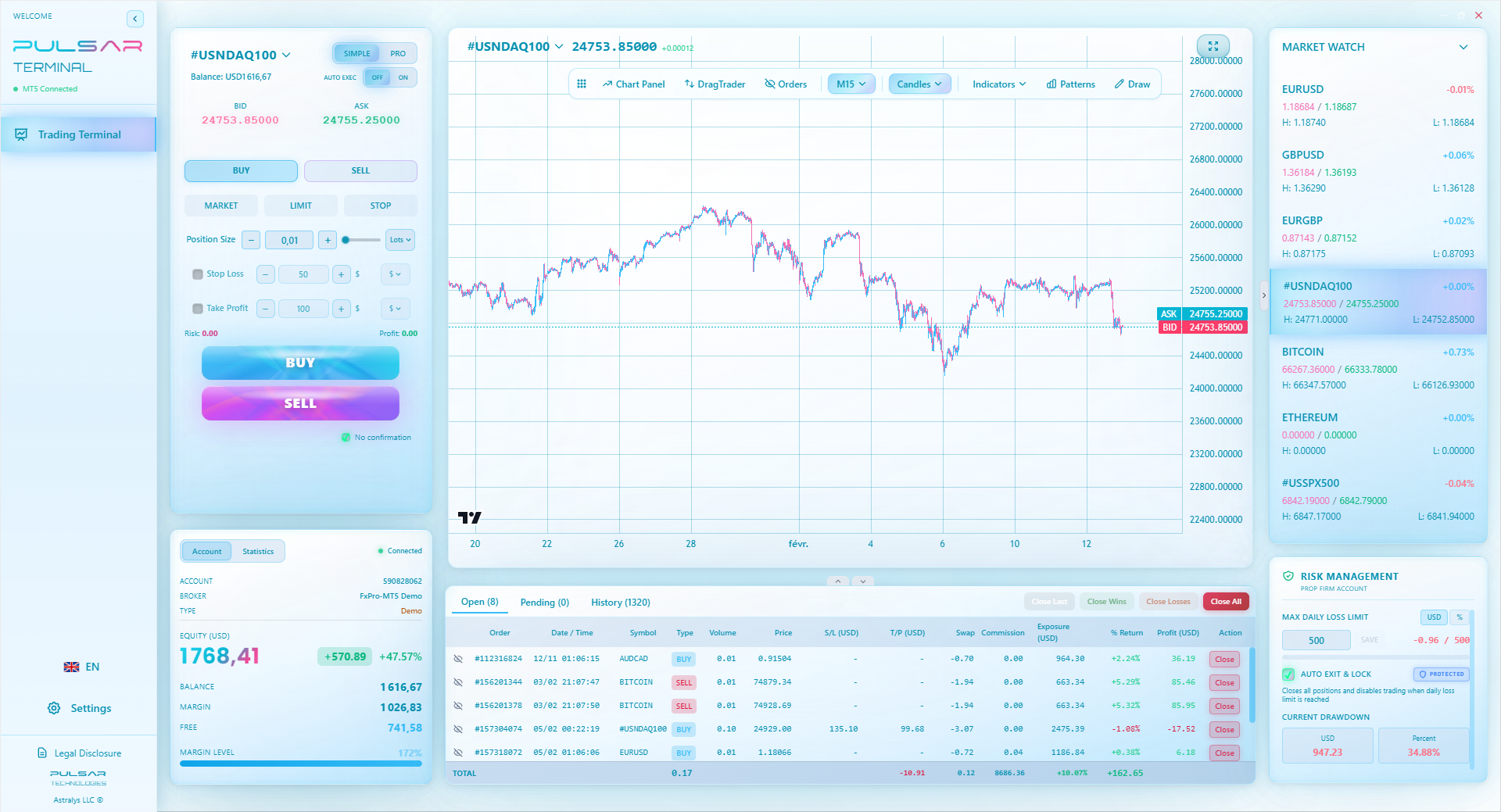
Managing wildly different volatility profiles requires precise order tools, and Pulsar Terminal's drag-and-drop orders and multi-TP/SL features let you adapt your strategy instantly on MT5.
“Forex gives you a weekend. Crypto never stops. This is a psychological trap.”
Trading is 80% psychology. This ratio gets even more skewed when you compare forex and crypto, especially with our unique SA pressures.
The ZAR Factor We're trading in Rands, but most assets are priced in USD. A weakening Rand makes your international deposits (like that $100 min deposit) more expensive to top up. It also means your profits in USD are worth more in Rands when you withdraw. This currency risk is a constant background hum in both markets, but it feels more acute with crypto's larger dollar swings.
Risk Perception and 'FOMO' Forex feels professional. Crypto feels like a lottery ticket that could moon. This leads to different emotional traps.
- In forex, the danger is overtrading out of boredom during slow sessions.
- In crypto, the danger is FOMO (Fear Of Missing Out). You see Bitcoin up 15% in two days, you jump in without a plan because 'this time it's different,' and you buy the exact top. I've done it. We all have.
Defining Your 'Why' Be brutally honest with yourself. Are you trading forex to steadily grow capital using economic logic? Or are you trading crypto for a chance at a life-changing, asymmetric payoff, knowing you might lose that capital?
Both are valid, but they require different mental frameworks and bankrolls. Never use money for crypto speculation that you allocated for your forex swing trading account. Segregate them mentally and literally.
“Have a 'forex brain' and a 'crypto brain,' and consciously switch between them.”
Still wondering if bitcoin and forex are the same and which you should try? Let's make it simple.
Choose FOREX if you:
- Value stability and clear regulation from the FSCA.
- Prefer analysing economic data and central bank speeches.
- Want predictable trading hours (24/5) and forced weekends off.
- Are comfortable with moderate, controlled use (up to 30:1).
- Like strategies based on trends and mean reversion.
- Are risk-averse and want client fund segregation.
Choose CRYPTO if you:
- Can tolerate extreme volatility and 24/7 market noise.
- Understand you're trading in a less mature regulatory space.
- Are willing to follow tech developments and social media sentiment as closely as charts.
- Have a high risk tolerance and use capital you can afford to lose completely.
- Are fascinated by blockchain technology itself, not just the price.
- Can implement and stick to ruthless risk management (tiny position sizes).
Can You Do Both? Absolutely. Many successful traders do. The key is to have separate plans. Treat them as two different businesses. Use a different trading journal. Have different risk parameters. I have a 'forex brain' and a 'crypto brain,' and I consciously switch between them. My forex account aims for 2-3% monthly growth. My crypto 'spec fund' aims for one or two big wins a year, expecting several small losses in between.

Pro Tip: Start with a demo account for both, but fund your live account with the one that matches your true personality. If you check prices anxiously every 10 minutes, forex might be your lane. If you get bored by steady trends, crypto's adrenaline might suit you. Just don't confuse the two.
💡 Petua Winston
Test any strategy you want to use in crypto during a 'bear market' or sideways period. If it can't make money when prices are flat or falling, it's just a bull market fantasy.
FAQ
Q1Can I trade Bitcoin with my normal forex broker in South Africa?
Yes, many FSCA-regulated forex brokers like Plus500, Pepperstone, and AvaTrade offer Bitcoin and other crypto CFDs. But be warned: you're not buying the actual Bitcoin. You're trading a Contract for Difference (CFD) that tracks the price. This often comes with much wider spreads, overnight financing fees, and different use rules compared to the spot crypto market on exchanges like VALR or Binance.
Q2Which is more regulated, forex or crypto, in South Africa?
Forex trading is significantly more regulated. It operates under decades-old financial laws enforced by the FSCA, with strict rules on use, client money, and broker conduct. Crypto regulation is new and evolving. While the FSCA now classifies crypto as a financial product and requires service providers to be licensed, the framework isn't as complete as forex yet. Always verify an exchange's FSCA FSP number.
Q3Is the use higher in forex or crypto trading?
For retail traders in South Africa, use is officially higher in crypto. The FSCA caps forex use at 30:1 for majors. There is no official use cap for spot crypto trading on exchanges (you trade with your full capital). However, crypto CFDs offered by forex brokers may have use, but it's still risky due to crypto's wild volatility. High use on a volatile asset is a recipe for a very fast margin call.
Q4Can I use the same technical analysis for both?
The basic tools (trend lines, support/resistance, RSI, MACD) are the same, but their reliability isn't. In forex, technical levels often hold due to institutional order flows. In crypto, these levels are more like suggestions that can be smashed through by whale orders or news. You need to use wider stop-losses and treat technical analysis in crypto as a guide, not a gospel.
Q5Which market is more profitable?
There's no simple answer. Forex offers more consistent, smaller opportunities due to lower volatility. Crypto offers the potential for massive, life-changing gains (and losses) in short periods. Profitability comes from your skill and risk management, not the market itself. A disciplined forex trader can consistently profit, while an undisciplined crypto trader can lose everything on one trade.
Q6Do I pay tax on forex and crypto profits in South Africa?
Yes, to both. SARS views profits from both trading activities as taxable income. If you trade frequently, it's likely considered revenue and taxed at your income tax rate. Less frequent, larger trades may be considered capital gains. The key is to keep careful records of all your trades, deposits, and withdrawals. This is non-negotiable. Consult a tax professional familiar with trading.
Pelajaran Prof. Winston
:
- ✓Bitcoin is 6x more volatile than EUR/USD on average.
- ✓FSCA caps forex use at 30:1; crypto has no official cap.
- ✓Forex costs are spreads & commissions; crypto adds network fees.
- ✓Separate your trading capital and plans for each market.
- ✓Tax applies to profits from both. Keep every single record.
Sejauh mana artikel ini berguna?
Klik bintang untuk menilai
Pandangan Dagangan Mingguan
Analisis & strategi mingguan percuma. Tiada spam.
Tentang Penulis
David van der Merwe
Pedagang Pasaran Membangun
Pedagang berpangkalan di Johannesburg dengan 11 tahun dalam mata wang pasaran membangun. Pakar dalam pasangan ZAR, dagangan terkawal FSCA, dan analisis pasaran Afrika Selatan.
Komen
Anda mungkin juga suka

Cara Trading Forex Sukses: 7 Prinsip dari Trader Profesional
Cara trading forex sukses dengan 7 prinsip trader pro: manajemen modal, disiplin, journal trading, backtest. Data nyata, bukan janji profit palsu.
Jam Trading Forex Terbaik untuk Trader Indonesia: Panduan Lengkap dengan Tabel Waktu
Panduan jam trading forex untuk trader Indonesia. Tabel 4 sesi dunia, jam emas 20:00-00:00, sesi mana yang harus dihindari. Data akurat + tips dari trader berpengalaman.
Top 5 Sàn Forex Uy Tín Nhất 2026: Review Jujur dari Trader Indonesia
Top 5 sàn forex uy tín 2026 untuk trader Indonesia. Review jujur: spread, deposit, withdraw, dukungan lokal. Exness, XM, IC Markets & lebih.
All these calculators are built into Pulsar Terminal with real-time data from your MT5 account. One-click position sizing, automatic risk management, and instant calculations.
