


If you've been told you can just sign up with any broker and start trading forex from Sri Lanka, you've been misled.

Daniel Harrington
Ketua Kandungan
☕ 9 minit baca
Apa yang akan anda pelajari:
If you've been told you can just sign up with any broker and start trading forex from Sri Lanka, you've been misled. The legal answer is 'yes,' but the practical reality is a maze of capital controls and payment restrictions that can trap the unprepared. I've seen too many traders here get their accounts frozen or lose money on transfer fees before they even place a trade. Let's cut through the noise. I'll walk you through exactly what 'legal' means under Sri Lankan law, how to actually fund an account, and the brokers that work reliably for us.
Forex trading is legal for individuals in Sri Lanka. The Central Bank of Sri Lanka (CBSL) is the main regulator, operating under the Foreign Exchange Act No. 12 of 2017. This is the key document, and it replaced the older, more restrictive Exchange Control Act.
The crucial point most beginners miss is this: legality doesn't mean freedom. The CBSL's primary job is to protect Sri Lanka's foreign reserves. Because of this, they've built a system of strict controls. You are allowed to trade, but moving your money to do so is heavily regulated.
Here’s the breakdown that matters to you:
- Authorized Dealers: You must conduct foreign exchange transactions through entities the CBSL approves, like commercial banks. You can't just wire money to a company in Cyprus.
- The LKR Rule: By law, transactions between residents in Sri Lanka must be in Sri Lankan Rupees (LKR). This affects how you might pool funds with friends for trading, for example.
- The Regulatory Gap: This is the big one. The CBSL does not license or supervise international retail forex brokers. When you open an account with Exness or IC Markets, you are operating outside of Sri Lankan regulatory protection. Your safety net is the broker's own overseas regulator, like the ASIC or FCA. This makes broker choice your most critical decision.

Warning: The common mistake is thinking 'legal' equals 'easy.' The hardest part of trading from Sri Lanka isn't the analysis, it's navigating the financial plumbing to get your money in and out safely.
This is where theory meets reality. While trading is legal, funding an international margin trading account via a direct bank transfer is practically restricted. Banks often block these transactions under the CBSL's capital outflow controls. I learned this the hard way in 2019 when a $500 transfer to a broker was held up for three weeks and then returned, minus a $35 bank fee. Gone.
So, how do you do it? Sri Lankan traders have adapted by using digital payment gateways. These are your practical on-ramps.
Common Payment Methods
- E-Wallets (Skrill, Neteller, Perfect Money): This is the most popular route. You fund the e-wallet via your local bank card or transfer, then send from the e-wallet to your broker. Fees apply at each step, but it works. I use Skrill regularly; a typical deposit involves a 1.45% fee to fund Skrill, then a free transfer to the broker.
- Cryptocurrency: Some brokers accept deposits in crypto like USDT. This can be faster and sometimes cheaper, but you must understand crypto wallets and the tax implications. Regulations here can shift.
- Credit/Debit Cards: Possible with some brokers, but success is hit-or-miss depending on your bank's policies. Always check if your broker supports "card deposits from Sri Lanka."
The Cost of Doing Business
Those ATM fees in the briefing? They're real. If you're using a card to fund an e-wallet, remember:
- ATM withdrawal fee: Rs 1,000
- Balance inquiry: Rs 75
These small costs add up and eat into your trading capital. You must factor them into your position size calculator. If you start with $1,000 and lose $50 to fees, you're down 5% before you've even clicked buy.

Example: Let's say you want to deposit $1,000. You use your card to put $1,015 into Skrill (a 1.5% fee). You then transfer it to your broker. Your starting capital for trading is now $1,000, but it cost you $1,015 of your LKR. That $15 is your first loss to manage.

💡 Petua Winston
Your first profit target should be to simply get your initial deposit back into your bank account. If you can't navigate the withdrawal process successfully, nothing else matters.
“The hardest part of trading from Sri Lanka isn't the analysis, it's navigating the financial plumbing.”
Since the CBSL doesn't oversee these firms, you must vet their international licenses. Never, ever use an unregulated broker. I don't care how good their bonuses look.
Look for brokers regulated by what we call Tier-1 authorities. These are the gold standard:
- ASIC (Australia): Very strict client money protection rules.
- FCA (UK): Offers a degree of compensation if the broker fails.
- CySEC (Cyprus): A common EU license with solid standards.
Many top global brokers accept Sri Lankan clients. Based on my experience and community feedback, these are consistently reliable:
| Broker | Key Feature for Sri Lankans | Good For |
|---|---|---|
| XM | Wide range of deposit methods, good local support. | Beginners for its user-friendly platform. |
| IC Markets | Raw spreads from 0.0 pips on majors. | Scalping and high-volume traders. |
| Exness | Instant withdrawals, even on weekends. | Traders who value fast access to profits. |
| Pepperstone | Strong ASIC regulation, excellent execution. | Serious traders focused on reliability. |
Minimum deposits can be as low as $10, but I always recommend starting with at least $200-$500 if you can. It gives you enough buffer to handle fees, spreads, and a couple of small losing trades without an immediate margin call.

Pro Tip: Open a demo account first, but also test a small live deposit (e.g., $50) with your chosen payment method. Confirm the entire process - deposit, trade, withdrawal - works smoothly before committing serious capital.
Here's another area where 'legal' gets specific. Your forex trading profits are considered taxable income by the Inland Revenue Department (IRD).
The progressive tax rates apply, ranging from 6% to 36%. Which bracket you fall into depends on your total annual income from all sources, including your job or business plus your trading gains.
You need to keep careful records. I maintain a simple spreadsheet for every financial year:
- Date and value of every deposit and withdrawal (in LKR equivalent).
- A detailed trade log (entry, exit, profit/loss in USD).
- A summary of net profit/loss for the year.
When you convert your USD profits back to LKR, use the official exchange rate for that day. The IRD may ask for this documentation. I'm not a tax advisor, but I can tell you that being able to show clear, organized records makes any potential process much smoother. Ignoring this is a risk you don't need.
💡 Petua Winston
Treat every Rs. 1,000 in fees like a 5-pip loss on a standard lot. Track these 'administrative pips' as ruthlessly as your trading losses.
“You are not the exception until you have a year of consistent, documented profits. Trade small.”
Best Trading Sessions
Your location gives you a unique schedule. The sweet spot is between 5:30 PM and 11:00 PM Sri Lanka Time (SLST). This window captures the overlap of the London afternoon and New York morning sessions. This is when liquidity is highest and spreads are often tightest on pairs like EUR/USD. I've placed most of my successful trades in this window. The Asian session (early morning for us) is much quieter.
What to Trade
Forget about finding USD/LKR on your MT5 platform with decent liquidity. It's not a retail trading instrument. Stick to the major and minor pairs. EUR/USD, GBP/USD, USD/JPY, and AUD/USD will be your bread and butter. If you're interested in commodities, XAU/USD (Gold) is also very popular.
The Psychological Hurdle
Trading with capital controls adds a layer of stress. When your money is harder to move, a losing streak feels worse. It can tempt you to over-use to 'make it back quickly.' This is a disaster recipe. You must be more disciplined, not less. A solid swing trading plan that doesn't require constant screen time can often be a better fit than frantic day trading.
Using tools like the RSI indicator or MACD indicator can help define clear, rules-based entries and exits, removing some emotion. The key is having a strategy and sticking to it, especially when you know withdrawing profits isn't as simple as a click.
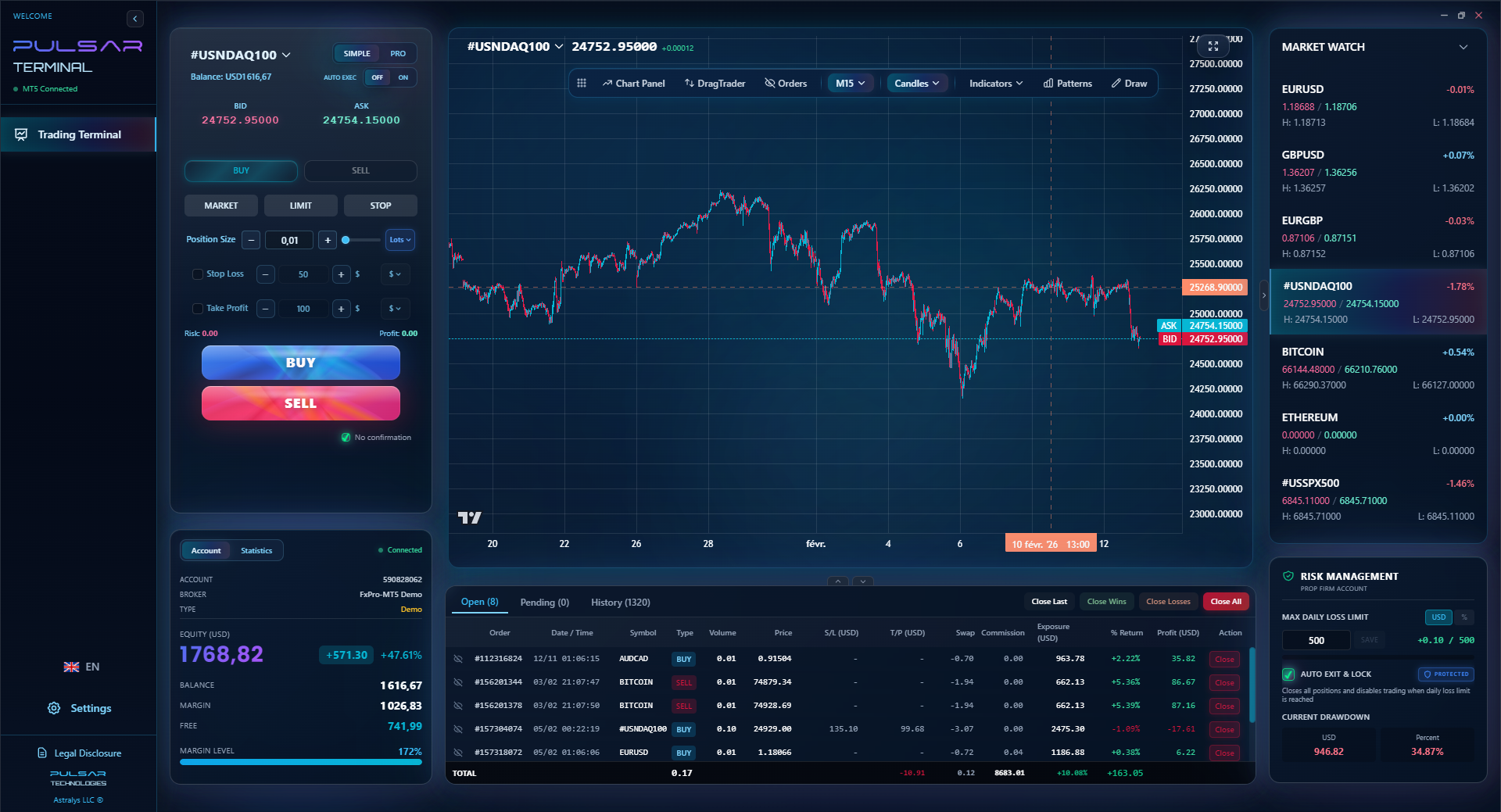
When trading in volatile sessions, having precise order tools is key; Pulsar Terminal's drag-and-drop orders and multi-take-profit levels let you manage complex trades on MT5 without hesitation.
Let me save you some pain by sharing what I and others have gotten wrong.
- Ignoring Total Deposit Cost: You see a $1,000 deposit requirement. You transfer Rs. 330,000 thinking that's it. But after bank fees, forex conversion spreads, and e-wallet charges, only $950 hits your trading account. You're underfunded from the start. Always transfer 3-5% more than you think you need to cover the hidden costs.
- Chasing 'Sri Lankan' Broker Promotions: Be wary of 'local' brokers or IB (Introducing Broker) offers that seem too good to be true. Often, they are unregulated entities offering huge bonuses that come with impossible withdrawal conditions. Stick to the major, internationally regulated brands.
- Underestimating the Loss Statistics: The briefing mentions 71-95% of retail CFD traders lose money. In Sri Lanka, with our additional friction costs, I believe the percentage is at the higher end of that range. You are not the exception until you have a year of consistent, documented profits. Trade small.
- No Withdrawal Plan: You're focused on making money, not getting it out. Test a small withdrawal first. Does it go back to your e-wallet? How long does it take to convert to LKR and reach your bank? Know this process cold. I once made a $300 profit and spent $12 in fees and a poor conversion rate to get it out. My net gain was less than my plan accounted for.
The single best thing you can do is to educate yourself relentlessly and start with a risk-first mindset. Assume every trade could lose, and size it so that loss won't keep you up at night.
💡 Petua Winston
The most important chart for a Sri Lankan trader isn't EUR/USD. It's a spreadsheet tracking deposit/withdrawal dates, amounts, fees, and net LKR received.
FAQ
Q1Can I legally trade forex in Sri Lanka with an international broker?
Yes, it is legal for you as an individual to trade forex. However, the Central Bank of Sri Lanka (CBSL) does not regulate offshore brokers. You are operating under the broker's foreign regulatory framework, not Sri Lankan protection. Your responsibility is to choose a broker regulated by a reputable authority like ASIC or FCA.
Q2What is the best way to deposit money into a forex broker from Sri Lanka?
The most reliable method is through international e-wallets like Skrill or Neteller. You fund the e-wallet using your local bank card or transfer, then send funds from the e-wallet to your broker. Direct bank transfers to forex brokers are typically blocked due to CBSL capital controls.
Q3Do I have to pay tax on my forex trading profits in Sri Lanka?
Yes. Profits from forex trading are considered taxable income by the Inland Revenue Department (IRD). You must declare them, and they will be taxed at the progressive income tax rates (6% to 36%) based on your total annual income. Keep detailed records of all trades and transactions.
Q4What is a good starting amount for forex trading in Sri Lanka?
After factoring in all the deposit fees and exchange costs, I recommend a minimum of $200-$500 as real starting capital. This allows for proper position sizing and gives you a buffer to withstand a few losses without blowing your account. Starting with less than $100 is very difficult after costs.
Q5Are there any forex brokers banned in Sri Lanka?
The CBSL does not maintain a specific list of 'banned' retail forex brokers. Instead, it restricts the outflow of funds for margin trading. The practical barrier is your bank blocking the transaction, not the broker being illegal. The onus is on you to find a broker that accepts clients from Sri Lanka and a payment method that works.
Q6What are the best currency pairs to trade from Sri Lanka?
Focus on the major pairs like EUR/USD, GBP/USD, and USD/JPY. They have the highest liquidity and tightest spreads, which is crucial because every pip counts when you have extra funding costs. Avoid exotic pairs or trying to trade LKR pairs, as they are illiquid for retail traders.
Q7What time should I trade forex in Sri Lanka?
The most active and optimal time is between 5:30 PM and 11:00 PM Sri Lanka Time (SLST). This overlaps with the key London and New York sessions, providing the best movement and liquidity. The Asian session (early morning) is generally quieter.
Pelajaran Prof. Winston
:
- ✓Forex is legal, but funding is restricted via capital controls.
- ✓Use e-wallets like Skrill; avoid direct bank transfers.
- ✓Only use brokers regulated by ASIC, FCA, or CySEC.
- ✓Factor in all fees - they can consume 3-5% of your capital.
- ✓Trade majors (EUR/USD) between 5:30 PM - 11:00 PM SLST.
Sejauh mana artikel ini berguna?
Klik bintang untuk menilai
Pandangan Dagangan Mingguan
Analisis & strategi mingguan percuma. Tiada spam.
Tentang Penulis
Daniel Harrington
Ketua Kandungan
Ketua kandungan di The Trading Mentor. Pedagang berpengalaman yang bersemangat menjadikan konsep dagangan kompleks mudah difahami. Meliputi topik global, strategi, dan panduan platform.
Komen
Anda mungkin juga suka

Cara Trading Forex Sukses: 7 Prinsip dari Trader Profesional
Cara trading forex sukses dengan 7 prinsip trader pro: manajemen modal, disiplin, journal trading, backtest. Data nyata, bukan janji profit palsu.
Jam Trading Forex Terbaik untuk Trader Indonesia: Panduan Lengkap dengan Tabel Waktu
Panduan jam trading forex untuk trader Indonesia. Tabel 4 sesi dunia, jam emas 20:00-00:00, sesi mana yang harus dihindari. Data akurat + tips dari trader berpengalaman.
Top 5 Sàn Forex Uy Tín Nhất 2026: Review Jujur dari Trader Indonesia
Top 5 sàn forex uy tín 2026 untuk trader Indonesia. Review jujur: spread, deposit, withdraw, dukungan lokal. Exness, XM, IC Markets & lebih.
All these calculators are built into Pulsar Terminal with real-time data from your MT5 account. One-click position sizing, automatic risk management, and instant calculations.
