


Most South Africans think checking Nedbank forex rates is the first step to trading.

David van der Merwe
Pedagang Pasaran Membangun ·  South Africa
☕ 9 minit baca
Apa yang akan anda pelajari:
- 1Nedbank Is Not a Forex Broker (And That's Critical)
- 2Decoding the Real Costs: Fees That Eat Your Capital
- 3Nedbank FCA vs. A Real Trading Account
- 4Where Should South Africans Actually Trade Forex?
- 5The Taxman Cometh: Implications for Profits
- 6So, When Should You Actually Use Nedbank Forex?
- 7The Final Verdict for Aspiring Traders

Most South Africans think checking Nedbank forex rates is the first step to trading. They're wrong. Confusing bank currency exchange with active forex speculation is the single fastest way to lose money before you even place a trade. I've watched traders blow accounts because they didn't understand the difference between a bank's travel card fee and a broker's spread. Let's set the record straight on what Nedbank actually offers, what those numbers mean for your pocket, and why you're probably looking in the wrong place if you want to trade.
This is the foundational mistake. Nedbank is an Authorised Dealer, a commercial bank licensed by the South African Reserve Bank (SARB) to help currency exchange and international payments. They are not, and do not pretend to be, a speculative forex trading broker like the ones you'd use for scalping strategy or swing trading.
Their core service is converting your Rands into Dollars, Euros, or Pounds for tangible purposes: travel, importing goods, or sending money overseas. The rates you see on their website or app are for these physical conversions, not for betting on the price movement of the EUR/USD pair with use. The FSCA caps use for retail traders at 30:1, but you won't get any use for speculation through a Nedbank Foreign Currency Account (FCA). You're just holding foreign cash.

Warning: Trying to use a bank account for active trading is like using a cargo ship for a Formula 1 race. The mechanisms, costs, and purposes are fundamentally different. You'll pay enormous fees on every transaction and have zero access to the charts, tools, or execution speed needed to trade.
I learned this the hard way early on. I tried to 'arbitrage' a Nedbank rate against an interbank quote I saw on a trading platform. By the time I'd filled out the paperwork for the international payment, the tiny discrepancy was gone, and I was left with a R290 fee for a 'Manual Outgoing Payment.' The profit was fictional; the bank charge was very real.

💡 Petua Winston
A bank's job is to sell you currency. A broker's job is to provide a venue for you to bet on its price. Never get the two confused, or you'll pay for both.

“Confusing bank currency exchange with active forex speculation is the single fastest way to lose money before you even place a trade.”
Nedbank's pricing is built on fees and commissions, not spreads. This is a crucial distinction. In trading, the spread is the difference between the buy and sell price, a built-in cost. At a bank, you pay explicit fees on top of an exchange rate that already includes their margin.
Let's look at the 2025 fee structure with a trader's eye:
For Buying Physical Cash (e.g., for a trip):
- Commission: 2.60% (minimum R145).
- Branch Commission: 4.20% (minimum R145).
Think about that. If you're buying $1,000 for a holiday, you're paying at least R145 just for the service, plus whatever margin is built into the exchange rate they quote you. That's a 1.5-4% headwind before you even board the plane.
For Digital International Payments:
- Outgoing (Digital): 0.63% (min R205, max R750).
- Incoming (over R2000): 0.78% (min R270, max R1,046).
The Hidden Killer: The 'Indicative Rate'
Nedbank's website shows 'indicative spot rates from Reuters.' They explicitly state these are not official Nedbank rates. The rate you actually get will be less favorable. This is their profit margin, and it's not transparent. Compare this to a broker like IC Markets, where you see a raw ECN spread of 0.0 pips on EUR/USD plus a clear $3.50 commission per lot. The total cost is known upfront.

Example: Sending $10,000 overseas via Nedbank's digital service costs 0.63%, which is R205 (the minimum). That's a flat, non-negotiable cost. In trading, the cost to open and close a $10,000 (0.1 lot) position on EUR/USD with a 1-pip spread is about $1. The efficiency difference is staggering.

“Nedbank's pricing is built on fees and commissions, not spreads. This is a crucial distinction.”
The Foreign Currency Account (FCA) is often misunderstood. It's a multi-currency savings account, not a trading platform. Here’s the head-to-head comparison.
| Feature | Nedbank Foreign Currency Account (FCA) | Typical FSCA-Regulated Trading Account (e.g., Pepperstone) |
|---|---|---|
| Primary Purpose | Hold foreign currency for travel, payments, savings. | Speculate on price movements of currency pairs, commodities, indices. |
| use | 1:1 (No use). You hold the full amount. | Up to 30:1 for retail traders (FSCA mandate). |
| Cost Structure | Percentage-based commissions (0.63%-4.2%), monthly fees for branch service. | Bid/Ask Spread, sometimes a per-trade commission. |
| Platform | Online Banking, Nedbank Money App. | MetaTrader 4/5, cTrader, proprietary platforms with charts, indicators like RSI and MACD. |
| Execution | Processed as a bank transaction, can take hours/days. | Instant or market execution, often in milliseconds. |
| Minimum Deposit | R1,500 (via banker) or 1 unit of currency (digital). | As low as $5 (e.g., XM) or $200. |
Opening an FCA to 'get better forex rates' for trading is a dead end. You cannot place a limit order, set a stop-loss, or use a technical indicator. You're just parking money in a different currency, hoping its value increases against the ZAR - which is more like a long-term investment view, not active trading.
💡 Petua Winston
If your 'trading cost' is a percentage with a minimum fee, you're not trading. You're just making a very expensive donation to a financial institution.
“Nedbank's pricing is built on fees and commissions, not spreads. This is a crucial distinction.”
If your goal is speculative trading (to profit from price movements), you need an FSCA-regulated broker. These entities are licensed for that specific activity. They provide the platforms, use, and market access.
Look for brokers that offer:
- FSCA Regulation (Category II): This is non-negotiable for client fund safety.
- Competitive Spreads on Majors: Check the live spread on EUR/USD, GBP/USD. Anything under 1.0 pip on a standard account is decent.
- MetaTrader 5 (MT5): The more modern platform with better back-testing and more instruments than MT4.
- Reasonable Minimum Deposit: Start small. A $100 deposit with a broker like Vantage is a smarter learning tool than depositing R10,000 into a bank FCA with no trading functionality.
I made my first serious profit trading XAU/USD (Gold) using a properly regulated broker. The platform allowed me to set a tight stop-loss 5 pips away. On a Nedbank structure, that kind of precise risk management is impossible. The broker's cost was a 35-cent spread; the potential loss was limited to $50. That's controlled trading. Using a bank's service for this would be like trying to perform surgery with a butter knife.

Pro Tip: Before funding any account, use a demo account to test the platform's execution speed and get a feel for the real, live spreads during volatile market periods (like London open). What you see on a broker's marketing site is often a 'from' figure, not the constant reality.

“If your goal is speculative trading, you need an FSCA-regulated broker. These entities are licensed for that specific activity.”
Here's another area where confusion between banking and trading is costly. Profits from forex trading with a broker are considered taxable income in South Africa. You're responsible for declaring them to SARS, and rates can go up to 45%. Some professional traders may also deal with VAT. You need to keep careful records of all your trades.
Conversely, if you simply hold USD in a Nedbank FCA and the Rand weakens, the ZAR value of your account increases. This could potentially be subject to Capital Gains Tax (CGT) upon withdrawal and conversion back to Rands, though the specifics can be complex. The key difference is the activity: trading is active income, while currency appreciation in a savings account is a passive gain.
Ignoring this has burned traders. I know a guy who had a great year trading, withdrew R500k, and spent it all. He was utterly unprepared for the SARS assessment that came later. He hadn't set aside a single cent for tax. Don't be that guy. Factor tax into your profit calculations from day one. A 20% winning trade becomes a 12% trade after tax if you're in a high bracket. It changes your entire risk-reward math.
This is where tools that help with trade management and record-keeping become useful, far beyond what any bank statement from a Nedbank FCA can provide.

Managing trades and calculating exact risk exposure is impossible with a bank, but tools like Pulsar Terminal bring professional trade management, including partial closures and multi-target orders, directly to your MT5 platform.
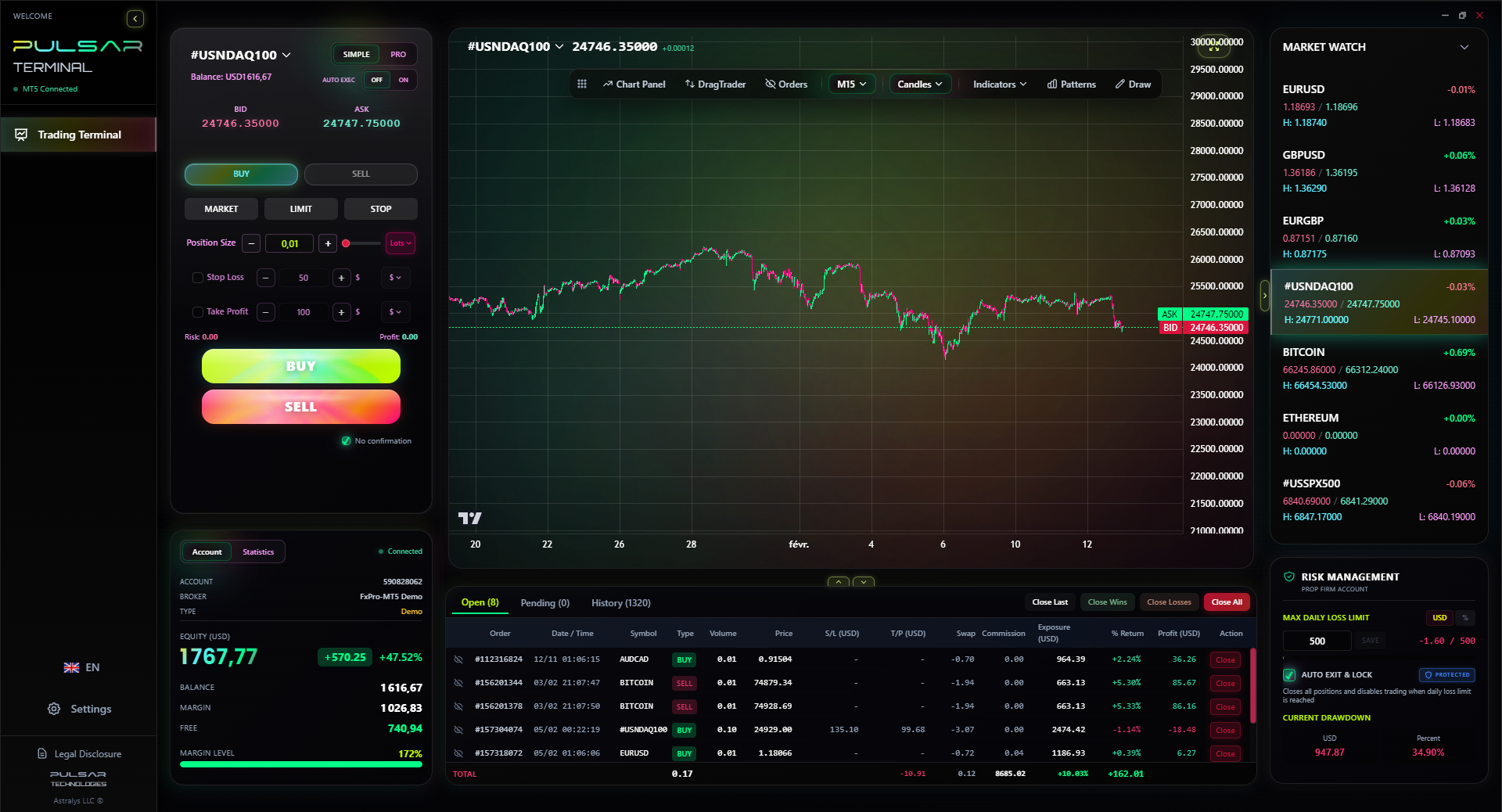
“If your goal is speculative trading, you need an FSCA-regulated broker. These entities are licensed for that specific activity.”
Nedbank's services have a clear and valid purpose. Use them for what they're designed for:
- You're Traveling: Buying foreign banknotes or loading a travel card. Yes, the 2.6%-4.2% fee is high, but it's the convenience cost for physical cash.
- You're an Import/Export Business: You need to pay an overseas supplier or receive payment from a foreign client. The international payment service, despite its fees, is a necessary business tool.
- You Want Long-Term Currency Exposure: You believe the Euro will strengthen against the Rand over the next 5 years and want to hold Euros in an FCA as a hedge. This is a strategic financial decision, not trading.
For these uses, shop around. Compare Nedbank forex rates and fees with Absa, Standard Bank, and FNB. Sometimes the difference on a large transaction can be hundreds of Rands. But never confuse this shopping for the best travel money rate with setting up your trading business. They exist in separate universes.
💡 Petua Winston
Your first tool should be a position size calculator, not a bank's rate sheet. Manage your risk in Rands first, worry about pips later.
“A 2.6% bank commission wipes out the profit from 5-10 good trades with a proper broker.”
If you're reading this to learn how to trade forex, close the Nedbank website. Their rates are irrelevant to your new venture. Your journey starts with understanding the FSCA regulatory framework, choosing a legitimate broker, learning to use a position size calculator, and practicing on a demo account.
The global forex market trades $6.6 trillion per day. South Africa's slice of that is over $19 billion daily, with about 190,000 local participants. You access that market through a broker's terminal, not a bank's internet banking portal.
The numbers don't lie. A 2.6% bank commission wipes out the profit from 5-10 good trades. In the broker world, your cost per trade might be 0.02% or less. Your focus should be on managing the market risk, not overcoming brutal institutional fees. Start with the right tools, the right broker, and a clear understanding that trading is a skill to be learned - not a currency to be bought from a teller.

FAQ
Q1Can I trade forex directly through my Nedbank account?
No, you cannot. Nedbank offers currency exchange and international payment services, not speculative forex trading platforms. You cannot place buy/sell orders, use use, set stop-losses, or trade on margin through a standard Nedbank or FCA account.
Q2Are Nedbank's forex rates good for buying US Dollars?
For buying physical cash, their rates are typical for a major South African bank, but their fees (2.6%-4.2% commission) are high. You should always compare the final total cost (rate + fee) with other banks and registered forex bureaus before exchanging large amounts for travel.
Q3What is the difference between a Nedbank forex rate and a broker's spread?
A Nedbank rate is an all-in price for converting one currency to another, with their profit built into the rate plus an added commission. A broker's spread is the pure difference between the global buy (Bid) and sell (Ask) price for a currency pair. It's a transparent, much smaller cost of doing business, often fractions of a percent (e.g., 0.01% for a 1-pip spread on EUR/USD).
Q4Is it cheaper to send money overseas with Nedbank or a forex broker?
For sending a defined amount (e.g., R50,000 to the UK), use a bank or a dedicated money transfer service. For speculative trading, use a broker. They are different services. A broker's low spreads are for opening/closing trading positions, not for sending tuition fees to a foreign university.
Q5Does Nedbank offer use for forex trading?
No. Nedbank does not offer any use for currency speculation. You can only hold the exact amount of foreign currency you deposit into an FCA. For leveraged trading (up to 30:1 under FSCA rules), you must use an FSCA-licensed forex broker.
Q6How often do Nedbank forex rates update?
Nedbank's currency conversion rates for services like travel cards and FCAs are updated every 15 minutes during business hours. However, these are retail customer rates, not the live interbank rates you see on a trading platform like MetaTrader 5.
Pelajaran Prof. Winston
:
- ✓Banks sell currency; brokers provide trading venues.
- ✓A 2.6% fee requires a 2.67% gain just to break even.
- ✓Use an FSCA broker for use (up to 30:1).
- ✓Trading profits are taxable income; plan for SARS.
Sejauh mana artikel ini berguna?
Klik bintang untuk menilai
Pandangan Dagangan Mingguan
Analisis & strategi mingguan percuma. Tiada spam.
Tentang Penulis
David van der Merwe
Pedagang Pasaran Membangun
Pedagang berpangkalan di Johannesburg dengan 11 tahun dalam mata wang pasaran membangun. Pakar dalam pasangan ZAR, dagangan terkawal FSCA, dan analisis pasaran Afrika Selatan.
Komen
Anda mungkin juga suka

Cara Trading Forex Sukses: 7 Prinsip dari Trader Profesional
Cara trading forex sukses dengan 7 prinsip trader pro: manajemen modal, disiplin, journal trading, backtest. Data nyata, bukan janji profit palsu.
Jam Trading Forex Terbaik untuk Trader Indonesia: Panduan Lengkap dengan Tabel Waktu
Panduan jam trading forex untuk trader Indonesia. Tabel 4 sesi dunia, jam emas 20:00-00:00, sesi mana yang harus dihindari. Data akurat + tips dari trader berpengalaman.
Top 5 Sàn Forex Uy Tín Nhất 2026: Review Jujur dari Trader Indonesia
Top 5 sàn forex uy tín 2026 untuk trader Indonesia. Review jujur: spread, deposit, withdraw, dukungan lokal. Exness, XM, IC Markets & lebih.
All these calculators are built into Pulsar Terminal with real-time data from your MT5 account. One-click position sizing, automatic risk management, and instant calculations.
