


Most traders get the NFP meaning forex completely wrong.

David van der Merwe
Pedagang Pasaran Membangun ·  South Africa
☕ 12 minit baca
Apa yang akan anda pelajari:
- 1What Exactly is the NFP Report?
- 2Why Does This US Report Shake the Rand?
- 3How to Actually Trade the NFP from South Africa
- 4South African Broker Realities for NFP Trading
- 5Risk Management: The Only Thing That Matters
- 6Using TA and Tools Around the NFP
- 7The Classic NFP Mistakes (I've Made Them All)
- 8The Bigger Picture: NFP in Your Trading Journey
Most traders get the NFP meaning forex completely wrong. They think it's about predicting the number. It's not. It's about surviving the 90 seconds of pure, unadulterated market chaos that follows it. I've blown accounts on NFP Fridays and I've made months of profit in minutes. The difference wasn't luck, it was a brutal understanding of what this report actually does to the USD/ZAR and every other pair on your screen. This guide will show you how to trade it, not just watch it.
Let's cut through the jargon. The Non-Farm Payrolls (NFP) report is America's monthly jobs report card. It's released by the US Bureau of Labor Statistics, usually on the first Friday of the month at 8:30 AM Eastern Time. For us in South Africa, that's 2:30 PM in winter and 3:30 PM in summer. Mark it in your calendar in red.
The core number is the change in total payrolls for all non-agricultural businesses. They exclude farm jobs, private household employees, and non-profit workers because those numbers are too volatile. The market consensus is set by economists in the days before, and the actual release is what matters.
But here's the critical part most miss: the headline number is only one of three killers. The report also includes the Unemployment Rate and, most importantly, Average Hourly Earnings. A strong jobs number with weak wage growth can actually sink the Dollar because it suggests less inflationary pressure. You have to read the whole story.

Warning: Don't get fixated on one number. The market's initial reaction is a gut punch based on the headline vs. expectation, but the follow-through over the next hour is where the real trend is set, as traders digest wages and revisions to previous months.
I learned this the hard way in 2018. The headline NFP smashed expectations. I bought USD/ZAR instantly. What I missed was that the prior two months' numbers were revised down by a combined 70k jobs, and wage growth was flat. The initial spike reversed violently. I was stopped out for a 1.5% loss on my account in under two minutes. The full NFP meaning forex isn't in the print, it's in the context.
You might wonder why a report about American jobs makes the South African Rand jump around. It all boils down to one word: the Dollar. The US Dollar is the world's reserve currency. When its value shifts dramatically, everything else moves in relation to it.
A strong NFP report signals a strong US economy. That increases the likelihood that the Federal Reserve will raise interest rates to cool potential inflation. Higher US interest rates make Dollar-denominated assets more attractive to global investors. Capital flows towards the US, strengthening the Dollar. A strong Dollar typically weakens emerging market currencies like the ZAR, as it becomes more expensive and riskier to hold them.
Conversely, a weak NFP suggests economic slowing. The Fed might pause or even cut rates. This weakens the Dollar's appeal, often leading to a rally in risk assets and currencies like the Rand. The USD/ZAR pair is a direct reflection of this dynamic.
The Domino Effect on Other Pairs
It's not just USD/ZAR. If you're trading EUR/USD or GBP/USD, you're trading the Dollar directly. A strong NFP will likely send these pairs lower. But it also affects crosses. A surging Dollar might push EUR/GBP around as traders adjust complex positions. For South Africans, understanding this global chain reaction is key. Your local broker's spreads on majors like EUR/USD will widen massively seconds before the release - Exness and IC Markets are known for stable systems, but even they see slippage.

Example: Imagine the NFP consensus is +180k jobs. The actual print is +250k, and wages are hot. Instantly, the market prices in a higher chance of a Fed hike. USD/ZAR might jump from 18.50 to 18.80 in a blink. That's a 300-pip move. If your position size isn't calculated for that kind of volatility, you're already gone.

💡 Petua Winston
The market's first reaction to NFP is often a false one. The algos trade the headline, but smart money waits for the full story - wages and revisions. Don't chase the initial spike.
“A strong NFP number with weak wage growth can actually sink the Dollar. You have to read the whole story.”
Forget fancy strategies for a second. Your first job is not to lose money. The volatility is insane. Spreads on USD/ZAR can widen from 30 pips to over 150 pips in the blink of an eye. If your broker's spread is 120 pips when you enter, you're already 120 pips in the hole.
Strategy 1: The Wait-and-See (My Personal Choice Now) I don't trade the initial spike anymore. I wait. The first 2-5 minutes are pure noise driven by algorithms and panic. After about 15-30 minutes, a clearer direction often emerges. I look for a retest of the initial high or low, and then enter in the direction of the prevailing trend on the 5-minute or 15-minute chart. This requires patience, but it's saved me countless times.
Strategy 2: The Straddle/Strangle (For the Prepared) This is an options-style approach using pending orders. You place a buy stop order 30 pips above the current price and a sell stop order 30 pips below. Whichever way the market breaks, you get in. The key? You immediately cancel the other order and set a tight stop-loss on the filled one. The risk is you get whipsawed - triggered in one direction only for it to reverse and hit your stop. I use this only on the most liquid pairs like EUR/USD, never on USD/ZAR during NFP.
Strategy 3: The Post-News Swing Trade Sometimes, the NFP sets a tone for the next week or month. After the dust settles on Friday, I analyze the weekly close. A strong, sustained move through key levels can be a signal for a longer-term position. This is lower stress but requires holding over the weekend.

Pro Tip: Use a demo account for at least three NFP releases before risking real money. The speed and emotional pressure are impossible to simulate otherwise. Most local brokers like XM or Pepperstone offer demo accounts with real-time data.
Trading NFP from South Africa isn't just about strategy; it's about infrastructure. Our internet, our brokers, our regulations all play a part.
First, regulation. The FSCA caps use for retail traders at 30:1. This is a good thing for NFP trading. High use on a day like that is a guaranteed account killer. A 50-pip move against you with 100:1 use can wipe out half your capital. With 30:1, you have a fighting chance to survive the volatility.
Second, execution. You need a broker with a solid server connection. During NFP, latency is everything. Look for brokers with local support and servers in major hubs like London or New York. Check their policy on slippage and requotes. Some brokers guarantee no requotes but may have wider spreads. Here's a quick comparison based on my experience and recent data:
| Broker | FSCA Regulated? | Min. Deposit (ZAR approx.) | NFP Spread on EUR/USD (Typical) | Key NFP Note |
|---|---|---|---|---|
| IG | Yes (via int'l entity) | R4,000+ | Can widen significantly | Stable platform, good for post-news analysis. |
| Tickmill | Yes | ~R1,800 ($100) | Very low, but commissions apply | Raw ECN pricing, fast execution. Good for scalping post-NFP. |
| AvaTrade | Yes | ~R1,800 ($100) | Fixed spreads offered | Predictable costs, but fixed spreads might be higher. |
| XM | Offers services | ~R90 ($5) | Widens considerably | Ultra-low deposit, but expect major spread expansion. |
Third, funding. Remember SARB exchange controls. Moving money to an offshore broker can be a hassle. Using an FSCA-regulated local entity of an international broker simplifies this. Also, watch for dormancy fees if you only trade around events like NFP. One broker, Alfa Financials, charges R1,500 per month after 30 days of inactivity.
My advice? Choose a broker you trust for execution speed over one with the flashiest bonuses. A missed stop-loss during NFP can cost more than any deposit bonus.
💡 Petua Winston
Your pre-NFP homework isn't guessing the number. It's identifying key support/resistance levels on the chart. That's where price will find its real direction after the chaos.
“The goal on NFP Friday isn't to get rich. The goal is to survive with your capital intact so you can trade next week.”
I'll be blunt: I have blown up an account trading NFP. It was 2015. I was over-leveraged, had no stop-loss, and thought I could outsmart the market. USD/ZAR moved 400 pips against me in one minute. My margin call came before I could even react. It was a R25,000 lesson.
Here’s what I do now, without fail:
- Position Size is King: I risk no more than 0.5% of my account on any single NFP trade. If my account is R20,000, my maximum loss on that trade is R100. I use a position size calculator every single time. This small size lets me breathe when the market is screaming.
- Stop-Losses Are Non-Negotiable: You must have a stop-loss. The question is where. Don't place it 10 pips away; that's just donating money. Place it beyond the obvious recent swing high or low, allowing for initial volatility. If the spread is 50 pips, your stop needs to be at least 100 pips away from entry to be realistic.
- No Adding to Losers: This isn't the time to average down. If your trade is wrong, it's wrong. Taking a small loss is a successful NFP trade.
- Beware of Margin Calls: With the FSCA's 30:1 limit, your margin requirement is higher. Ensure your account equity is well above the margin needed, especially if you have other positions open. A sharp move can trigger a call on all your trades.
The goal on NFP Friday isn't to get rich. The goal is to survive with your capital intact so you can trade next week. Profits are a bonus.
Pure fundamental trading on NFP is a coin toss. Combining it with technical analysis gives you edges.
Pre-NFP Preparation: In the hour before the release, I identify key technical levels on the 1-hour and 4-hour charts. Strong support and resistance, recent highs/lows, psychological numbers (like 19.00 for USD/ZAR). These are the levels the price is likely to react to during the volatility.
Post-NFP Confirmation: Once the news is out and the first wave passes, I look for technical confirmation. Did the price break and close above a key resistance level on the 15-minute chart? Is the RSI indicator showing overbought or oversold conditions that might signal a short-term reversal? I might use the MACD indicator on a 5-minute chart to confirm momentum after the initial chaos.
Volume is Your Friend: A sharp price move on huge volume is more likely to sustain than a thin, spiky move. Some advanced platforms have volume tools, but reading pure price action is often enough.
The biggest mistake is forcing a trade because the news "seems" strong. If the price hits a major resistance level and stalls, even on a great NFP number, that's a signal. I once saw a perfect bullish NFP print for the Dollar, but USD/ZAR slammed into a multi-week trendline at 18.90 and reversed 200 pips. The technicals overruled the fundamentals in that moment.
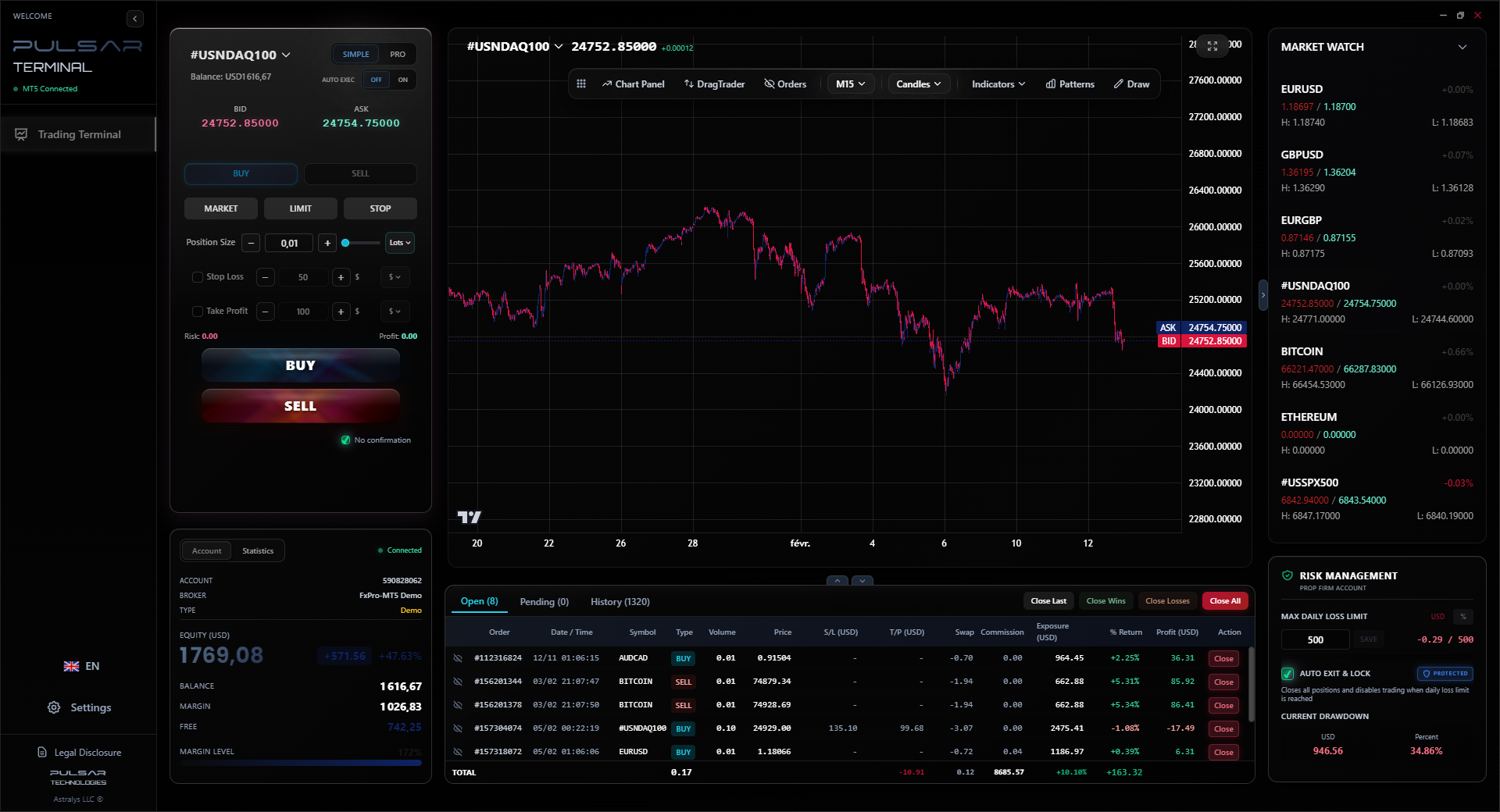
Managing multiple orders and emotions during NFP chaos is nearly impossible manually, which is where a tool like Pulsar Terminal, with its drag-and-drop orders and automated multi-TP/SL management, becomes a trader's anchor in the storm.
“I've blown accounts on NFP Fridays and I've made months of profit in minutes. The difference wasn't luck.”
Let me save you some money by listing my greatest hits of failure:
- Trading Right on the Release: Clicking buy or sell the millisecond the number hits. The slippage is horrific, and you're entering at the absolute worst price. Wait for the first candle to close.
- Ignoring the Revisions: The devil is in the details. That great headline number might be paired with a downward revision of last month's figure from +200k to +110k. That changes everything. Always read the full report summary.
- Trading Exotic Pairs: Trying to trade ZAR/JPY or EUR/TRY during NFP is suicidal. Stick to the most liquid pairs: EUR/USD, GBP/USD, USD/JPY, and if you must, USD/ZAR. Liquidity dries up in exotics, and spreads become canyons.
- Forgetting About Other News: Sometimes, there's a simultaneous release from Canada or a Fed speaker right after. You can get the NFP direction right and still get taken out by an unrelated event.
- Letting Emotions Run the Show: The adrenaline rush is real. Turning a R500 win into a R2,000 loss because you "felt" a reversal is a classic. Have a plan and stick to it. Automate what you can. Setting multiple take-profit levels and a trailing stop after entry can lock in profits without you needing to stare at the screen.
My most expensive lesson? Not having a plan. I went into an NFP with a "let's see what happens" attitude. What happened was I lost discipline, revenge-traded, and wiped out a week's profits in an hour. Now, my plan is written down before 2:29 PM.
💡 Petua Winston
If your hands are sweating 5 minutes before the release, your position is too big. Reduce it by half. Survival is the only profit target for the first 15 minutes.
Here's the truth most gurus won't tell you: You don't have to trade the NFP. It's okay to sit it out. Some of the most consistent traders I know close all their positions 30 minutes before and go for a walk. They come back after an hour and assess the new landscape.
Treat the NFP as a learning event. Even if you don't trade, watch the charts. See how price reacts. Note how USD/ZAR behaves versus gold (XAU/USD), which often moves inversely to the Dollar. This observation is free education.
, understanding the NFP meaning forex is about understanding market psychology. It's a scheduled moment of collective panic and greed. If you can learn to keep your head while others are losing theirs, you've gained a skill that applies to every trading day, not just the first Friday.
Start small. Use a demo. Respect the volatility. The NFP won't make you a trader, but how you handle it will reveal what kind of trader you are.
FAQ
Q1What time is the NFP release in South Africa?
It's released at 8:30 AM US Eastern Time. For South Africa, this is 2:30 PM SAST during South African winter (when the US is on Daylight Saving Time). During South African summer (when the US is on Standard Time), it's 3:30 PM SAST. Always double-check the time zone difference a day before.
Q2Is it better to trade USD/ZAR or EUR/USD during NFP?
EUR/USD is generally more liquid and has tighter spreads, even during volatility. USD/ZAR spreads can widen dramatically (100+ pips), making entry and exit more costly and risky. For most traders, especially beginners, EUR/USD is a safer pair to observe or trade during the event.
Q3What use should I use for NFP trading in South Africa?
Use the minimum use necessary. The FSCA retail limit is 30:1, and that's more than enough. Given the extreme volatility, I often use effective use of 10:1 or less for NFP trades. High use is the fastest way to a margin call on days like this.
Q4Can I get a guaranteed fill on my stop-loss during NFP?
No. In extreme volatility, market orders (including stop-losses) are subject to slippage. Your stop-loss may be filled at a significantly worse price than you set. This is why position sizing is critical - you must be able to absorb worse-than-expected slippage.
Q5Do all South African brokers allow NFP trading?
Yes, but their terms differ. Some may increase margin requirements (reduce effective use) for major news events. Some may not allow pending orders too close to the current price before the release. Always check your broker's specific policy on trading during high-impact news.
Q6Besides the headline number, what should I look at in the report?
The three key components are: 1) The headline jobs change, 2) The Unemployment Rate, and 3) Average Hourly Earnings (wage growth). Also, always check the 'revisions' to the previous two months' data. A revision can completely change the narrative of the current report.
Q7Is trading NFP a good strategy for beginners?
Honestly, no. It's one of the most advanced and risky trading environments. The speed, slippage, and emotional pressure are intense. Beginners should watch and learn from the sidelines using a demo account for many months before considering a live trade.
Pelajaran Prof. Winston
:
- ✓Risk max 0.5% of capital on any NFP trade.
- ✓Wait 15 minutes after release for the real trend.
- ✓Always check wage data and prior revisions.
- ✓Use 30:1 use or less (FSCA limit).
- ✓Wider stops are essential (>100 pips).
Sejauh mana artikel ini berguna?
Klik bintang untuk menilai
Pandangan Dagangan Mingguan
Analisis & strategi mingguan percuma. Tiada spam.
Tentang Penulis
David van der Merwe
Pedagang Pasaran Membangun
Pedagang berpangkalan di Johannesburg dengan 11 tahun dalam mata wang pasaran membangun. Pakar dalam pasangan ZAR, dagangan terkawal FSCA, dan analisis pasaran Afrika Selatan.
Komen
Anda mungkin juga suka

Cara Trading Forex Sukses: 7 Prinsip dari Trader Profesional
Cara trading forex sukses dengan 7 prinsip trader pro: manajemen modal, disiplin, journal trading, backtest. Data nyata, bukan janji profit palsu.
Jam Trading Forex Terbaik untuk Trader Indonesia: Panduan Lengkap dengan Tabel Waktu
Panduan jam trading forex untuk trader Indonesia. Tabel 4 sesi dunia, jam emas 20:00-00:00, sesi mana yang harus dihindari. Data akurat + tips dari trader berpengalaman.
Top 5 Sàn Forex Uy Tín Nhất 2026: Review Jujur dari Trader Indonesia
Top 5 sàn forex uy tín 2026 untuk trader Indonesia. Review jujur: spread, deposit, withdraw, dukungan lokal. Exness, XM, IC Markets & lebih.
All these calculators are built into Pulsar Terminal with real-time data from your MT5 account. One-click position sizing, automatic risk management, and instant calculations.
