


Here's the biggest myth I hear from new traders: 'I'll just use a no deposit bonus to make free money.' If that's your plan, you're already setting yourself up to lose.

David van der Merwe
Pedagang Pasaran Membangun ·  South Africa
☕ 10 minit baca
Apa yang akan anda pelajari:
- 1What Exactly Is a No Deposit Bonus? (It's Not What You Think)
- 2How Bonuses Really Work in the South African Market
- 3Reviewing Real Broker Offers for South Africans
- 4A Realistic Strategy to Convert Bonus to Cash
- 5Pitfalls That Will Wipe Your Bonus (And Your Morale)
- 6The Final Verdict: Are No Deposit Bonuses Worth It?
Here's the biggest myth I hear from new traders: 'I'll just use a no deposit bonus to make free money.' If that's your plan, you're already setting yourself up to lose. These bonuses aren't free cash - they're marketing tools with strings attached so tight they could strangle your trading career before it starts. I've seen too many guys in Joburg and Cape Town get excited about 'free $140' only to blow their chance because they didn't read the fine print. Let me walk you through exactly how these bonuses work in our market, which ones are actually worth your time, and how to turn that bonus into real, withdrawable ZAR without getting your account locked.
A no deposit bonus is exactly what it sounds like: a broker gives you trading credit without requiring you to deposit your own money first. Sounds great, right? Here's the catch - it's almost never free money you can just withdraw. Think of it as a 'demo account with real stakes.' The broker fronts you, say, $30 or $140 in a live trading environment. You can trade with it, and if you make a profit, you might be able to withdraw that profit after jumping through some serious hoops.
The psychology behind this is clever. For you, it feels like risk-free trading. For the broker, it's the most effective customer acquisition tool they have. They get you hooked on their platform, you experience the thrill of real trading (even with their money), and statistically, most traders will lose the bonus capital anyway. I learned this the hard way early on. I took a $50 bonus from an offshore broker, turned it into $300 in two days of aggressive scalping strategy, and then found out I needed to trade 50 standard lots before I could touch a cent. I blew the account trying to hit that impossible volume.
In South Africa, because we're regulated by the FSCA, the offers tend to be a bit more transparent than the wild west of unregulated brokers. But the core principle remains: it's a trial, not a gift.

Warning: The bonus credit itself is virtually never withdrawable. You're only ever working to withdraw the profits you make from it, and only after meeting strict conditions.
Our market has its own quirks. The FSCA's 30:1 use cap for retail traders, set in 2021, changes the game compared to international offers boasting 1000:1. This actually makes a no deposit bonus slightly more manageable here - you can't get over-leveraged and blow the account in one trade as easily.
The Standard Playbook
Nearly every legitimate offer follows this script:
- Sign Up & Verify: You provide your ID, proof of address (a utility bill works), and get your account approved. This is non-negotiable FSCA KYC policy.
- Bonus Credited: The broker drops $30, $50, or sometimes $140 into your live account.
- The Trading Volume Requirement: This is the gatekeeper. To withdraw any profits, you must trade a certain number of lots. The standard formula is 5 to 10 standard lots for every $50 of bonus. So, a $100 bonus might require 20 lots traded.
- The Time Limit: You usually have 7 to 30 days to hit that volume.
- Profit Withdrawal: If you meet the volume, you can apply to withdraw your profits. There's often a cap (e.g., max $100 profit withdrawal from a $30 bonus).
A Real Example from My Trading
Last year, I tested the XM $30 no deposit bonus for this very guide. The terms: trade 10 standard lots to unlock profits. With 30:1 use, that $30 gave me about $900 in buying power (30 * $30). I traded EUR/USD cautiously, aiming for 0.1 lot positions. Each 0.1 lot trade moved me 0.1 towards the 10-lot goal. It took me 100 trades! I used a strict 10-pip stop-loss and a 20-pip take-profit on each EUR/USD scalp. After a week, I'd made a $47 profit and hit the volume. I withdrew the $47 successfully to my FNB account. It worked, but it was a grind, not a lottery win.

Example: Let's say you get a $50 bonus with a '5 lots per $50' rule. You need to trade 5 standard lots. One standard lot is 100,000 units of currency. With a typical spread of 1 pip on EUR/USD, you're paying about $10 in spread cost per lot round trip. Just to break even on costs and unlock profits, you need to make over $50 in profit. It's a high bar.

💡 Petua Winston
A bonus is a test of your patience, not your skill. The broker is betting you'll get impatient and trade too big. Prove them wrong by being boring.
“Your goal with a bonus isn't a 500% return; it's hitting the trading volume without losing the initial credit.”
I've poked and prodded most of these offers. Here’s my take on the current landscape. Remember, always check the broker's own site for the latest terms - they change like the wind in the Karoo.
| Broker | Bonus Amount (USD) | Key Requirement to Withdraw Profits | My Take |
|---|---|---|---|
| XM | $30 | Trade 10 standard lots | One of the most straightforward. FSCA-regulated, low minimum deposit. The 10-lot volume is high but clear. XM review. |
| FBS | $140 (in stages) | Very high trading volume | The 'Level Up' bonus sounds amazing. You get $70, then another $70 for app installs. But the volume required is enormous. Good for practice, unlikely for profit withdrawal. |
| JustMarkets | $30 | Trade 5 lots in 30 days, each trade must have 6 pips P/L | The 6-pip rule is sneaky. It prevents you from making 100 tiny, safe trades. Forces you into riskier territory. Minimum deposit is just $1 though. |
| Tickmill | $30 Welcome Account | Stated in account conditions | A reputable, FSCA-regulated broker. Their offer is clean, but like all, read every word of the terms. Their Raw account is excellent for serious trading later. |
| RaiseFX | $30 | Trade 3 standard lots, max $100 profit withdrawal | The 3-lot volume is one of the lowest I've seen. This makes it one of the more achievable offers for actually getting money out. |
A note on the crazy offers: You'll see ads for '$1000 no deposit bonus!' from brokers like InstaForex. I'm skeptical. The volume requirements on those are typically astronomical, designed so that 99.9% of traders never meet them. They're a lure, not a legitimate opportunity.
Okay, so you want to try. Here's the only method I've found that doesn't end in a blown account or frustration. I call it the 'Volume Grind with Capital Preservation.'
Step 1: Choose Your Instrument Wisely Stick to major forex pairs. EUR/USD, GBP/USD, USD/JPY. Why? They have the tightest spreads and highest liquidity. Every pip in spread you save is a pip closer to your profit goal. Avoid exotic pairs, gold (XAU/USD), and indices with the bonus money. The volatility will eat you alive.
Step 2: Position Size is Everything This is critical. Your $30 bonus is not $30,000. With 30:1 use, you have ~$900 buying power. Do NOT use it all. I never risked more than 5% of the bonus capital on a single trade. That's $1.50. Use a position size calculator religiously. For a $30 account with a 10-pip stop loss, your position size should be around 0.01 lots (a micro lot). This keeps you in the game.
Step 3: The Grind Your goal is not to make 500% return. Your goal is to hit the trading volume requirement without losing the bonus. Aim for small, consistent trades. I'd look for 10-15 pip moves on the 5-minute chart, using basic support/resistance. Each 0.01 lot trade adds 0.01 to your volume tally. It's boring. It's slow. But it's the only way.
Step 4: Withdrawal and The Deposit Catch Here's another gotcha. Some brokers, like XGLOBAL FX, will let you withdraw your bonus profits... but only after you've made a real deposit first (e.g., $100 or 1500 ZAR). They've now converted you from a bonus hunter to a deposited client. It's a smart business move. Factor this into your plan.

Pro Tip: Before you even take the bonus, open the broker's Terms and Conditions PDF. Use Ctrl+F and search for 'bonus', 'withdrawal', 'volume', and 'lot'. Read those paragraphs three times. That's where the truth is.
💡 Petua Winston
If the terms and conditions for the bonus are longer than two pages, walk away. Complexity is a weapon used against you.
“The spread on a tiny bonus account isn't just a cost; it's the wall you have to climb before you even see a profit.”
I've made these mistakes so you don't have to.
1. Chasing the Volume with Huge Trades. This is the killer. You have 7 days left and need 8 more lots. The temptation is to slap on a 1.0 lot trade to get it done. This is a guaranteed way to get a margin call on a $30 account. The market will gap against you, and your bonus - and any profit - is gone in seconds.
2. Ignoring the Spread. On a tiny account, the spread is your enemy. If you're scalping for 5 pips but the spread is 3 pips, you need an 8-pip move just to be up 2 pips. It's a brutal math game. Always calculate your breakeven point including the spread.
3. Treating It Like 'Play Money'. The psychological shift is subtle but dangerous. Because it's 'not your money,' you take risks you never would with your own R500 deposit. This lack of emotional connection leads to reckless trading. You have to treat every cent as if it came from your own pocket.
4. Not Understanding the 'Profit' Calculation. Some brokers calculate your 'withdrawable profit' as your total balance minus the bonus. So if you get a $30 bonus, grow your account to $80, your 'profit' is $50. If you then have a losing trade that drops you to $40, your 'profit' is now only $10. If you withdraw then, you only get $10. They lock in your profit only at the moment of withdrawal request.
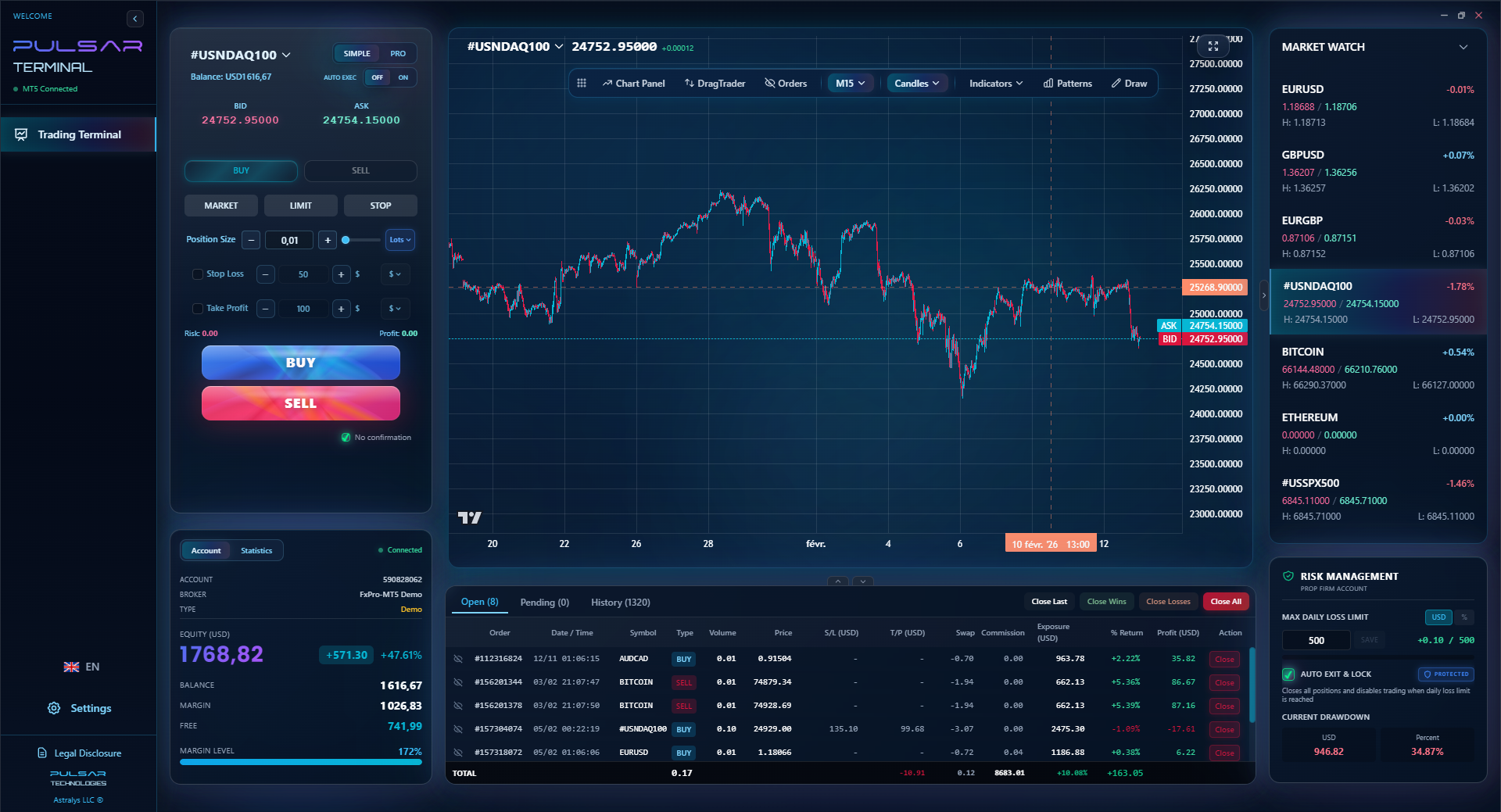
Managing the precise, small trades needed to hit bonus volume requirements is tedious; Pulsar Terminal's drag-and-drop order tools and one-click partial closures make executing this 'volume grind' strategy far faster and less error-prone on MT5.
It depends on your goal.
Yes, they are worth it IF:
- Your goal is to test a broker's platform - execution speed, slippage, customer service - in a live environment without risking your capital.
- You want to practice live trading psychology with a tiny, finite stake. The fear and greed are real, even with $30.
- You have the patience for the 'volume grind' strategy and see it as a challenging, low-stakes puzzle.
No, they are a waste of time IF:
- You think this is a way to get rich quick or fund your trading career.
- You lack the discipline to trade micro lots for weeks on end.
- You're easily frustrated by complex terms and conditions.
For most serious South African traders, your time is better spent: opening a proper demo account to hone your strategy, then funding a live account with an amount you can afford to lose (even if it's just $50 or 1000 ZAR) with a reputable broker like Pepperstone or IC Markets. You'll have full control, no withdrawal restrictions, and you'll be building your actual trading history.
The no deposit bonus forex account is a fascinating corner of our market. It can be a useful tool, but it's a tool with very specific, limited uses. Go in with your eyes wide open, treat it as a paid internship (where the pay is uncertain), and you might just learn something valuable without costing yourself a rand.
FAQ
Q1Can I actually withdraw money from a no deposit bonus in South Africa?
Yes, but not the bonus itself. You can only apply to withdraw the profits you generate from trading the bonus, and only after meeting specific trading volume requirements (like trading 5-10 standard lots per $50 of bonus). There's often a maximum profit withdrawal limit too.
Q2What's the best no deposit bonus for beginners?
For a complete beginner, the XM $30 bonus or the RaiseFX $30 bonus are decent starting points due to their relatively clear terms and FSCA regulation. However, I'd strongly suggest using a full demo account first to learn the basics without any strings attached.
Q3Do I need to pay tax on profits from a no deposit bonus?
In South Africa, SARS views all income as taxable. If you successfully withdraw profits, that constitutes income. It's your responsibility to declare it, though for small amounts (like the $47 I made), it often flies under the radar. For significant sums, consult a tax professional.
Q4Why do brokers offer these bonuses if they lose money?
They statistically don't lose money. The vast majority of traders fail to meet the withdrawal conditions or lose the bonus capital trading. The bonus cost is a marketing expense that acquires new clients. Even if you withdraw $100 profit, they've now gained a verified, active trader who is likely to deposit more of their own money.
Q5Is there a minimum deposit required later to withdraw?
Sometimes, yes. This is a common 'second catch.' Brokers like RoboForex or XGLOBAL FX may require you to make a small real deposit (e.g., $10-$100) before they process the withdrawal of your bonus profits. Always check the terms for this clause.
Q6Can I use a no deposit bonus with prop firm challenges?
Almost never. Prop firms have their own strict rules and funded accounts. A no deposit bonus from a retail broker is completely separate and won't help you pass a prop firm challenge, which tests your strategy and risk management on a simulated account.
Pelajaran Prof. Winston
:
- ✓The bonus credit itself is never withdrawable, only potential profits.
- ✓You must trade 5-10 standard lots per $50 bonus to unlock withdrawals.
- ✓Stick to major pairs like EUR/USD to minimize spread costs.
- ✓Never risk more than 5% of the bonus on a single trade.
- ✓Always read the withdrawal terms before you place your first trade.
Sejauh mana artikel ini berguna?
Klik bintang untuk menilai
Pandangan Dagangan Mingguan
Analisis & strategi mingguan percuma. Tiada spam.
Tentang Penulis
David van der Merwe
Pedagang Pasaran Membangun
Pedagang berpangkalan di Johannesburg dengan 11 tahun dalam mata wang pasaran membangun. Pakar dalam pasangan ZAR, dagangan terkawal FSCA, dan analisis pasaran Afrika Selatan.
Komen
Anda mungkin juga suka

Cara Trading Forex Sukses: 7 Prinsip dari Trader Profesional
Cara trading forex sukses dengan 7 prinsip trader pro: manajemen modal, disiplin, journal trading, backtest. Data nyata, bukan janji profit palsu.
Jam Trading Forex Terbaik untuk Trader Indonesia: Panduan Lengkap dengan Tabel Waktu
Panduan jam trading forex untuk trader Indonesia. Tabel 4 sesi dunia, jam emas 20:00-00:00, sesi mana yang harus dihindari. Data akurat + tips dari trader berpengalaman.
Top 5 Sàn Forex Uy Tín Nhất 2026: Review Jujur dari Trader Indonesia
Top 5 sàn forex uy tín 2026 untuk trader Indonesia. Review jujur: spread, deposit, withdraw, dukungan lokal. Exness, XM, IC Markets & lebih.
All these calculators are built into Pulsar Terminal with real-time data from your MT5 account. One-click position sizing, automatic risk management, and instant calculations.
