


You're probably wondering: does the oldest forex broker in the world automatically mean it's the safest or best for me? Here's the blunt truth from someone who's traded through three market crashes: age doesn't equal suitability, especially for us trading from South Africa.

David van der Merwe
Pedagang Pasaran Membangun ·  South Africa
☕ 11 minit baca
Apa yang akan anda pelajari:
- 1What "The Oldest Forex Broker in the World" Actually Means
- 2The South African Forex Landscape: Rules, Rand, and Reality
- 3Forget Age: Your South African Broker Selection Criteria
- 4Top FSCA-Regulated Brokers for South Africans (2025)
- 5Mistakes I Made (So You Don't Have To)
- 6A Quick Word on Trading Gold (XAU/USD) from SA
- 7The Final Verdict: History vs. Practicality
You're probably wondering: does the oldest forex broker in the world automatically mean it's the safest or best for me? Here's the blunt truth from someone who's traded through three market crashes: age doesn't equal suitability, especially for us trading from South Africa. While firms like Sucden Financial (founded 1973) or Interactive Brokers (1977) hold the historical titles, they often cater to massive institutions, not the retail trader in Johannesburg or Cape Town trying to make sense of USD/ZAR volatility. Your real focus should be on who's licensed by the FSCA, who offers decent spreads on Rand pairs, and who won't vanish with your deposit. Let's separate the museum pieces from the practical tools.
When you hear that phrase, you picture a venerable institution with decades of wisdom, right? The reality is more nuanced, and frankly, a bit boring for our purposes.
The title of the oldest forex broker in the world usually goes to Sucden Financial, founded in 1973. That's over 50 years in the game. But here's the kicker: they're not really your broker. They're a prime broker for other financial institutions, hedge funds, and corporates. Their minimum trade sizes are in the millions, not the hundreds of Rands you and I are working with. Interactive Brokers (1977) and HYCM (1977) are also ancient by market standards, but their focus and accessibility vary wildly.
Why does this matter to you? Because longevity in finance often signals stability, but it doesn't guarantee they're set up for the South African retail trader. A broker could have been around since the 70s but offer terrible spreads on USD/ZAR, have clunky ZAR deposit options, or provide zero local customer support. I learned this the hard way early on. I opened an account with a famously old European broker, lured by their history. Their platform was solid, but funding from my Standard Bank account took 5 business days and cost a fortune in fees. Closing a trade on the EUR/ZAR pair felt like moving through syrup compared to the slick execution I later got with a more modern, FSCA-focused broker like IC Markets.

Warning: Don't confuse a broker's age with its regulatory standing in your jurisdiction. A broker founded in 1996 but fully licensed by the FSCA is infinitely safer for you than a 50-year-old firm operating under a dubious offshore license.
The takeaway? Use the concept of the oldest forex broker as a benchmark for industry endurance, but never as your primary selection criteria. Your checklist starts with FSCA regulation, not founding date.

💡 Petua Winston
A broker's age is a fact. Its suitability for you is the only opinion that matters. Verify the FSCA license first, last, and always.
Trading from South Africa isn't like trading from London or New York. We have our own rules, our own volatile currency, and our own set of practical challenges. You need a broker that gets this.
Regulation: The FSCA is Your First and Last Check
The Financial Sector Conduct Authority (FSCA) is the sheriff in town. Any broker you seriously consider must be on their register. This isn't a nice-to-have; it's non-negotiable. FSCA regulation means client funds are segregated (your money is kept separate from the broker's operating cash), and the broker has to play by a set of fair conduct rules. I verify every single broker's FSCA license number on the authority's website before I even look at their spreads. It takes two minutes and has saved me from at least three shady operators over the years.
Trading the ZAR: It's a Wild Ride
The South African Rand is an emerging market currency. It's liquid but famously volatile. A political headline or a shift in gold prices can send USD/ZAR swinging hundreds of pips in a session. This is where your broker's execution and spreads matter critically.
Let's talk numbers. On a major pair like EUR/USD, you might find raw spreads of 0.0 pips (plus a commission). On USD/ZAR, don't expect that. A good, tight spread might be around 5 pips. On exotic crosses like EUR/ZAR, you're looking at 14 pips or more. I once got caught in a widening spread on GBP/ZAR during a Brexit news event - the spread ballooned to over 25 pips, instantly putting my trade deep in the red. This is why understanding the spread definition and how it affects your position size calculator is crucial for survival here.
How to Actually Get Your Money In and Out
Local payment methods are a deal-breaker. The best broker in the world is useless if you can't fund your account efficiently. Look for brokers that offer:
- Instant EFTs (like Ozow, PayFast)
- Local bank wire transfers to a South African account
- ZAR-denominated accounts to avoid conversion fees (which can nibble away 1.2% or more per conversion)
Brokers like XM and Exness have really nailed this local aspect, making deposits and withdrawals feel almost like moving money between your own accounts.
“Your checklist starts with FSCA regulation, not founding date.”
Here’s what you should actually care about, in order of importance.
- FSCA License: Verified on the official website. Full stop.
- Trading Costs on ZAR Pairs: Look at the typical spreads for USD/ZAR and EUR/ZAR, not just EUR/USD. Also check if they charge commissions on these pairs.
- Minimum Deposit & use: You don't need R50,000 to start. Many solid brokers allow deposits from $5 (Roughly R90) to $200 (Roughly R3,600). Be smart about use. While offers of 1:500 or 1:1000 are common, using that much on the volatile ZAR is a one-way ticket to a margin call. I never use more than 1:50 on Rand pairs.
- Platform & Tools: MT4 and MT5 are the standards here. But does the broker offer good integration, fast execution, and the tools you need? For my swing trading on daily charts, I need reliable access to tools like the MACD indicator and the RSI indicator.
- Local Support: Can you call someone in SA during market hours? Do they understand what "load-shedding" means when your internet drops?

Example: Let's compare two realistic starting scenarios for a South African trader:
| Feature | Scenario A (Low Cost Focus) | Scenario B (Premium Tools Focus) |
|---|---|---|
| Broker Example | Fusion Markets, XM | IC Markets, Pepperstone |
| Min. Deposit | $0 - $5 | $200 |
| USD/ZAR Spread | ~6-8 pips | ~5-7 pips |
| Platform | MT4/MT5 | MT4/MT5, cTrader |
| Best For | Beginners keeping costs minimal | Serious traders needing top-tier execution |
My own journey started with a Scenario A broker (a $10 minimum deposit). It was perfect for learning without risk. After 18 months and a few profitable quarters, I moved to a Scenario B broker for the sharper execution, which matters more when your account size grows.
Based on my experience and the constant chatter among local trading circles, these are the names that consistently come up for the right reasons. Remember, the oldest forex broker in the world isn't on this list, because these are the ones that work for us.
- IC Markets: My personal primary broker for raw spreads. FSCA licensed, fantastic execution on MT5 and cTrader. Their USD/ZAR spreads are among the tightest I've seen. Minimum deposit is $200, which is a reasonable commitment for serious trading. I've had orders filled instantly during major SA data releases, which is the ultimate test.
- Pepperstone: Another heavyweight with a strong FSCA presence. Their Razor account is superb for active traders. They offer excellent educational resources that are relevant to global and local markets.
- Exness: Unbeatable for flexibility and low entry. FSCA regulated, with a minimum deposit as low as $10. They have a massive local user base because they've made deposits/withdrawals incredibly easy. Their spreads on majors are tight, though ZAR pairs can be slightly wider.
- XM: A veteran in the retail space. Heavily regulated, including by the FSCA. Famous for their customer service and educational support. They run regular trading seminars in Johannesburg and Cape Town, which is a huge plus for beginners.
- Tickmill: Offers very competitive conditions with FSCA protection. Their Pro account has low spreads and fair commissions. A solid, no-nonsense choice.
Here's a real trade example from last month on IC Markets: I went long on USD/ZAR at 18.7250, based on a breakdown of a key support level on the 4-hour chart combined with a strong bearish move in gold (which often pressures the ZAR). I used a modest position size calculator for a 1.5% risk. I set two take-profit levels (partial closure is key). TP1 hit at 18.8150 (+90 pips), TP2 hit at 18.8700 (+145 pips). The spread on entry was 5.2 pips. The execution was flawless, no requotes. That's the practical benefit of a good, modern broker.
💡 Petua Winston
Your first withdrawal request is the most important trade you'll ever make with a new broker. Test it with a small amount immediately.
“use is a tool, not a strategy. For ZAR pairs, start with 1:20 or 1:30 max.”
I've blown up accounts. I've paid stupid fees. Learn from my errors.
Pitfall 1: Chasing the Highest use. A broker offered me 1:1000. I thought, "Great! I can turn R1,000 into a fortune!" On my third trade, a 10-pip move against me on GBP/JPY wiped out 30% of my account. use is a tool, not a strategy. For ZAR pairs, start with 1:20 or 1:30 max until you have the stomach for their swings.
Pitfall 2: Ignoring the Total Cost of a Trade. I once took a scalping strategy on EUR/USD with a broker that had "zero spread." I made 5 pips, 10 times in a day. Felt like a genius. Then I saw the commission charges: $7 per round lot. I'd paid $70 in commissions to make $50 in profit. Always calculate the spread + commission as your total entry/exit cost. This is especially critical for fast strategies.
Pitfall 3: Not Testing Withdrawal First. I deposited R5,000 with a new, shiny broker. Traded it to R7,500. The withdrawal took 12 days, involved three support tickets, and they tried to deduct a "processing fee" not listed anywhere. Now, my first action with any new broker is to deposit the minimum, then immediately request a withdrawal of that same amount. If it comes back to my bank account smoothly and within a few days, they pass the test. If it's a hassle, I close the account. Exness and XM have always been fastest for me, often within 24 hours.

Pro Tip: Before you fund a new broker, do a dummy trade on their demo account during South African market hours (when JSE is open). Watch the spreads on USD/ZAR. If they widen uncontrollably, that broker's liquidity for our local market is poor. Move on.
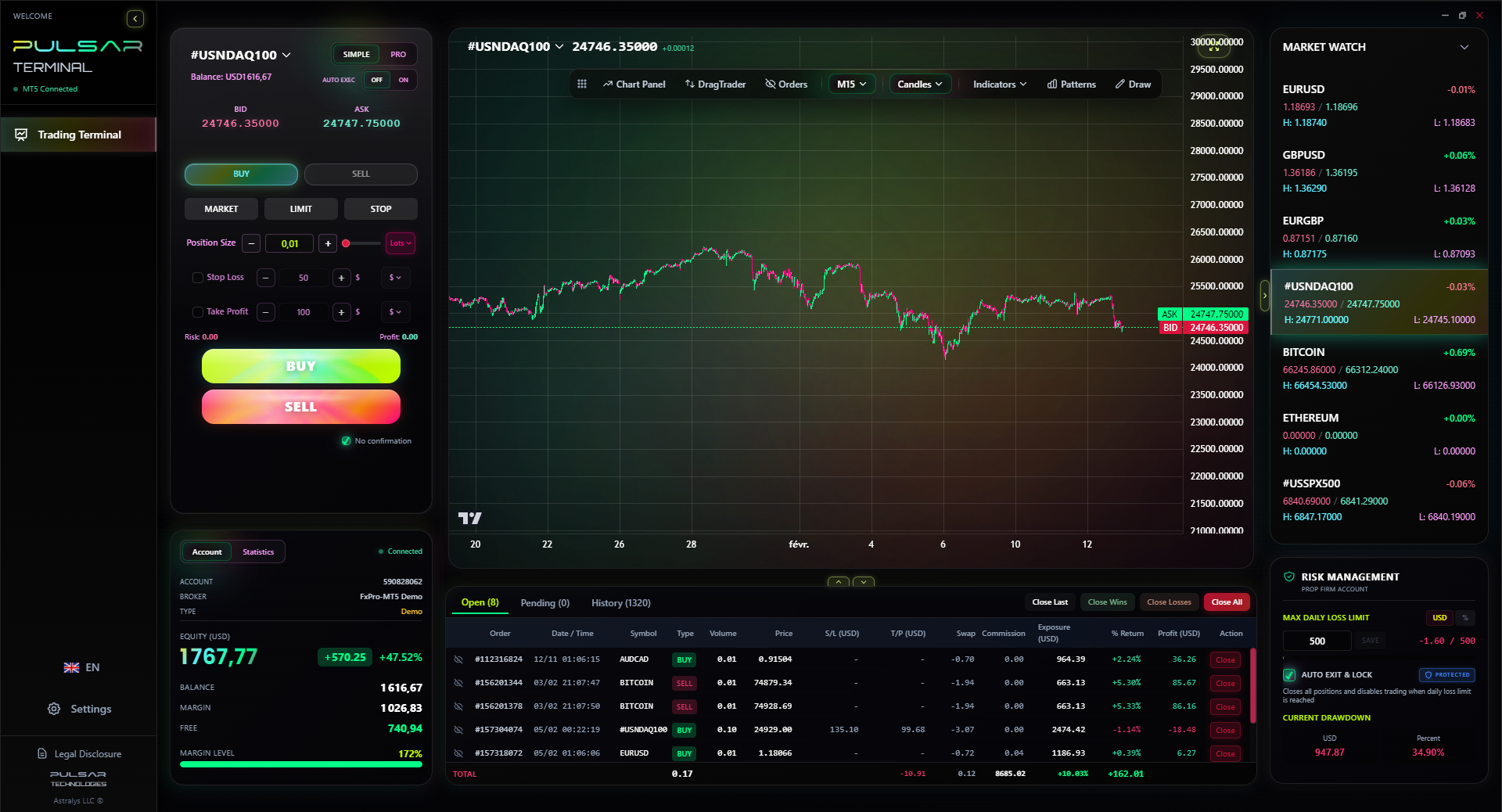
Managing volatile trades on Rand pairs requires precise order tools, which is why a platform enhancer like Pulsar Terminal, with its drag-and-drop orders and multi-take-profit management, is so valuable for MT5 users.
It's not forex, but so many of us trade it because gold is in our soil and our market psyche. The principles for choosing a broker are similar: FSCA regulation, good execution.
Gold (XAU/USD) is often quoted in US Dollars, so you're exposed to the USD/ZAR rate when you profit. Some brokers offer XAU/ZAR, but liquidity is much lower. I stick to XAU/USD. The key is finding a broker with tight spreads (under 0.30 is good) and reliable execution during volatile periods, like US Fed announcements. Brokers like Pepperstone and IC Markets are consistently good here.
I once held a gold swing trade through a major CPI report. The price spiked $50 in minutes. My broker's platform held up, my stop-loss was honored exactly where I set it (a rare blessing), and the profit was in my account instantly. That's the stability you're looking for, more than a historical founding date. For a deeper look, check out our dedicated XAU/USD guide.
💡 Petua Winston
On the ZAR, a 20-pip stop-loss is a prayer, not a plan. Respect the volatility and give your trades room to breathe.
“The right broker is the one that fades into the background, providing a stable platform for your strategy to shine.”
So, should you care about the oldest forex broker in the world? As a piece of trivia, sure. As a guiding light for your trading in South Africa, absolutely not.
Your journey is about finding a partner that understands the FSCA rulebook, provides fair access to the volatile Rand, and gets your money back to your Nedbank or Capitec account without drama. The brokers I've listed have proven themselves on these practical, gritty, everyday metrics.
Start small. Pick a broker from the list above that matches your starting capital. Use a demo account relentlessly. Learn how the ZAR moves. Practice your risk management until it's boring. The right broker is the one that fades into the background, providing a stable, low-friction platform for your strategy to shine. That's worth more than any 50-year-old corporate history.
Now, go check the FSCA register. Then open a demo account. Stop reading, start testing. That's where the real education begins.
FAQ
Q1Is the oldest forex broker, Sucden Financial, available to retail traders in South Africa?
No, not really. Sucden Financial, founded in 1973, is primarily a prime broker for institutions and professional clients. Their services, minimum trade sizes, and account structures are not designed for the average retail trader in SA. You'd be better off with an FSCA-regulated retail broker like IC Markets or XM.
Q2What is the single most important thing to check before choosing a forex broker in South Africa?
The broker's FSCA (Financial Sector Conduct Authority) license. Verify the license number on the official FSCA website. This ensures they are legally allowed to operate here, must segregate client funds, and adhere to local financial conduct rules. Everything else (spreads, platforms) is secondary to this safety check.
Q3Why are spreads on USD/ZAR so much higher than on EUR/USD?
USD/ZAR is an exotic currency pair, meaning it's less liquid and traded in lower volumes than major pairs like EUR/USD. The higher spread (often 5-8 pips vs. under 1 pip) compensates the broker and liquidity providers for the higher risk and cost of facilitating the trade in a less liquid market. It's the cost of trading our local currency.
Q4Can I start trading forex in South Africa with R500?
Technically, yes. Some brokers allow deposits as low as $5 (approx. R90). But practically, it's a bad idea. With R500, even tiny market moves amplified by necessary use will likely trigger margin calls or leave you unable to place sensible trades with proper stop-losses. A more realistic and safer starting point is between R1,500 and R5,000.
Q5Are my forex trading profits taxable in South Africa?
Yes. Profits from forex trading are generally considered taxable income by SARS (South African Revenue Service). You should declare them as part of your annual income tax return. It's crucial to keep detailed records of all your trades, deposits, and withdrawals for tax purposes. Consult with a local tax professional who understands trading.
Q6What's better for a beginner: MT4 or MT5?
For a complete beginner, MT4 is often simpler and has more than enough features. Its interface is slightly less cluttered, and there's a mountain of free educational content and custom indicators built for it. MT5 is more powerful (more timeframes, more order types, an economic calendar) and is the future. Most FSCA brokers offer both, so you can start on MT4 and graduate to MT5 later.
Q7Is high use (like 1:500) a good thing for a new trader?
No, it's a trap. High use magnifies both profits and losses. For a new trader still learning risk management, it dramatically increases the chance of blowing up your account with a single bad trade. I recommend beginners start with use no higher than 1:30, especially on volatile pairs like ZAR crosses. It forces you to focus on trade quality, not just quantity.
Pelajaran Prof. Winston
:
- ✓FSCA license verification is non-negotiable.
- ✓USD/ZAR spreads under 6 pips are competitive.
- ✓Test withdrawals before committing serious capital.
- ✓Start with use under 1:30 on Rand pairs.
- ✓A minimum of R1,500 is a realistic starting point.
Sejauh mana artikel ini berguna?
Klik bintang untuk menilai
Pandangan Dagangan Mingguan
Analisis & strategi mingguan percuma. Tiada spam.
Tentang Penulis
David van der Merwe
Pedagang Pasaran Membangun
Pedagang berpangkalan di Johannesburg dengan 11 tahun dalam mata wang pasaran membangun. Pakar dalam pasangan ZAR, dagangan terkawal FSCA, dan analisis pasaran Afrika Selatan.
Komen
Anda mungkin juga suka

Cara Trading Forex Sukses: 7 Prinsip dari Trader Profesional
Cara trading forex sukses dengan 7 prinsip trader pro: manajemen modal, disiplin, journal trading, backtest. Data nyata, bukan janji profit palsu.
Jam Trading Forex Terbaik untuk Trader Indonesia: Panduan Lengkap dengan Tabel Waktu
Panduan jam trading forex untuk trader Indonesia. Tabel 4 sesi dunia, jam emas 20:00-00:00, sesi mana yang harus dihindari. Data akurat + tips dari trader berpengalaman.
Top 5 Sàn Forex Uy Tín Nhất 2026: Review Jujur dari Trader Indonesia
Top 5 sàn forex uy tín 2026 untuk trader Indonesia. Review jujur: spread, deposit, withdraw, dukungan lokal. Exness, XM, IC Markets & lebih.
All these calculators are built into Pulsar Terminal with real-time data from your MT5 account. One-click position sizing, automatic risk management, and instant calculations.
