


Here's a number that gets everyone's attention: a top-tier forex affiliate in South Africa can earn more from one referred client's lifetime losses than from their own successful trades.

David van der Merwe
Pedagang Pasaran Membangun ·  South Africa
☕ 11 minit baca
Apa yang akan anda pelajari:

Here's a number that gets everyone's attention: a top-tier forex affiliate in South Africa can earn more from one referred client's lifetime losses than from their own successful trades. That's the uncomfortable truth behind the glossy 'passive income' promises. I've been on both sides of this game for over a decade, collecting cheques and watching friends blow accounts they signed up for. This isn't a hype piece. It's a breakdown of how these programs actually work under South African law, what you can realistically earn, and the ethical tightrope you'll walk.
At its core, a forex affiliate program is a commission deal. You refer a new client to a broker, and you get paid based on their trading activity. It's not a salary. It's a performance-based revenue share, and the structure is everything.
Forget the fancy terms. You're a freelance recruiter for the broker. The broker wants active traders (specifically, traders who generate transaction costs). Your job is to find them. In South Africa, this isn't some grey-area side hustle. It's a regulated commercial activity if you're serious about it. The Financial Sector Conduct Authority (FSCA) has its eyes on this, especially regarding how you market and what promises you make.
The payout models are where you need to focus:
- CPA (Cost Per Acquisition): A flat fee for a verified, deposited account. Simple, clean, and my personal favourite when starting. You might get $200-$500 per qualified trader. The catch? The trader can deposit R1,000, lose it in a day, and you still only get that flat fee. No long-term upside.
- Revenue Share: This is the famous 'lifetime value' model. You get a percentage of the broker's revenue from your client's trading - forever (or as long as they trade). This is usually 20%-40% of the spread and commission they pay. This is where the real money is, but it's also where the moral conflict lives. Your income is directly tied to their transaction costs, not their profitability.
- Hybrid: A smaller CPA upfront plus a reduced revenue share. A good compromise.

Warning: If a program promises 'rebates' or 'cashback' to the trader through you, tread carefully. This can blur lines with unlicensed financial services in the eyes of the FSCA. You're an affiliate, not a fund manager.
The key is understanding that your asset isn't a website; it's your reputation and audience. Whether it's a YouTube channel, a Telegram group, or just a network of friends at the braai, that's your marketing channel. Choosing the right broker partner is your first major decision. I've had good, consistent payouts from global brokers with strong local support like IC Markets and Pepperstone. Their affiliate systems are transparent and they understand the SA market.

💡 Petua Winston
Your first ten affiliate Rand should go to a lawyer for a basic consult on marketing compliance. It's cheaper than an FSCA fine.
Let's cut the nonsense. You won't get rich from 10 referrals. The maths is brutal but simple.
The Reality of Revenue Share
Say you refer "Mike from Durban." Mike deposits R20,000. He's a typical retail trader - he overtrades. He might generate an average of 5 lots per month. If the average spread on EUR/USD is 1.2 pips, that's about $6 per lot in cost (0.00012 * 100,000). 5 lots = $30 in monthly revenue for the broker.
Your cut at 30% revenue share is $9 per month. About R160. That's not quitting-your-job money. It's a tank of petrol. Mike would need to trade like that for over 16 months just for you to earn back a modest R2,500 CPA fee.
Where it changes is with high-volume traders or, darkly, consistent losers who churn their account. A trader who deposits and loses R20,000 three times a year is a goldmine for the broker and, by extension, for you on revenue share. This is the unspoken core of the business model.
A Personal Example (The Good)
My most successful referral period was 2017-2019. I had a strategy website and was honest about my swing trading approach. I referred about 50 active traders over two years to a broker with a 25% revenue share. My average monthly earnings stabilized around $1,200. That's R21k a month at today's rates. Not life-changing, but a serious secondary income. Crucially, these were educated traders who lasted. The key was quality over quantity.
A Personal Example (The Bad)
Early on, I partnered with a shady broker offering a $800 CPA. I pushed hard on social media, got 15 sign-ups in a month. Payout: $12,000. Felt like a king. Then, 14 of those 15 traders blew their accounts within 60 days. I made my money, but I killed my reputation with that audience. They felt burned by the broker's dodgy execution (slippage was horrific) and associated me with it. The short-term win cost me long-term trust. Never again.

Example: Let's model a semi-successful affiliate. You refer 5 traders per month. 60 per year. With a 50% activation rate (they actually deposit), that's 30 funded traders.
- CPA Model ($300 each): 30 traders * $300 = $9,000/year (≈ R162,000).
- Revenue Share Model: Assume 10 are active long-term, generating $50/month broker revenue each. Your 30% cut: 10 * ($50 * 0.30) * 12 months = $1,800/year (≈ R32,400). See the difference? Volume matters for CPA. Quality and longevity matter for revenue share.
“The short-term win cost me long-term trust. Never again.”
This is the section most 'gurus' skip. You can't just slap up a Facebook page and start pushing links. The FSCA is increasingly vigilant about the marketing of financial products.
1. You Are Advertising a Financial Service. Even as an affiliate, you are promoting access to leveraged OTC derivatives. Your marketing must be fair, clear, and not misleading. That means:
- No guaranteed profits. Ever.
- Prominent risk warnings. Not hidden in tiny text.
- Clear disclosure that you are paid for referrals.
2. Tax Man Cometh. Your affiliate income is taxable business income. SARS will want its share. Keep records of every payment. If you're earning consistently, consider registering as a sole proprietor. I got a nasty surprise back in 2015 with a tax bill on income I'd foolishly considered 'bonuses.'
3. The Ethical Heart of Darkness. This is the big one. Your financial incentive as an affiliate is misaligned with your follower's success. You profit from their trading activity, not their profits. This creates a perverse incentive to encourage more trading, riskier trading, or to promote brokers with higher costs.
The only way to sleep at night is to consciously align yourself with the trader's success. This means:
- Only promoting brokers you genuinely trust, with tight spreads and good execution. (My reviews of Exness and XM come from this place).
- Providing genuine educational content that helps people manage risk. Teach them about position size calculators and what a margin call really means.
- Being transparent about your affiliate relationship in every single post, video, or conversation.
You're building a business, not running a scam. The long-term players in the SA affiliate space understand that trust is the only real currency.
Ready to give it a shot? Don't quit your day job. Follow this sequence.
Step 1: Choose Your Niche & Platform. Are you a scalper? A gold bug? Focus there. Your content will attract a specific crowd. Platform? Start where you're comfortable. YouTube for tutorials, a simple blog for strategy write-ups, Twitter/X for daily commentary. I started with a basic WordPress blog analysing gold (XAU/USD) setups.
Step 2: Select 1-2 Broker Partners. Do not sign up for 10 networks. It's messy and you can't properly track. Research brokers that:
- Accept South African clients seamlessly.
- Have a reputable, transparent affiliate program with reliable monthly payments (ask for payment proofs!).
- Offer competitive trading conditions (low spreads on majors).
- Provide you with proper tracking links and marketing materials.
Step 3: Create Value-First Content. For 3-6 months, just create useful content. No hard selling. Explain how the MACD indicator works. Share a lesson on why you got stopped out on a EUR/USD trade (here's my EUR/USD guide for reference). Build an audience that trusts your analysis.
Step 4: Integrate Affiliate Links Naturally. Only after you have an audience, mention your broker. Do it like this: "I use XYZ Broker for my trading. They have tight spreads on the Euro, which is key for my strategy. If you're looking for a broker, you can check them out here [link]. I do get a commission if you sign up, which helps support this channel." Transparency disarms scepticism.
Step 5: Track, Analyse, Optimise. Use the affiliate dashboard. See which content drives sign-ups. Double down on what works. Is your audience responding to live trade analysis? Do more. Are they ignoring broker comparisons? Stop wasting time.

Pro Tip: Your most powerful tool is a simple 'Broker Comparison' page on your site. Objectively compare 2-3 brokers you're affiliated with on spreads, minimum deposit, platforms. It's useful content that naturally funnels readers to your links. Update it quarterly.
💡 Petua Winston
Track your time spent creating content. If you're earning R500 a month but spending 40 hours on it, you're working for less than minimum wage. Treat it like a business from day one.

“In affiliate marketing, trust is the only real currency that doesn't devalue.”
Learn from my wallet and my reputation.
Pitfall 1: Chasing High CPA Offers. The broker offering $500 CPA when others offer $200 is usually a bucket shop with terrible execution. Your referrals will have a bad experience and blame you. The broker's high CPA is a clue they expect the client's lifetime value to be short and brutal.
Pitfall 2: Not Disclosing the Relationship. This is a fast track to losing all credibility. The SA trading community is tight-knit. Word gets around. Always disclose.
Pitfall 3: Promoting Trading as 'Easy Money.' Besides being illegal, it attracts the worst kind of client - the one who will deposit R5,000, lose it in an hour on a scalping strategy they don't understand, and then chargeback their deposit. You'll get no commission and a strike on your affiliate account.
Pitfall 4: Ignoring Your Own Trading. I got so wrapped up in building affiliate content in 2020 that my own trading journal gathered dust. My performance slipped. Remember, your trading edge is your primary source of authority. Never let it get dull. Use tools that make your analysis and order management sharper, so you have more time for both trading and content.
Pitfall 5: Putting All Eggs in One Basket. What if your main broker changes its affiliate terms or closes its SA office? Have a second-tier partner. Don't let 100% of your affiliate income depend on one company's policy change.
Once you have a system that works, here's how to grow.
1. Diversify Your Traffic Sources. Don't rely only on YouTube. Repurpose content: turn a video script into a blog post, key points into Twitter threads, charts into Instagram carousels. Use SEO basics to get organic search traffic for terms like 'best forex broker South Africa.'
2. Build an Email List. This is your most valuable asset. Offer a free PDF (like 'My 5 Key Risk Management Rules') in exchange for an email. Now you can communicate directly, without algorithm interference. Send weekly market updates with valuable insights, occasionally mentioning your broker.
3. Consider Paid Advertising (Carefully). This is advanced. You can use Google Ads or Facebook Ads to target South Africans interested in forex. But you must know your numbers. If your cost per click is R5 and your conversion rate to a deposited account is 2%, your cost per acquisition is R250. Is that lower than your CPA or projected lifetime value? If not, you're losing money.
4. Create Your Own Products. This is the ultimate goal. Use your affiliate income to fund the creation of a real product - a detailed course, a set of custom indicators, a paid community. Now you have a business that isn't dependent on broker payouts. Your affiliate income becomes the marketing budget for your own brand.
5. Automate and Systematise. As you grow, you can't do everything manually. This is where professional tools pay for themselves. For your own trading, using a platform that lets you set complex order types, trailing stops, and manage multiple positions efficiently saves hours a week. Those are hours you can pour into creating better affiliate content.
Remember, scaling is a function of trust multiplied by reach. Increase both, without sacrificing the first for the second.
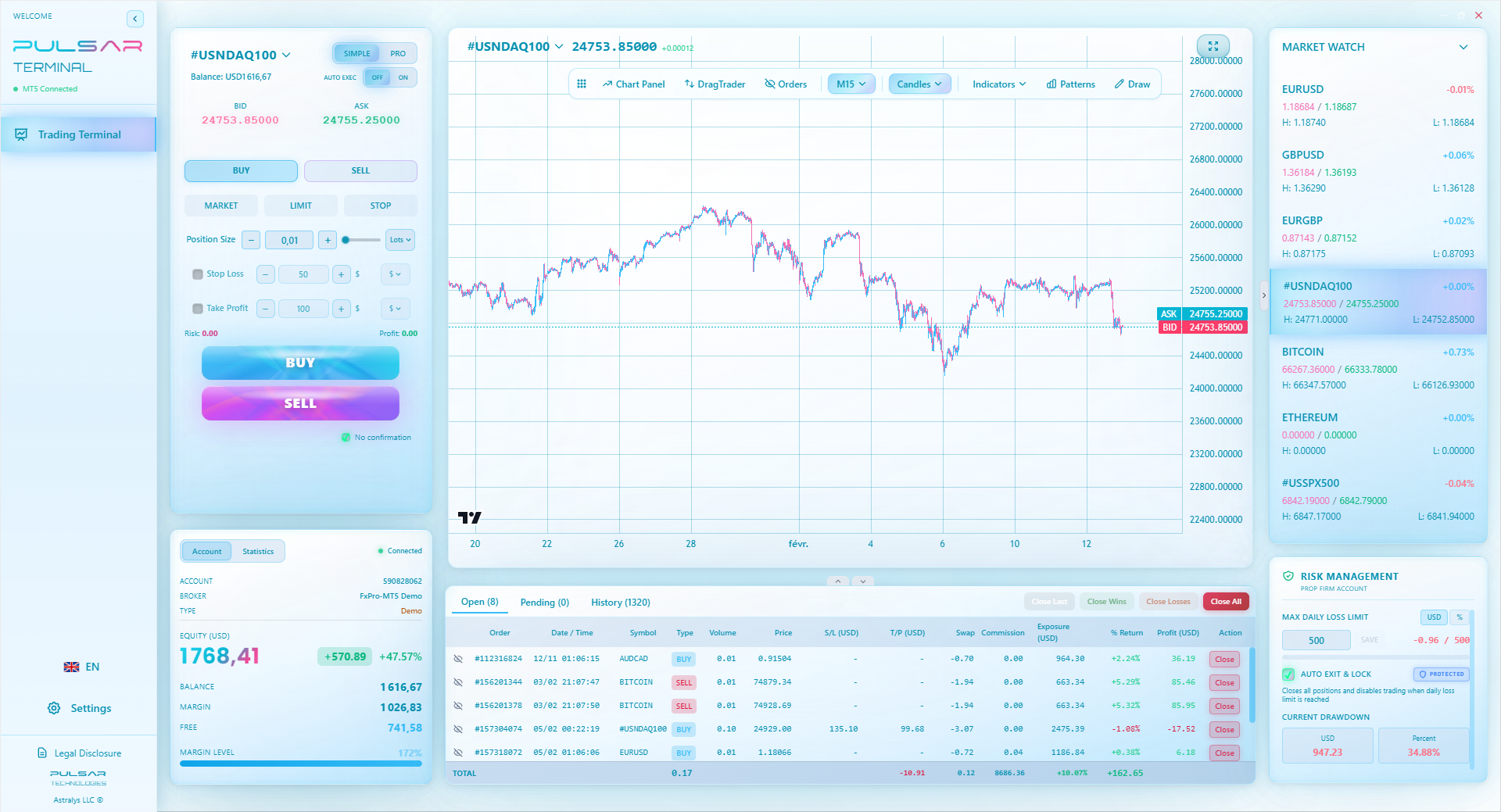
When scaling your affiliate business, efficiency in your own trading is key; Pulsar Terminal's drag-and-drop orders and automated trade management free up hours for content creation.
FAQ
Q1Do I need a license to run a forex affiliate program in South Africa?
You don't need a financial advisor license just for referring clients to a licensed broker. However, if you start giving specific trading advice, managing signals, or arranging 'rebate' schemes, you could cross into regulated activity. As a pure affiliate, you're a marketer. But all your marketing must comply with FSCA conduct standards - no false promises, clear risk disclosures, and upfront about your commercial interest.
Q2How and when do affiliates get paid?
Most reputable programs pay monthly, around the 15th-20th of the month for the previous month's earnings. Payment methods include international bank transfer (you'll deal with forex conversion), PayPal, or Skrill. Minimum payout thresholds are common, usually $50-$100. Always check the payment terms before signing up. A 60-day 'hold' period on CPA payouts is also standard to ensure the client doesn't just deposit and withdraw.
Q3What's the single biggest mistake new affiliates make?
Thinking it's easy, passive money. It's not. It's a marketing and content creation business. The second biggest mistake is promoting a broker they've never used themselves. You have zero credibility if you can't speak firsthand about the trading platform, spreads, or withdrawal process. Always test the broker with a small live account first.
Q4Can I promote prop firm challenges as an affiliate?
Absolutely, and it's huge right now. Many prop firms have aggressive affiliate programs. The same ethical rules apply - maybe more so. These challenges have strict rules. You must understand the drawdown limits, daily loss rules, and profit targets inside out. Promoting something you don't understand will lead to a flood of angry questions from people who fail. Tools that help traders manage the strict risk parameters of a prop challenge are a valuable related recommendation.
Q5Is revenue share better than CPA?
It depends on your audience. For a broad, inexperienced audience that tends to churn accounts quickly, a high CPA might yield more immediate cash. For a niche, educated audience of long-term traders, revenue share builds a lasting income stream. I recommend starting with a hybrid model if available, or a solid CPA to fund your initial efforts while you build a quality audience for revenue share.
Q6How do I track which content is driving referrals?
Any decent affiliate platform will give you unique tracking links. Use different links for your YouTube description, your blog sidebar, and your email newsletter. The dashboard will show you which link generated the click and the sign-up. This data is gold. It tells you where to focus your energy.
Pelajaran Prof. Winston
:
- ✓Revenue share pays 20-40% of client's spread/commission costs.
- ✓A quality referred trader is worth 10x a quick-burning sign-up.
- ✓Always disclose your affiliate relationship. Every. Single. Time.
- ✓FSCA rules apply to your marketing. No guarantees, clear risks.
Sejauh mana artikel ini berguna?
Klik bintang untuk menilai
Pandangan Dagangan Mingguan
Analisis & strategi mingguan percuma. Tiada spam.
Tentang Penulis
David van der Merwe
Pedagang Pasaran Membangun
Pedagang berpangkalan di Johannesburg dengan 11 tahun dalam mata wang pasaran membangun. Pakar dalam pasangan ZAR, dagangan terkawal FSCA, dan analisis pasaran Afrika Selatan.
Komen
Anda mungkin juga suka

Cara Trading Forex Sukses: 7 Prinsip dari Trader Profesional
Cara trading forex sukses dengan 7 prinsip trader pro: manajemen modal, disiplin, journal trading, backtest. Data nyata, bukan janji profit palsu.
Jam Trading Forex Terbaik untuk Trader Indonesia: Panduan Lengkap dengan Tabel Waktu
Panduan jam trading forex untuk trader Indonesia. Tabel 4 sesi dunia, jam emas 20:00-00:00, sesi mana yang harus dihindari. Data akurat + tips dari trader berpengalaman.
Top 5 Sàn Forex Uy Tín Nhất 2026: Review Jujur dari Trader Indonesia
Top 5 sàn forex uy tín 2026 untuk trader Indonesia. Review jujur: spread, deposit, withdraw, dukungan lokal. Exness, XM, IC Markets & lebih.
All these calculators are built into Pulsar Terminal with real-time data from your MT5 account. One-click position sizing, automatic risk management, and instant calculations.
