


Everyone's chasing prop firm discounts, but I think that's the wrong game.

James Mitchell
Penganalisis Dagangan Kanan
☕ 9 minit baca
Apa yang akan anda pelajari:
Everyone's chasing prop firm discounts, but I think that's the wrong game. A 50% off coupon on a challenge you're statistically destined to fail is no bargain. The real savings don't come from a promo code; they come from understanding the business model, the brutal math of pass rates, and the regulatory storm that's about to reshape the entire industry. I've blown my share of challenge fees, and I'll show you how to stop treating them like lottery tickets and start treating them like a calculated business expense.
Let's cut through the marketing. You see a prop firm running a 70% off sale on a $50,000 challenge. The fee drops from $299 to $89. Feels like a win, right? It's not. You're not buying capital; you're renting a test. And the price of that test is almost irrelevant if your strategy isn't bulletproof.
The industry's dirty little secret is the pass rate. While firms don't publish official numbers, the consensus among traders who've been around is brutal: only about 5% to 10% of traders pass the initial evaluation. Some data suggests a 94% failure rate. Think about that. A room of 100 traders pays for challenges, and maybe 5 get funded. That's not a trading problem; that's a business model.
I learned this the hard way. In 2021, I got excited by a 'Black Friday' deal from a now-defunct firm. I bought three different challenge accounts for a total of $450, thinking one had to stick. I blew all three in under two weeks. The discount didn't save me money; it just made it cheaper to confirm I wasn't ready. The real cost was the $450 plus the time and emotional capital wasted.

Warning: A discounted challenge fee is often a firm's most effective customer acquisition tool. They know the odds. Your one-time $89 fee is pure profit if you fail, which, statistically, you probably will.
So, where does the value lie? It's in the firms with clear rules, fair profit splits (aim for 80% or higher), and, crucially, a transparent path to getting your fee back. A discount on a firm with a 50% profit split is a worse deal than full price at a firm with an 90% split and a refundable fee. Your position size calculator is more important than any coupon.

💡 Petua Winston
A professor once told me, 'A discount on something you don't need is a tax on your intelligence.' In trading, a discount on a test you're not prepared for is a fee for your ignorance. Prepare first, then purchase.
Forget the headline challenge price. To understand prop firm discounts, you need to know the full menu of fees. Missing one can turn a 'great deal' into a money pit.
The Evaluation (Challenge) Fee
This is the one they discount. It ranges wildly, from as low as $17 for a tiny $5k account to over $1,000 for a $200k+ account. This fee is sometimes refundable after you hit certain profit targets in your funded account. That's a key feature to look for - it turns your fee from a cost into a recoverable deposit.
The Reset Fee
You hit the max daily loss or drawdown limit. Game over. Want to try again? That's a reset fee, typically $60-$80 for futures firms. This is where impulsive traders get murdered. If you need 4 resets to pass, your 'discounted' $89 challenge just cost you $89 + (4 x $70) = $369. Suddenly, that discount doesn't look so hot.
The Activation Fee
You passed! Congrats. Some firms then charge a one-time fee to activate your live, funded account. This can be $0, or it can be several hundred dollars. It should be clearly stated before you buy the challenge. A firm discounting the challenge but hitting you with a $300 activation fee is playing games.
The Invisible Costs: Spreads & Commissions
This is critical. A firm might offer a cheap challenge but have wide spreads or high commissions that eat your profits alive. I once traded a prop account where the spread on EUR/USD was consistently 1.8 pips when my usual broker like IC Markets had it at 0.6. That 1.2 pip difference on every trade is a massive, silent fee. Always check the real trading conditions. A good prop firm partnership will have tight spreads, often from 0.0 pips on majors, and clear commission structures (e.g., $3-$4 per futures contract per side).
“The real cost of a prop firm isn't the fee; it's the cost of not being ready.”
Here's the biggest thing nobody talking about discounts will mention: the entire U.S. prop firm model is living on borrowed time. For years, they've operated in a regulatory gray area by calling themselves 'evaluation services' rather than fund managers. That game is ending.
Regulators, particularly the CFTC, are waking up. The expectation is that by 2026, many of these firms will be classified as Commodity Trading Advisors (CTAs). What does that mean for you?
- Mandatory Licensing: Firms will need formal registration. The shady ones will vanish.
- Fund Segregation: Your profits might have to be held in separate, protected accounts. No more worrying if the firm can actually pay out.
- Strict Risk Disclosures: The rules about drawdowns, daily loss limits, and what you can trade will be clearer and more enforceable.
- use Limits: Expect lower maximum use, especially on crypto and volatile indices. The 100:1 days might be numbered.
Why does this matter for discounts? Because an 80% off coupon from a firm that won't exist in 18 months is worthless. The industry is consolidating fast - estimates say 80 to 100 firms closed up shop between 2023 and 2025. Your due diligence now must include regulatory positioning. A slightly more expensive challenge with a firm that's proactively preparing for CTA status is a far better investment. This shift is the ultimate filter, and your goal is to be with a firm that survives it.
Okay, so where do you put your money? Stop hunting for promo codes and start evaluating these factors.
1. Profit Split & Scaling Plan: This is your real earning potential. A 90% profit split is standard for top futures firms. Forex firms often offer 80-85%. Some, like Topstep, offer 100% on the first $10k. A firm's scaling plan - how quickly they add more capital to your account based on profits - is more valuable than any initial discount. I'd rather pay full price for a firm that scales me from $50k to $250k than get a discount from one that caps me at $100k.
2. Payout Schedule & Reliability: Bi-weekly payouts are standard. But some firms now offer next-day or even same-day processing. Fast, reliable payouts are a sign of operational health. Search for user experiences on payout delays. A discount means nothing if you can't access your profits.
3. Trading Rules You Can Live With: This is personal. Do they have a consistent daily loss limit? Is it based on your starting balance or your current equity? Can you hold trades over the weekend? Can you trade news? Their rules must fit your swing trading or scalping strategy. A firm with overly restrictive rules will cause you to break them, blowing your account and any 'savings.'
4. Platform & Tools: You need to trade on a platform you're comfortable with. Most firms offer MT4, MT5, or cTrader. Some integrate with TradingView. Can you use the tools you rely on, like the RSI indicator or MACD indicator in your preferred way? Also, check if they allow tools that automate risk management - this is a game-changer.

Pro Tip: The best 'discount' is a free retry or a lower profit target for the same fee. Some firms occasionally run promotions where your first reset is free, or the profit target is 6% instead of 8%. These directly increase your odds of passing, which is infinitely more valuable than shaving a few dollars off the entry ticket.
💡 Petua Winston
The market doesn't care what you paid for your opportunity. A $10,000 position moved by the same forces whether your challenge fee was $19 or $190. Focus your energy on understanding those forces, not the receipt.
“Your position size calculator is more important than any promo code.”
I want to share a specific trade that changed my perspective. After my early failures, I got serious. I practiced a disciplined strategy on a demo, then a small live account with Exness. Finally, I felt ready. I paid $499 for a $100k challenge with a reputable firm - no discount.
I traded cautiously, using tight stops. After two weeks, I was up 4%, halfway to the 8% profit target. Then, I took a setup on gold (XAU/USD). My analysis, based on my usual XAU/USD guide principles, suggested a bounce. I entered long at $1824.50. It moved my way by $3, then reversed hard. I was watching, but I hesitated. My stop was at $1819. The firm's rules had a hard daily loss limit of $2,500 (2.5% of the starting balance). This single gold trade, because of its volatility, hit my stop and also took out my daily loss in one shot. Account failed. Just like that.
The $499 was gone. But the lesson was priceless: I hadn't internalized the firm's specific risk parameters into my trade sizing. My usual 0.5% risk per trade was fine, but on a highly volatile instrument with the firm's daily loss rule, I needed to size down to 0.25% or less. The 'fee' was actually tuition.
I didn't chase a discount for my next attempt. I spent that money on a journaling tool and backtested my strategy against various drawdown scenarios. When I tried again, I passed. The discount wasn't on the fee; it was on the years of frustration I avoided by finally respecting the rules.
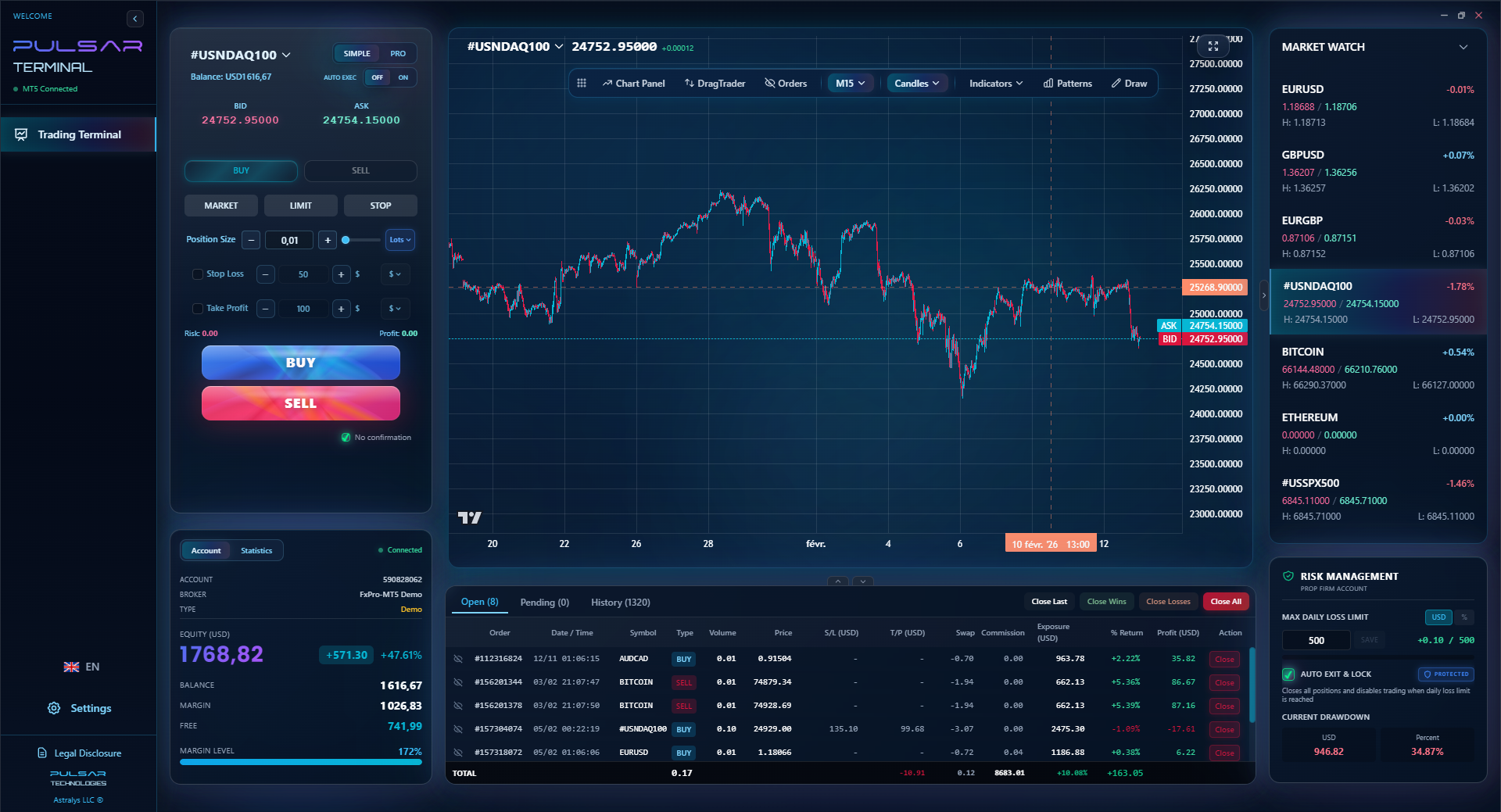
Managing a prop firm's strict daily loss limit is the hardest part, which is why tools like Pulsar Terminal that automate stop-loss and breakeven orders directly on your MT5 chart are non-negotiable for serious candidates.
Let's turn this into a checklist. Before you get seduced by a prop firm discount email, do this:
- Read the Terms of Service. Yes, all of it. Focus on the rules: daily loss, max drawdown (is it trailing or from starting balance?), profit target, restricted instruments, and weekend holding policy.
- Calculate Your True Risk. Use your position size calculator. If the max daily loss is $1,000 on a $50k account, how many pips is that on your typical EUR/USD trade? How does that align with your strategy's stop-loss distances? If your typical stop is 20 pips, you can risk 5 mini lots. Does that make sense for your plan?
- Contact Support. Ask specific questions: 'Is the activation fee waived?' 'What is the exact commission per lot on EUR/USD?' 'Can you provide a history of payout times?' Their speed and clarity tell you a lot.
- Verify the Broker Liquidity. Which broker provides the liquidity? Is it a well-known entity like the ones we review (Pepperstone, XM)? This affects execution quality and slippage, especially during news events.
- Plan for the Worst. Assume you will need one reset. Add that cost to your initial challenge fee. Is the total number still an acceptable cost for the education and the chance at funding?
Following these steps filters out the marketing noise and forces you to evaluate the offer as a business decision. That mindset shift is the only discount that guarantees long-term returns.
FAQ
Q1Are prop firm discounts a scam?
Not inherently, but they're a powerful marketing tool that plays on our love of a 'deal.' The scam isn't the discount itself; it's the illusion that a lower price improves your odds of success. It doesn't. Your strategy and discipline do. A discount from a reputable firm is fine; a discount that lures you into a firm with unfair rules or poor payouts is the problem.
Q2What's the best type of prop firm discount to look for?
Look for promotions that improve your conditions, not just lower the fee. A 'free reset' offer, a 'lower profit target' period, or a 'fee refunded after first payout' deal are far more valuable. These directly impact your probability of getting and staying funded, which is the entire point.
Q3With new regulations coming, should I even join a prop firm now?
Yes, but be selective. The regulatory shake-up is actually a good thing for serious traders. It will force out unstable, shady operators. Your job is to choose a firm that is transparent, has been around for a few years, and seems to be preparing for a more regulated environment (e.g., discussing fund segregation, clear terms). Now is the time to be picky, not to chase the cheapest option.
Q4How do I know if a prop firm's trading conditions (spreads) are good?
Compare them to a major retail broker you trust. If the prop firm's typical spread on EUR/USD is 1.5 pips and your usual broker offers 0.7, that's a huge hidden cost. Ask the firm for a demo account or a recent statement from a funded trader. Real data beats marketing claims every time.
Q5Is it worth paying for multiple challenge accounts at once?
Almost never. This is usually a sign of gambling, not trading. It means you're unsure of your edge and hoping one account 'gets lucky.' Focus all your effort and capital on passing one challenge. If you can't do that consistently in simulation, buying multiple real challenges is just a faster way to burn money.
Q6What's the single most important rule in a prop firm challenge?
The daily loss limit. This is the rule that kills most accounts, often before the overall drawdown is hit. You must calculate your position size so that no single trade, or a series of losing trades in one day, can trigger this limit. Protecting your daily loss is the #1 priority for passing.
Pelajaran Prof. Winston
:
- ✓Pass rates are ~5-10%; a discount doesn't change the math.
- ✓Evaluate total fees: challenge + resets + activation.
- ✓Prioritize profit split & scaling over entry price.
- ✓Regulatory changes in 2024-2026 will wipe out weak firms.
Sejauh mana artikel ini berguna?
Klik bintang untuk menilai
Pandangan Dagangan Mingguan
Analisis & strategi mingguan percuma. Tiada spam.
Tentang Penulis
James Mitchell
Penganalisis Dagangan Kanan
Berpangkalan di New York dengan lebih 9 tahun pengalaman perdagangan. Fokus pada pasangan USD utama, cabaran prop firm, dan landskap peraturan AS.
Komen
Anda mungkin juga suka

Cara Trading Forex Sukses: 7 Prinsip dari Trader Profesional
Cara trading forex sukses dengan 7 prinsip trader pro: manajemen modal, disiplin, journal trading, backtest. Data nyata, bukan janji profit palsu.
Jam Trading Forex Terbaik untuk Trader Indonesia: Panduan Lengkap dengan Tabel Waktu
Panduan jam trading forex untuk trader Indonesia. Tabel 4 sesi dunia, jam emas 20:00-00:00, sesi mana yang harus dihindari. Data akurat + tips dari trader berpengalaman.
Top 5 Sàn Forex Uy Tín Nhất 2026: Review Jujur dari Trader Indonesia
Top 5 sàn forex uy tín 2026 untuk trader Indonesia. Review jujur: spread, deposit, withdraw, dukungan lokal. Exness, XM, IC Markets & lebih.
All these calculators are built into Pulsar Terminal with real-time data from your MT5 account. One-click position sizing, automatic risk management, and instant calculations.
